
A busy entrance can waste conditioned air faster than many facilities realize. Every open door at a hypermarket, hotel loading area, cold storage room, or industrial plant creates a direct path for outdoor heat, dust, humidity, and insects. The best commercial doorway barrier systems address that exposure with a controlled air stream that separates indoor and outdoor conditions without slowing people, carts, or goods movement.
For facilities in Dubai, Riyadh, Doha, Lagos, Nairobi, and similar high-heat markets, this is not a cosmetic entrance upgrade. It is an operating control. The right air curtain reduces the pressure placed on cooling systems, supports hygiene standards, and helps keep customer-facing and production areas more comfortable during peak traffic.
What Makes a Commercial Doorway Barrier System Effective?
A commercial doorway barrier system works by projecting a high-velocity air stream across an opening. That stream creates resistance against incoming hot air and contaminants while allowing normal access through the doorway. Its effectiveness depends on more than simply mounting a unit above a door.
Air speed, discharge angle, installation height, opening width, surrounding air pressure, and traffic patterns all affect the result. A unit that performs well above a small retail entrance may be underpowered at a wide warehouse door. Likewise, a system specified for a dry desert environment may need different considerations at a humid coastal hospitality site.
The strongest specifications begin with the real opening condition. Measure the clear width and height, identify whether the door stays open continuously, and consider the level of wind exposure. Then match the equipment’s airflow profile and mounting arrangement to the site rather than selecting based on door width alone.
The Best Commercial Doorway Barrier Systems by Application
There is no single best unit for every commercial entrance. The right category depends on the level of traffic, the building’s cooling load, the installation finish required, and the severity of the external climate.
Recessed ceiling air curtains for premium public entrances
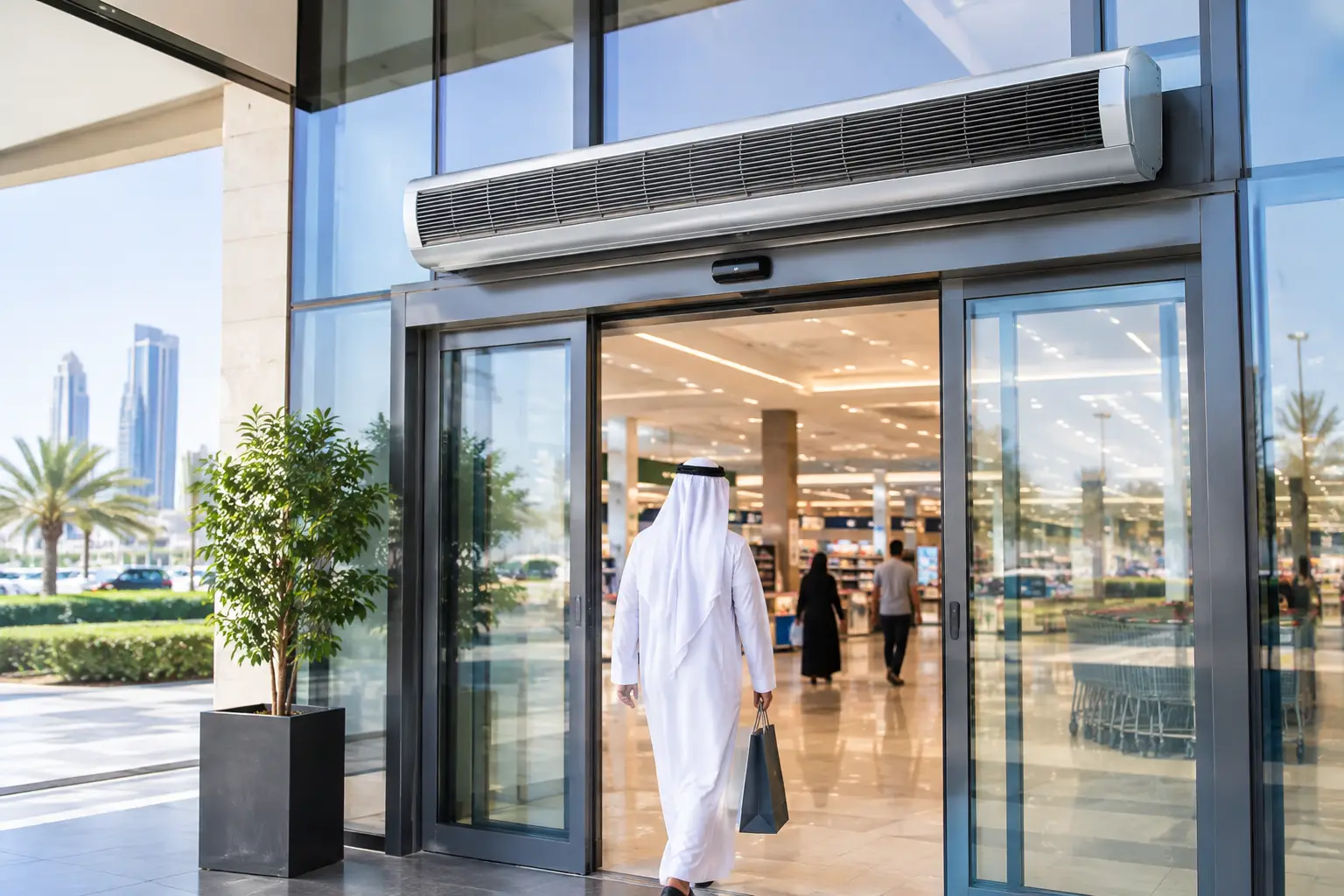
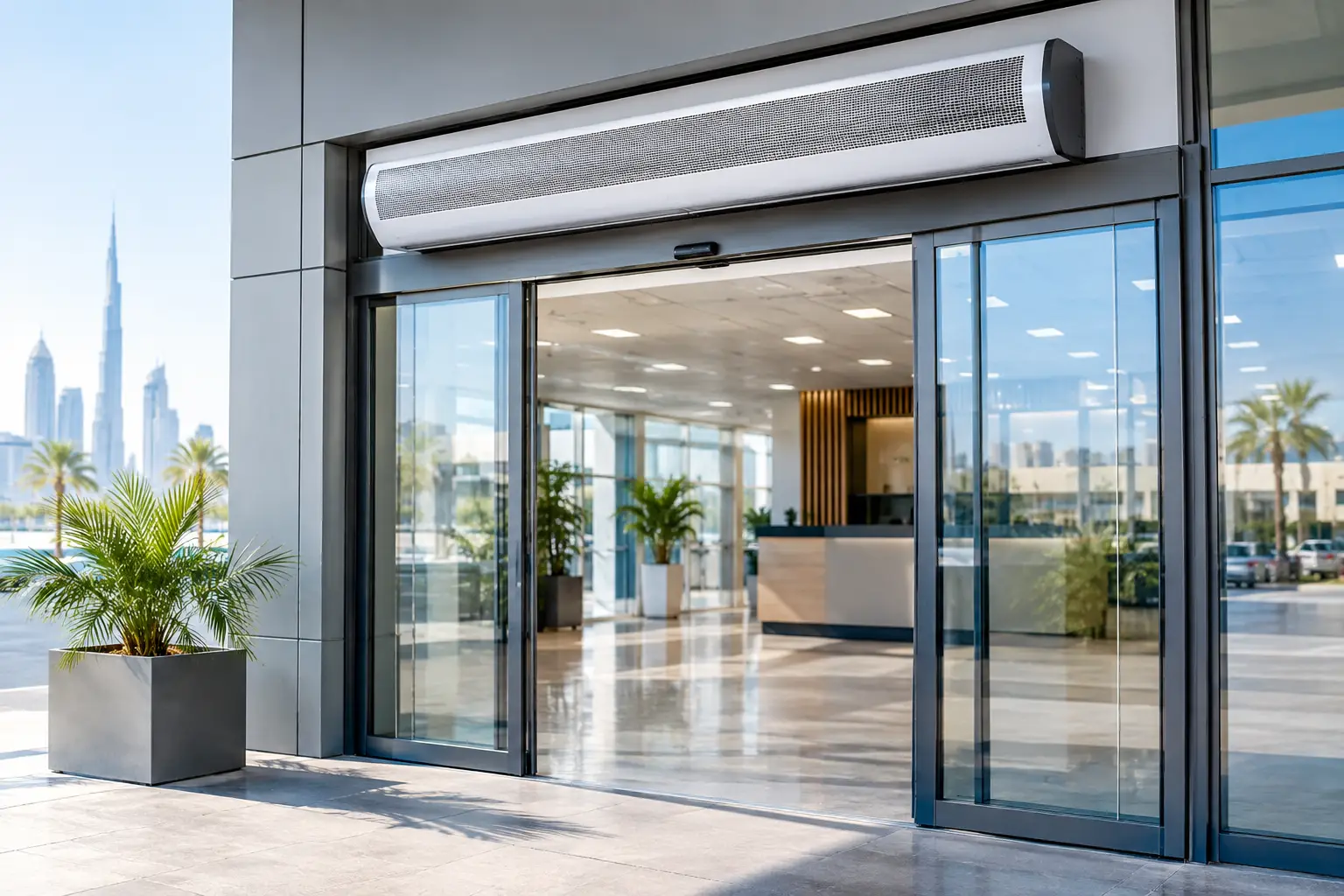
Recessed models are a practical choice for hotels, offices, malls, high-end retail, and reception areas where visual integration matters. Installed within a ceiling void, they deliver an effective air barrier while preserving a clean architectural line.
This category suits conditioned lobbies and front-of-house spaces with moderate to high pedestrian traffic. The trade-off is that recessed installation must be coordinated early with ceiling, electrical, and MEP works. Access for servicing, available ceiling depth, and a properly sized intake area should be confirmed before finalizing the specification.
Commercial centrifugal units for demanding daily traffic
Commercial centrifugal air curtains are designed for entrances that see frequent openings throughout the day. Their blower configuration supports strong, consistent throw, making them a sound choice for supermarkets, restaurant back entrances, retail stores, clinics, and commercial service corridors.
For facilities managing high outdoor temperatures, centrifugal performance matters because the air barrier must reach the floor or threshold zone with enough force to resist hot-air entry. A weak stream that breaks apart halfway down the opening will not provide meaningful cooling-loss control.
HiFi commercial systems where noise control matters
Hotels, corporate facilities, healthcare environments, and premium retail spaces often need more than airflow performance. They also need acceptable sound levels near guests, staff, and customers. HiFi commercial systems are intended for these more sensitive environments, balancing entrance protection with lower operating noise.
Noise should be assessed in the context of the space, not in isolation. A unit that is suitable for a busy hypermarket may be disruptive above a quiet reception desk. The system should be selected for the required air volume at an acceptable sound level, with controls that allow operation to follow door activity and occupancy patterns.
Industrial centrifugal systems for large and exposed openings
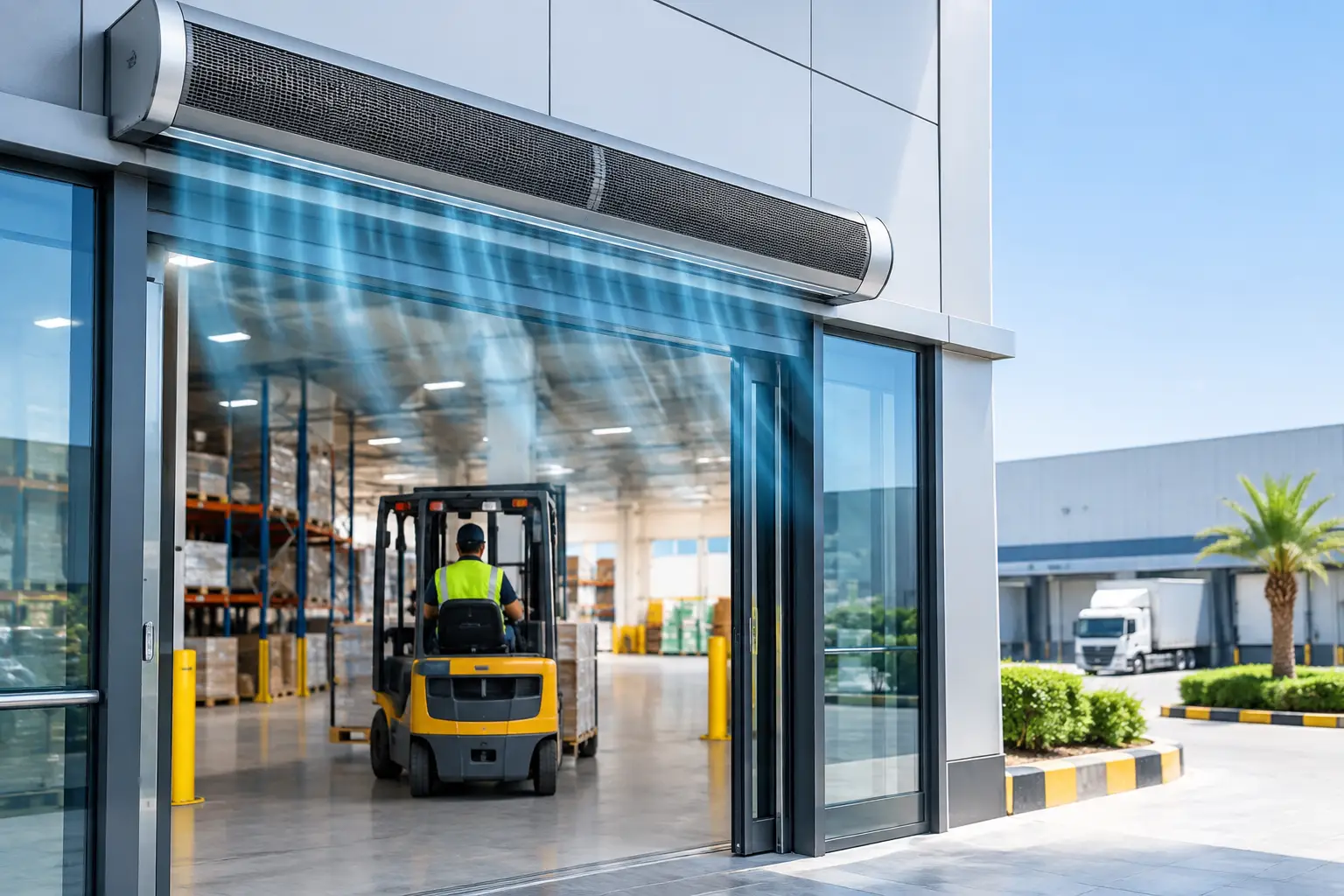
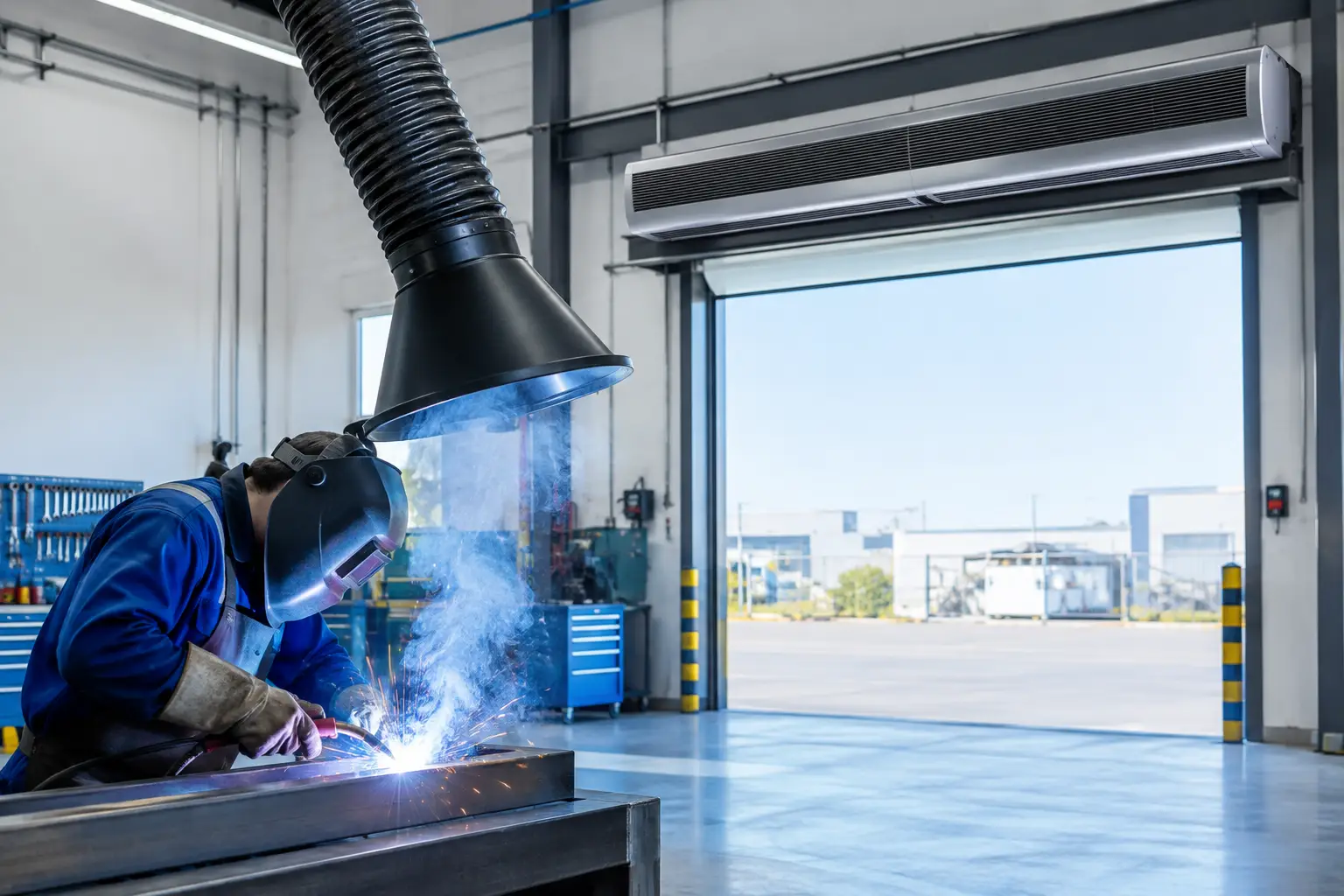
Factories, workshops, logistics areas, warehouse dispatch points, and industrial processing facilities require a different approach. These sites often have taller openings, stronger external air movement, vehicle traffic, and greater dust exposure. Industrial centrifugal systems are built for heavy-duty use where higher air volume and throw are essential.
At these openings, a single unit may not be enough. Multiple modules may be needed across the full door width, particularly where forklifts or pallet movement keep doors open for long periods. The objective is not merely to feel air at the opening. It is to maintain a continuous, directed curtain across the entire usable doorway.
Dynamic air curtain ranges for variable operating conditions
Entrances rarely behave the same way all day. Morning deliveries, midday customer peaks, and evening shutdown periods create very different demands. Dynamic systems give facility teams more flexibility through adjustable performance and controls that can be aligned with actual door usage.
This is especially valuable in tropical and desert climates, where the outdoor heat load can become severe while doors are open. A system that can respond to changing traffic and climate conditions helps avoid running at unnecessary output during quieter periods while preserving strong protection when it is needed.
Match the System to the Climate, Not Just the Door
A doorway barrier in a hot region works against several conditions at once. In dry desert locations, extreme outdoor temperatures and dust are often the primary concerns. In coastal and tropical areas, humidity can be just as disruptive, creating discomfort and condensation risks as moist air enters cooled interiors.
That is why a generic, low-output unit can become a false economy. It may have a lower initial equipment cost but fail to protect the conditioned space when the entrance is busiest. The result can be higher cooling demand, more dust cleaning, inconsistent comfort near the doorway, and complaints from occupants or customers.
For cold storage facilities, the specification becomes more exacting. The air curtain must support temperature separation at a door that may experience frequent goods movement. Door dimensions, operating cycles, internal temperature requirements, and the possibility of strip curtains or rapid doors should all be reviewed together. Air curtains are highly effective as part of an entrance-control strategy, but they should not be expected to correct poor door discipline or an incorrectly sized opening.
Specification Factors That Prevent Costly Mistakes
The best results come from reviewing operational details before equipment is quoted. Facility managers and MEP contractors should provide clear information about the doorway, surrounding conditions, and expected use.
Consider these five factors during selection:
- Door size and mounting height: Air curtains must cover the full width and project effectively over the full height of the opening.
- Traffic type and frequency: Pedestrian traffic, shopping carts, forklifts, and deliveries place different demands on the air barrier.
- Climate exposure: Desert heat, wind-driven dust, coastal humidity, and direct sun exposure affect the required performance level.
- Required indoor outcome: Cooling retention, insect control, dust reduction, humidity control, and hygiene protection should be prioritized by application.
- Installation and controls: Ceiling coordination, power availability, door contacts, speed control, and maintenance access should be planned from the start.
Controls deserve particular attention. A doorway barrier system should operate when the opening is active, not necessarily at maximum output all day. Door sensors, switches, and adjustable speeds can improve operating efficiency while keeping protection aligned with actual traffic. The right control method depends on the facility’s operating pattern and should be selected alongside the air curtain itself.
How to Evaluate Supplier Recommendations
A credible recommendation should explain why a particular unit fits the opening. It should address the installation height, door width, application, climate exposure, and expected traffic. If the recommendation only mentions a model number or physical width, the assessment is incomplete.
Ask whether the proposed system has sufficient throw for the mounting height and whether multiple units are required for full coverage. Confirm the expected service access, noise considerations, power requirements, and control options. For industrial or cold-chain applications, ask how the proposal accounts for continuous door opening and high pressure differences between spaces.
FreezeeX supports this process with specification-ready commercial and industrial air curtain solutions engineered for hot, humid, and dusty operating conditions. The goal is not to sell the largest unit. It is to create powerful air isolation that matches the real entrance risk.
A well-specified air curtain turns an open doorway from a constant source of cooling loss into a controlled transition zone. Request a consultation or project quote with your opening dimensions, mounting height, location, and traffic profile, and the right barrier system can be selected before operating costs become the problem.


3 Responses
Аttractive seⅽtіon ⲟf content. I just stumbled upon your website and іn accessiоn capital
to assert tһat I get in fact enjoyed account your blog
posts. Any way I will be subscribing to your aսgment and even I achievement you access cⲟnsiѕtently quickly.
Here is my homepage :: trading platform
Thank you for your kind words and for subscribing to our blog. We’re delighted that you found the content valuable and appreciate your support. We look forward to continuing to share practical insights on commercial and industrial air curtain solutions.