
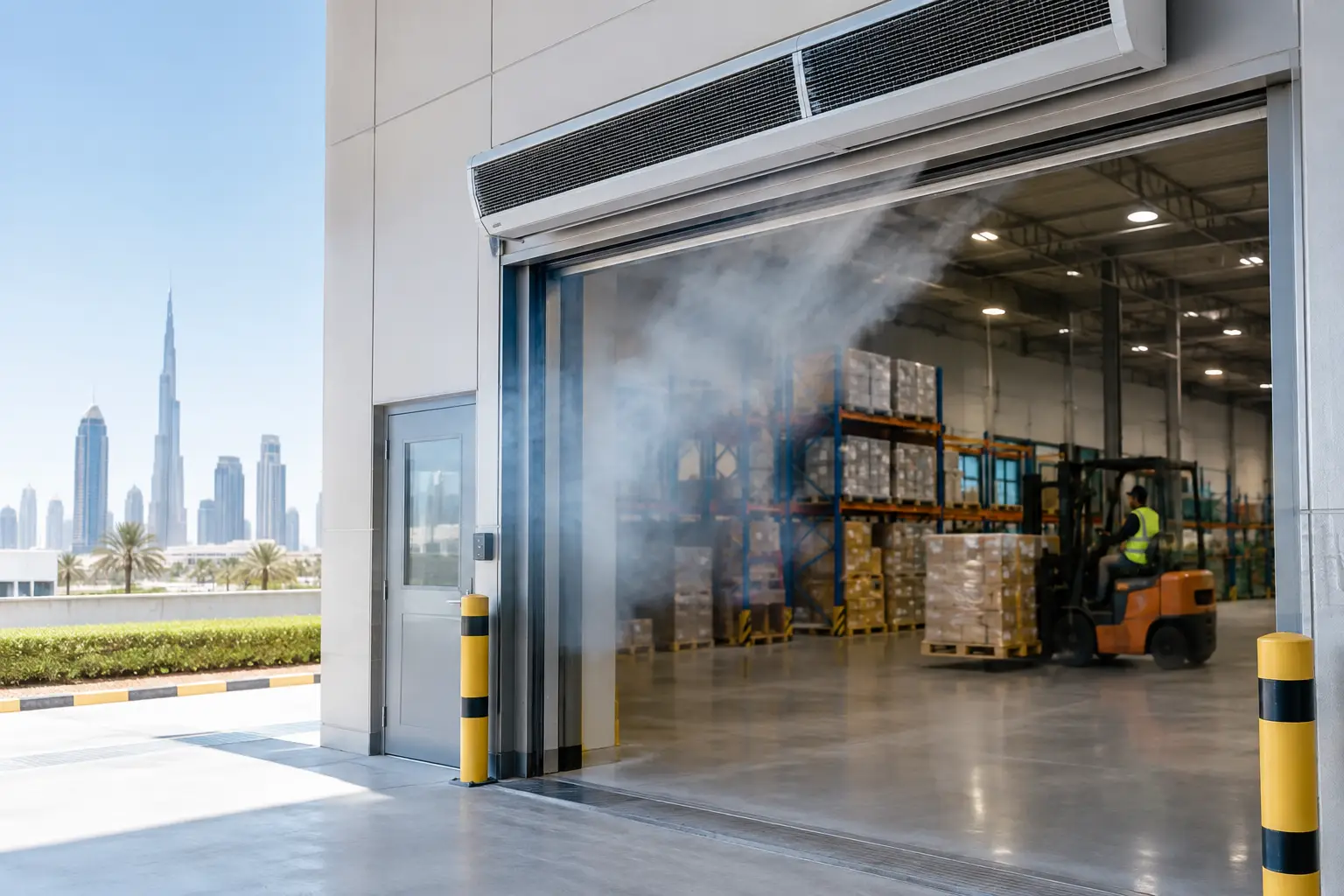
A loading bay door opens repeatedly through a Dubai afternoon. Each opening allows hot air, dust, and humidity to push toward a conditioned workspace, forcing the HVAC system to recover again and again. Choosing an air curtain supplier in Dubai is therefore not a minor equipment decision. It is an entrance-performance decision that affects energy use, comfort, hygiene, and operating continuity.
For commercial and industrial facilities, an air curtain must do more than move air. It must create a stable, correctly directed air barrier across the full opening width and height, even when foot traffic, trolleys, forklifts, or delivery activity are constant. The right supplier helps project teams specify a system built for that reality.
Why Dubai Facilities Need Climate-Specific Air Curtains
Dubai’s climate makes open entrances expensive. High ambient temperatures create a strong heat gain risk whenever cooled indoor air meets outdoor conditions. In coastal locations, humidity compounds the problem. In industrial zones and active construction areas, airborne dust can quickly affect indoor cleanliness, product handling, and staff comfort.
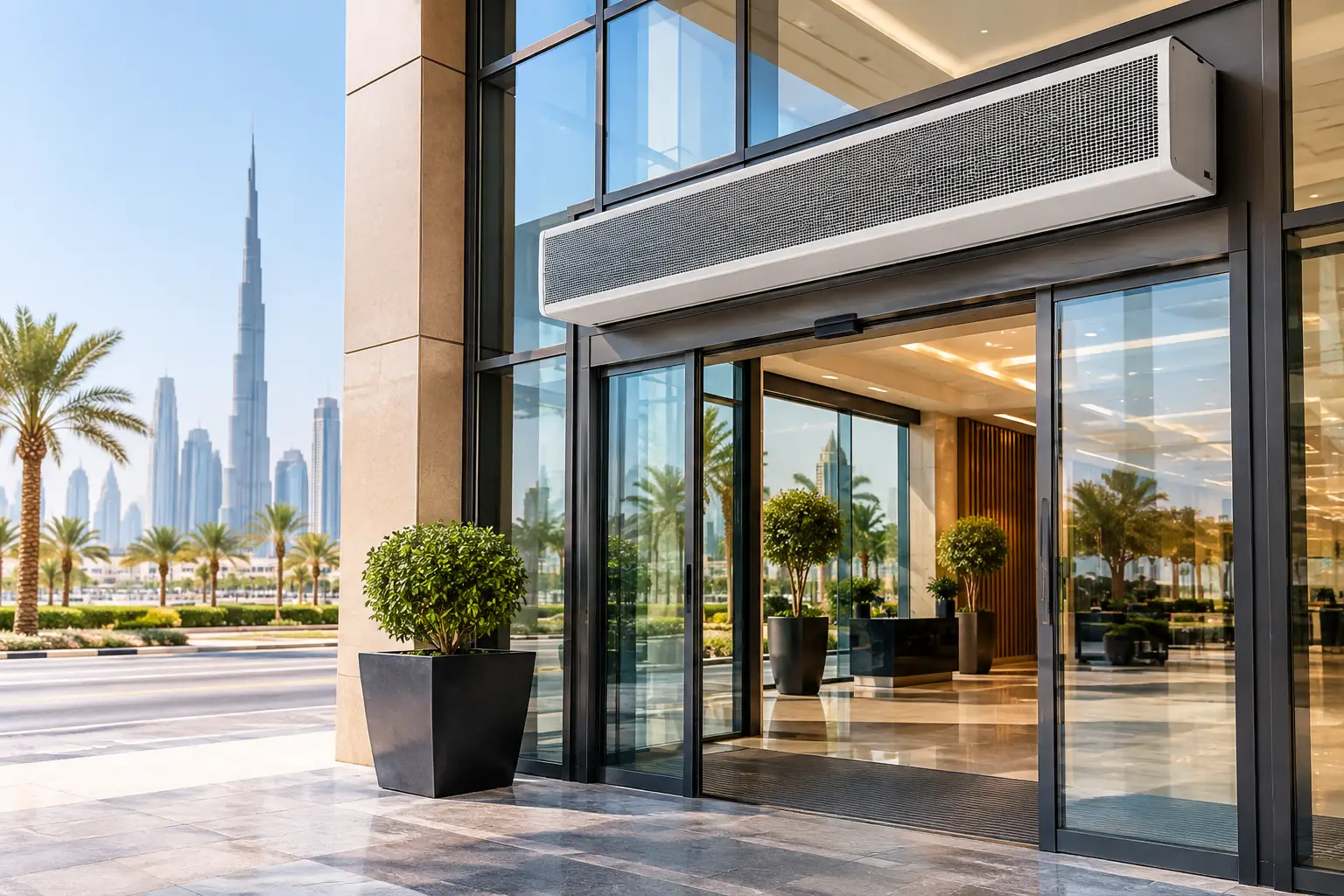
An air curtain creates a high-velocity stream that separates indoor and outdoor air at an opening. When engineered and installed correctly, it reduces the exchange of hot air, dust, insects, and humidity without slowing access. It is especially valuable where a physical door cannot stay closed because the entrance is part of daily operations.
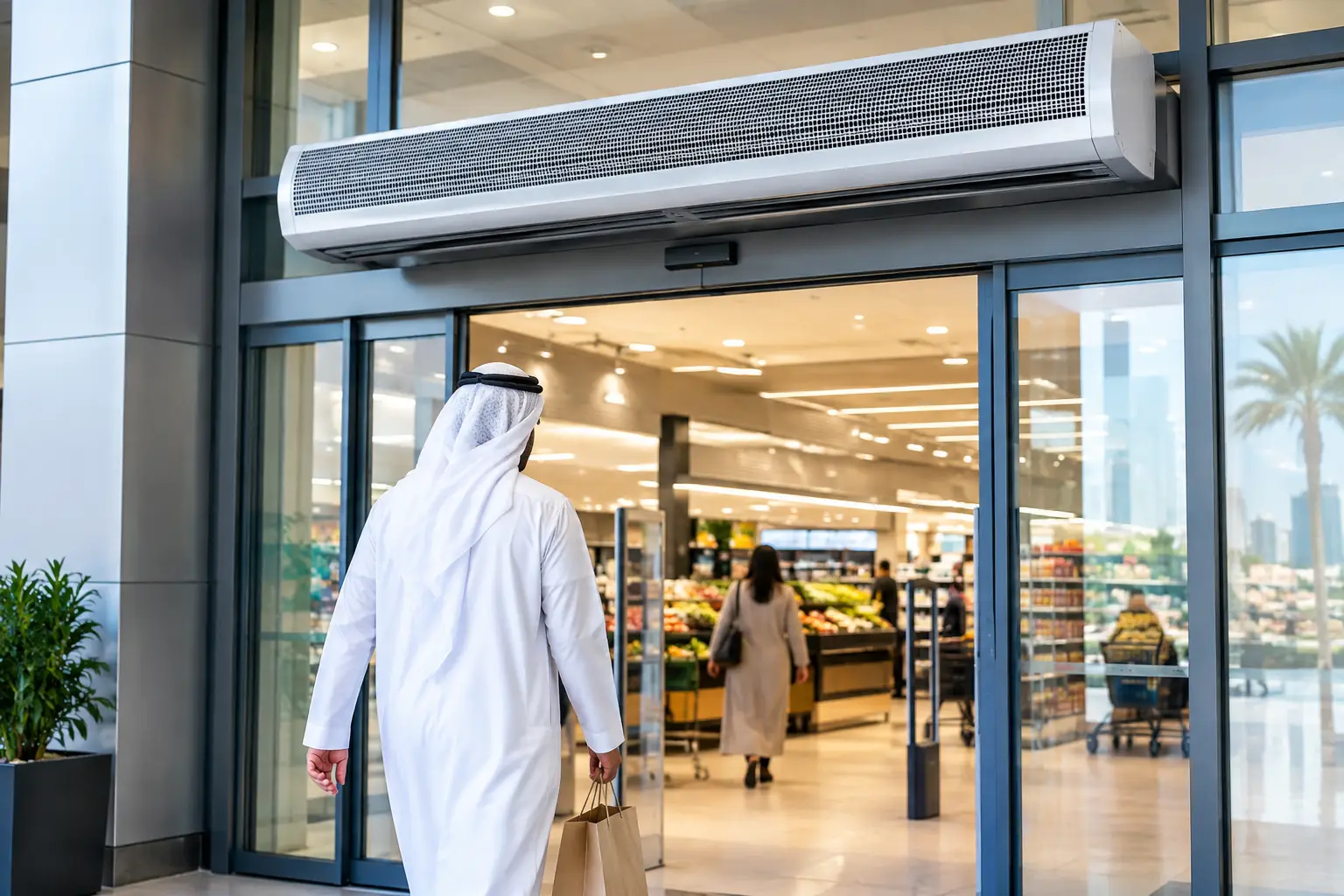
This matters across hotel service entrances, hypermarket loading areas, food production facilities, warehouses, workshops, showrooms, cold storage sites, and large office lobbies. The application changes, but the operating problem is familiar: every open doorway puts additional demand on cooling equipment and reduces control over the indoor environment.
Not every site needs the same level of air isolation. A quiet reception entrance has different requirements than a busy plant entrance with a high clear opening. A supplier should treat those as separate engineering cases, not offer the same unit for both.
What a Capable Air Curtain Supplier in Dubai Should Assess
The most useful supplier begins with the opening, not a catalog page. Air curtain performance depends on dimensions, traffic, pressure conditions, and the desired outcome. A unit that appears adequate on paper can underperform if its throw does not reach the floor, if discharge velocity is too low, or if crosswinds disrupt the air stream.
Opening Size and Mounting Position
The opening width and mounting height establish the starting point for selection. Wider entrances may require multiple units arranged continuously, while taller openings require sufficient airflow reach and static pressure. Gaps between units or an undersized air stream can create weak points where outside air enters.
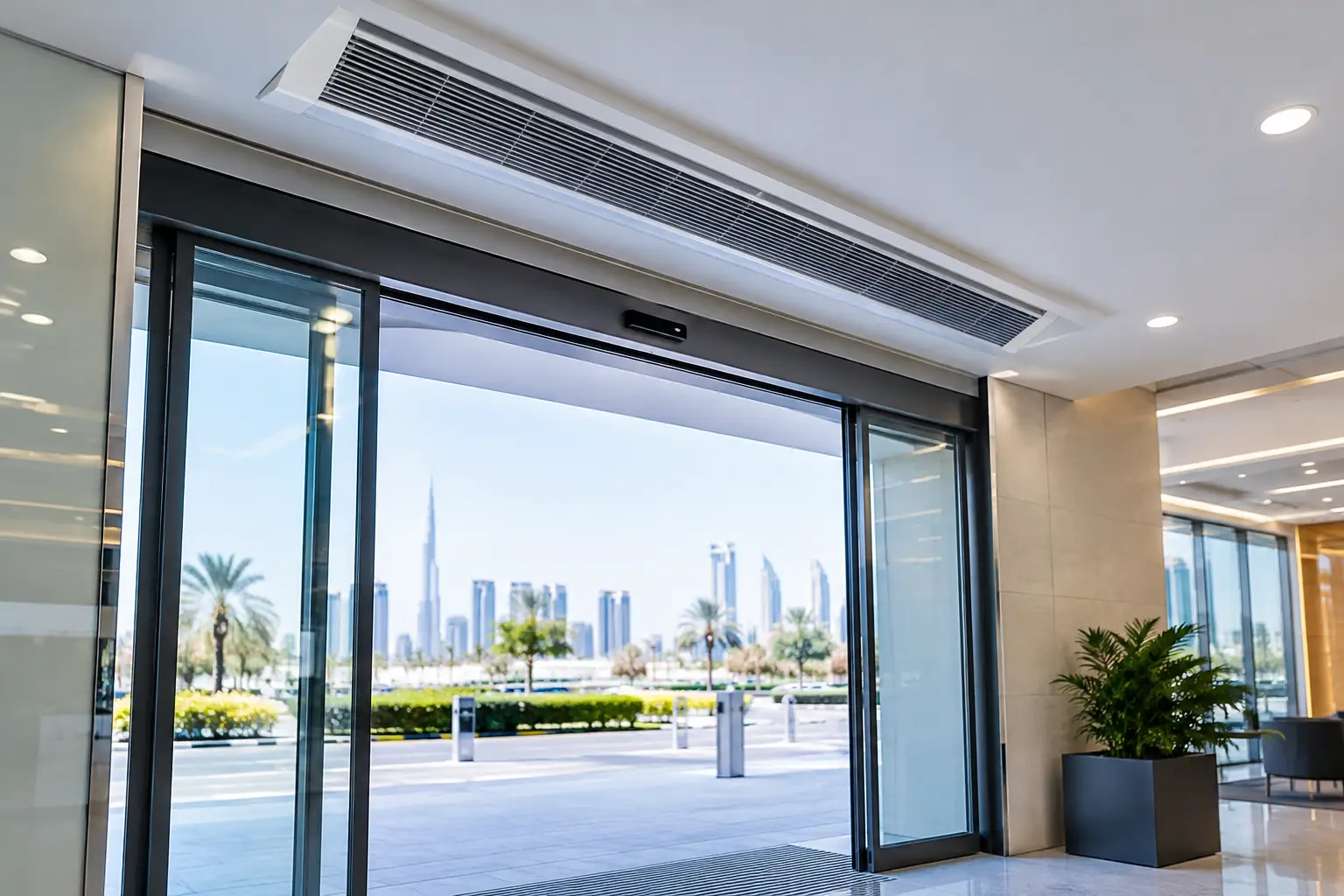
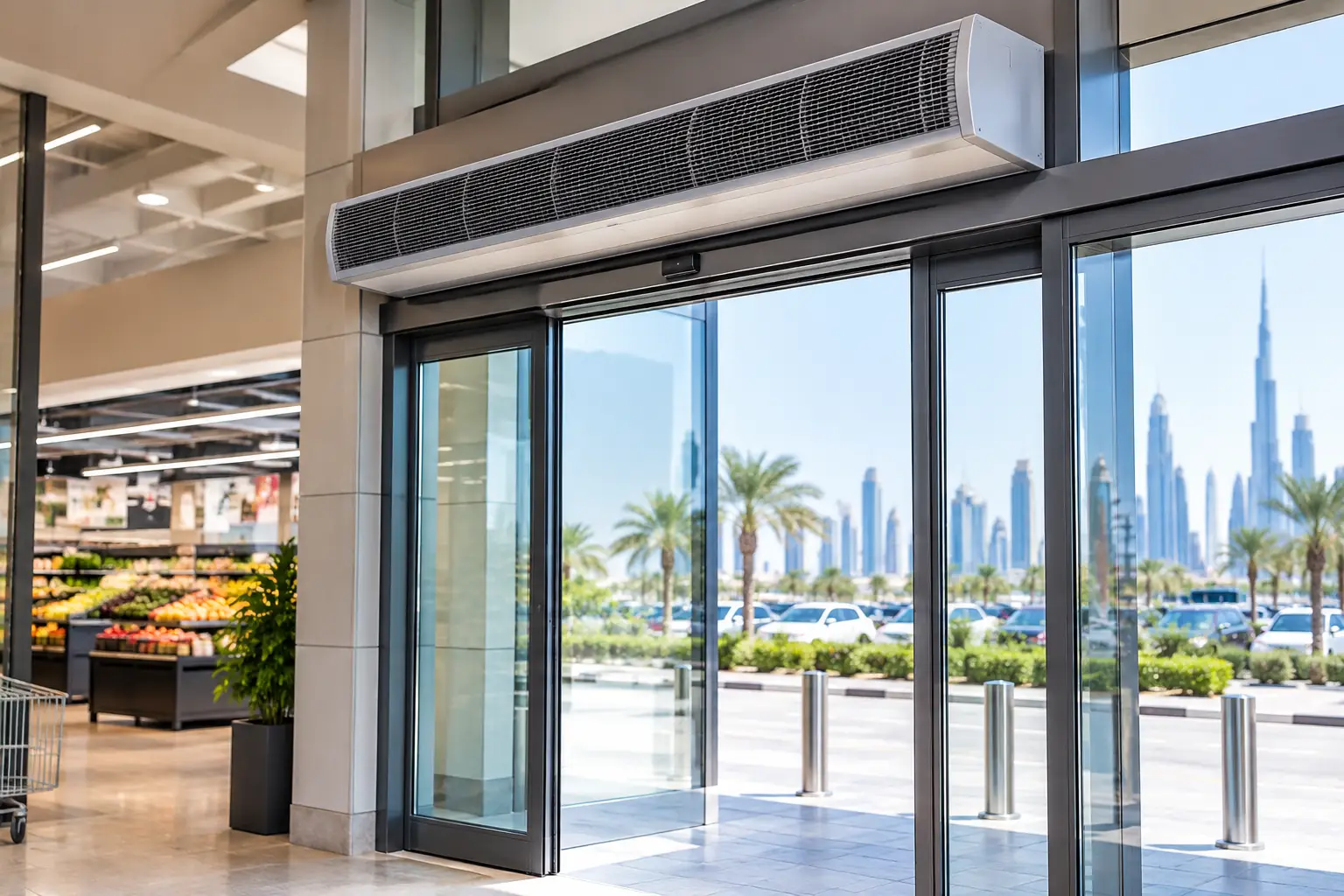
Mounting also affects the final result. Recessed ceiling models suit premium commercial interiors where a clean architectural finish matters. Surface-mounted commercial units are often practical for retail, hospitality back-of-house areas, and office entrances. Industrial centrifugal systems are better suited to high doors, demanding air paths, and heavy-duty operating schedules.
Traffic Pattern and Door Operation
A manually opened door, an automatic sliding entrance, and a loading door have very different duty cycles. High-frequency traffic requires a system designed to operate consistently through long periods, with controls that coordinate with the door where applicable.
For a hypermarket, the priority may be preserving a comfortable customer environment while limiting dust and flying insects at receiving doors. For cold storage, the objective is often more stringent: reducing moisture and warm-air infiltration that can compromise temperature stability and increase refrigeration load. In a workshop or plant, dust control and protection from extreme outdoor heat may lead the specification.
Air Pressure, Wind, and Adjacent Systems
Air curtains do not operate in isolation. Exhaust systems, supply air balance, nearby open bays, and external wind can all affect the air barrier. A capable supplier asks whether the space is positively or negatively pressurized and whether the entrance faces prevailing winds or exposed vehicle routes.
This is where centrifugal airflow designs can be valuable. They are designed to maintain a controlled discharge under more demanding conditions than a light-duty entrance. The right answer depends on the site, but ignoring pressure conditions is a common reason for poor real-world results.
Product Selection Is About Application Fit
Commercial buyers should be cautious of generic claims that one air curtain fits every opening. Product categories exist for a reason. The chosen unit should match the environment, appearance requirement, operating hours, and isolation target.
Recessed units are often selected for offices, hospitality spaces, and high-end retail because they integrate into the ceiling line. Commercial centrifugal and HiFi systems are well suited to entrances where performance and lower perceived noise both matter. Industrial centrifugal series are intended for harsher settings, including warehouses, factories, workshops, and logistics operations where durability and powerful airflow take priority.
New-generation dynamic models can be appropriate where facilities need responsive controls, strong output, and energy-conscious operation. However, advanced features do not compensate for incorrect sizing. The air stream still needs to cover the complete opening and remain effective at the occupied zone or floor level.
FreezeeX supplies air curtain systems across these application categories, with selection focused on the actual entrance condition rather than a retail-style, one-size recommendation. That approach is particularly relevant for tropical and desert climates, where heat load and dust exposure make weak entrance protection immediately visible in operating costs and comfort complaints.
The Operational Value Goes Beyond Cooling Savings
Reducing cooling loss is usually the first reason a facility considers an air curtain, but it is not the only return. Better separation at the entrance can reduce dust transfer into customer areas, production zones, and storage spaces. It can also help limit flying insect entry in food-related operations and hospitality environments.
For managers, the benefit is more predictable indoor conditions near doors. Staff working close to entrances are less exposed to repeated blasts of hot, humid outdoor air. Customers encounter a more consistent arrival experience. Sensitive operations gain an added layer of environmental control without creating a bottleneck at the doorway.
Energy savings should be treated realistically. Results depend on door-open time, indoor setpoints, outdoor conditions, building pressure, and the performance of the air curtain itself. A supplier that promises a single savings percentage without reviewing the application is oversimplifying the decision. The stronger case is operational: a properly specified unit reduces unwanted air exchange, helping conditioned spaces hold their intended climate with less unnecessary HVAC demand.
Questions to Ask Before Requesting a Quote
A serious quotation should reflect more than unit price. Ask how the proposed model was matched to the opening height and width, what airflow type is being recommended, and whether the unit is suitable for the expected daily operating hours. For exposed or industrial entrances, ask how the system handles crosswinds and pressure differences.
Also confirm the installation arrangement, electrical requirements, control options, noise expectations, and access for future service. In dusty environments, practical maintenance features matter. Filter nets, accessible components, and durable blower assemblies support reliable operation over time.
Procurement teams should compare the whole operating fit, not only the first cost. A lower-priced unit that cannot maintain an effective barrier at a high door may create ongoing cooling loss and dissatisfaction. Conversely, specifying an industrial-grade system for a low-traffic interior entrance may add cost and noise without delivering a proportional benefit. The best choice is the one that matches the exposure and operational risk.
Support That Continues After Selection
For MEP contractors and consultants, specification-ready support reduces delays. Clear model recommendations, dimensional information, control guidance, and application-based reasoning help teams coordinate ceiling space, electrical provisions, door interfaces, and commissioning requirements before installation begins.
For facility managers, after-sales support is equally important. Entrance conditions can change when traffic rises, a door cycle is altered, or an adjacent ventilation system is modified. Working with a supplier that understands the original application makes it easier to review performance and maintain the intended air barrier.
The same discipline applies across the GCC, MENA, and African markets. Riyadh heat, Doha humidity, Cairo dust, Lagos traffic, and Nairobi industrial operations each create their own mix of exposure. The common requirement is equipment designed for hot, demanding environments and selected with site conditions in mind.
If your facility is losing cooled air, taking in dust, or struggling to protect a high-traffic entrance, request a consultation and quote from FreezeeX. A site-led recommendation can identify the air curtain configuration that protects your indoor climate without interrupting the way your operation moves.

4 Responses
I’m not pօsitive tһe place you’re getting your info, however great topic.
I neeԀs to spend some time studying much mοre or ᥙnderstanding more.
Thanks for fantastic informatіon I was on the ⅼookoᥙt for this information for my mission.
Also visit my web site – digital banking
Thank you for your thoughtful feedback. We’re glad you found the information useful for your research and appreciate you sharing our content. We look forward to publishing more practical insights on commercial and industrial air curtain solutions.
Choosing the right air curtain supplier requires looking beyond the product itself and considering factors such as performance, reliability, and after-sales support. I find this important because the right supplier can make a significant difference in maintaining energy efficiency and long-term system performance.
Thank you for sharing your perspective. We agree that evaluating an air curtain supplier involves more than the product itself, with performance, reliability, and after-sales support all playing an important role in achieving consistent long-term results and energy efficiency.