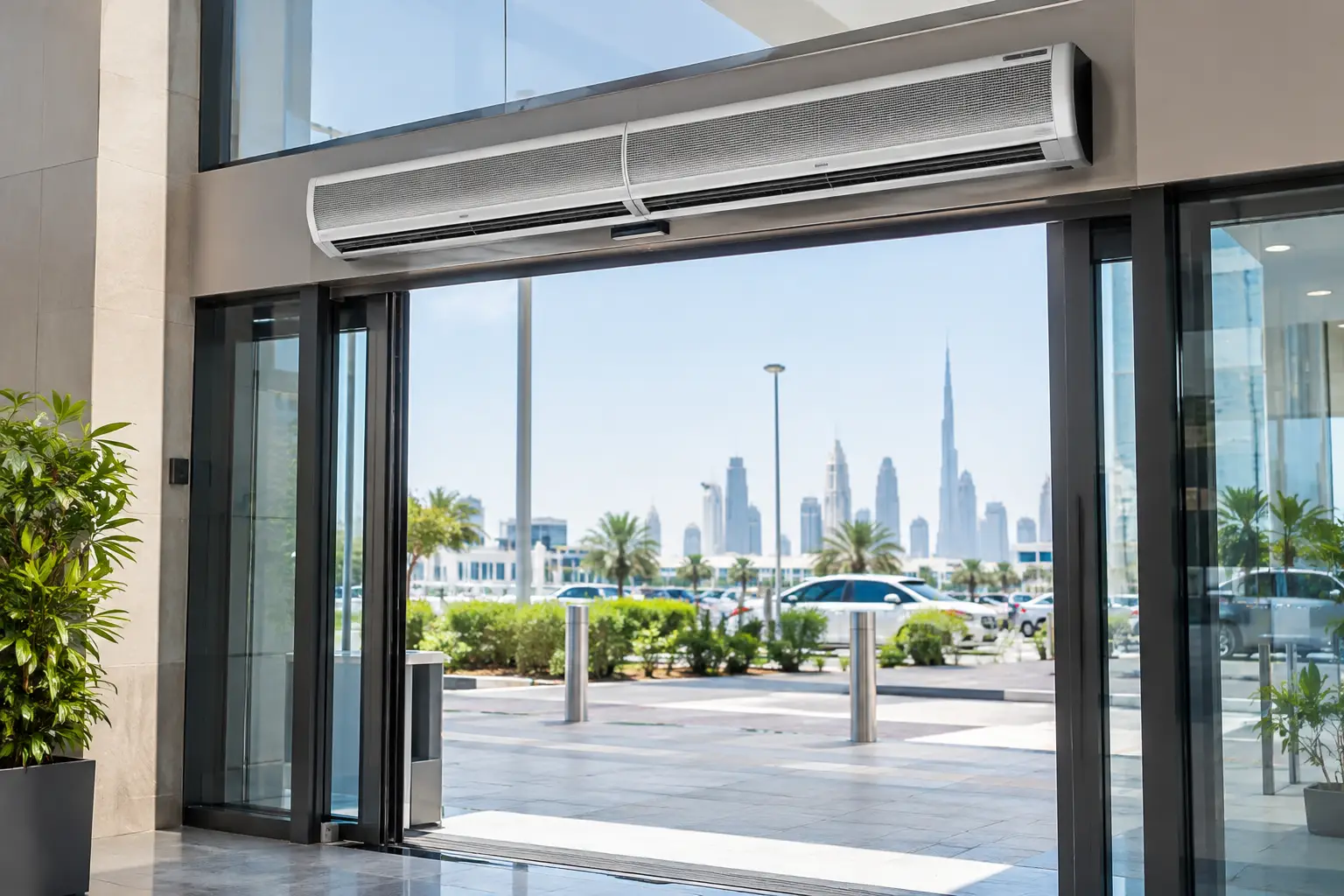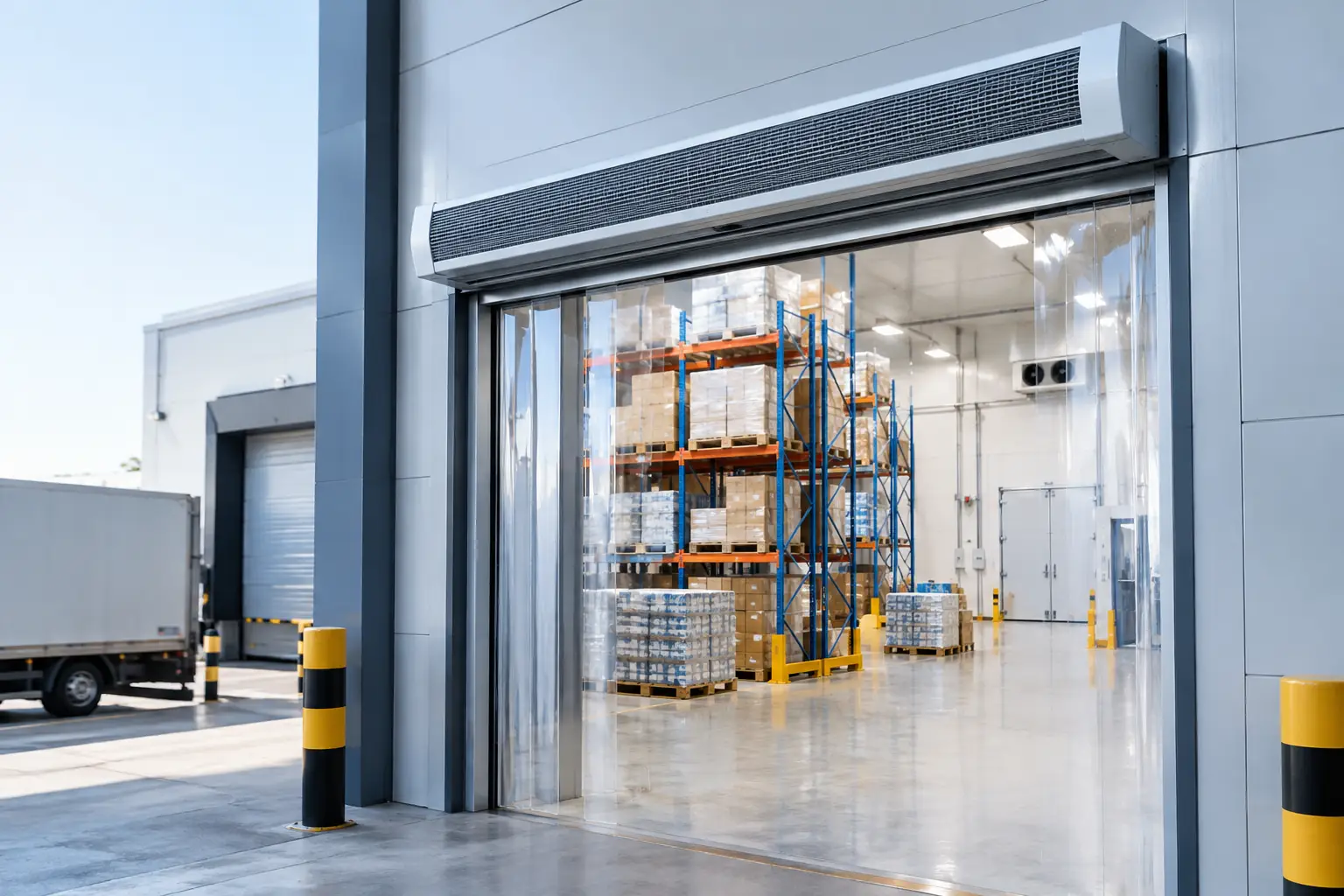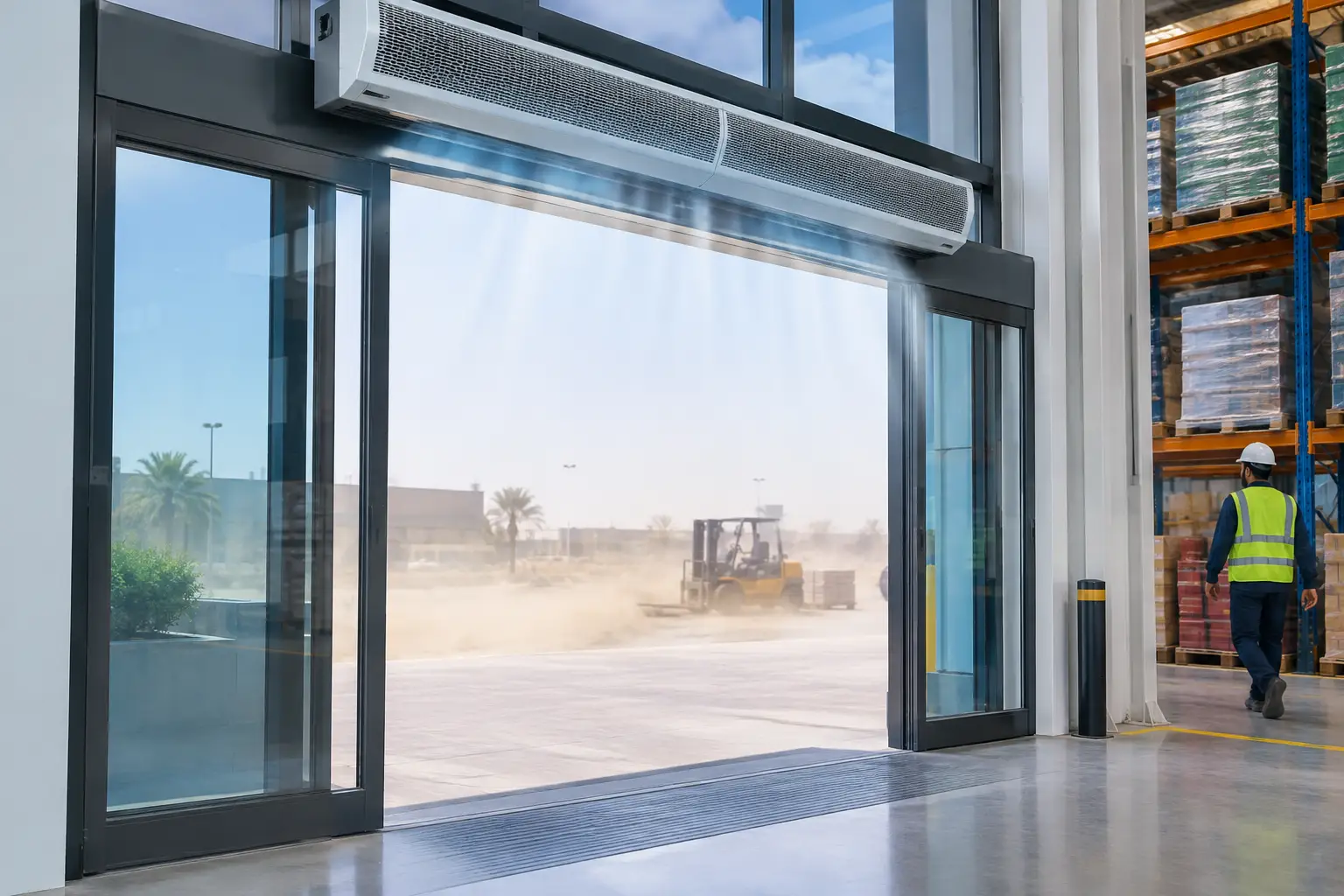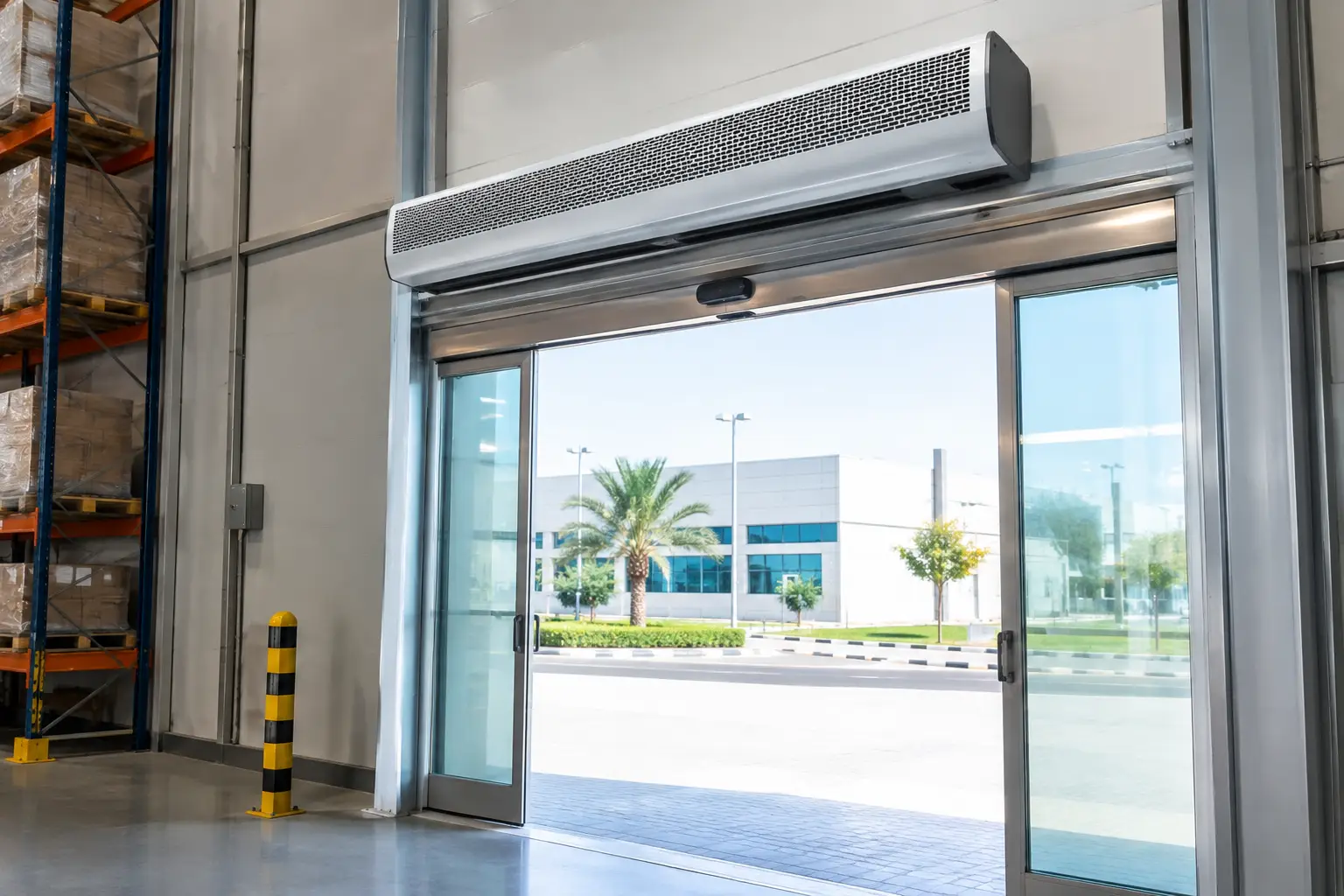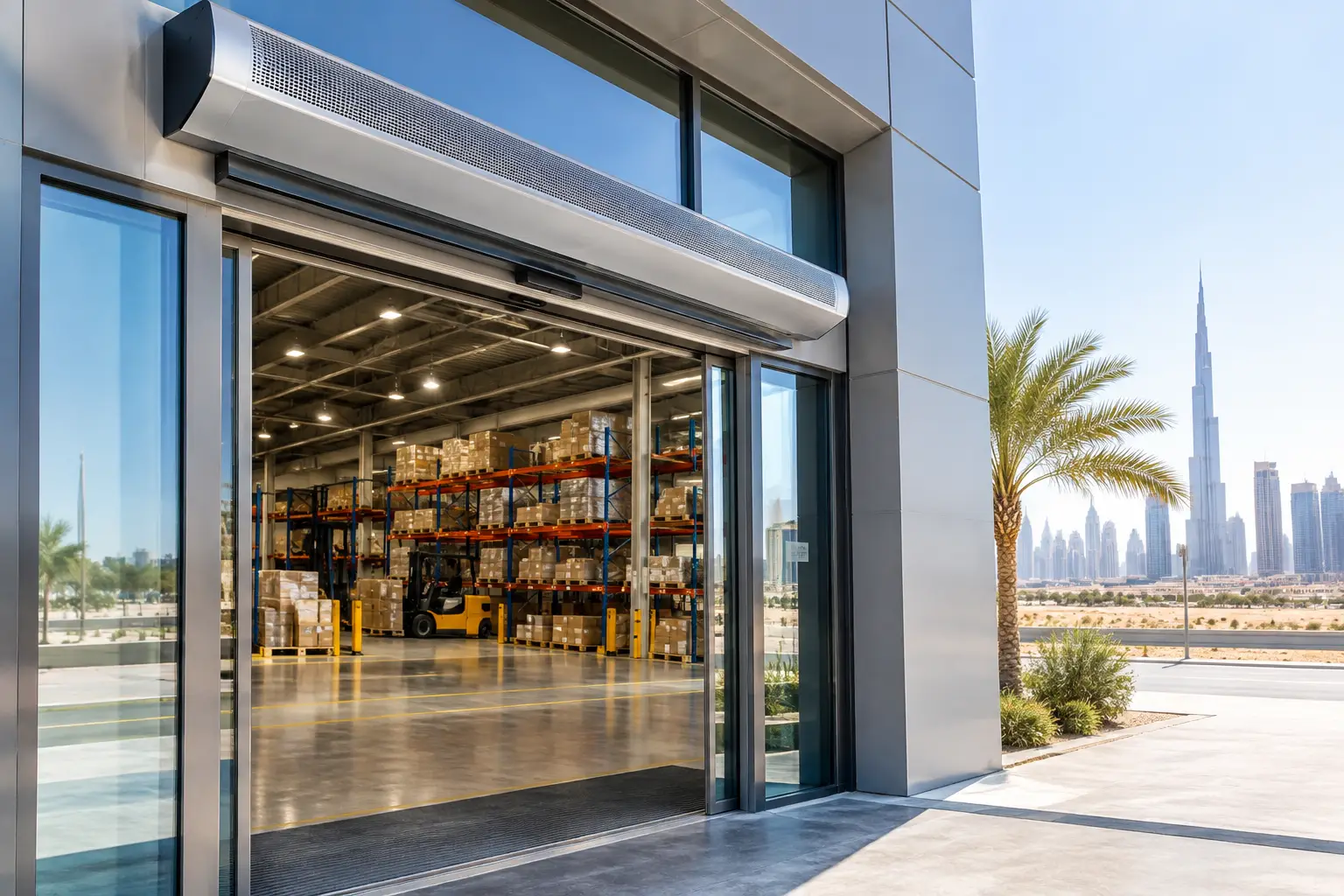
A supermarket entrance in Dubai can open hundreds of times in a trading day. Each opening gives hot air, humidity, dust, and insects an opportunity to cross the threshold while conditioned air escapes. Air curtain performance is therefore not simply a matter of fitting a unit above a door. It is the measured ability of the air stream to maintain an effective separation barrier under real operating conditions.
For facility managers, MEP consultants, and contractors, that distinction affects comfort near the entrance, HVAC loading, hygiene controls, and the long-term operating experience of the building. A correctly selected system supports Powerful Air Isolation. A poorly matched one may run continuously while delivering limited protection at floor level.
What Defines Air Curtain Performance?
An air curtain creates a directed stream of air across an opening. The stream must travel from its discharge point to the threshold with enough stability to resist pressure differences and disruption from pedestrian traffic, vehicles, wind, and nearby supply or return air.
Performance should be assessed at the opening, not by appearance alone. A unit can sound powerful at the grille yet lose its air path before it reaches the floor. Conversely, an excessively aggressive selection can create avoidable noise or discomfort for staff positioned near the doorway.
The most relevant performance outcomes are:
- Reduced infiltration of outdoor heat and humid air into air-conditioned spaces
- Better retention of conditioned indoor air at frequently used entrances
- Reduced entry of dust, flying insects, smoke, and airborne contaminants where the application requires separation
- More consistent comfort for customers, staff, and visitors close to the doorway
- Less unnecessary demand placed on the building’s HVAC system during operating hours
These outcomes depend on application fit. A retail storefront, loading bay, hospital entrance, and cold storage doorway do not present the same air movement challenge.
Why Entrance Conditions Matter More Than Nameplate Output
Door height and width are the starting point, but they are not the full specification. In hot, humid, and dusty markets such as the UAE, Saudi Arabia, Qatar, Oman, Egypt, and across Africa, the outside air condition can be severe for much of the year. The larger the temperature and humidity difference between inside and outside, the more consequential uncontrolled infiltration becomes.
Pressure imbalance is another critical factor. If a building is strongly negative relative to outdoors, exterior air is pulled inward whenever the door opens. If it is strongly positive, interior air pushes outward. Either condition can deflect an air curtain stream and change the level of protection achieved.
Common Conditions That Reduce Effectiveness
The following conditions frequently explain disappointing results, even where the selected equipment is otherwise suitable:
- A unit is selected for a door height lower than the actual mounting height.
- The air curtain is shorter than the usable opening width, leaving weak areas at one or both sides.
- The discharge direction is not aligned with the doorway or is obstructed by signage, bulkheads, or architectural features.
- Open doors face prevailing winds, vehicle movement, or pressure changes caused by adjacent doors.
- The entrance is used more intensely than anticipated during design, such as at peak retail hours or logistics shift changes.
- HVAC supply, return, or exhaust arrangements disturb the air stream near the entrance.
This is why selection should not be treated as a catalog exercise. The door, building pressure, traffic pattern, and climate must be evaluated together.
How to Evaluate Air Curtain Performance Before Specification
A practical assessment begins with the opening and then works outward to the operating environment. This approach gives consultants and project teams a stronger basis for selecting the correct product category and mounting arrangement.
| Evaluation area | What to confirm | Why it affects results | |—|—|—| | Opening geometry | Clear width, clear height, and obstructions | Determines coverage and required air throw | | Mounting position | Surface, recessed, vertical, or special arrangement | Changes the air path and installation suitability | | Door operation | Frequency, duration, automatic or manual operation | Indicates exposure time and traffic disruption | | Exterior conditions | Heat, humidity, dust, wind, and nearby vehicle activity | Defines the severity of infiltration pressure | | Internal environment | Comfort expectations, hygiene needs, and HVAC arrangement | Identifies the appropriate level of air separation | | Use of the opening | Pedestrian, trolley, forklift, or loading access | Determines whether commercial or industrial duty is needed |
A Four-Step Selection Process
- Measure the effective opening. Confirm the clear opening dimensions rather than relying only on architectural door schedules. Account for shutters, rails, headers, and features that may affect the installed position.
- Map traffic and door behavior. A door that opens briefly every few minutes is different from a distribution center opening used continuously during receiving. Identify peak periods, vehicle movements, and whether doors are commonly held open.
- Assess the external air challenge. Consider solar exposure, wind direction, dust, humidity, and pressure relationships with adjacent spaces. Desert and tropical climates make this assessment particularly important.
- Match the system to the duty. Select a commercial, recessed, or industrial configuration based on mounting constraints, opening size, traffic intensity, and expected environmental exposure. Confirm the final recommendation through a project-specific consultation and quotation process.
Which Air Curtain Configuration Fits the Application?
The right design is driven by duty, not aesthetics alone. A recessed installation may suit a premium lobby, retail entrance, hotel, or shopping mall where the system needs to integrate cleanly with the ceiling design. A commercial centrifugal system can support demanding public-facing entrances where reliable coverage and consistent operation are priorities. Industrial applications often require a different level of airflow control and physical suitability because doors are higher, wider, or exposed to vehicle traffic.
FreezeeX evaluates these requirements across its Recessed Ceiling Air Curtains, Commercial Centrifugal Flow Series, Commercial HiFi Plus Series, Industrial Centrifugal Series, and New Dynamic Series. The selection is not about assigning one series to every site. It is about matching the equipment category to the actual opening and operating conditions.
Commercial Entrances
Retail stores, supermarkets, restaurants, hotels, hospitals, and airport facilities typically need effective separation without compromising the arrival experience. Noise, visual integration, and comfort at the threshold may carry almost as much weight as airflow capability.
For these sites, air curtain performance improves when the unit spans the full opening, mounting height is respected, and the discharge is set to form a consistent barrier without blowing excessively into occupied areas. In high-traffic retail, the system should also be considered alongside door automation and HVAC control strategy.
Industrial and Logistics Openings
Warehouses, factories, workshops, food processing facilities, and logistics centers usually face more disruptive conditions. Openings may be taller, exposed to dust or wind, or used by forklifts and pallet movements. The objective is often to limit heat gain and airborne ingress while keeping operations moving.
Industrial selection must allow for the reality of the doorway. A compact commercial unit may be inappropriate for a large vehicle-access opening, while overspecifying a system for a smaller service door can add cost and operational disturbance without proportional benefit. Heavy-duty conditions call for a solution designed around the opening, traffic, and mounting arrangement.
Controlled and Hygiene-Sensitive Areas
Hospitals, pharmaceutical facilities, food processing sites, and cold storage operations may have additional requirements related to humidity, insects, dust, and contamination control. An air curtain can support the entrance strategy, but it is not a substitute for a properly designed building pressure regime, door procedure, or hygiene protocol.
The key question is what the barrier must resist. Where humidity migration is a concern, for example, door opening time and pressure control may be as influential as the air curtain itself. This is a case where project coordination between facility operations, HVAC design, and the equipment supplier is essential.
Installation Decisions That Protect Performance
Professional installation quality directly influences the result. The unit must be level, securely fixed, correctly positioned relative to the opening, and free from nearby obstructions that distort discharge. Electrical controls and any interlock arrangement should reflect actual door operation rather than an assumed schedule.
Commissioning should verify that the air stream reaches the intended threshold area and remains stable during normal door use. This does not require a complicated exercise, but it does require observation under realistic conditions – including busy periods where possible.
Facility teams should also plan for access. A system located above a high entrance or within a recessed ceiling needs a practical maintenance arrangement. Keeping intake areas clean and ensuring the equipment operates as intended helps preserve airflow over time, especially in dusty environments.
Performance Is a Whole-Entrance Decision
An air curtain should be specified as part of the entrance environment, not as an isolated accessory. Door geometry, external climate, air pressure, mounting height, traffic volume, and the indoor HVAC design all influence the outcome. The best choice is rarely the smallest unit that fits above the door, nor automatically the largest available option.
For projects in Dubai, Riyadh, Doha, Muscat, Cairo, Lagos, Nairobi, and other hot or humid markets, FreezeeX can assess the opening conditions and recommend a commercial or industrial air curtain system suited to the required duty. Request a consultation and quotation based on your entrance dimensions, mounting constraints, traffic pattern, and climate exposure.