
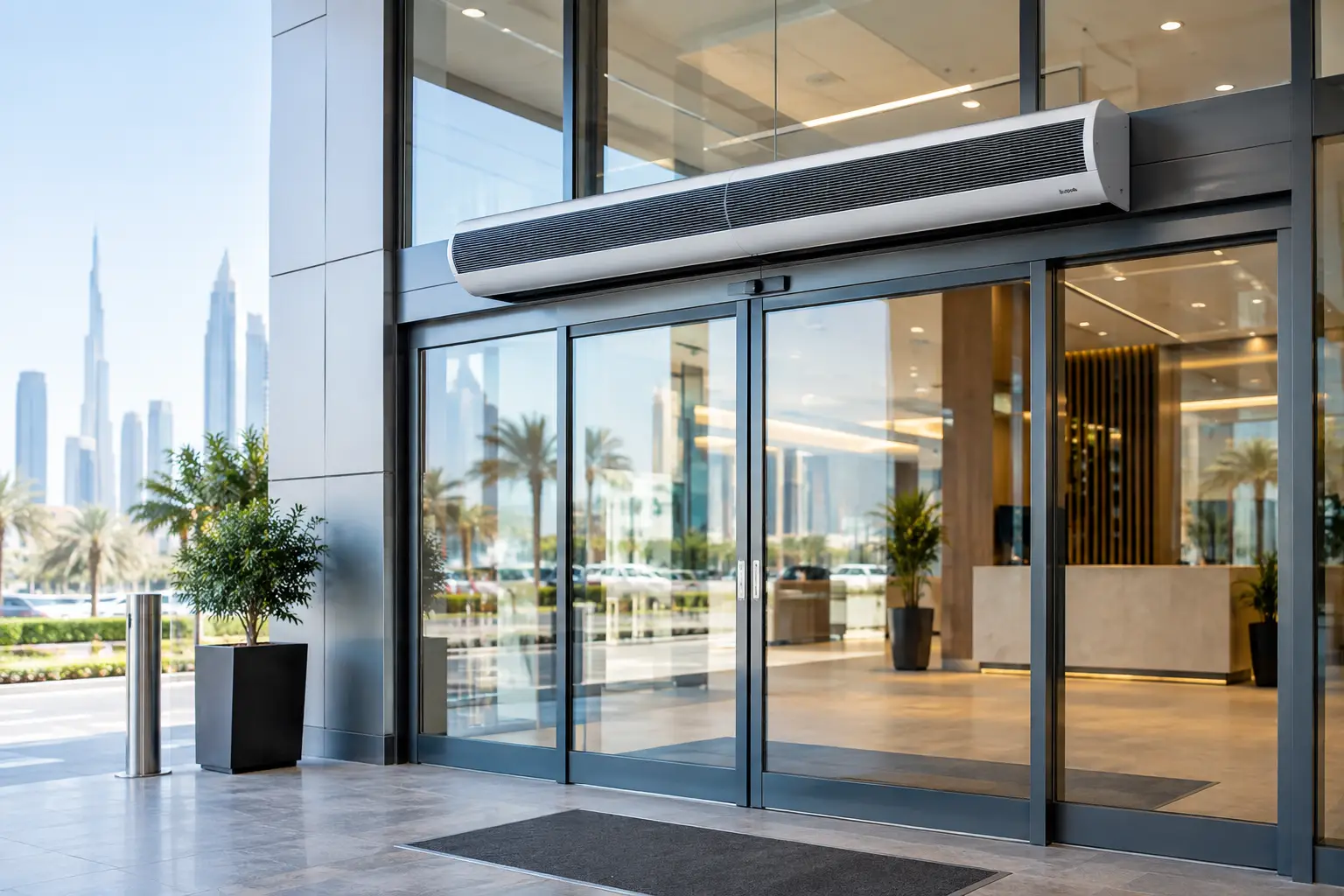
A door that looks simple on a drawing can become the weak point of an entire cooling strategy once the site is live. If you are specifying for a hypermarket entrance in Dubai, a warehouse in Riyadh, or a cold room access point in Lagos, an air curtain mounting height calculator is not a nice extra. It is one of the quickest ways to avoid underperforming equipment, wasted energy, and callbacks after handover.
Mounting height determines whether the air stream reaches the floor with enough velocity to create a real barrier. Get that wrong, and even a high-quality unit can struggle against hot outside air, dust, humidity, and insects. In tropical and desert climates, where temperature difference and infiltration pressure can be severe, this calculation matters even more.
What an air curtain mounting height calculator actually tells you
At a basic level, the calculator helps match door height with the right air curtain performance range. That sounds straightforward, but the real value is in preventing the common assumption that any unit can cover any opening as long as the physical width fits.
It cannot. Air curtain performance depends on how far the discharge air must travel, how stable the jet remains on the way down, and whether the unit can hold an effective air seal under actual site conditions. A recessed commercial model above a retail entrance and an industrial centrifugal unit above a loading bay may both be called air curtains, but they are solving different problems at different heights.
A good calculator is really evaluating one question: can this unit deliver enough air volume and throw at this installed height to protect the opening in the real operating environment?
Why mounting height changes performance
The higher the installation point, the harder the job becomes. Air loses momentum as it travels. Crosswinds, pressure differences, frequent door openings, and traffic movement all disturb the air stream before it reaches the floor.
That is why a two-meter glass shopfront and a five-meter industrial entrance should never be treated the same way. In high ambient heat, the challenge increases because the barrier is not only resisting outside air movement. It is also helping reduce cooling loss from conditioned interiors that are expensive to maintain.
An air curtain that is mounted too high for its rating often shows the same symptoms. The lobby still feels hot near the entrance. Dust migrates inside. Insects get through. HVAC runtime increases. Staff assume the product is weak, when the real issue is specification mismatch.
The main inputs behind the calculator
Most mounting height calculations rely on a set of linked variables, not a single dimension. Door height is the headline number, but width, traffic type, wind exposure, indoor-outdoor temperature difference, and building pressure also influence the result.
For example, a three-meter entrance in a sheltered hotel lobby is a different application from a three-meter opening facing a dusty service yard in a desert climate. The nominal mounting height may be the same, but the unit selection should not be.
This is where many generic online tools fall short. They may estimate based on height alone, but serious commercial selection requires performance context.
How to use an air curtain mounting height calculator properly
Start with the finished opening height, not the rough structural dimension from an early drawing. The installed distance from discharge outlet to floor is what matters. Ceiling bulkheads, beam drops, recessed mounting details, and signage zones can all change the final position.
Next, confirm the door width and whether the entrance is single, double, sliding, or constantly open. Width affects how many units you need and whether you are looking at a single long body or multiple synchronized sections.
Then evaluate the site environment honestly. This is where experienced specifiers save time later. Ask whether the entrance faces prevailing wind, whether forklifts or carts create disturbance, whether the space operates under negative pressure, and whether the goal is comfort, insect control, dust control, humidity reduction, or cold air retention. Usually it is a combination.
The calculator gives you a starting point for the allowable mounting height band. From there, the right decision is to compare that result against actual product performance data, especially air volume, outlet velocity, and recommended installation conditions.
Height alone is not enough
Two units can both claim suitability for the same mounting height and still perform very differently. The difference usually comes down to fan type, casing design, outlet geometry, motor strength, and application intent.
Commercial centrifugal units often offer stronger and more stable discharge than lighter-duty decorative models. Industrial series are built for larger openings, harsher environments, and higher-duty operation. Recessed ceiling units may be the right architectural fit for premium entrances, but only if their performance matches the opening and climate load.
That is why a calculator should support selection, not replace engineering judgment.
Typical mistakes specifiers make
One common mistake is sizing only to the architectural look of the entrance. A recessed finish or slim housing may suit the design intent, but if the mounting height is beyond the unit’s effective range, the barrier will be cosmetic rather than functional.
Another mistake is ignoring local climate conditions. In GCC, MENA, and many African cities, high heat and airborne dust create more demanding entrance conditions than standard catalog assumptions. A unit that appears adequate on paper may be marginal in a shopping center entrance in Abu Dhabi or an industrial facility in Nairobi if wind and thermal load are not considered early.
The third mistake is treating all traffic patterns equally. A staff door with intermittent use is one thing. A hypermarket entrance with continuous foot traffic, trolleys, and automatic doors is another. The more disturbed the opening, the more important discharge strength and mounting height discipline become.
Choosing the right unit after the calculator result
Once the calculator suggests the workable height range, the next step is matching that result to the right product category. For lower and mid-height commercial entrances, a commercial centrifugal or premium architectural model may provide the right balance of appearance, noise control, and barrier performance.
For taller openings, logistics areas, workshops, plants, and industrial access points, heavier-duty centrifugal systems are usually more appropriate. They are built to maintain stronger airflow across larger vertical distances and more difficult operating conditions.
If the opening connects to temperature-sensitive space such as food retail back-of-house or cold storage support areas, the tolerance for leakage is lower. In those applications, the conversation should move beyond basic mounting height into complete entrance control strategy.
What the calculator cannot solve by itself
An air curtain mounting height calculator will not fix poor installation layout. If the unit is offset from the opening, interrupted by structure, or installed with insufficient coverage across the full width, performance will suffer.
It also will not solve pressure imbalance in the building. If the interior is pulling or pushing air aggressively due to mechanical systems, the air curtain must work much harder. In some cases, correcting adjacent ventilation balance is just as important as selecting the right air curtain.
Noise expectations also need context. More powerful units usually deliver better throw at greater height, but that can involve a trade-off in sound profile depending on the environment. In a hotel or premium office, the specification may prioritize acoustic control. In a warehouse or industrial plant, barrier strength usually comes first.
When consultation matters more than the calculator
If the entrance is exposed, taller than standard commercial doors, connected to cold space, or located in an extreme heat and dust environment, a calculator should be the start of the conversation, not the end of it.
This is especially true for projects in desert and tropical markets, where real-world performance matters more than generic catalog language. A unit that works well in moderate conditions may not hold the same barrier stability at a busy entrance in Doha, Cairo, or Casablanca. Site conditions, opening geometry, and operating hours all change the selection logic.
For contractors and consultants, the practical goal is simple: specify a system that performs on day one and still performs after months of heavy traffic and high ambient load. That means using the calculator to establish a credible height range, then validating it against application type, duty cycle, and equipment class.
FreezeeX supports this process with specification-led guidance for commercial and industrial air curtain projects across hot-weather markets. If you are working on an entrance where cooling loss, dust ingress, humidity, or insect control is affecting operations, request a consultation or quote and get the right unit matched to the real mounting height and site conditions.





10 Responses
That’s a key consideration when specifying an air curtain. Matching the unit’s airflow performance to the entrance height and application helps ensure an effective air barrier, supporting better energy efficiency, climate control, and protection against dust and insects.
That’s an important specification consideration. Selecting an air curtain based on both entrance width and mounting height helps ensure the airflow reaches the floor effectively, providing reliable climate separation, energy efficiency, and protection against dust and insects in larger commercial and industrial openings.