
Every cold room manager knows the moment that costs money – the door opens, warm humid air rushes in, evaporators work harder, and the floor near the entrance becomes a risk area. An air curtain for cold storage is built to reduce that exchange at the doorway, where temperature loss, moisture gain, and traffic pressure collide.
In hot regions such as the Gulf, North Africa, and Sub-Saharan Africa, that doorway problem gets worse. Ambient heat is high, humidity can be severe, and many facilities operate with constant forklift or staff movement. That means a cold storage entrance is not just a door opening. It is a pressure point in the entire cooling system.
Why an air curtain for cold storage matters
Cold storage performance is often measured by refrigeration capacity, insulation quality, and door discipline. Those matter, but entrance control is where many facilities lose efficiency every day. Each opening allows warm air, dust, and moisture to move into the conditioned space. That creates a chain reaction – temperature instability, frost buildup, coil strain, product risk, and higher electricity demand.
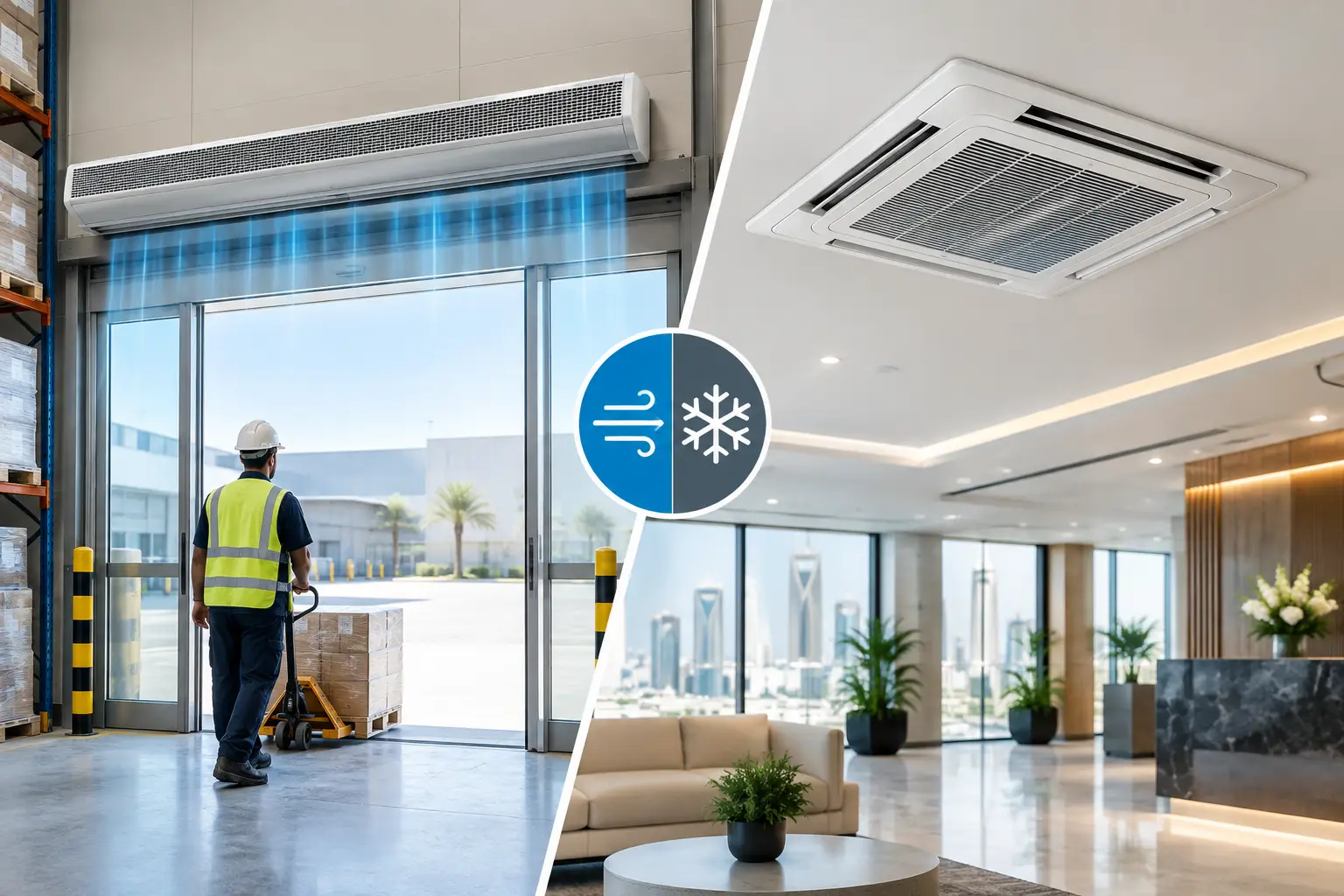
An air curtain adds a controlled, high-velocity air barrier across the opening. It does not replace a door, and it does not solve poor room design. What it does is reduce uncontrolled infiltration during frequent access. For loading areas, processing transitions, and hypermarket back-of-house cold rooms, that difference can be operationally significant.
The biggest gain is often not just energy. It is stability. When the entrance environment is better controlled, facilities see fewer swings in room conditions, less moisture migration, and cleaner movement between zones. In food handling and temperature-sensitive operations, that consistency matters as much as the utility bill.
The real problem at cold storage doorways
At a cold storage opening, warm outside air naturally wants to move inward while denser cold air spills outward. In tropical and desert-climate markets, the temperature gap is usually aggressive. If the site is in Dubai, Riyadh, Lagos, or Nairobi, external conditions can place heavy stress on every opening cycle.
Humidity is often the hidden issue. Once moist air enters a chilled or frozen threshold, condensation and icing become more likely. That affects visibility, traction, maintenance frequency, and product handling conditions. A facility may think it has a door problem, when the real issue is uncontrolled air exchange during normal traffic.
Dust and flying insects can also become a concern depending on the site. This is especially true in logistics yards, food service supply chains, and industrial compounds where external contamination pressure is high. An air curtain helps create a cleaner boundary between outdoor loading activity and controlled internal zones.
What a cold storage air curtain needs to do
Not every unit sold as an entrance air solution is suitable for this application. Cold storage requires strong, consistent airflow with enough throw to cover the full opening height and width. If the air stream breaks before it reaches the floor, barrier performance drops fast.
Blower design matters. Centrifugal systems are often preferred in commercial and industrial settings because they deliver stable pressure and more dependable air distribution across wider openings. Mounting position matters too. The unit must be selected around the actual doorway geometry, clearance, traffic pattern, and surrounding pressure conditions.
This is also where climate-specific engineering makes a difference. In high-heat markets, the unit is not operating in mild ambient conditions. It has to maintain barrier performance while exposed to demanding external temperatures, dusty service environments, and long run hours. That is why specifiers should look beyond catalog claims and focus on application fit.
Air curtain for cold storage: where it performs best
The best use case is a doorway with frequent openings and repeated traffic between ambient and cooled spaces. That includes cold rooms in food distribution centers, prep zones in hospitality supply chains, hypermarket storage areas, pharmaceutical holding spaces, and industrial process rooms where temperature control supports product integrity.
In these environments, an air curtain works best as part of a full entrance strategy. Strip curtains, rapid doors, insulated doors, and disciplined opening cycles may still be needed. The air curtain improves performance during the moments when the opening is active. It is most effective when specified as a barrier solution, not treated as a standalone fix for every thermal problem in the room.
If the facility has long door-open times, strong crosswinds, or badly imbalanced pressure between spaces, expectations need to be realistic. An undersized unit will not overcome a poor opening design. Good results depend on correct sizing, mounting height, discharge angle, and airflow strength.
How to choose the right system
Selection starts with the opening itself. Height, width, and traffic frequency are the first variables, but they are not enough on their own. Specifiers also need to assess room temperature, external ambient conditions, humidity level, forklift movement, and whether the goal is mainly energy reduction, hygiene control, condensation reduction, or all three.
A busy cold room in a hypermarket has different demands from an industrial cold chain loading bay. The first may prioritize compact installation, lower noise, and continuous operation near staff. The second may require heavier-duty construction, stronger throw, and a build quality suited to rougher conditions.
This is why quote-based selection makes more sense than off-the-shelf buying. Cold storage entrances are application-specific. The correct recommendation should be based on site conditions and operating patterns, not just door size.
Performance factors buyers should ask about
Air velocity profile is one of the most important indicators because it determines whether the barrier remains intact from top to bottom. Noise level matters in occupied commercial environments. Motor durability matters where run time is high. Casing quality matters in humid and industrial conditions. Service access matters because maintenance teams need practical access for cleaning and inspection.
Buyers should also ask how the unit performs in hot-weather regions where outside air pressure, dust load, and ambient temperature are more severe than standard reference conditions. That question is especially relevant across GCC and African markets, where climate stress is not a side issue. It is the operating reality.
Common mistakes in cold storage air curtain projects
The first mistake is underspecifying the unit to save initial cost. That usually leads to weak barrier performance and little measurable improvement at the doorway. The second is installing a general commercial model on an industrial or high-loss opening. The third is ignoring surrounding conditions such as wind, pressure imbalance, and traffic behavior.
Another common issue is treating the air curtain as a cure for a refrigeration system that already has deeper problems. If door seals are poor, room insulation is compromised, or staff keep openings active longer than necessary, the air curtain can help but it cannot carry the whole load.
There is also a practical trade-off between stronger airflow and occupant comfort in some spaces. In staff-intensive access points, the system has to be selected to maintain an effective barrier without creating an uncomfortable or disruptive blast. That balance depends on the use case.
The operational payoff
When the right system is installed correctly, facilities usually notice the difference in daily operation before they calculate the energy savings. The room recovers faster. Moisture intrusion is reduced. Floors near the entrance stay more manageable. Cooling equipment does not fight the doorway as aggressively during every opening cycle.
For operators in hot and humid markets, this can support lower refrigeration strain and better environmental control around stored goods. For procurement and project teams, it strengthens the business case for entrance climate protection as an asset, not an accessory.
That is the practical value of a well-specified air curtain for cold storage. It protects the most vulnerable point in the room – the opening where conditioned air is usually lost fastest.
If you are planning a cold room, upgrading a high-traffic entrance, or trying to reduce thermal loss in a demanding facility, the right next step is a technical review of the opening, traffic pattern, and climate conditions. FreezeeX supports contractors, consultants, and facility teams with quote-based recommendations built for tropical and desert-climate performance. Request a consultation and get a system matched to your site, not a generic unit pulled from a catalog.





2 Responses
Exactly. In cold storage applications, controlling temperature exchange and condensation at doorways is essential for maintaining product quality and reducing refrigeration load. A properly specified air curtain helps support these objectives while allowing efficient movement through busy access points.