
At a busy entrance in Dubai, Riyadh, Lagos, or Nairobi, every second the doorway stays open has a cost. Cooled air escapes, hot air pushes in, dust follows, insects find a path, and the HVAC system works harder to recover. That is why the decision around air curtains vs automatic doors is not just about convenience at the entrance. It is a building performance decision that affects energy use, hygiene, comfort, and day-to-day operations.
For commercial and industrial sites in tropical and desert climates, the right answer depends on how the entrance actually functions. In some facilities, an automatic door helps limit open time. In others, an air curtain provides a stronger operational return because the door still opens constantly and the climate pressure at the threshold never stops. Many projects also benefit from using both, but not for the reasons people often assume.
Air curtains vs automatic doors: what problem are you solving?
The first mistake in this comparison is treating both systems as direct substitutes in every case. They solve related problems, but not exactly the same one.
Automatic doors control physical access. They reduce the time a doorway remains open by opening only when needed and closing afterward. That improves convenience and can cut some cooling loss compared with a manually operated door left ajar.
Air curtains control air movement across an opening. They create a high-velocity air barrier designed to reduce the transfer of hot air, humidity, dust, fumes, and flying insects from outside to inside. In a climate where outdoor conditions are extreme, that distinction matters. A door can close after traffic passes. An air curtain works while the opening is in use.
For a hypermarket entrance, hotel service entry, cold room access point, or industrial loading zone, the main issue is often not whether a door can close. The issue is what happens while people, carts, pallet jacks, or deliveries are moving through the opening all day.
Where automatic doors perform well
Automatic doors make sense when access control, aesthetics, and managed pedestrian flow are the priorities. Office towers, premium retail, healthcare receptions, and certain hospitality entrances often need the door itself to operate with minimal contact and predictable timing.
They also help when outside conditions are moderate and the doorway is not exposed to constant heavy traffic. In these settings, reducing unnecessary open time can be enough to support indoor comfort.
There are also practical reasons specifiers choose automatic doors. They create a clear physical barrier when closed, support security policies, and may better match the architectural intent of the building frontage. If the entrance must remain visually polished and acoustically contained, the door system carries value beyond climate control alone.
But in harsh environments, their limitation is simple. Every cycle still allows direct air exchange. If the door opens every few seconds, or remains open longer due to traffic volume, deliveries, trolleys, or slow movement, the cooling loss becomes significant.
Where air curtains gain an edge
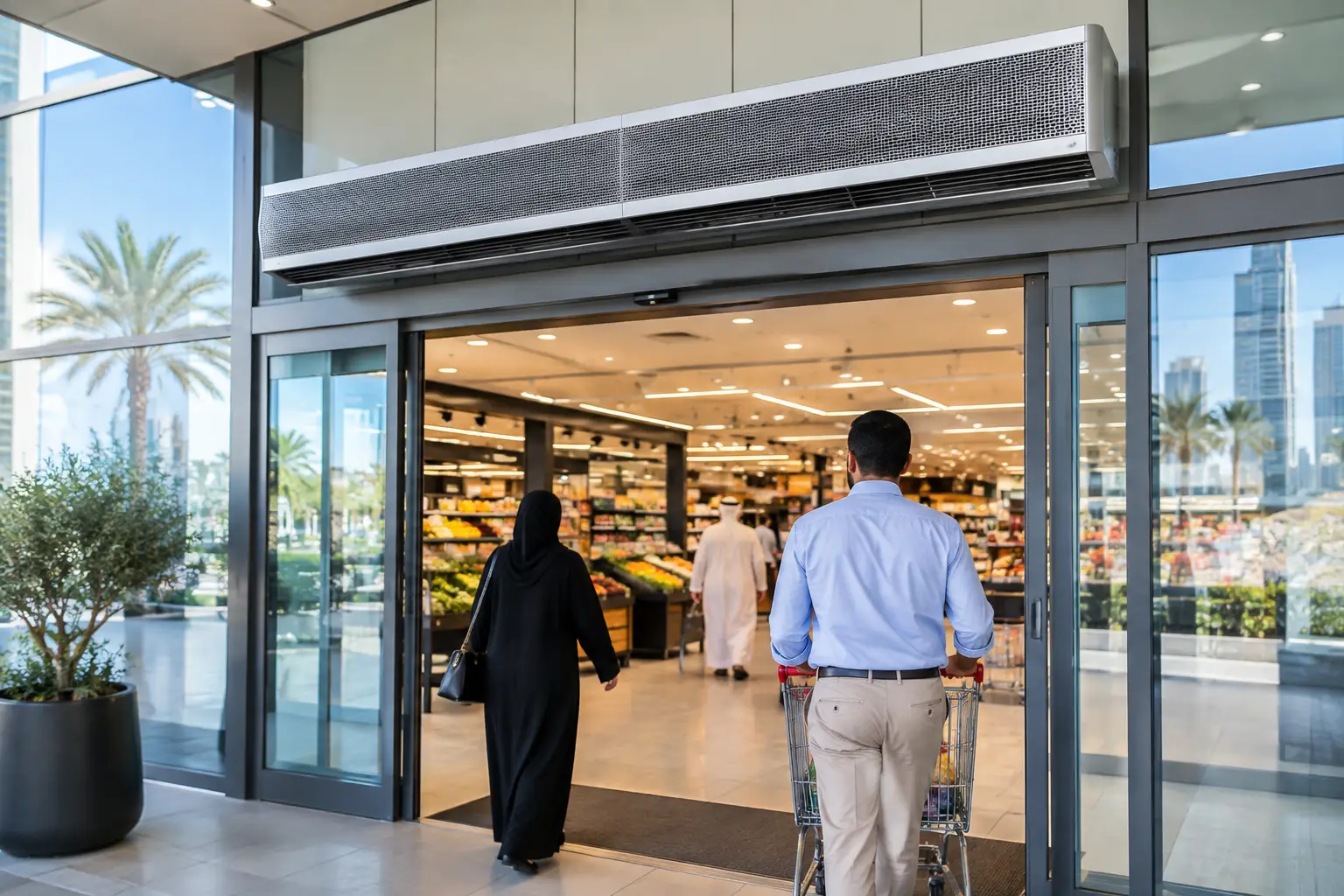
Air curtains are strongest where frequent opening is unavoidable and outside air is aggressive. That includes supermarket entrances, commercial kitchens, warehouses, workshops, cold storage transitions, logistics points, and high-traffic back-of-house doors.
In hot-weather markets, the outside air is not just warm. It can carry humidity, dust, sand, vehicle exhaust, and insects. An air curtain is built to address that moving boundary condition at the entrance. It does not wait for the opening to close before doing its job.
This is why air curtains often outperform expectations in facilities that already have doors but still struggle with cooling loss or contamination at thresholds. If staff are complaining about heat near the entrance, if condensation is appearing around cold areas, or if the HVAC load spikes during peak traffic hours, the problem is usually dynamic air infiltration. That is the exact condition an air curtain is designed to reduce.
For MEP contractors and consultants, the detail that matters is not just airflow volume, but correct discharge velocity, installation height, blower selection, and application fit. A poorly specified unit will underperform. A properly matched commercial or industrial air curtain can materially improve comfort and reduce strain on the cooling system.
The real comparison: energy, hygiene, traffic, and cost
In energy terms, automatic doors reduce losses by shortening open time. Air curtains reduce losses during open time. In buildings with low to moderate traffic, the difference may be narrow. In buildings with constant movement, the gap becomes wider.
In hygiene-sensitive spaces, air curtains usually offer a stronger operational advantage. They help limit airborne dust, flying insects, and unconditioned air crossing into food retail, hospitality service areas, and processing environments. Automatic doors alone do not create that active barrier.
In traffic flow, air curtains are often less restrictive. Staff, guests, shoppers, and goods can pass without waiting for door cycles. That matters in supermarkets, factories, and logistics environments where delays at the threshold create bottlenecks.
On capital cost, the answer depends on opening size, automation requirements, and entrance design. Automatic door packages can become expensive when framing, sensors, controls, and glazing are involved. Air curtains vary by duty level and width, but for many commercial and industrial openings they provide a cost-effective performance upgrade, especially when the existing door arrangement is staying in place.
On maintenance, both systems require attention. Automatic doors involve moving mechanical assemblies, sensors, tracks, and safety systems. Air curtains require correct installation and routine servicing to maintain airflow performance. In dusty or sandy environments, proper maintenance discipline matters even more.
Air curtains vs automatic doors in hot climates
This is where the decision shifts.
In cities such as Abu Dhabi, Doha, Muscat, Cairo, and Casablanca, entrance conditions are shaped by heat load, air pressure difference, humidity in some coastal zones, and dust exposure. In these environments, the open doorway behaves like a constant leak point in the building envelope.
An automatic door can reduce the duration of exposure, but it does not neutralize the outside air pushing inward each time the door opens. An air curtain is specifically intended to defend that threshold during operation. That makes it especially relevant for properties that pay heavily for cooling and cannot afford weak entrance control.
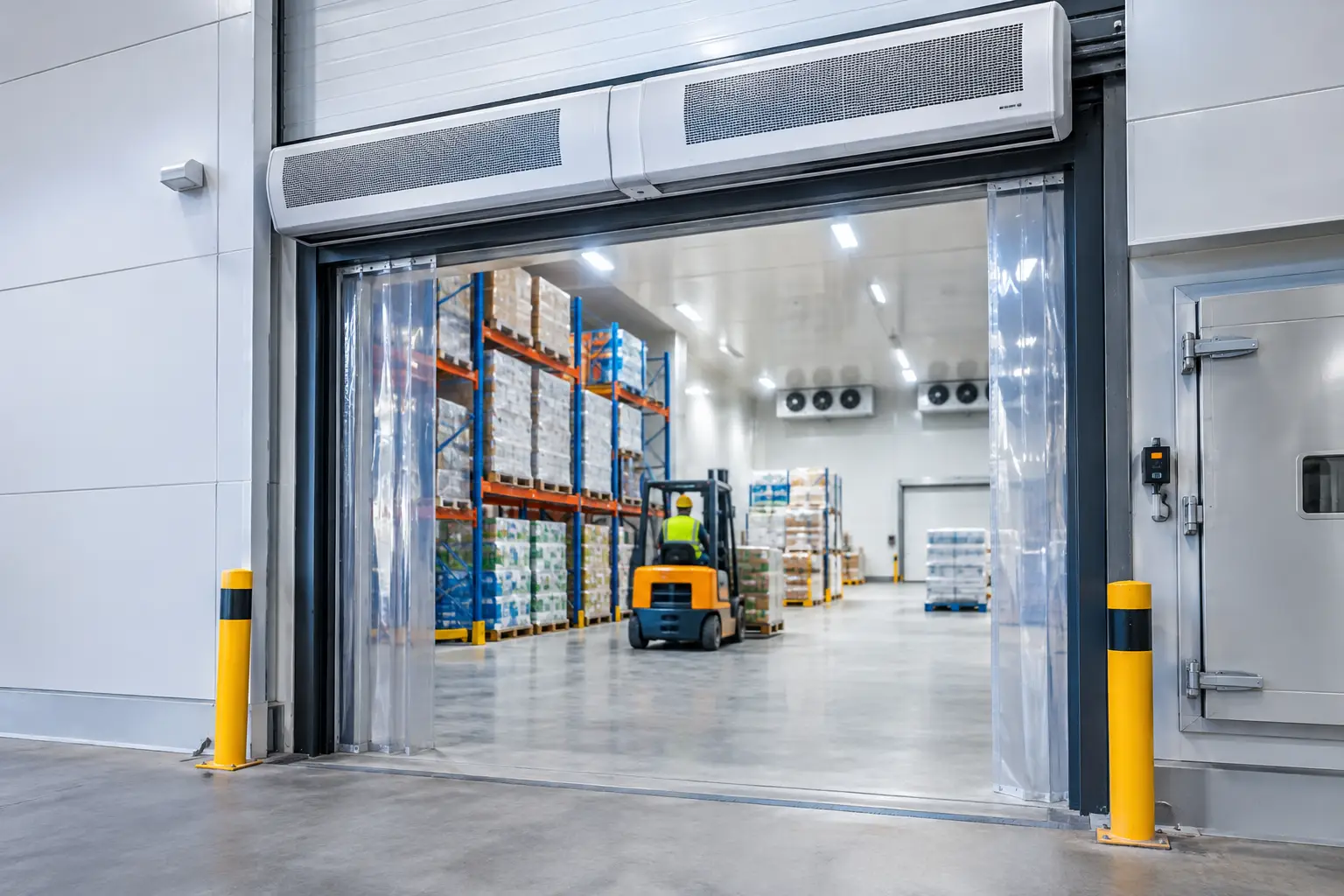
For cold storage operators in hot regions, this becomes even more critical. When warm ambient air enters a temperature-controlled space, the result is not just energy waste. It can affect product conditions, condensation levels, slip risk, and compressor workload. At these openings, a correctly selected industrial air curtain is often a practical layer of protection.
When both systems are the right answer
The smartest specification is not always either-or.
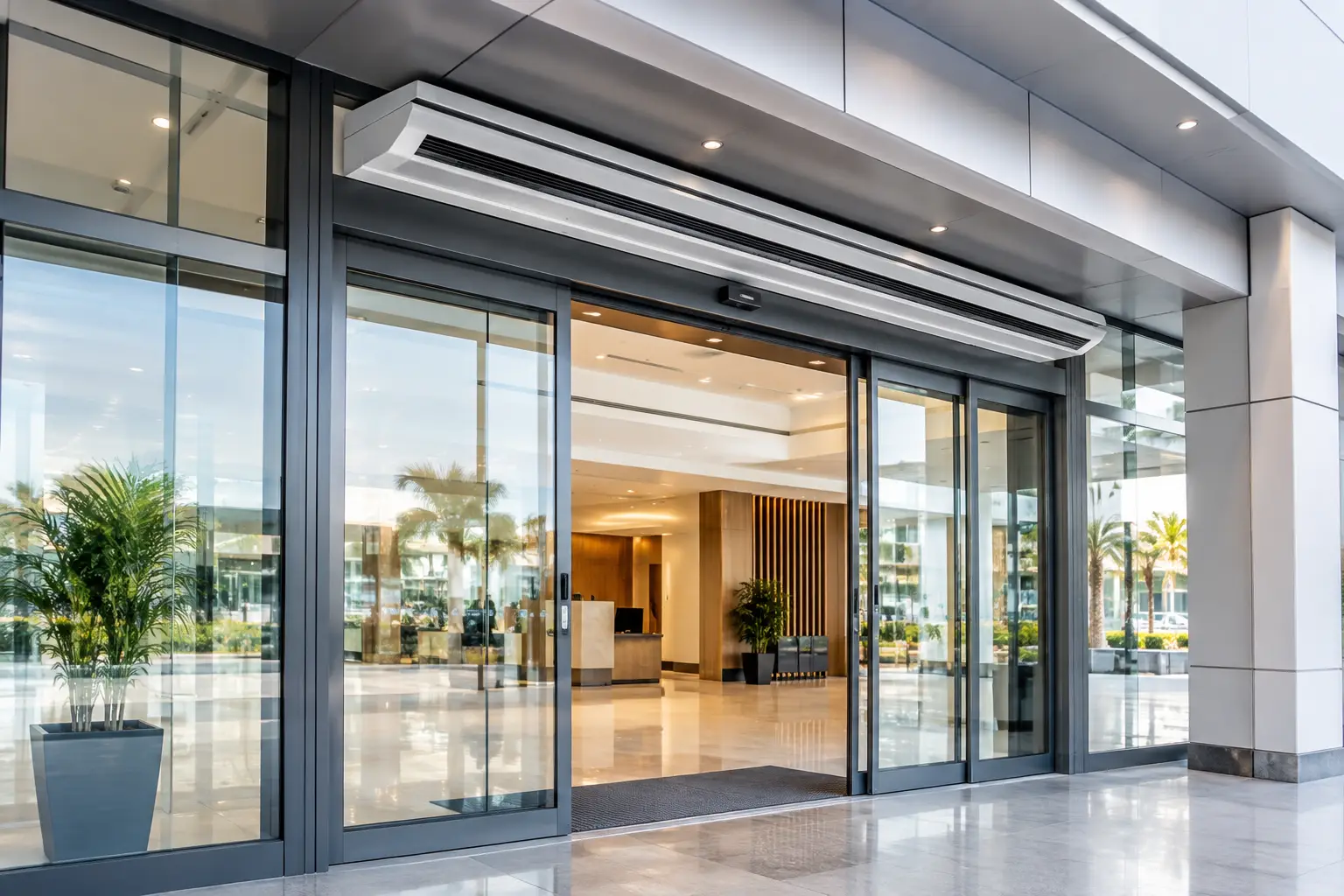
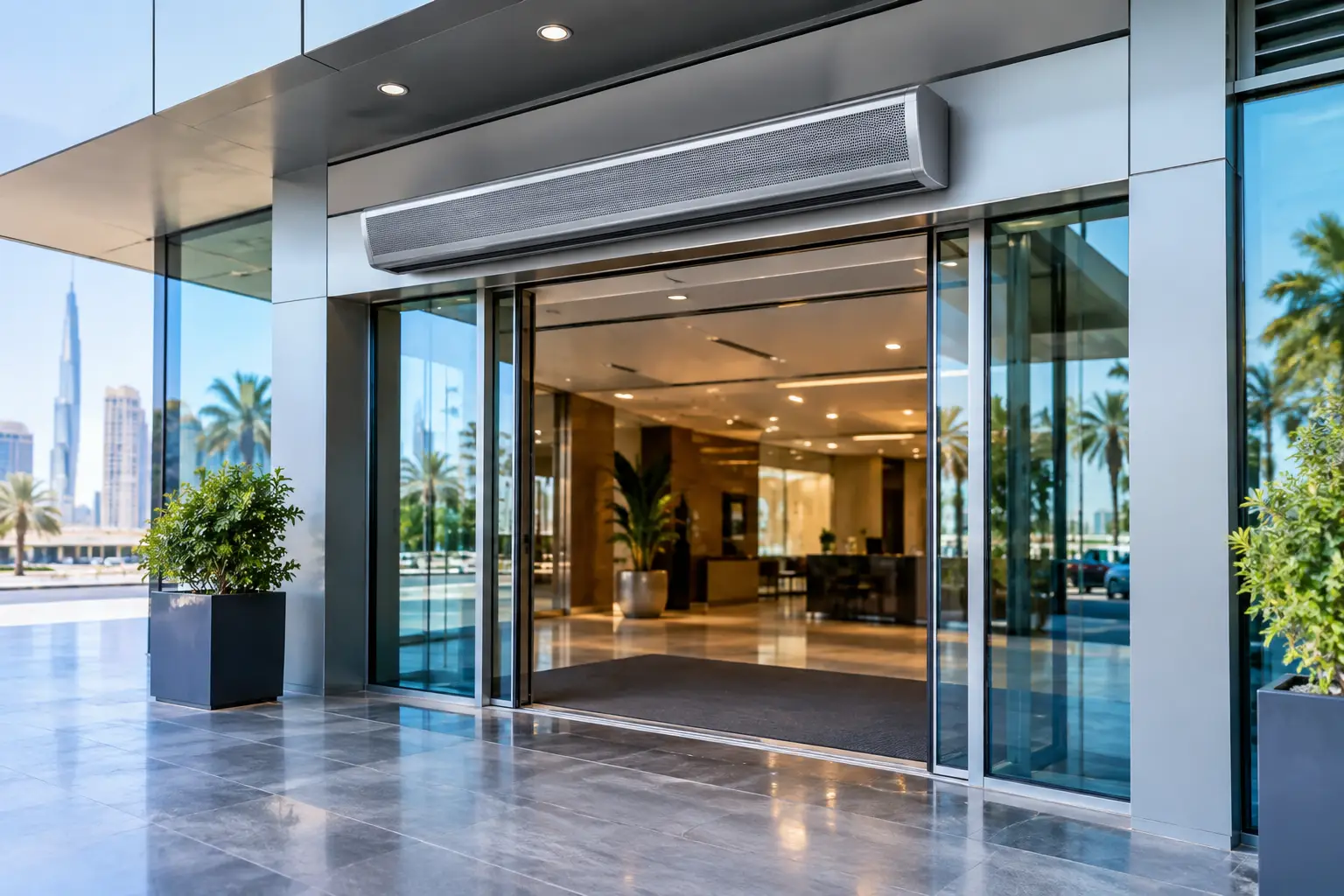
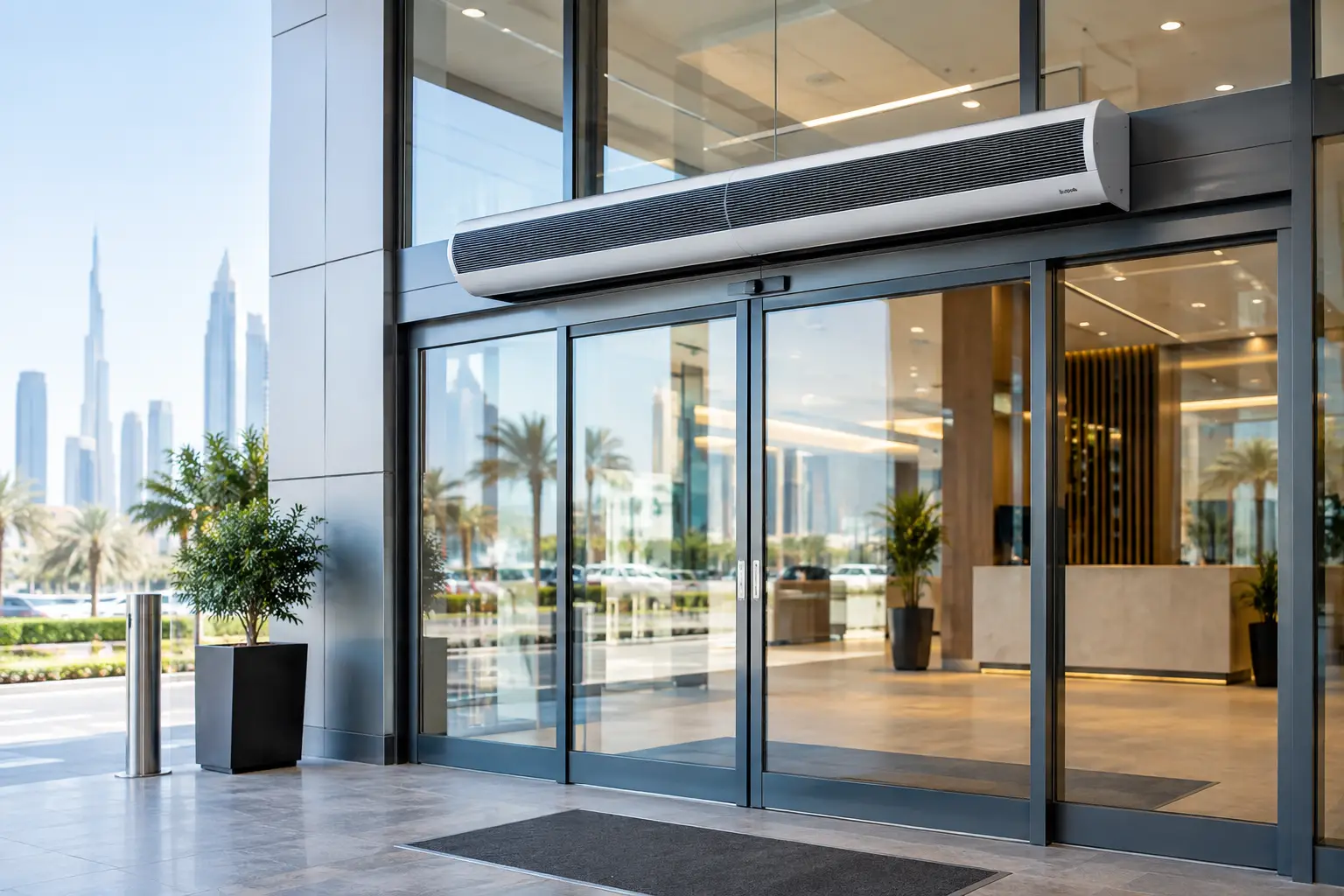
At premium commercial entrances, automatic doors and air curtains can work together. The door manages access and physical closure. The air curtain strengthens climate separation when traffic activates the opening. This combination is often the strongest approach for hotels, malls, healthcare sites, and flagship retail environments where both presentation and performance matter.
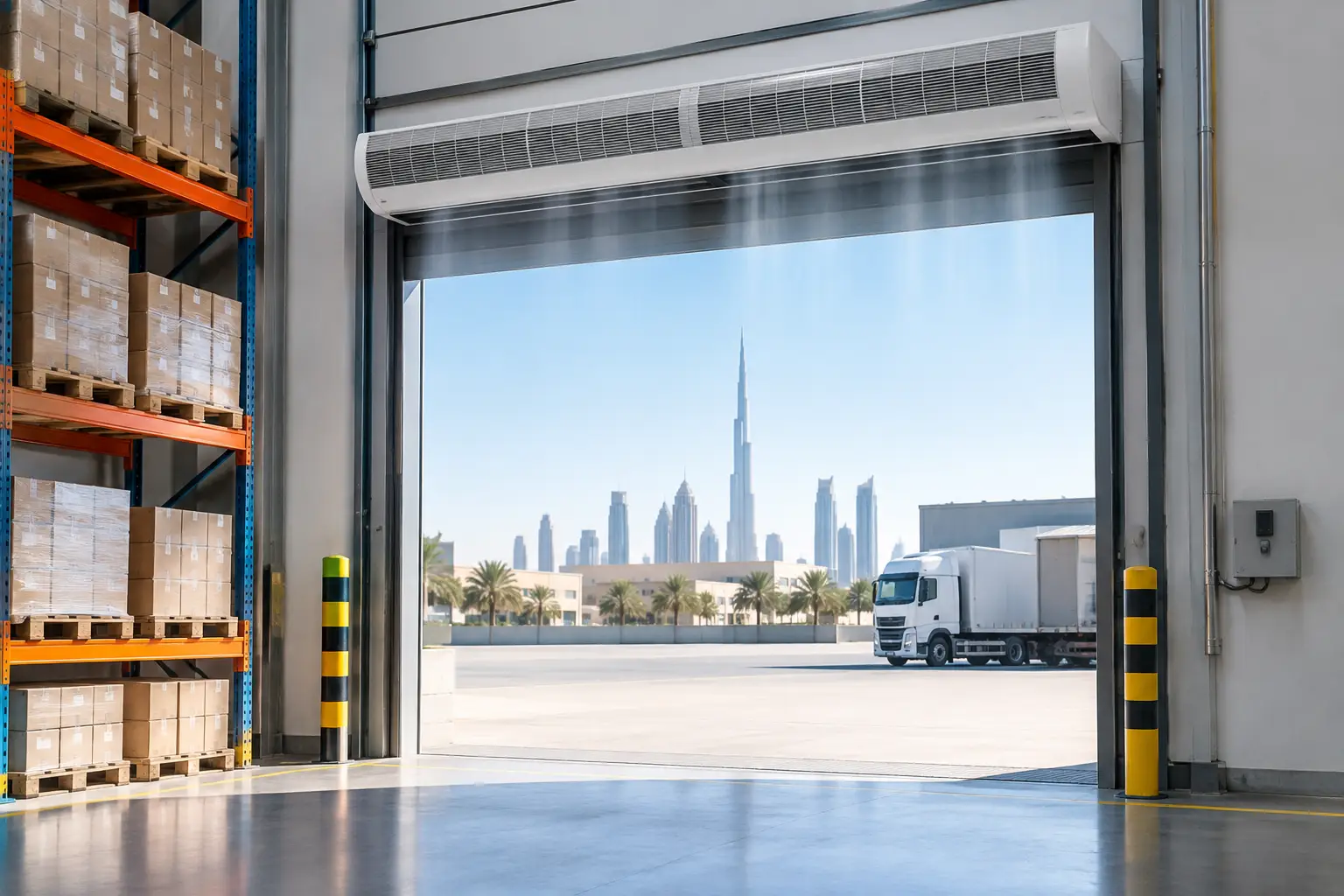
In industrial settings, the same logic applies at larger or busier openings. A high-performance air curtain can support the door system by limiting infiltration during active use, especially when forklifts, carts, or repeated staff movement make full closure intervals less effective.
The key is proper application design. Oversimplifying the choice usually leads to overspending on the wrong entrance solution or underperforming at the threshold.
How to choose the right system for your facility
Start with traffic frequency. If the doorway opens occasionally, an automatic door may be enough. If it opens constantly, an air curtain deserves serious consideration.
Then look at the environment outside the opening. If the site faces high heat, humidity, dust, insects, or pressure-driven air infiltration, the case for air curtains becomes stronger.
Next, consider what moves through the opening. Pedestrians only is one scenario. Shopping carts, housekeeping trolleys, pallets, and industrial handling equipment change the requirement.
Finally, think in operational terms, not just product terms. Are you trying to improve customer comfort at the front entrance, reduce HVAC loss, protect a conditioned workspace, support hygiene control, or stabilize a cold room threshold? Different goals point to different specifications.
That is why consultation matters. Entrance width, mounting height, usage pattern, and climate exposure all affect performance. A generic answer is rarely the right one for a commercial or industrial site in hot-weather markets.
If you are evaluating air curtains vs automatic doors for a project in the GCC, MENA, or Africa, the best next step is to assess the opening conditions before specifying equipment. FreezeeX supports contractors, consultants, and facility teams with application-based recommendations and quote-ready guidance built for tropical and desert climate performance. If you need the right entrance control solution for your facility, request a consultation and quote based on your actual traffic, opening size, and operating environment.
One Response