
A door opening that looks simple on a drawing can become the biggest source of cooling loss in the building. In hot, humid, and dusty markets, knowing how to specify entrance air barriers correctly is not a minor detail. It affects HVAC load, indoor comfort, hygiene, and how well the entrance performs under constant traffic.
For consultants, contractors, and facility teams, the mistake is usually the same: treating the entrance as a generic opening and the air barrier as a generic accessory. It is not. The right specification depends on door geometry, traffic pattern, pressure conditions, and the climate the unit must work against. A retail entry in Dubai, a hypermarket loading point in Riyadh, and a food processing door in Lagos do not need the same machine or the same performance criteria.
What an entrance air barrier needs to do
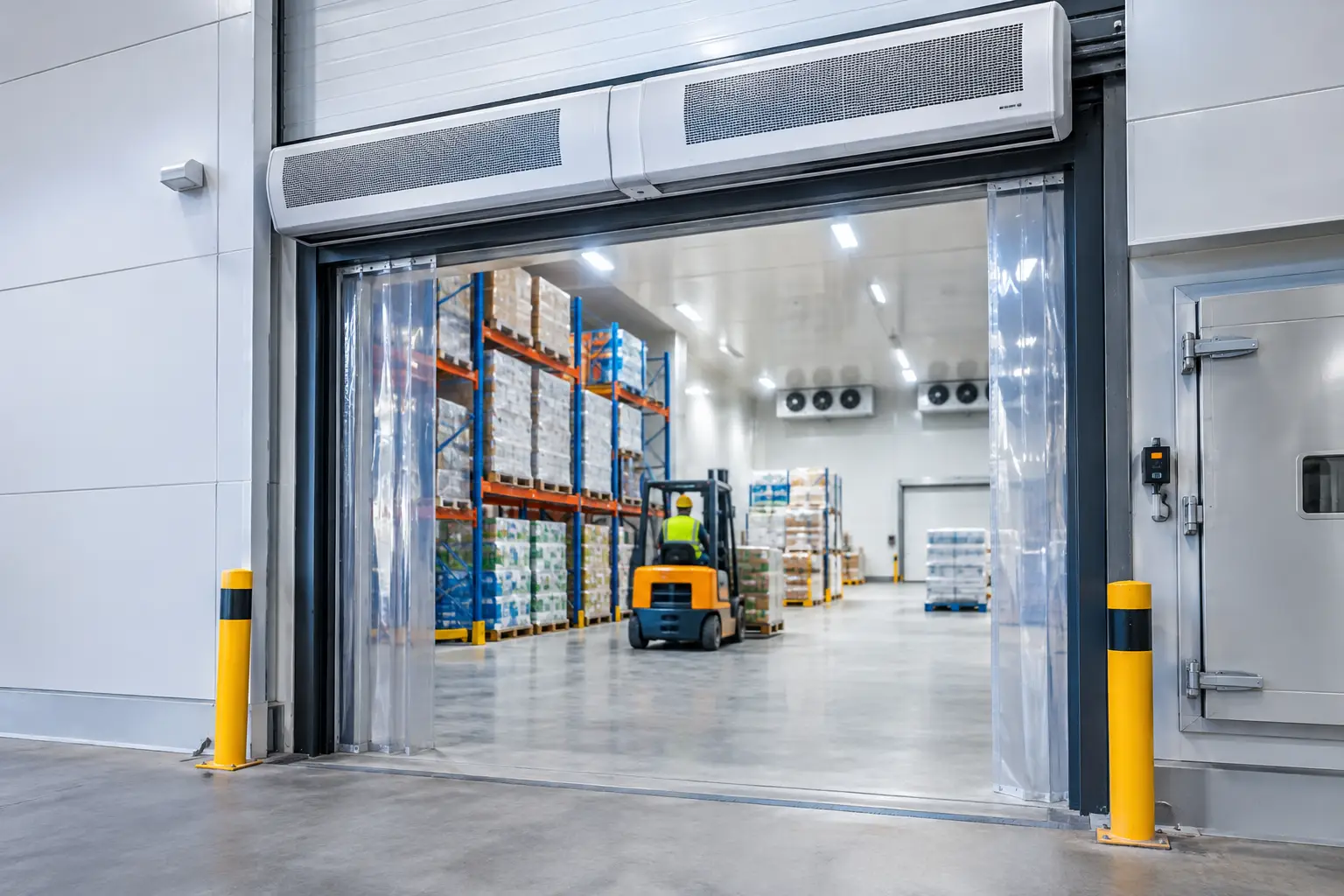
An entrance air barrier is specified to control infiltration at an open doorway. That sounds straightforward, but the actual performance target can vary. In one project, the priority is reducing conditioned air loss. In another, it is stopping dust and insects. In a cold room interface, the focus may be humidity control and minimizing condensation risk around the opening.
That is why a good specification starts with the operational problem, not the product catalog. If the opening serves a hotel lobby, appearance and noise will carry more weight. If it serves a warehouse or industrial bay, throw distance, motor strength, and casing durability may matter more than aesthetics. The equipment has to match the use case, not just the dimensions.
How to specify entrance air barriers by opening type
The first step is to define the opening accurately. Width and height are obvious, but they are not enough on their own. You also need to know whether the door is sliding, hinged, revolving-adjacent, or permanently open during trading hours. A high-traffic entrance with frequent door cycling behaves very differently from a service entrance that opens in short intervals.
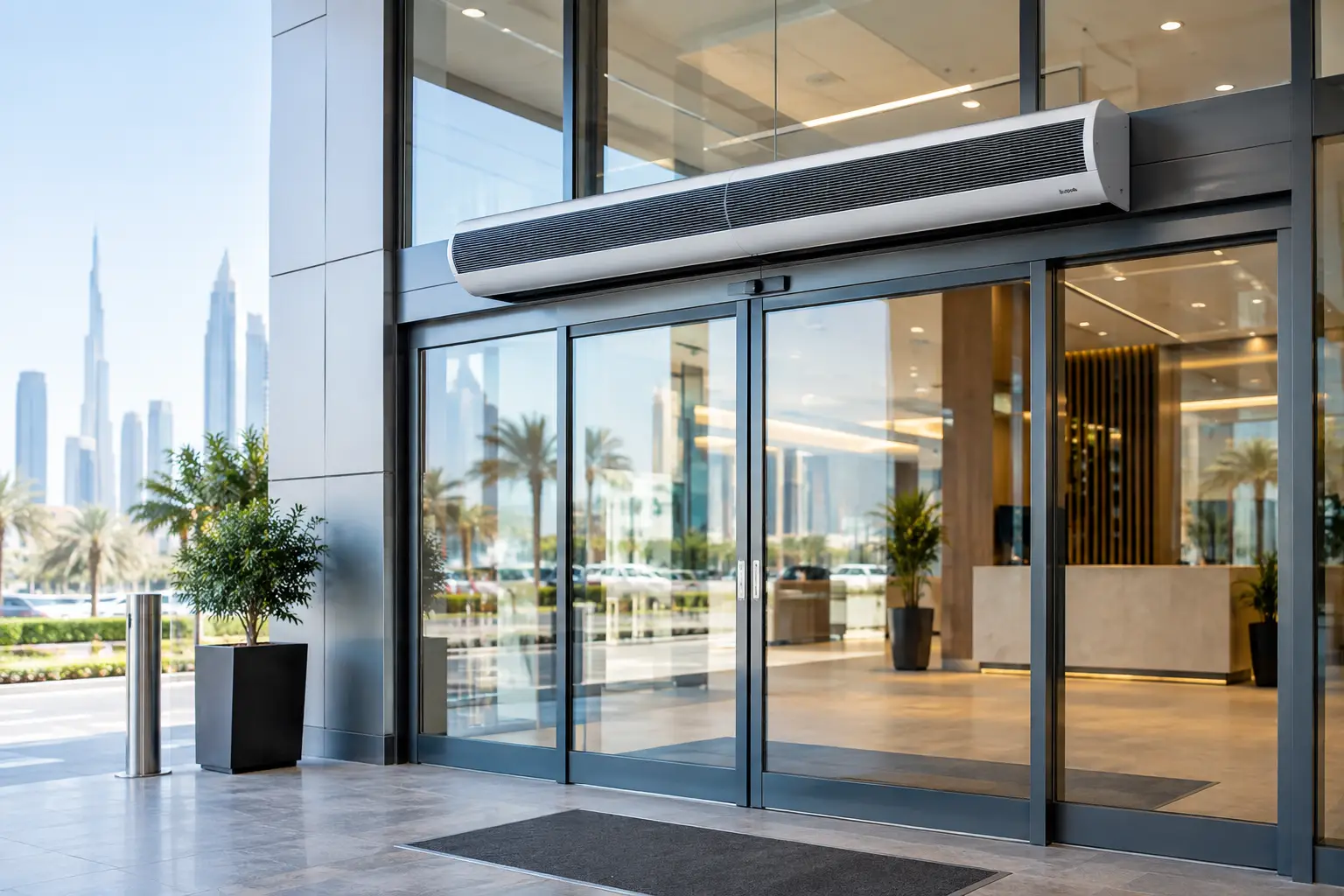
Mounting position matters just as much. Most entrance air barriers are mounted horizontally above the opening, but some applications require vertical units mounted at the sides. If there is limited headroom, recessed ceiling models may be the better answer. If the entrance is architecturally exposed, the visual integration of the unit needs to be part of the specification from the start, not fixed later on site.
The key question is whether the air stream can reach the floor or the opposing side of the opening with enough velocity to hold the barrier line. If it cannot, the unit may run continuously and still fail to control infiltration.
Door height changes everything
As door height increases, performance demands rise quickly. A compact commercial unit that works well over a standard entrance may be the wrong choice for a taller vestibule-free opening. Specifiers should avoid selecting by width alone. Height determines the required throw, fan configuration, and discharge performance.
This is where under-specification causes real operating cost. If the air stream loses strength before it reaches the occupied zone, hot outside air, humidity, dust, and insects will still pass through. The HVAC system then compensates for a problem the entrance should have controlled.
Traffic intensity affects control strategy
A low-traffic office entrance can often work with simpler control logic. A busy supermarket, logistics point, or hospitality entrance usually cannot. At high traffic volumes, the unit may need door-linked operation, staged fan speed, or integration with the building management approach to keep the barrier effective without creating unnecessary noise or energy use.
There is always a trade-off. More air volume can improve separation, but if velocity is excessive for the application, occupant comfort can suffer near the doorway. That balance needs to be considered at specification stage.
Airflow, velocity, and throw are the real selection criteria
When teams ask how to specify entrance air barriers, the most useful answer is this: specify performance, not just model size. The critical values are airflow volume, discharge velocity, and effective throw across the full opening.
A unit needs enough air volume to create a continuous stream and enough velocity to resist outside air movement. In desert and tropical climates, that outside movement is often stronger than many standard schedules assume. Wind, stack effect, pressure imbalance, and frequent entry traffic all work against the barrier. If the building is negatively pressurized near the entrance, the air barrier has to fight a harder battle.
Blower type also matters. Commercial centrifugal systems are often preferred where controlled, stable airflow is needed across wider openings. Industrial centrifugal designs are better suited to tougher duty, larger doors, and harsher environments. For premium commercial settings, low-noise high-performance systems may be necessary where appearance and occupant experience carry equal weight with performance.
Specifiers should also review the manufacturer performance data in relation to actual mounting height. Rated airflow alone can be misleading if it is not tied to installation conditions.
Climate conditions should be part of the specification
In the Gulf, North Africa, and many African commercial markets, entrance performance is shaped by heat, humidity, airborne dust, and insect pressure. This is not the same as specifying for mild climates. Equipment selection should reflect the environment it will face every day.
In humid locations such as coastal hospitality and retail sites, moisture control becomes part of the entrance strategy. The wrong unit may reduce some air exchange but still allow enough humid air infiltration to increase latent load and discomfort near the entrance. In dusty industrial zones or logistics sites, casing durability, motor protection, and service access become more important.
This is one reason climate-adapted product selection matters. Equipment built for tropical and desert climate performance is more likely to deliver stable results under the operating conditions common in places like Doha, Muscat, Cairo, Nairobi, and Lagos.
Controls, noise, and installation details
A strong specification does not stop at airflow. It should define how the unit will operate and how it will be installed. Door contact activation, multiple fan speeds, and coordinated control with the door operation can all improve efficiency. A unit running at full output all day may not be the smartest answer, especially where traffic varies by hour.
Noise level is another point often missed until late in the project. In hospitality, offices, healthcare-adjacent commercial spaces, and premium retail, the acoustic profile matters. In workshops and industrial sites, noise may be less sensitive, but maintainability and mechanical endurance move higher on the list.
Installation details should cover mounting height, fixing method, electrical requirements, service clearances, and whether the discharge line is obstructed by signage, beams, lighting, or architectural trims. Even a well-selected unit can underperform if site conditions disturb the air stream.
Common specification mistakes
The most common mistake is choosing a unit only by door width. The second is ignoring pressure conditions around the entrance. The third is failing to define the application target clearly. Energy saving, dust control, insect exclusion, and humidity reduction overlap, but they are not identical objectives.
Another problem is assuming every commercial entrance needs the same air barrier category. A recessed unit may be right for an upscale lobby but wrong for a rough service opening. An industrial-duty model may be excellent for a plant entrance but inappropriate where aesthetics and low sound levels are critical.
Finally, some schedules leave out service considerations. Filter access, cleaning needs, and maintenance access can affect long-term performance just as much as day-one selection.
A better way to write the specification
A useful specification describes the opening, mounting arrangement, climate exposure, traffic profile, and performance objective. It should state the required coverage across the full opening and confirm that the selected unit is suitable for the actual mounting height. It should also define the control sequence, electrical characteristics, finish requirements where relevant, and any acoustic or environmental constraints.
For larger projects, it is worth asking for application-specific selection support rather than relying on generic schedules. That is especially true for hypermarkets, cold storage interfaces, hotels, factories, and logistics sites where entrances have very different operating patterns.
FreezeeX works with consultants, contractors, and facility teams that need entrance air barrier selection tied to real site conditions, especially in hot-weather and high-load environments. If you are specifying for a commercial or industrial opening and want the right unit category, performance match, and quotation support, request a consultation and get the selection aligned before procurement locks in the wrong equipment.




4 Responses
That’s an important consideration during specification. Door height, width, traffic pattern, and entrance layout all influence performance. An air curtain that works well for a narrow retail doorway may not deliver the same results at a wide hospitality entrance or an opening with different airflow and access conditions.
Thank you for your thoughtful observation. Selecting an air curtain based on factors such as mounting height, entrance dimensions, door configuration, and site conditions is essential for achieving effective performance. A properly specified system provides a more reliable air barrier, helping improve energy efficiency and indoor environmental control.