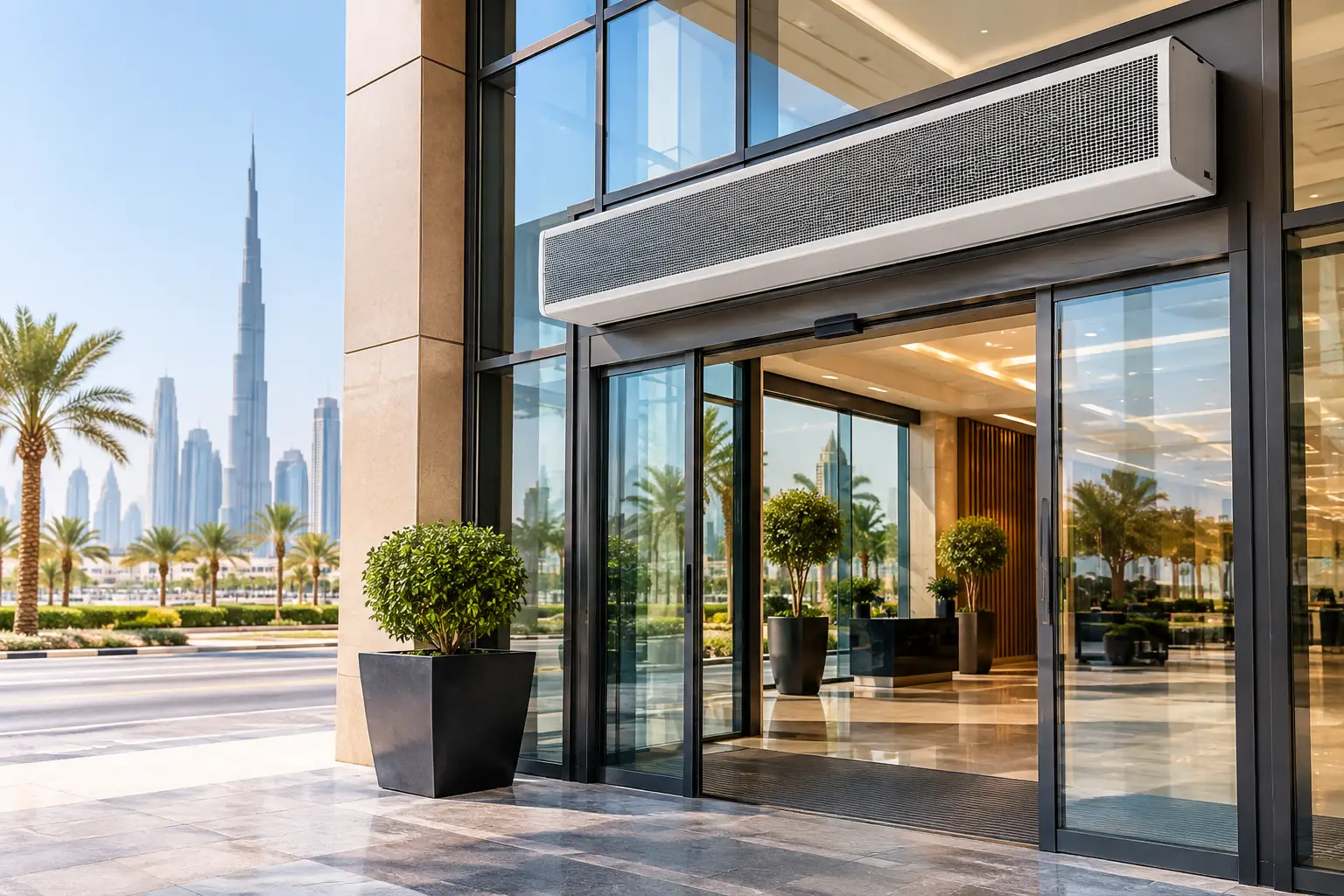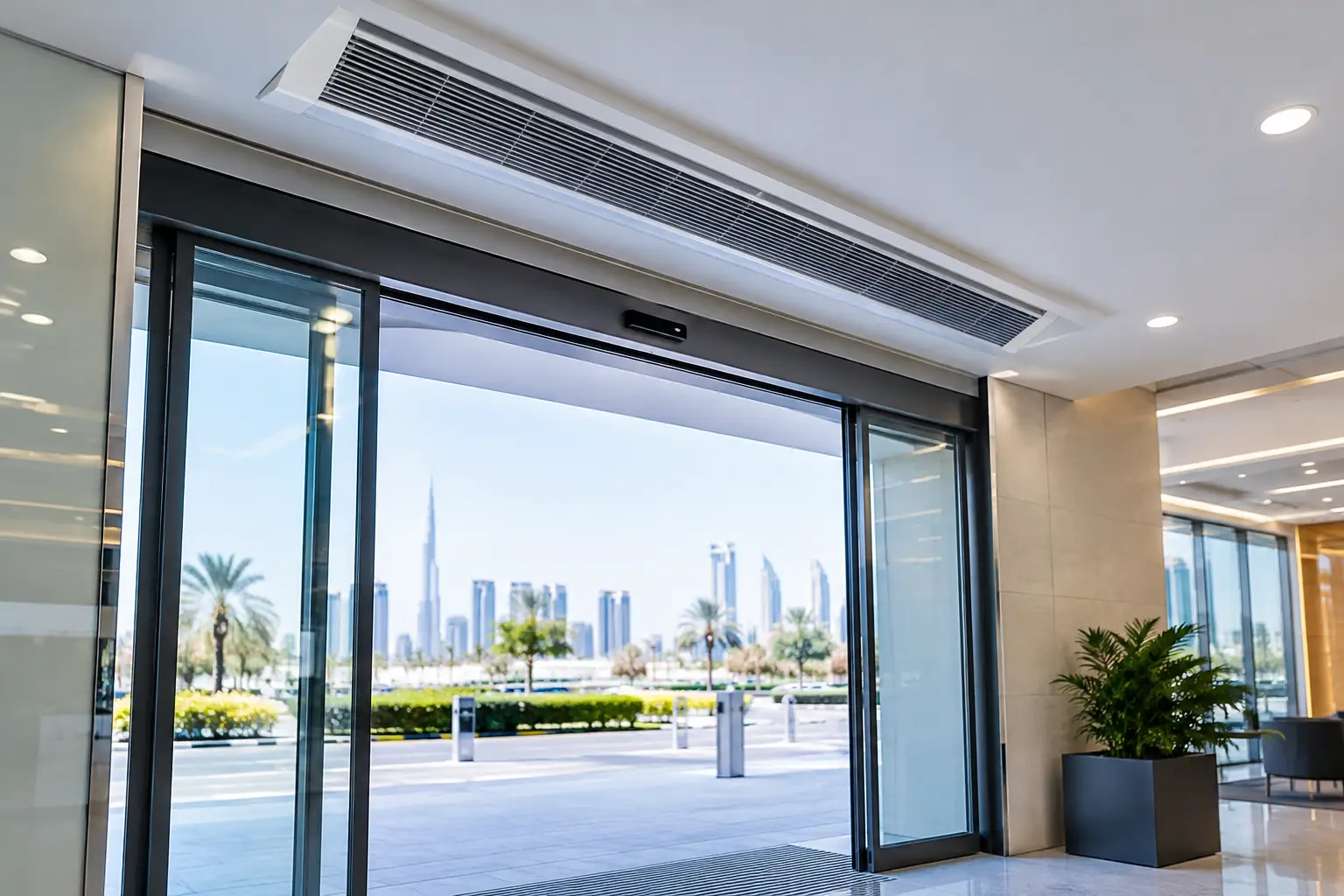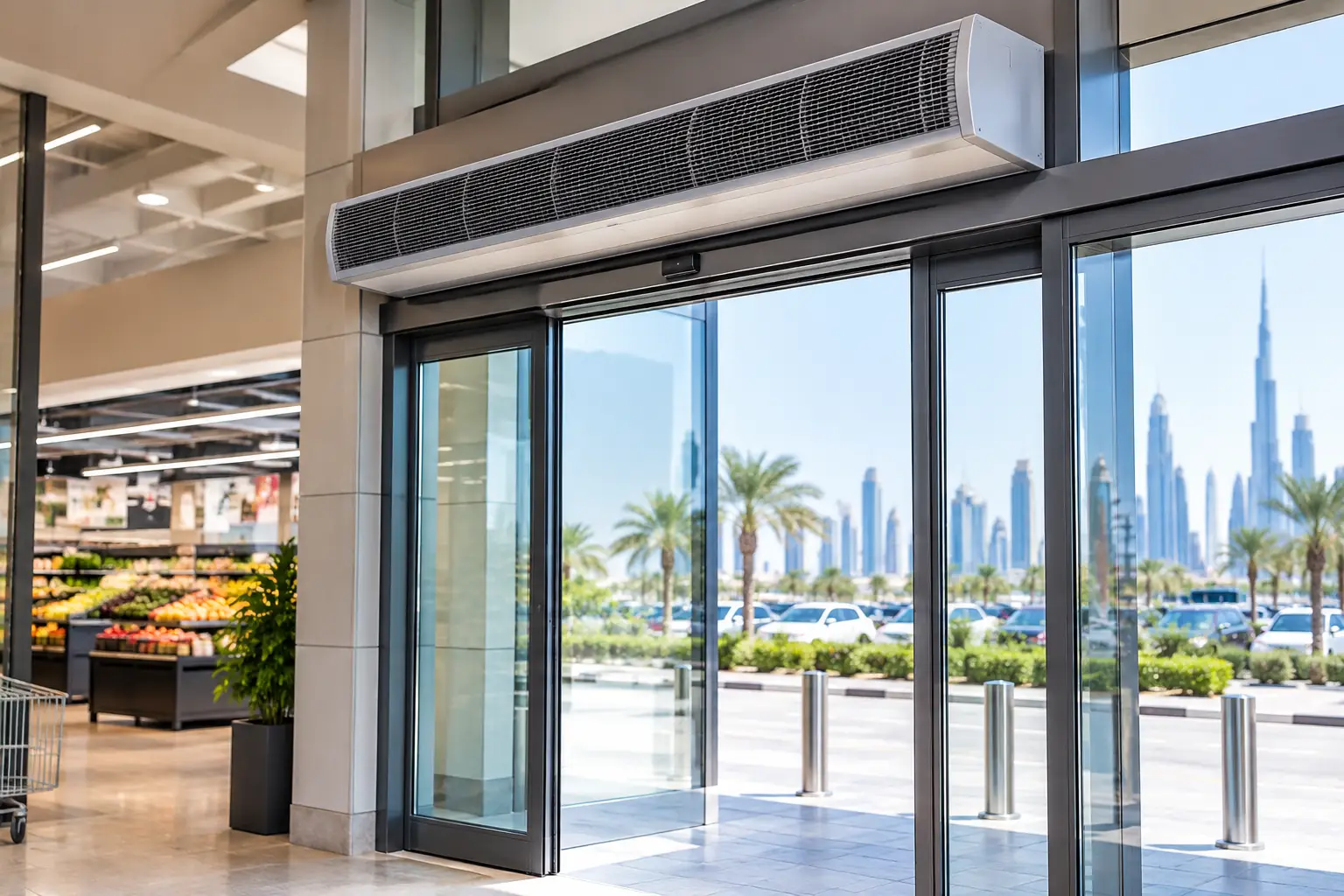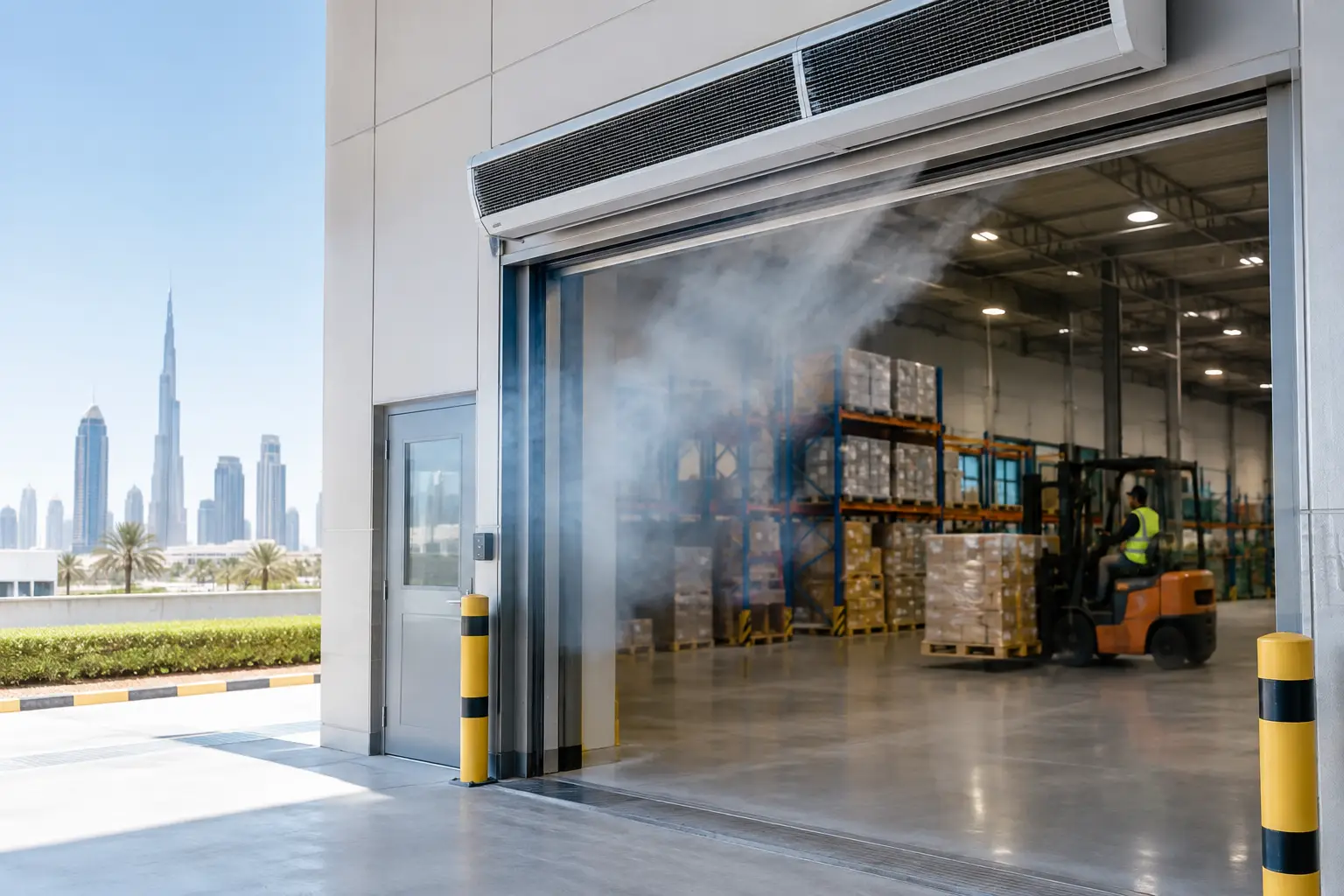
A loading door left open for two minutes can introduce more than warm air. In Dubai, Riyadh, Lagos, or Nairobi, it can bring in heat, moisture, dust, insects, and a sudden spike in HVAC demand. This entrance climate control guide is built for facility teams that need to protect indoor conditions without slowing down people, deliveries, or operations.
For commercial and industrial sites, the entrance is often the weakest point in the building envelope. A well-selected air curtain creates a controlled, high-velocity air barrier across that opening. The result is stronger cooling retention, cleaner interiors, better comfort near entrances, and lower pressure on the cooling system.
Why Entrance Climate Control Fails at the Door
Most facilities control temperature inside the building and overlook what happens at the threshold. That approach works poorly where doors open frequently, openings are wide, or outdoor conditions are severe. Conditioned air escapes at low levels while hot outdoor air, airborne dust, and humidity move inside through the same opening.
The problem becomes more expensive when the entrance connects directly to a customer area, cold room, production zone, warehouse, or food-handling space. A hypermarket entrance may feel uncomfortable and dusty. A hotel lobby may struggle to maintain a consistent first impression. A cold storage operation can face condensation, temperature instability, and higher refrigeration load. In each case, the door is not a minor detail. It is an operating condition.
Air curtains are designed to address this condition, but they are not all interchangeable. A compact unit above a narrow office doorway cannot provide the air volume, throw, or durability required at a high-bay workshop entrance or a constantly active loading dock.
Entrance Climate Control Guide: Start With the Opening
The correct specification begins with the physical opening, not a preferred model or a price point. Measure the clear width and mounting height, then consider the real operating pattern. A door that opens occasionally for staff traffic requires a different approach from a roller shutter used by forklifts throughout the day.
Mounting height is especially critical. As height increases, the air stream needs enough velocity and stability to reach the floor and maintain separation. If the discharge air breaks apart before it reaches the threshold, hot air and contaminants can pass underneath. Wide entrances may also need multiple units arranged continuously so there are no weak gaps along the opening.
The next question is what happens on both sides of the door. A conditioned retail floor facing a hot, dusty parking area has different requirements than a cold storage doorway adjoining a humid warehouse. Pressure differences, wind exposure, nearby exhaust systems, and air-conditioned zones all affect performance.
A proper site assessment should account for:
- Opening width, height, and door type
- Frequency and duration of door openings
- Outdoor heat, humidity, dust, and insect pressure
- Wind exposure and building pressure balance
- Required noise level in the occupied area
- Available electrical supply, mounting space, and controls
These details determine airflow capacity, fan technology, discharge configuration, and control strategy. Skipping them often leads to an air curtain that runs continuously but delivers limited isolation.
Match the Unit to the Facility Environment
Commercial entrances need a balance of performance, appearance, and noise control. Hotels, offices, pharmacies, showrooms, and retail sites commonly benefit from commercial air curtains with a refined exterior and controlled sound profile. Recessed ceiling models can be effective where architects require a clean visual line while the facility still needs continuous protection at the entrance.
For busy retail doors and public-facing facilities, centrifugal-flow systems are often selected for stronger, more directed air delivery. They are suited to locations where the unit must operate for long periods and maintain an effective barrier despite frequent pedestrian traffic.
Industrial sites demand a different standard. Workshops, plants, logistics areas, and loading entrances may have greater mounting heights, wider shutters, airborne contaminants, and constant vehicle movement. Industrial centrifugal units are better suited to these conditions because the application requires higher air volume, greater throw, and durable construction for heavy-duty operation.
Cold storage and temperature-sensitive operations require especially careful selection. The aim is not only to reduce cooling loss. The air curtain must help limit humid air infiltration that can contribute to condensation, frost-related operational issues, and unstable temperatures near the doorway. Door cycles, temperature differential, and the arrangement of the storage area all matter when defining the solution.
Airflow Is the Performance Variable That Matters Most
Air curtain performance is frequently described in terms of motor power or physical size. Those figures alone do not define whether the unit will protect the entrance. The decisive factor is the quality of the airflow curtain at the opening.
A useful air barrier must be uniform across the full width, directed correctly, and strong enough to resist disruption from temperature differences and external air movement. The discharge angle also matters. In a hot climate, a slight outward angle may help counter incoming heat, but excessive angle can create turbulence and reduce floor coverage. This should be set during commissioning, based on the actual site conditions.
Fan design influences both airflow performance and operating characteristics. Centrifugal blowers are commonly preferred for demanding commercial and industrial applications because they can produce the pressure and directed throw needed for taller or more exposed openings. The right design, however, still depends on the entrance. Oversizing can create unnecessary noise and energy use, while undersizing leaves the facility exposed.
For this reason, facility managers should evaluate air velocity, air volume, throw distance, sound level, and duty rating together. A specification that looks strong on one data point may still be wrong for the door.
Controls Should Follow Door Activity
An air curtain should support operations, not become another system that staff must manage manually. Controls can be selected around the way the entrance is used. A pedestrian entrance may operate during business hours with adjustable speed settings. A warehouse shutter may use a door contact so the unit activates when the door opens and reduces operation when it closes.
Variable-speed control is useful where traffic changes throughout the day. It allows the facility to use a lower setting during quiet periods and increase airflow when the entrance is active or outdoor conditions become harsher. This can reduce unnecessary electrical consumption without compromising protection when it is needed.
Control integration also needs practical thinking. If a door remains open for extended periods due to loading activity, the air curtain should be configured for sustained operation within its duty capability. If the opening is only used briefly, automatic activation can avoid wasted runtime. The best choice depends on the process, not a one-size-fits-all control package.
Plan for Desert Heat, Tropical Humidity, and Dust
Air curtain selection in the GCC, MENA, and African markets cannot rely on mild-climate assumptions. Desert locations bring intense heat and dust loading. Tropical and coastal locations add high humidity, which can make indoor comfort harder to maintain and increase moisture concerns around cooled spaces.
In these environments, the air curtain is part of the facility’s climate-defense strategy. It helps reduce the direct entry of outdoor air at the moment the building is most vulnerable: when the door is open. It does not replace correctly sized cooling equipment, good door discipline, or building-pressure management. It makes those investments work harder by reducing uncontrolled infiltration.
Durability matters as much as output. Specify equipment designed for extended operation, with components suitable for commercial or industrial duty. Consider service access, filter-net requirements where applicable, and the reality of dust accumulation in the operating environment. A unit that cannot be maintained easily will lose performance over time.
Commissioning Determines Whether the Barrier Works
Installation is not the finish line. Commissioning is where the design is tested against the actual doorway. The contractor should verify that units cover the complete opening, airflow reaches the threshold, discharge direction is correct, and controls respond as intended.
Walk the entrance during a busy period. Look for hot drafts, dust movement, insect entry, or obvious gaps at the sides and floor line. Observe the system with the cooling equipment operating and with the door in normal use. These checks reveal issues that are not always visible on drawings.
FreezeeX supports consultants, MEP contractors, and facility operators with application-based air curtain selection for tropical and desert climates. For a new project or an underperforming entrance, request a technical consultation and quote based on your opening dimensions, traffic pattern, and indoor climate target. The right air barrier turns a constantly open door into a controlled operating boundary.