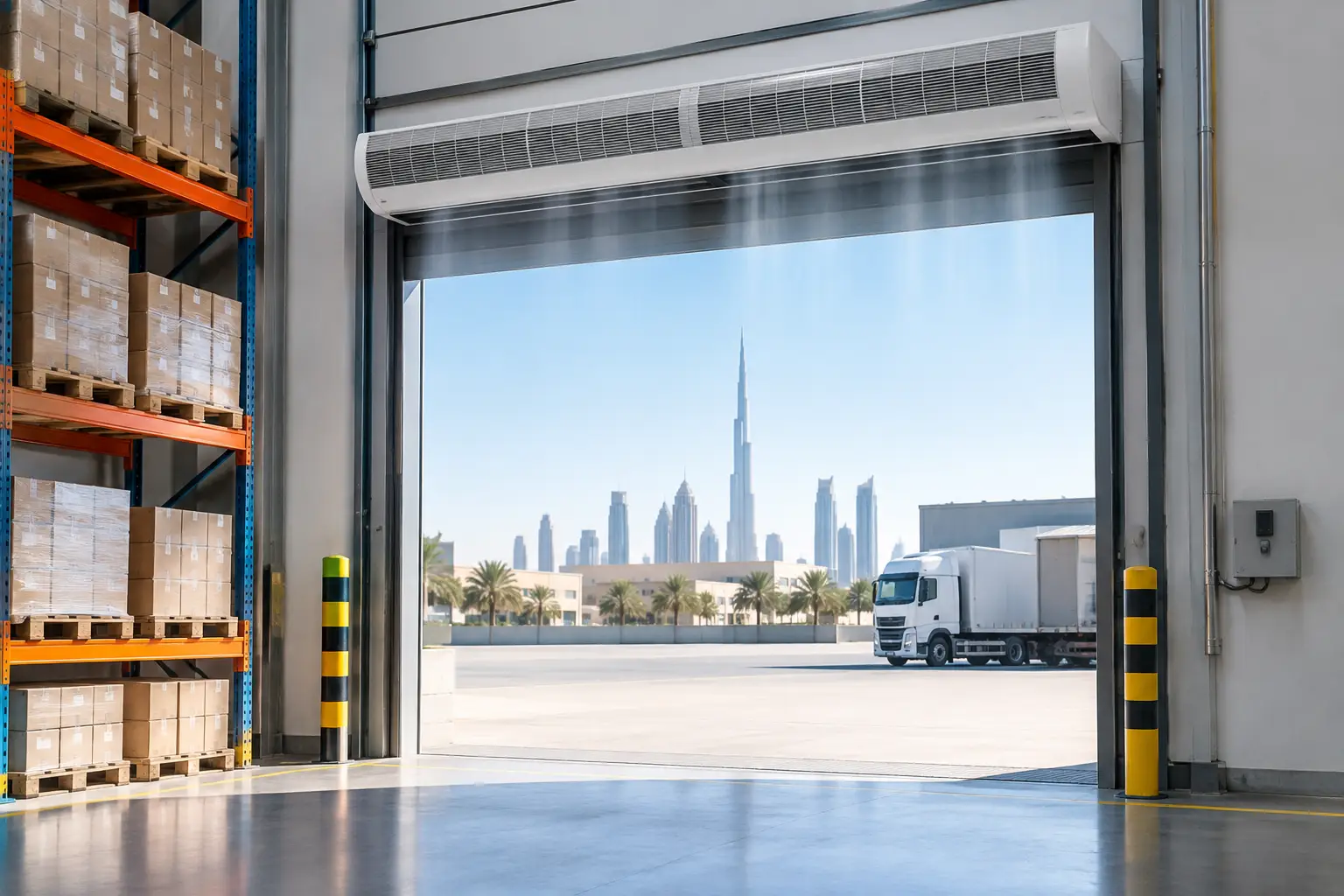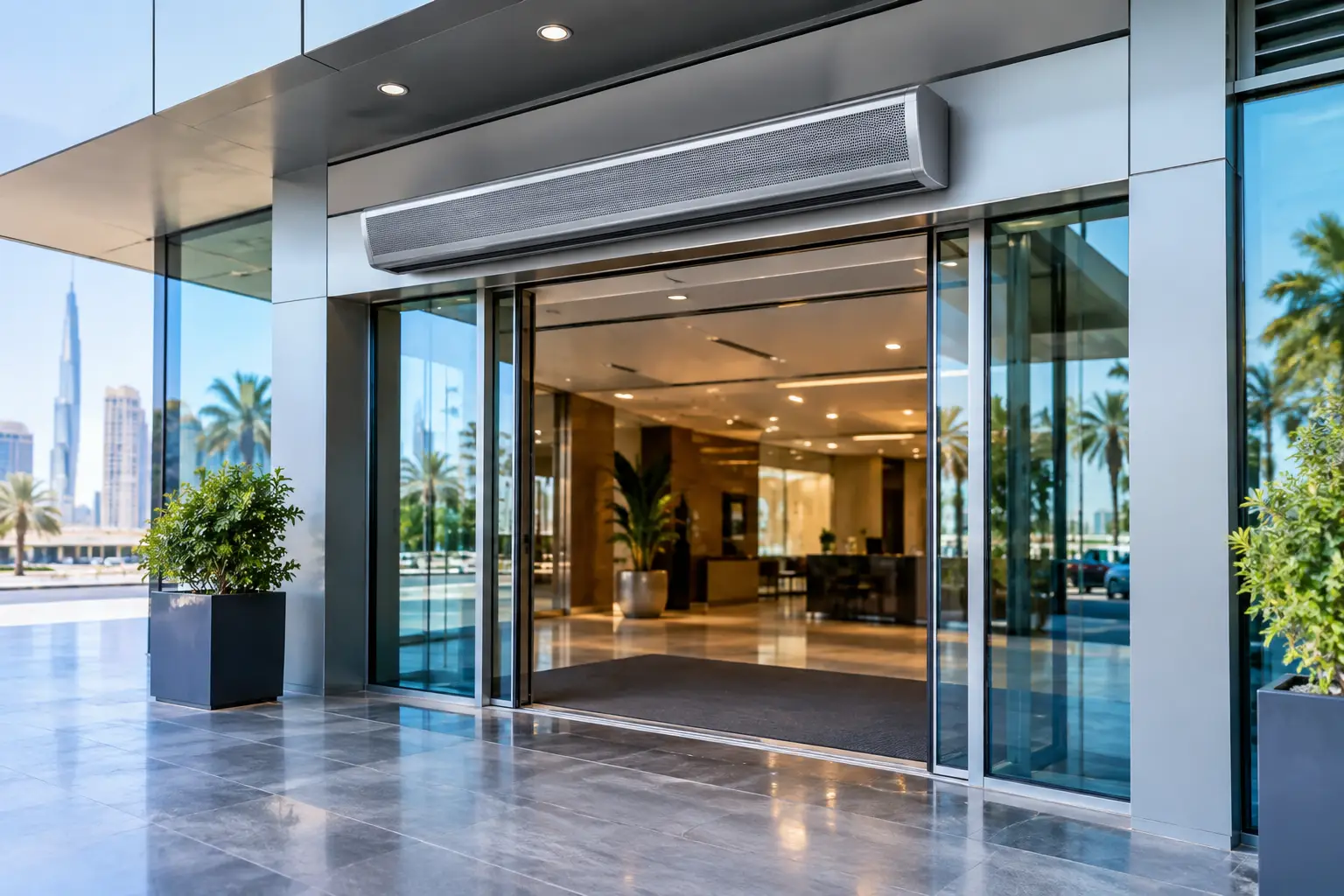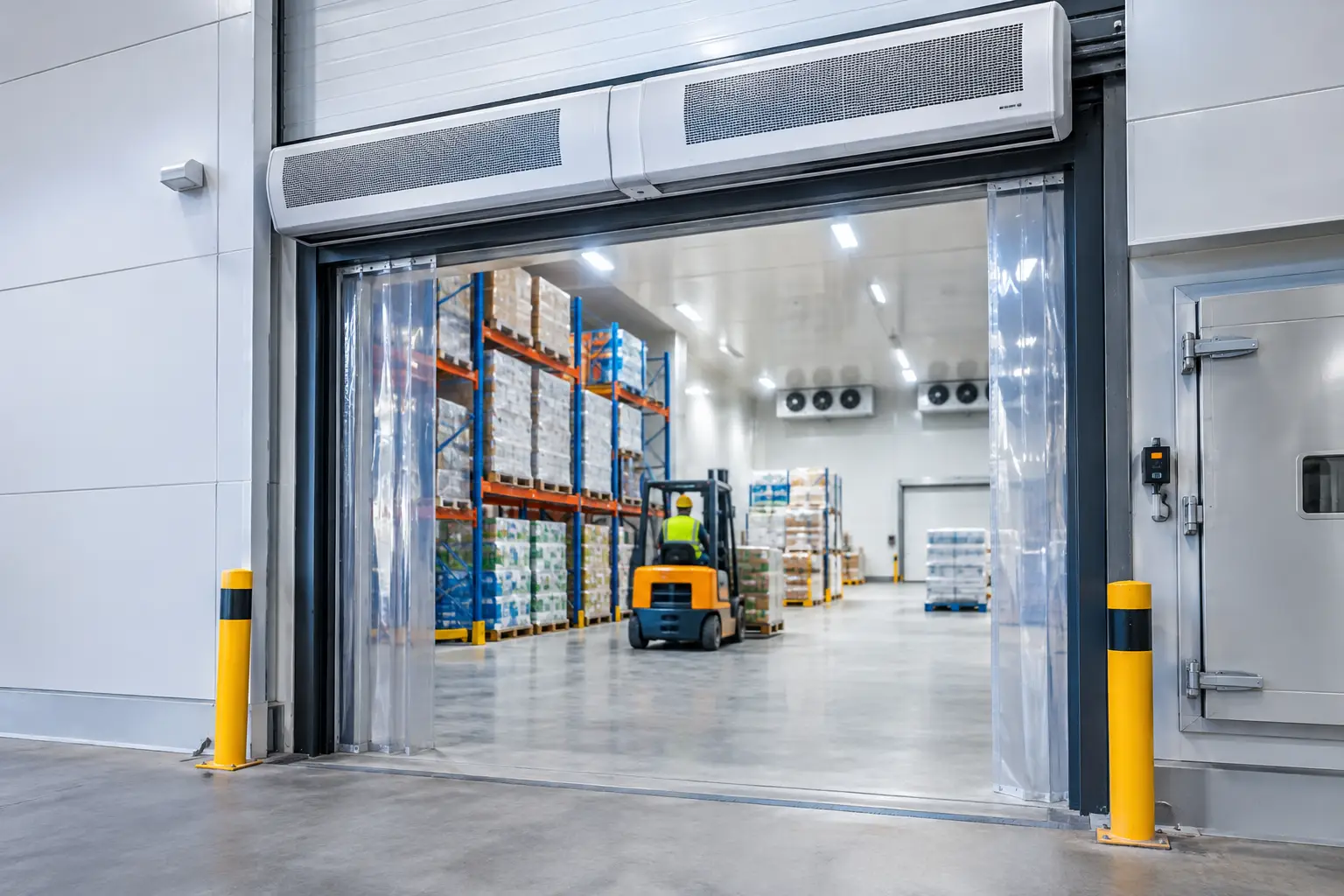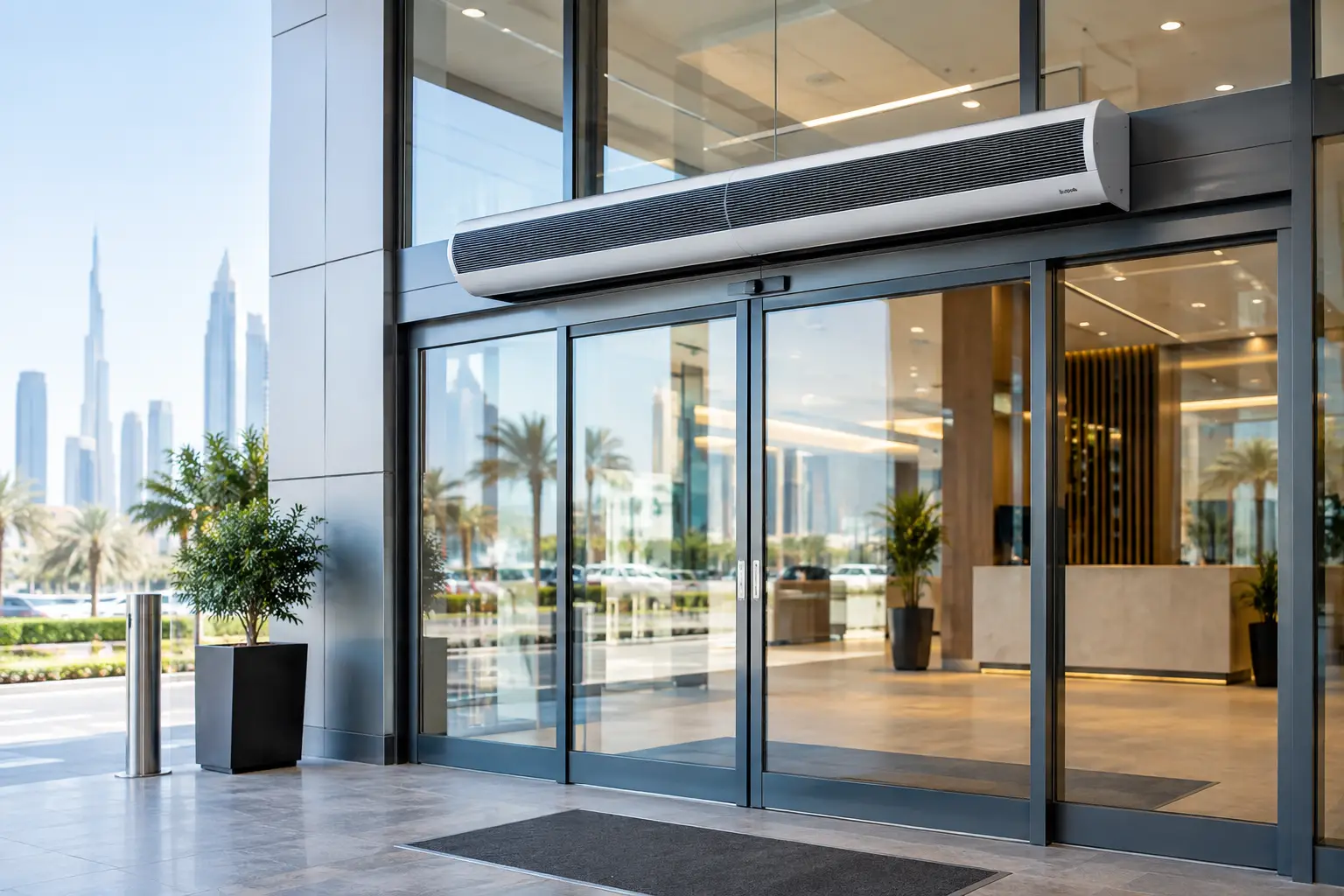
A frequently opened entrance can become one of the largest uncontrolled loads on a commercial HVAC system. At a supermarket receiving bay, warehouse dispatch door, hotel lobby, or food processing entrance, cooled air escapes while hot, humid, dusty outdoor air enters. That exchange happens every time the door opens, often hundreds of times a day. This is why facilities need air curtains: they create an active air barrier that helps separate indoor and outdoor conditions without slowing operational traffic.
For facilities operating in Dubai, Riyadh, Doha, Muscat, Cairo, Lagos, Nairobi, and other hot or tropical markets, the impact is especially significant. Outside air is not simply warmer. It may also carry humidity, dust, insects, fumes, and airborne contaminants that affect comfort, cleanliness, product handling, and HVAC demand.
Why Facilities Need Air Curtains for Entrance Control
An air curtain uses a carefully directed, high-velocity stream of air across an opening. When specified and installed correctly, this stream creates resistance to the natural movement of air between two different environments. It does not physically seal an opening like a door. Instead, it helps maintain separation while people, carts, forklifts, and deliveries continue moving through the entrance.
The operational value is straightforward. An air-conditioned facility spends energy removing heat and moisture from the indoor environment. When a door is left open, that conditioned space is exposed to a constant infiltration load. The HVAC system then has to work harder to restore the temperature and humidity setpoint. Air curtains reduce that exposure at the opening itself.
This matters at customer entrances, but it can matter even more at service doors. A busy logistics center may have large doors open for loading cycles. A restaurant may have rear access doors opened repeatedly for deliveries. A cold room or temperature-controlled production area may need to protect a much tighter indoor condition. Each application requires a different airflow strategy, but the underlying need is the same: control the opening rather than accept uncontrolled infiltration.
Lower Cooling Loss and HVAC Load
In hot desert climates, outdoor heat entering through an open doorway can quickly disrupt indoor comfort. In humid coastal or tropical areas, moisture adds another burden. The HVAC system must manage both sensible heat, which raises air temperature, and latent heat, which increases humidity. That can translate into longer equipment run times, inconsistent comfort near entrances, and higher energy consumption.
An air curtain helps reduce the amount of external air that crosses the threshold. This can support more stable internal conditions and reduce demand on the cooling system, particularly during peak traffic periods. For a retail store or hotel, that means fewer hot zones around the entrance. For an industrial facility, it can mean less temperature variation in work areas located close to loading doors.
Energy performance depends on several factors. Door dimensions, opening frequency, external wind pressure, mounting height, indoor temperature targets, and the available HVAC capacity all affect the result. An air curtain should therefore be viewed as part of an entrance climate-control strategy, not as a substitute for a correctly sized HVAC system or well-managed door operation.
The right airflow matters more than simple air volume
A unit that is too small for the opening may not project airflow to the floor or threshold, allowing outside air to pass underneath. A unit that is oversized or poorly aimed can create unnecessary noise, drafts, or turbulence. Effective air isolation depends on airflow velocity, discharge angle, throw distance, and the ability to overcome crosswinds and pressure differences.
This is why industrial doors generally require more than a standard commercial entrance unit. High mounting positions, wide openings, forklift traffic, and external wind exposure demand higher-capacity equipment, often with centrifugal airflow designed for heavier-duty conditions. Smaller retail, restaurant, and office entrances may be better suited to a commercial model that balances airflow performance with appearance and sound levels.
Protect Indoor Air From Dust, Insects, and Humidity
Cooling loss is only one reason to install an air curtain. Open entrances are also entry points for dust, sand, insects, humidity, smoke, and vehicle-related fumes. In many GCC, MENA, and African operating environments, airborne dust and sand can be a daily facility-management issue rather than an occasional event.
At a supermarket or restaurant, preventing flying insects from entering through service doors supports hygiene and customer experience. In a hospital or pharmaceutical environment, reducing uncontrolled outside-air movement helps protect cleaner internal zones. In factories and food processing facilities, minimizing dust intrusion can support housekeeping requirements and reduce cleaning demand around production or packing areas.
Air curtains do not replace site hygiene controls, filtration systems, vestibules, or pressure-control design where those measures are required. They are most effective as a practical front-line barrier at frequently used openings. The key is matching the air curtain to the risk at that entrance. A public lobby has different requirements from a high-traffic warehouse dock or a chilled product dispatch area.
Maintain Comfort Without Restricting Traffic
Facilities often face a difficult choice: keep doors closed to protect indoor conditions, or leave them open to keep customers, staff, and goods moving. Air curtains reduce that compromise. They allow access to remain practical while helping limit the climate penalty associated with an open doorway.
For hotels, malls, and retail stores, this supports a more comfortable arrival experience. Customers entering from intense outdoor heat should not immediately feel a blast of warm air moving into the conditioned space. For airports, hospitals, and other public buildings, air curtains can help stabilize entrance conditions where doors cycle continuously throughout the day.
For warehouses and factories, the benefit is operational continuity. Forklifts and goods can pass without staff having to wait for doors to close after every movement. That said, an air curtain is not automatically appropriate for every opening. If a door remains fully open for extended periods in strong wind, or if the opening is exceptionally large, the design may require additional measures such as rapid doors, dock seals, or revised traffic controls.
Application-Specific Selection Is Essential
Selecting an air curtain by door width alone is a common specification error. Width is important, but the full application determines whether the barrier will perform as intended. A proper review should consider mounting height, opening width, traffic type, indoor and outdoor temperatures, humidity, wind exposure, contamination concerns, and architectural constraints.
Key factors to consider when selecting an entrance air curtain include:
- Door width and opening height
- Door traffic frequency and operating pattern
- Indoor and outdoor temperature difference
- Humidity, dust, and other external conditions
- Required air throw and discharge velocity
- Available mounting position
- HVAC operating conditions
- Controls and maintenance requirements
For example, a recessed ceiling air curtain can suit a premium lobby or retail entry where visual integration matters. A commercial centrifugal unit may be appropriate for a high-traffic supermarket entrance that requires dependable airflow and manageable noise. Industrial centrifugal systems are typically more suitable for loading bays, manufacturing doors, and logistics facilities where mounting heights and airflow demands are greater. Dynamic air curtain configurations can be considered where the operating environment changes throughout the day and response to varying entrance conditions is valuable.
Noise should also be evaluated realistically. In a warehouse, higher sound levels may be acceptable if the application requires stronger air throw. In a reception area, restaurant, clinic, or luxury retail setting, acoustic performance may carry more weight. There is no single correct model category for every facility. The best choice is the one that delivers effective air separation within the building’s operational and architectural constraints.
Installation position affects real-world performance
Most air curtains are mounted above the opening and discharge downward. However, ceiling height, obstructions, automatic door tracks, signage, sprinklers, and structural elements can affect placement. The unit must cover the opening consistently and be positioned so the airflow reaches the threshold without being disrupted.
A professional specification should also account for maintenance access. Filters, intake areas, and internal components need practical inspection and cleaning access in dusty operating environments. Selecting a durable unit is important, but long-term performance also depends on keeping the airflow path clear and verifying that settings remain appropriate as traffic patterns change.
A Practical Investment at High-Traffic Doors
The strongest business case for air curtains usually appears where an entrance is opened repeatedly, where outside conditions are severe, or where indoor air quality and temperature control are operationally important. In these cases, the unit supports measurable facility priorities: reduced cooling loss, better comfort, lower contaminant entry, improved hygiene control, and less strain on HVAC equipment.
For project developers, consultants, and contractors, air curtains should be considered early in the design process rather than added after occupants complain about hot entrance zones or dust intrusion. Early selection makes it easier to coordinate power, mounting, controls, clearances, and architectural finishes. For existing buildings, an entrance assessment can identify whether the current problem is caused by inadequate airflow, incorrect mounting height, wind exposure, or an air curtain that was never matched to the door’s actual use.
If your facility operates in a hot, humid, tropical, or desert climate, begin with the entrance that causes the greatest cooling loss or contamination concern. Share the opening dimensions, mounting position, traffic volume, operating environment, and HVAC objectives with FreezeeX for a consultation and project-specific quotation. The right air curtain is not an accessory at the door – it is a practical control point for protecting the conditions your facility pays to maintain.