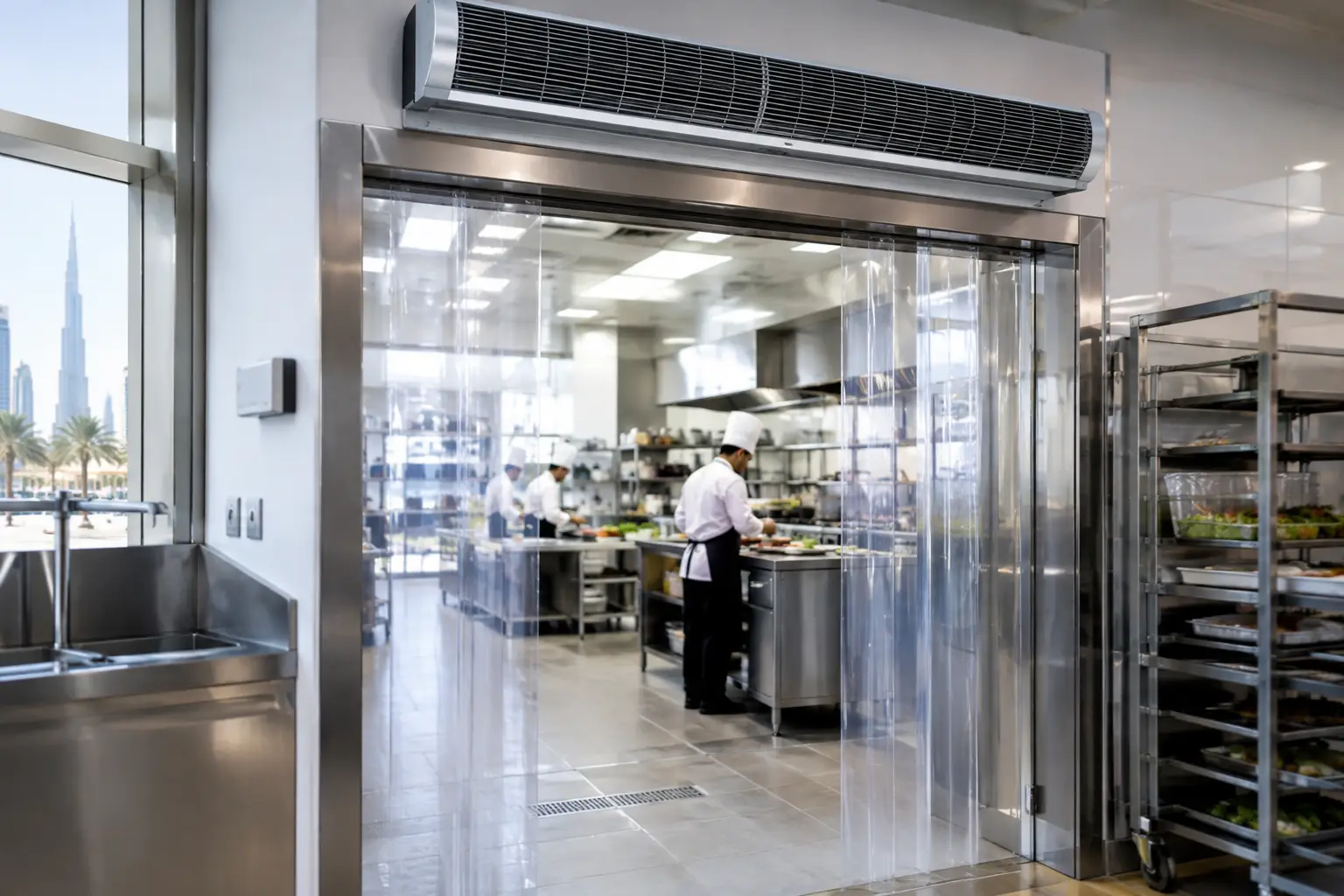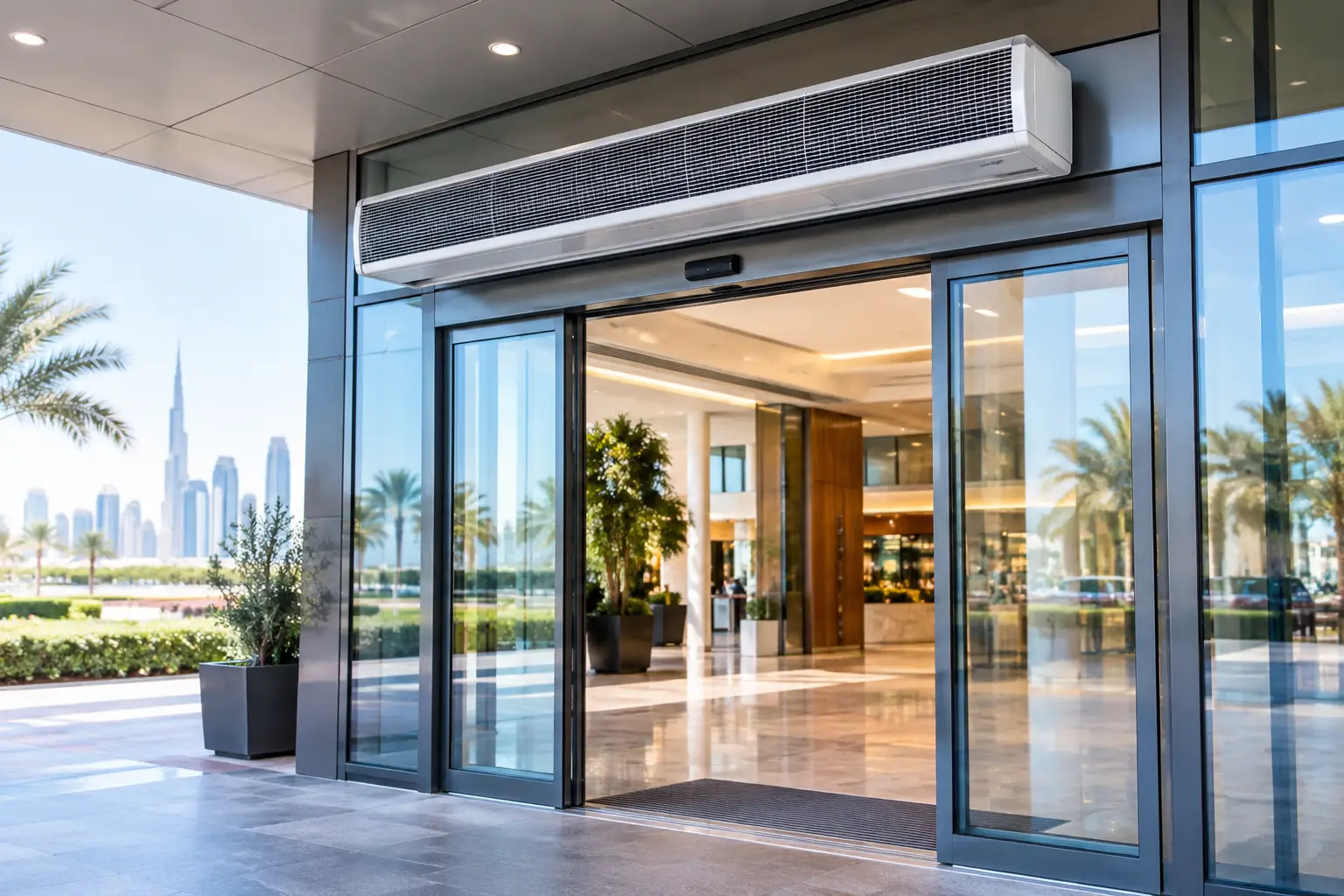
A cold-room door left open for even a short loading cycle can bring warm, humid, dusty outside air directly into a temperature-controlled operation. Cold storage air curtains create a high-velocity air barrier at that opening, helping separate two very different environments without slowing essential people, pallet, or goods movement.
For cold-chain operators in Dubai, Riyadh, Doha, Muscat, Cairo, Lagos, and other hot or humid markets, that barrier is not a cosmetic entrance feature. It is part of protecting product conditions, controlling moisture exposure, and reducing avoidable demand on refrigeration and adjacent HVAC systems.
Why are cold storage air curtains different?
A standard commercial entrance and a cold-storage doorway face different pressures. At a retail entrance, the objective is often to limit the entry of heat, dust, insects, and outdoor humidity while preserving customer comfort. At a cold room, refrigerated dispatch area, or chilled loading bay, the temperature difference can be far more severe and the consequences of uncontrolled air exchange are more immediate.
Warm air entering a cold zone carries moisture. As that air cools, condensation and frost risks can increase around openings and nearby surfaces. Refrigeration equipment must then work harder to recover the intended operating temperature. During high-traffic periods, the problem compounds quickly.
Cold storage air curtains are specified to support air isolation at these critical openings. They are not a substitute for correctly designed insulated doors, refrigeration capacity, operational controls, or cold-chain procedures. They are a practical complement when doors need to open frequently for forklifts, carts, staff, and deliveries.
What operational problems can an air barrier address?
The exact result depends on door geometry, traffic patterns, pressure conditions, and the selected unit. However, a properly specified air curtain can help operators manage several common concerns:
- Warm-air and humidity infiltration during frequent door openings
- Cooling loss between chilled spaces and warmer work or loading areas
- Dust and airborne contaminants entering from warehouses or exterior docks
- Insect entry where food handling or distribution requires better separation
- Discomfort for personnel working near openings between different temperature zones
- Unnecessary refrigeration recovery cycles after repeated access events
The business case is strongest where a doorway is opened many times per shift or held open during active loading. A rarely used, tightly managed access point may call for a different approach. This is why specification should begin with the actual operating pattern, not only the size of the door.
Where should cold storage air curtains be used?
Cold-chain facilities have more than one type of opening, and each presents a different air-control challenge. The most appropriate mounting arrangement, airflow profile, and product series depend on whether the opening connects to outdoors, a hot warehouse, a production area, or another temperature-controlled room.
| Application area | Main exposure | Air-curtain objective | |—|—|—| | Refrigerated loading bay | Outdoor heat, humidity, dust, and vehicle activity | Reduce air exchange during dispatch and receiving | | Cold-room personnel door | Frequent staff movement | Support temperature separation without interrupting access | | Chilled distribution zone | Forklift and pallet movement | Maintain a more stable transition between warehouse and cold storage | | Food processing access point | Humidity, dust, and insect exposure | Improve environmental separation around production traffic | | Pharmaceutical temperature-controlled area | Temperature drift and airborne contaminants | Support controlled access between adjoining operational zones |
In food distribution and processing, an air curtain should be considered alongside hygiene protocols, door discipline, and the facility’s wider temperature-control strategy. In pharmaceutical settings, the design team should also assess the operating requirements of the controlled area and any applicable site procedures. Air curtains support separation, but they do not replace validation requirements or specialized containment systems where those are needed.
How does the air barrier work at a cold-room opening?
An air curtain directs a controlled stream of air across the full width of an opening. When the unit is correctly sized and positioned, that stream helps resist the mixing of air from each side of the doorway. The aim is to create a barrier strong enough to reach the floor or threshold area while remaining suitable for the traffic passing beneath it.
Performance is affected by more than motor power. The installation height, doorway width, mounting position, cross-drafts, nearby exhaust or supply air, stack pressure, and frequency of opening all matter. A unit that works well above a pedestrian doorway may not be appropriate for a tall loading entrance with forklift traffic and strong external wind exposure.
Why mounting position matters
Top-mounted air curtains are common, but not every doorway allows an ideal overhead position. Structural beams, sectional doors, dock equipment, ceiling services, and clear-height limitations can affect the layout. Recessed arrangements may be considered where the ceiling design allows it, while industrial configurations are often more appropriate for demanding operational entrances.
The critical issue is not selecting a visually discreet or physically convenient location. It is ensuring the airflow can form an effective barrier over the opening under real operating conditions. A design review should include the door’s clear opening dimensions, floor level conditions, and obstructions that may deflect the air stream.
Selecting the right air curtain for cold storage
A consultation-led selection process avoids a common mistake: choosing a unit based only on the nominal door width. For a high-use cold-storage doorway, project teams should assess the complete operating environment before issuing a final recommendation.
- Define the opening and traffic. Record the clear width and height, door type, opening duration, and whether people, carts, or forklifts use the entrance.
- Map the two environments. Identify the temperature difference, humidity exposure, dust conditions, and whether the door leads outdoors, to a loading bay, or to another internal zone.
- Review airflow interference. Check for prevailing winds, dock doors, air-conditioning supply outlets, extraction points, and pressure differences that could disturb the air barrier.
- Choose the mounting approach. Confirm available overhead space, ceiling conditions, service access, and the need for a recessed, commercial, or industrial arrangement.
- Coordinate controls and operation. Consider door-status controls, operating schedules, and how the unit will align with facility traffic and refrigeration practices.
FreezeeX evaluates these conditions before recommending from its commercial and industrial air curtain ranges. For heavy-duty cold-chain access points, the requirement is often closer to an industrial application than a conventional storefront entrance. The correct choice should reflect the duty cycle and exposure, not the appearance of the opening alone.
What should facility teams ask during specification?
The best project questions are operational. Instead of asking only, “What size air curtain do we need?”, ask how the opening behaves at peak activity. Is the door open repeatedly during a morning delivery window? Does a forklift pass through it every few minutes? Is there a strong temperature and humidity difference between the loading area and the cold zone? Are nearby dock doors producing cross-drafts?
It is also worth confirming maintenance access early. Commercial and industrial air curtains need to remain accessible for inspection and routine service within the facility’s planned maintenance program. A difficult-to-reach installation can increase disruption later, especially in active food, logistics, or manufacturing environments.
For projects in desert and tropical climates, outdoor conditions deserve particular weight in the evaluation. Extreme heat, humid coastal air, windblown dust, and heavy loading activity can place greater demands on entrance climate control than a drawing alone may suggest. The air curtain must be specified for the real site, not an assumed average condition.
Air curtains support discipline, not shortcuts
Cold storage air curtains provide the greatest value when they support well-run door management. They help protect controlled spaces while keeping necessary access practical, but they cannot correct damaged door seals, prolonged unattended openings, inadequate refrigeration design, or poor loading practices.
That distinction matters for procurement teams. The right system is not simply the largest available unit. It is the solution that creates effective air isolation at the specific opening, fits the mounting constraints, and remains dependable through the facility’s daily operating cycle.
For a cold storage, food-processing, pharmaceutical, or logistics project in the GCC, MENA, or Africa, request a consultation and quotation based on your door dimensions, traffic volume, mounting conditions, and climate exposure. A site-specific recommendation will help ensure the air curtain supports both operational continuity and temperature-control performance.