A Factory Fumes Control Example: The Open Loading-Bay Problem
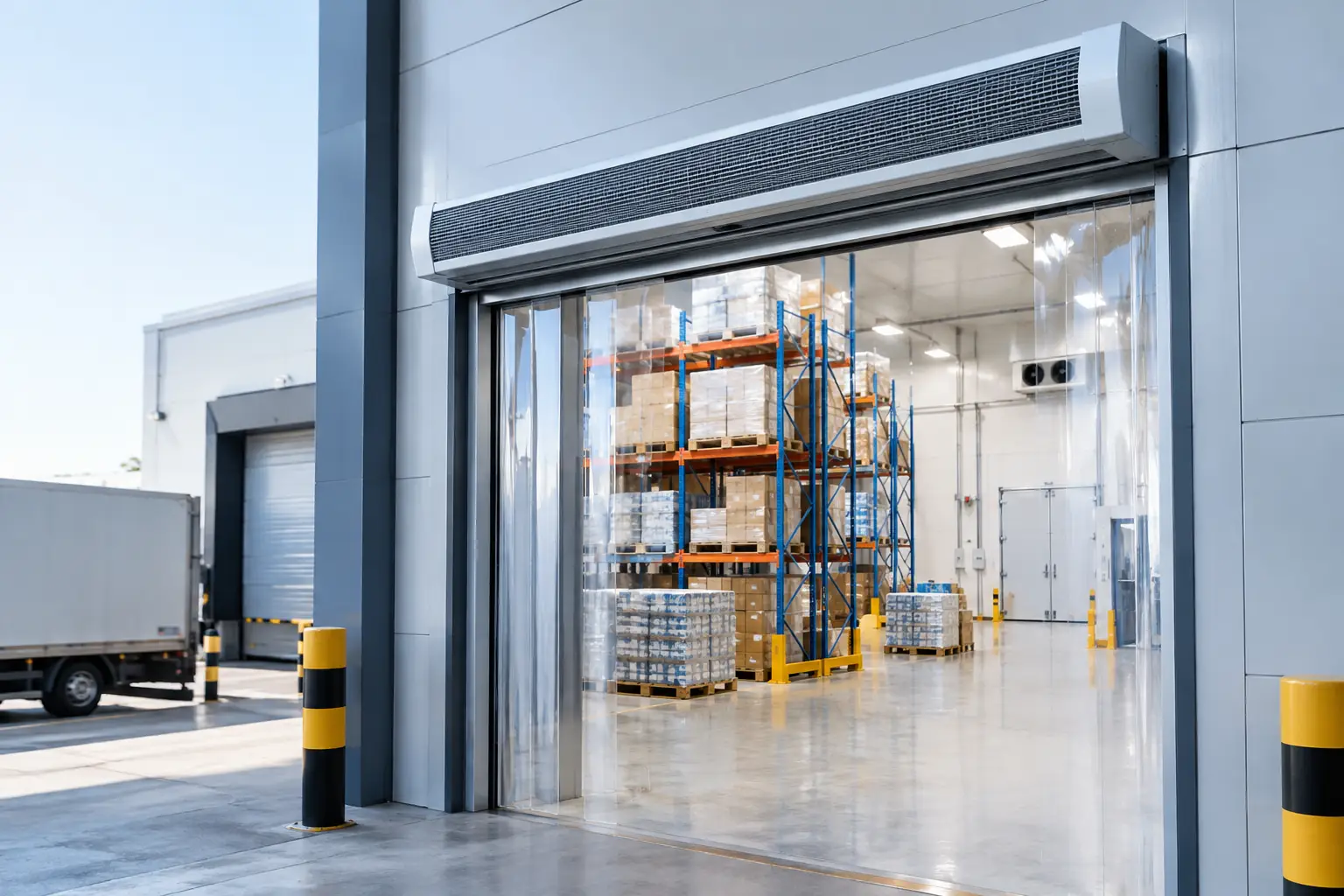
A practical factory fumes control example begins at a busy loading bay, not at the production line. A factory may have effective local extraction around welding, coating, mixing, or packaging processes, yet still experience odor, smoke, dust, and heat entering through open roller shutters. This is especially common where forklifts move continuously between a warehouse yard and an air-conditioned production or storage zone.
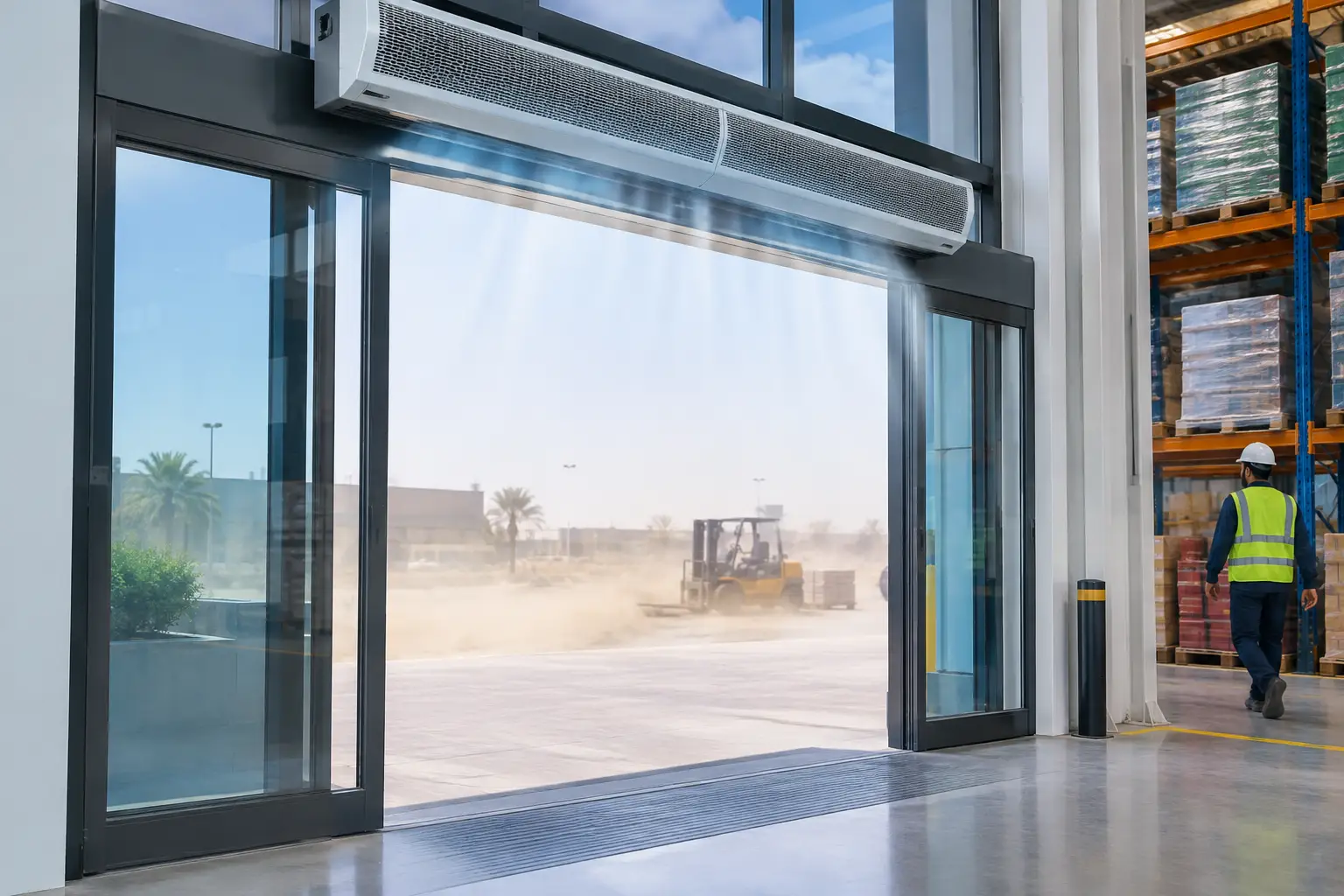
In Dubai, Riyadh, Doha, Muscat, and similar hot, dusty, or humid locations, every open industrial door becomes a pressure break in the building envelope. Outdoor air can carry vehicle exhaust, airborne dust, humidity, and neighboring-process fumes into the facility. The result is greater HVAC load, reduced indoor comfort, and a higher risk of contaminants moving toward sensitive work areas.
An industrial air curtain is not a replacement for source capture, extraction, or required ventilation design. Its role is different: it creates a directed air barrier at the doorway to limit the uncontrolled transfer of air and airborne contaminants between two zones.
The Operating Scenario
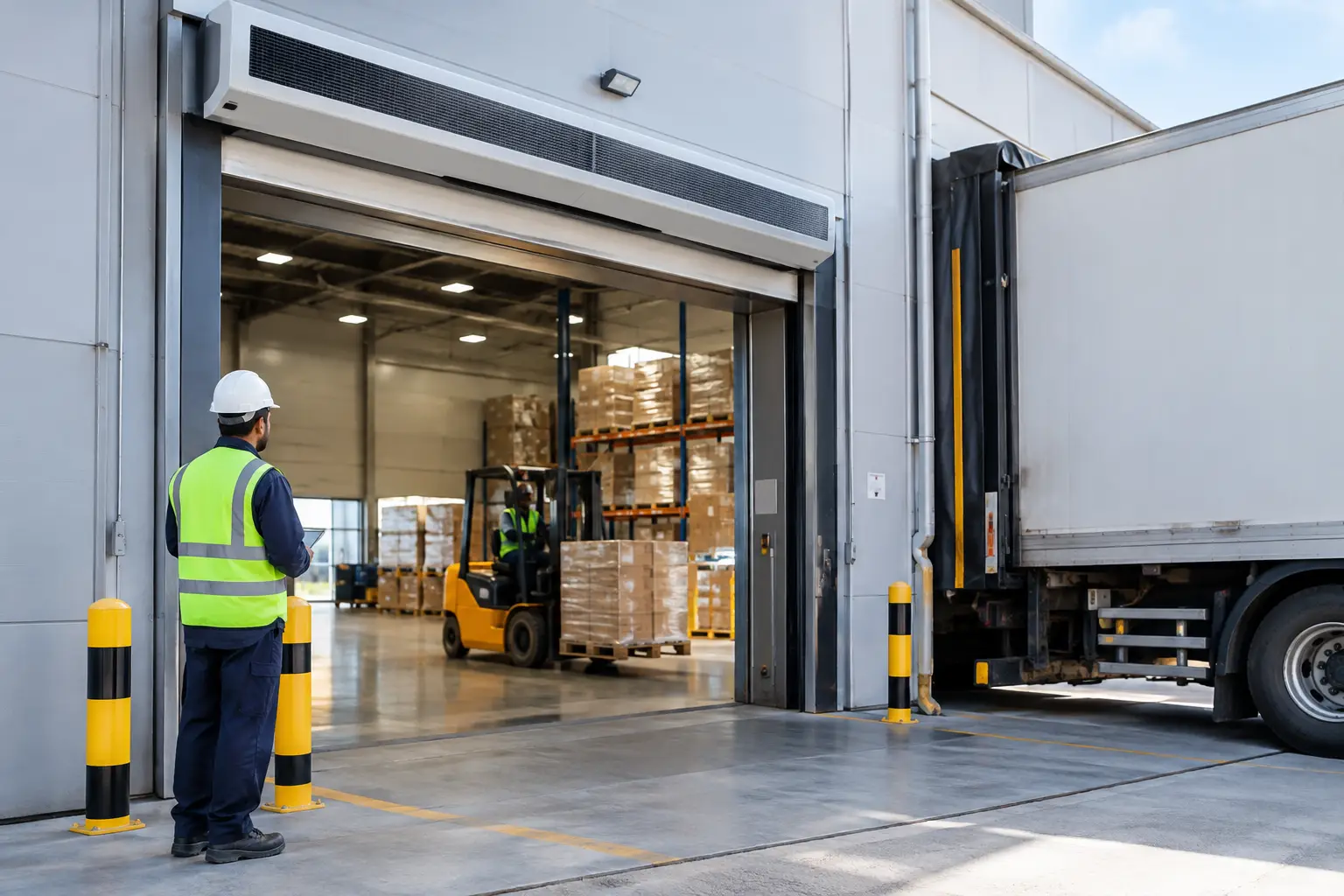
Consider a food-processing or light-manufacturing factory with a 5-meter-high loading door connecting a conditioned production corridor to an active dispatch yard. The door remains open for long periods during shift changes and material movements. Diesel-powered handling equipment operates outside, while dust and humid air are common at the entrance.
Without an entrance air barrier, the doorway becomes a direct migration path. The building’s cooling system must deal with incoming hot air, while dust and exhaust odors can affect adjacent production, packaging, and staff areas. If the facility relies only on internal cooling, it is treating the consequence rather than controlling the doorway condition.
The appropriate response is a layered control strategy:
- Capture process-generated fumes at their source using the facility’s specified extraction system.
- Maintain suitable airflow and pressure relationships between production, storage, and external areas.
- Install an industrial air curtain above or beside the open doorway to create air isolation during traffic movement.
- Coordinate the air curtain with the door type, opening height, vehicle traffic, and site HVAC operation.
This approach helps separate the exterior loading environment from the conditioned interior without interrupting logistics flow.
Why Doorway Air Isolation Matters
A loading-bay opening behaves differently from a personnel entrance. The opening is larger, traffic is heavier, and the door may be open for extended periods. In desert and tropical climates, the temperature and humidity difference across that opening can be significant.
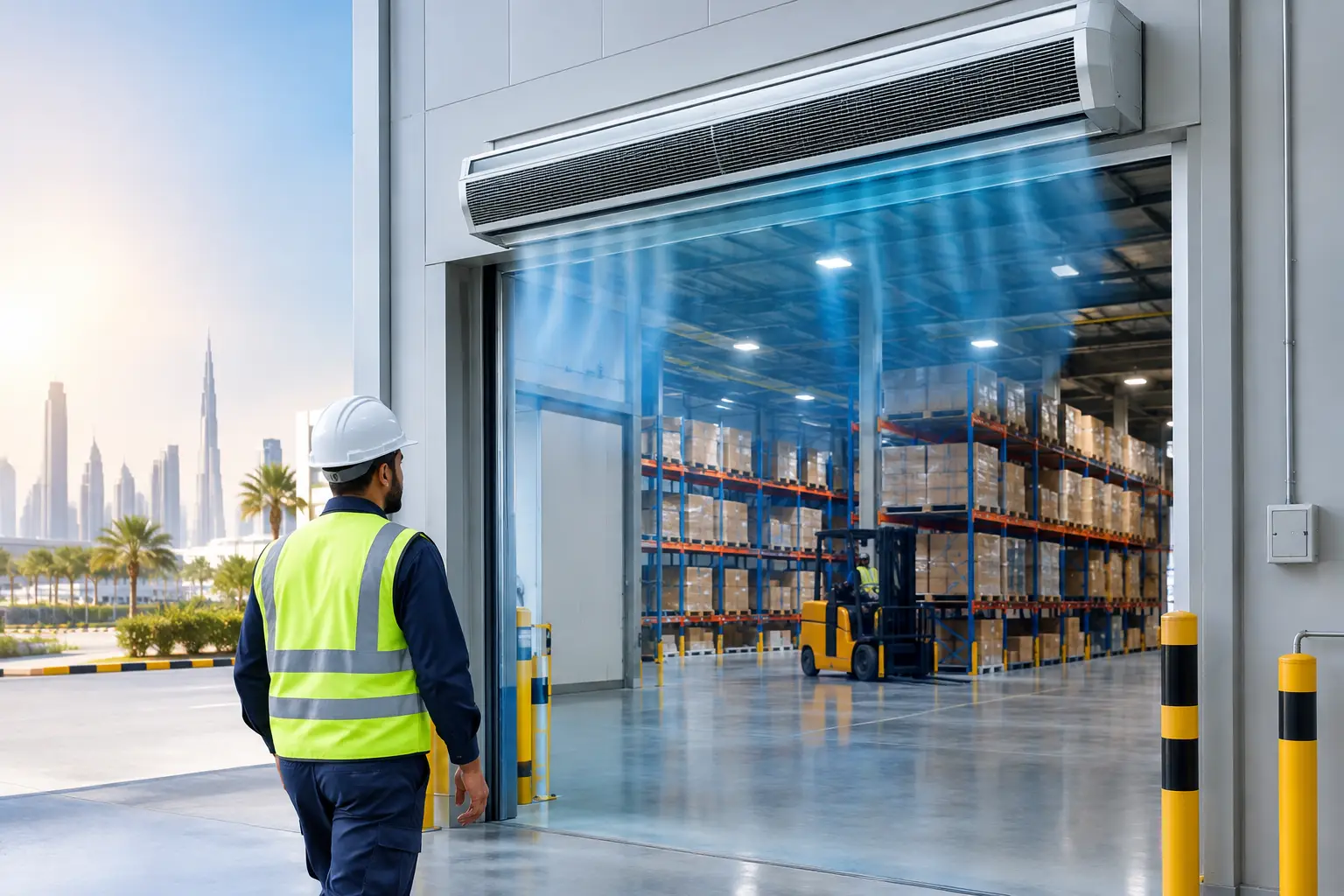
A correctly selected air curtain delivers a controlled high-velocity airstream across the opening. That stream is designed to reduce air exchange at the entrance, making it harder for dust, insects, heat, humidity, and airborne contaminants to move indoors with uncontrolled outdoor air.
For a factory managing fumes, the distinction matters. Air curtains do not neutralize hazardous substances or remove emissions at their origin. They can, however, help reduce the inward movement of outdoor exhaust and suspended contaminants through a frequently open door. They also help prevent conditioned indoor air from spilling out as quickly, supporting more stable HVAC performance.
What the Air Curtain Must Be Designed Around
Selecting an industrial unit by door width alone can lead to disappointing results. Effective doorway protection depends on the full operating environment, particularly at high doors exposed to wind, heat, and forklift movement.
| Design factor | Why it affects performance | Specification question | | — | — | — | | Opening width and height | A wide or tall opening requires adequate coverage and throw | Does the air stream reach the floor or intended landing point? | | Mounting location | Beam positions, shutter tracks, and lintel depth affect installation | Is top mounting possible, or is a side-mounted arrangement needed? | | Traffic volume | Continuous forklift activity changes how long the opening remains exposed | Is the door open intermittently or for most of the shift? | | Outdoor conditions | Desert dust, humidity, crosswinds, and extreme heat can disrupt the air stream | What is the typical exposure at the loading face? | | Interior use | Production, food handling, pharmaceuticals, and packaging may have different contamination concerns | What must be kept in, kept out, or separated? | | HVAC and pressure strategy | Air curtains work best when coordinated with the wider air-management plan | Is the interior positively or negatively pressured relative to the yard? |
For heavy-duty loading areas, FreezeeX typically evaluates industrial-duty configurations rather than treating the application like a standard retail doorway. The company’s Industrial Centrifugal Series is intended for demanding commercial and industrial entrances where stronger air delivery and application-specific selection are required.
How the Solution Works in Practice
In this factory fumes control example, the industrial air curtain is mounted at the loading-bay entrance and activated whenever the shutter opens. The system creates a continuous air barrier across the opening while pallets and forklifts move through.
The production area remains mechanically cooled, while source extraction continues to control any process-generated fumes inside the factory. The air curtain addresses the doorway gap between the controlled interior and the harsher external environment.
The practical benefits are operational rather than theoretical:
- Less intrusion of hot, dusty, and humid outdoor air during loading activity.
- Reduced migration of vehicle exhaust odors and airborne yard contaminants toward interior areas.
- Lower cooling loss through large, frequently open doorways.
- Better separation between dispatch zones and cleaner production, packing, or storage spaces.
- A more comfortable environment for staff working near the entrance.
Actual performance depends on installation quality, air velocity, door geometry, crosswinds, and the broader ventilation design. A sheltered loading bay may need a different approach from an exposed dock facing prevailing desert winds.
When an Air Curtain Is Not Enough
An air curtain should be specified realistically. If welding smoke, solvent vapor, combustion products, or chemical fumes are generated inside the building, doorway air isolation alone is not an acceptable control method. Those contaminants require source capture and professionally designed extraction or ventilation measures appropriate to the process and applicable safety requirements.
Likewise, if a facility needs strict contamination segregation, such as between high-care food processing zones or sensitive pharmaceutical spaces, the entrance system must be evaluated as part of the entire pressure-control and access design. Door interlocks, vestibules, high-speed doors, filtration, and documented operating procedures may also be relevant.
The key question is simple: are fumes being generated at the source, or are they entering through an open doorway? Source-generated contamination needs source control. Door-borne contamination needs entrance control. Many industrial sites need both.
A Specification Workflow for Factory Entrances
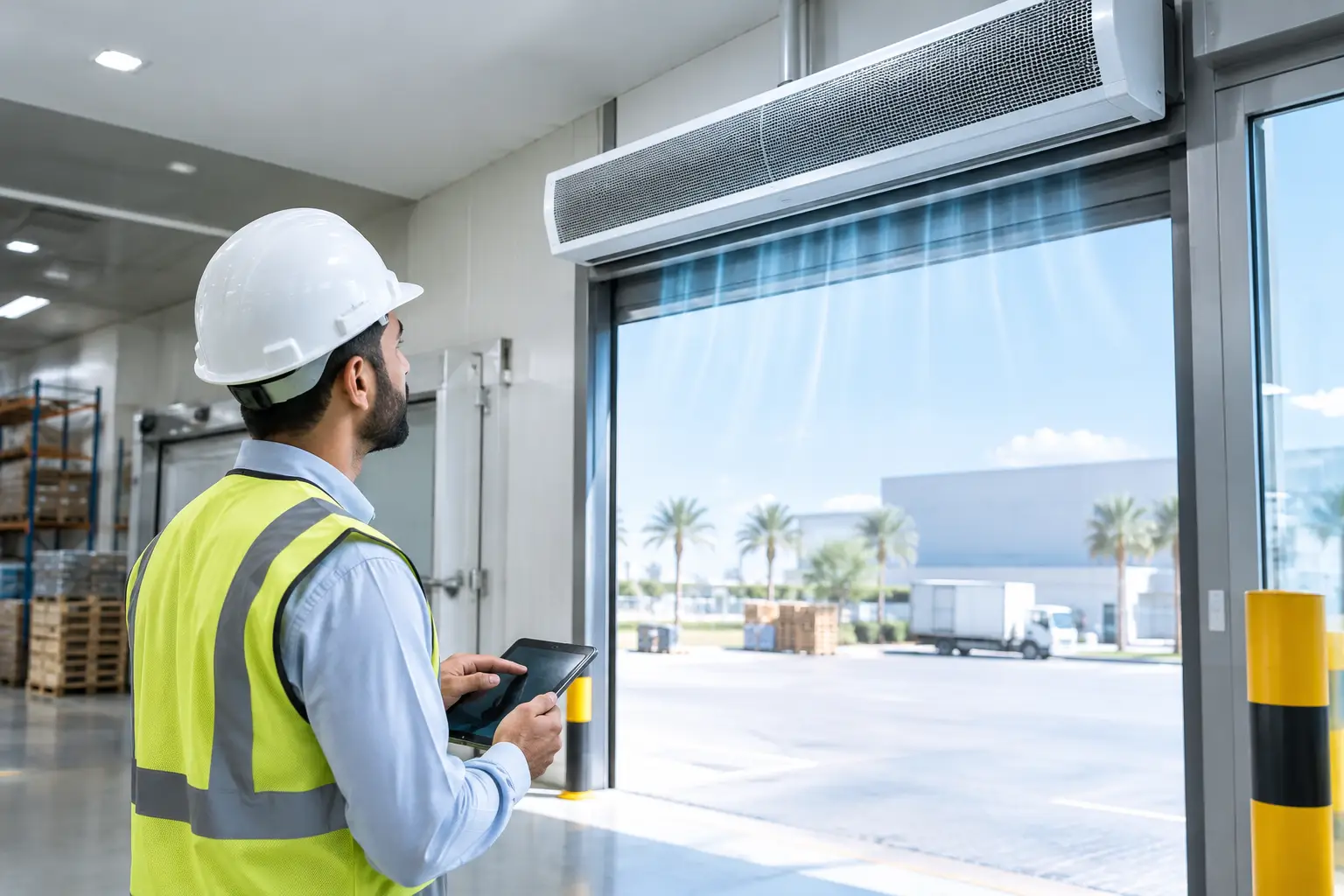
MEP consultants, facility managers, and project teams can assess the application in a structured way before requesting a quotation.
- Identify the contaminant pathway. Confirm whether the concern is external dust and exhaust entering through doors, internal process fumes, or a combination of both.
- Record the opening conditions. Measure door width and height, note the mounting clearance, and identify shutter, sectional, or high-speed door operation.
- Review traffic patterns. Establish whether forklifts, pallet jacks, personnel, or large vehicles use the opening and how long it remains open.
- Assess climate exposure. Note direct sun, humidity, desert dust, crosswinds, and the relationship between the loading face and prevailing weather conditions.
- Define the protected zone. Clarify whether the objective is HVAC efficiency, cleaner packaging conditions, staff comfort, separation of process areas, or all of these outcomes.
- Coordinate with the HVAC and ventilation design. Confirm that the proposed air curtain supports, rather than conflicts with, the facility’s pressure and extraction strategy.
This information allows a supplier to recommend a suitable mounting arrangement and industrial air-curtain category without making unsupported assumptions about performance.
Choosing the Right Air Curtain Category
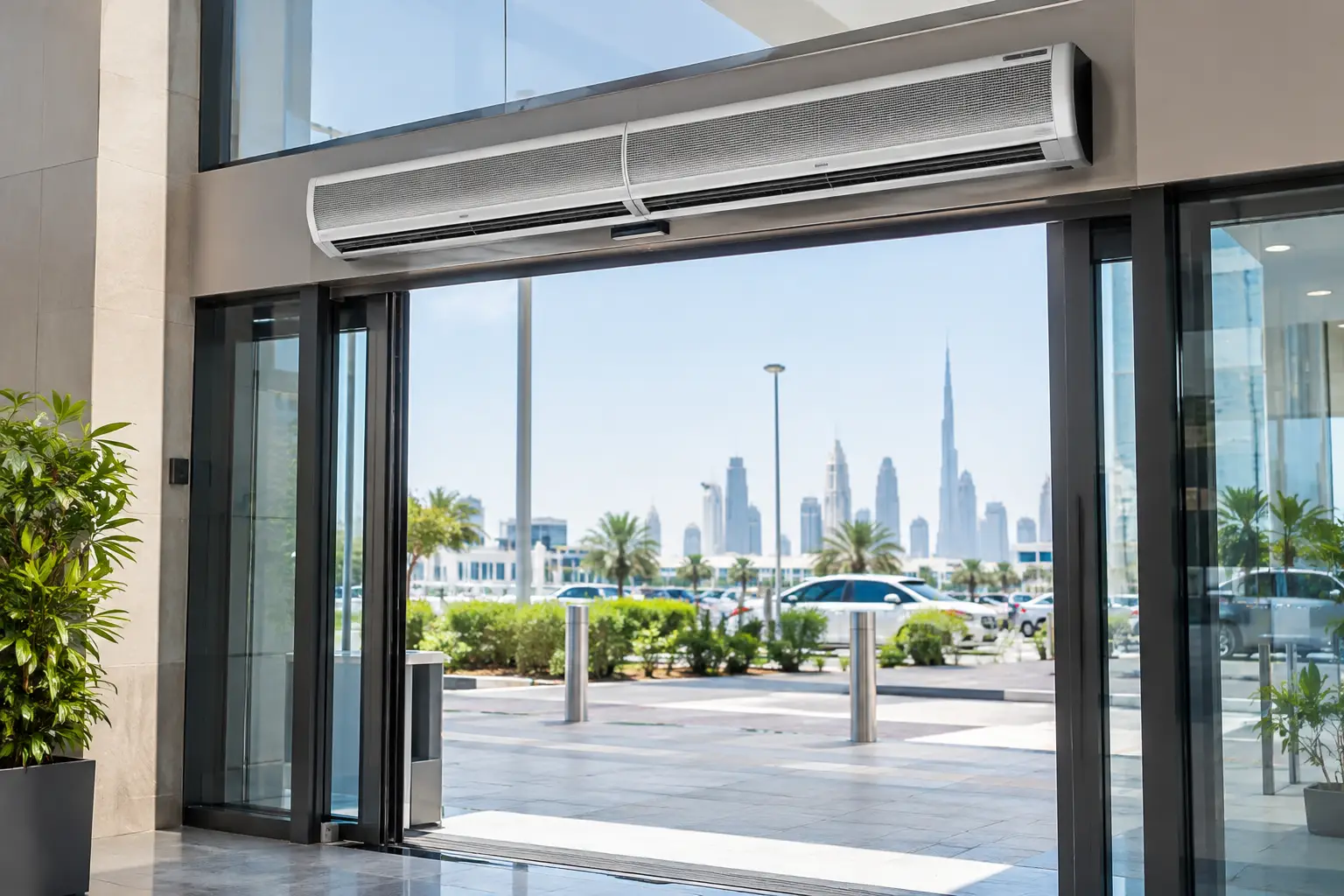
The product category should reflect the severity of the entrance duty. Commercial air curtains can suit smaller factory personnel doors, internal transitions, or moderate-traffic access points. Large loading docks, warehouse shutters, and exposed industrial openings generally require a more heavy-duty approach.
For example, a compact internal doorway between a warehouse and an air-conditioned packing room may suit a commercial centrifugal design. A tall external loading-bay opening with sustained forklift traffic is more likely to require an industrial centrifugal solution designed for heavier operating conditions. Recessed ceiling air curtains may be suitable where aesthetics and concealed installation matter, but they are not automatically the right choice for exposed industrial docks.
The decision should be driven by air coverage, installation constraints, traffic, and environmental exposure – not simply by the lowest initial equipment cost.
Get a Site-Specific Factory Entrance Recommendation
For factories in the UAE, Saudi Arabia, Qatar, Oman, Kuwait, Bahrain, Egypt, and African markets with demanding heat, dust, or humidity conditions, entrance air isolation should be part of the operational control plan. It can support cleaner indoor conditions and smarter energy management while allowing the loading operation to keep moving.
Request a FreezeeX consultation and quotation with your doorway dimensions, mounting details, operating hours, traffic pattern, and contamination concerns. A properly matched industrial air curtain can make the entrance a controlled transition rather than the weakest point in the factory envelope.