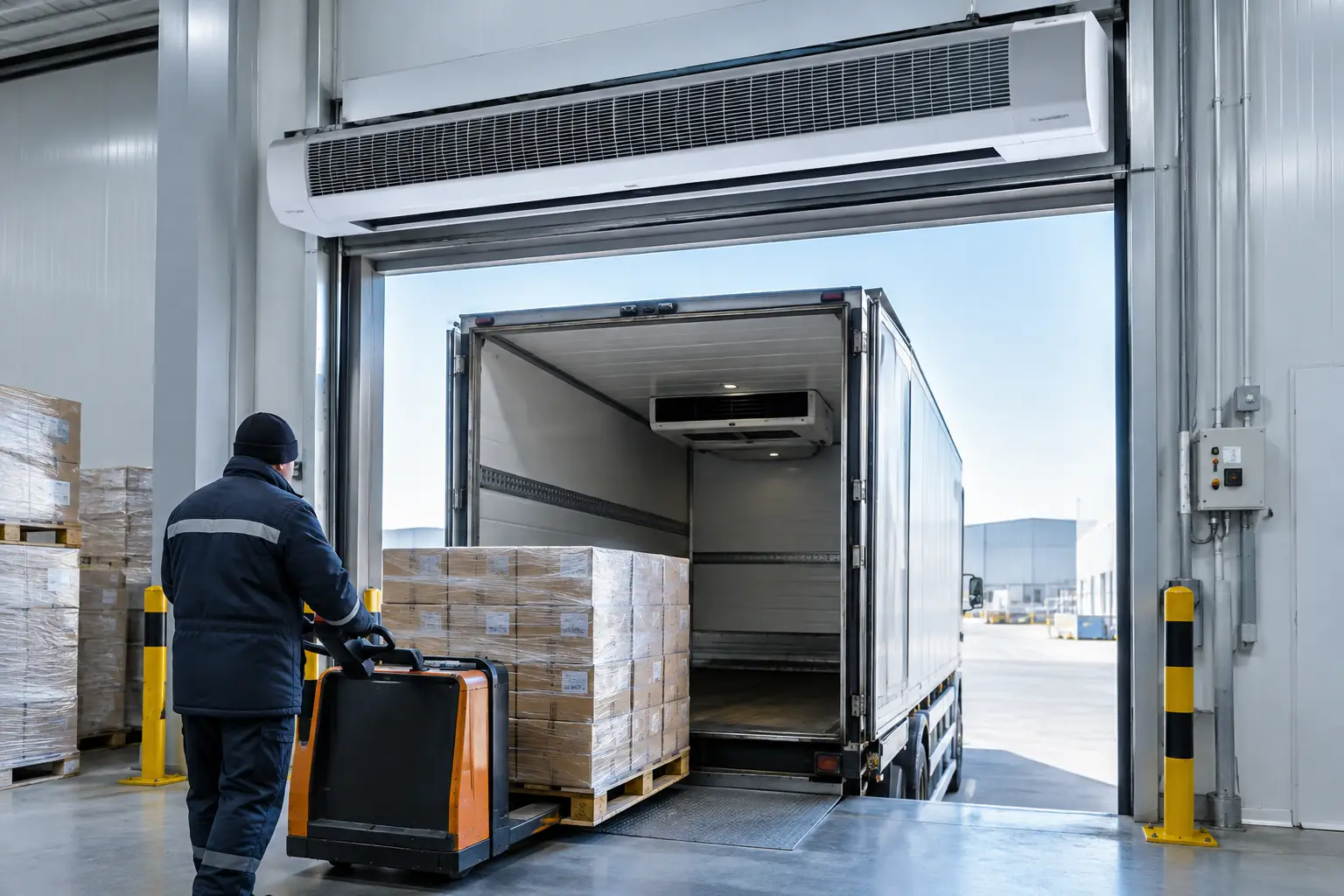
A loading bay can move hundreds of pallets in a shift, but every open dock door can also pull dust, hot air, humidity, vehicle exhaust, and airborne debris into the building. To control loading bay dust, facility teams need to treat the doorway as an active boundary, not simply an opening between the warehouse and the yard.
For warehouses, factories, logistics centers, food processing sites, and cold storage operations across the GCC, MENA, and Africa, the issue is amplified by desert dust, high ambient temperatures, and frequent vehicle movements. A properly specified industrial air curtain can help create powerful air isolation at the opening while keeping loading operations practical.
Why Loading Bays Become Major Dust Entry Points
A loading dock is designed for movement, which makes it difficult to seal in the same way as a conventional entrance. Trucks reverse into position, shutters stay open during loading, forklift traffic passes repeatedly, and staff may keep doors open to prevent operational delays. This activity creates a direct route for outdoor contaminants.
Dust commonly enters through a combination of wind pressure, air pressure differences between the conditioned building and the loading yard, and turbulence created by trucks and forklifts. In hot climates, cooled indoor air can escape through the opening while hotter outside air moves inward. The resulting exchange carries fine dust and humidity with it.
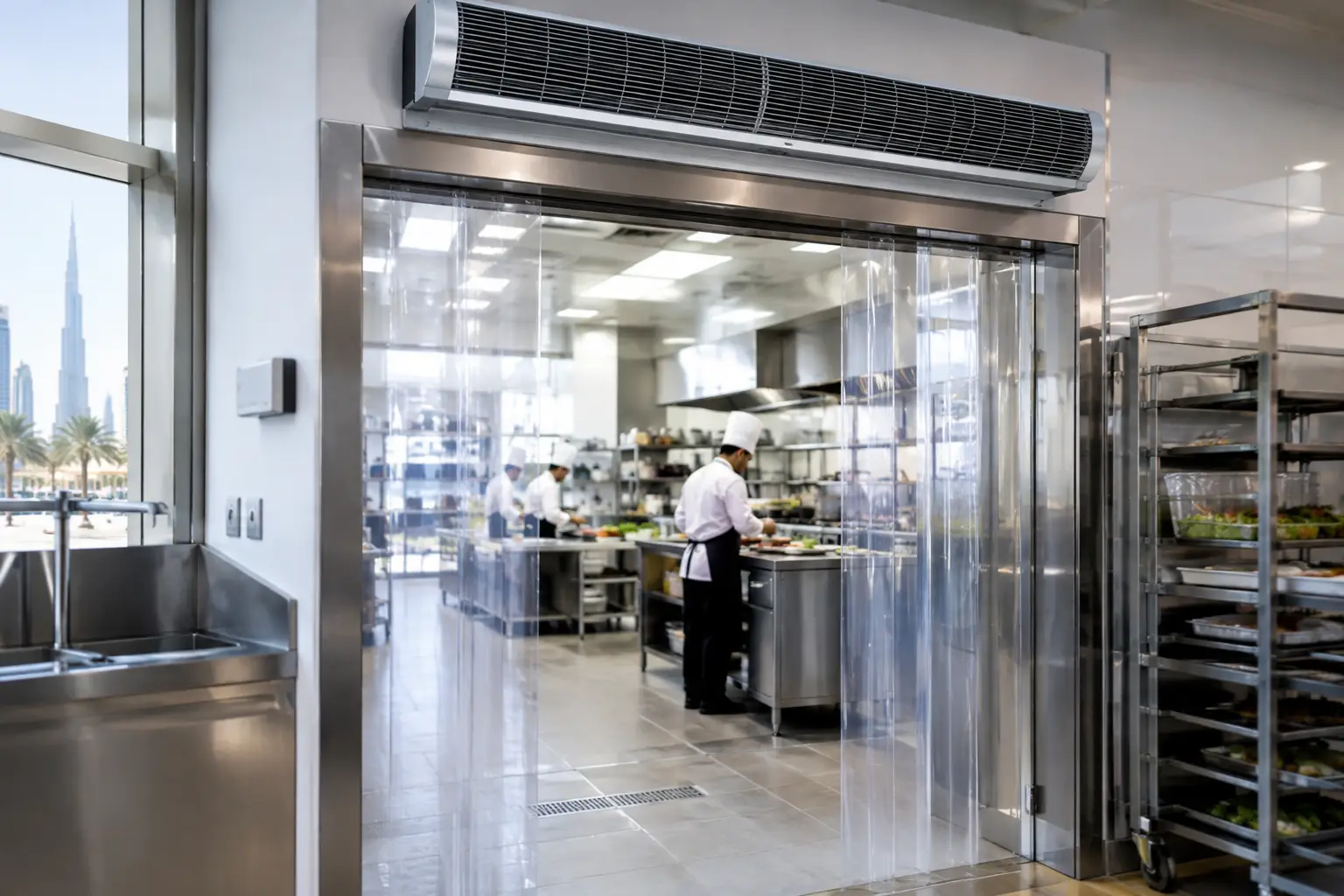
The operational consequences extend beyond housekeeping. Dust buildup can affect stored goods, packing areas, floor safety, indoor comfort, and the workload placed on HVAC systems. In sensitive environments, such as pharmaceutical logistics, food handling, or electronics manufacturing, the loading bay can become a weak point in the site’s contamination-control strategy.
What Makes Dust Control at a Loading Bay Different?
A standard pedestrian entrance and a high-traffic loading bay do not face the same conditions. Dock doors are wider, higher, exposed to vehicle movement, and often open for longer periods. They may also sit in areas with strong crosswinds, direct sun exposure, unpaved yards, or frequent heavy-vehicle traffic.
An effective approach must account for these site conditions:
- Door height and width, including whether the opening serves trucks, forklifts, or pedestrians
- How long doors remain open during receiving and dispatch activity
- Outdoor dust levels, wind direction, humidity, and extreme heat exposure
- Indoor temperature requirements and the presence of sensitive stock or processes
- Existing dock seals, shutters, traffic routes, and HVAC supply or return locations
This is why a small commercial unit selected only by door width may not perform as required at an industrial dock. The air stream must reach the floor area with enough consistency to help resist infiltration without obstructing vehicle access or creating unnecessary noise in nearby work zones.
Use Air Curtains as an Active Barrier
An industrial air curtain produces a controlled downward air stream across an open doorway. Rather than physically closing the opening, it helps separate the indoor and outdoor air zones while traffic continues to move through.
At a loading bay, the goal is not to eliminate every airborne particle under every operating condition. Strong wind, fully open doors, and constant truck movements can create difficult conditions. The practical objective is to reduce the volume of dust, heat, humidity, insects, and airborne contaminants entering during normal dock activity.
For industrial applications, an air curtain should be considered alongside physical controls such as dock shelters, fast-acting doors, and managed vehicle routes. Each control addresses a different part of the problem. Dock seals reduce gaps around a vehicle, while an air curtain protects the open doorway during active movement.
Where Industrial Air Curtains Add the Most Value
Industrial air curtains are especially relevant where a bay door opens directly to an exposed yard or road. Typical applications include distribution centers, manufacturing dispatch areas, warehouse receiving bays, factory loading doors, and facilities where outdoor dust regularly reaches the work floor.
They can also support operations where comfort and cooling retention matter. In Dubai, Riyadh, Doha, Muscat, and other hot-climate logistics markets, repeated loss of cooled indoor air at dock doors can increase the burden on the building’s HVAC system. Air isolation helps maintain more stable conditions near the entrance while supporting operational access.
Selecting the Right System for the Loading Bay
The correct solution depends on the opening and the operating environment, not on a generic product category. FreezeeX air curtain selection is consultation-led because mounting position, traffic volume, climate exposure, and HVAC conditions all influence the recommendation.
The following comparison helps project teams identify the direction of travel before a technical assessment.
| Loading bay condition | Primary concern | Air curtain selection focus | |—|—|—| | High, wide truck door | Dust and heat crossing a large opening | Industrial-duty coverage and mounting suitability | | Busy forklift route | Continuous traffic with limited door closure | Stable air separation that does not interrupt movement | | Food or pharmaceutical logistics | Dust, insects, humidity, and cleaner internal conditions | Application-appropriate air isolation with coordinated hygiene controls | | Hot, dusty yard | High heat gain and airborne debris | Performance suited to desert and tropical climate exposure | | Enclosed dock with moderate traffic | Cooling loss and occasional dust ingress | Commercial or industrial configuration based on opening size and use |
Questions Specifiers Should Ask
Before selecting an air curtain, the project team should establish whether the unit will be mounted above the opening or in another suitable position, whether there is clear structural space, and whether the doorway is regularly affected by side winds. It is also necessary to understand the door’s actual open time, not simply the number of deliveries per day.
A bay that opens only briefly between vehicle movements may benefit greatly from coordinated door controls and an air curtain. A bay that remains open for hours in a dusty yard may require a broader strategy, including yard surface management and revised loading procedures. The equipment choice should reflect the duty cycle rather than an idealized operating scenario.
A Practical Dust-Control Plan for Loading Operations
Air curtains perform best when they are part of a coordinated entrance-control plan. The sequence below helps facility managers and MEP teams evaluate the loading bay as a system.
- Map dust pathways. Observe the dock during vehicle arrivals, reversing, loading, and door opening. Identify whether dust enters around vehicles, through the full door opening, or via adjacent pedestrian doors.
- Review the door operating pattern. Measure how long each dock remains open and determine whether doors are left open for convenience after loading has finished. Operational discipline often affects dust entry as much as equipment selection.
- Assess the yard environment. Unpaved surfaces, loose material handling, vehicle wheel dust, and prevailing winds can all increase airborne particulate levels at the dock face.
- Specify the air curtain around actual conditions. Provide door dimensions, mounting height, building use, traffic pattern, local climate, and indoor temperature expectations to the supplier or consultant.
- Coordinate complementary controls. Confirm that dock shelters, door seals, shutters, and HVAC arrangements do not work against the air curtain’s airflow path.
- Review performance after commissioning. Facility teams should check whether dust accumulation, comfort complaints, and cooling loss near the dock have reduced under normal operating conditions.
Common Specification Mistakes to Avoid
One common mistake is choosing an air curtain based only on the nominal width of the door. At a loading bay, mounting height and external conditions can be equally significant. A system that appears adequate on paper may struggle if installed too high or exposed to strong crosswinds.
Another mistake is treating the air curtain as a replacement for sensible dock management. If doors remain open unnecessarily or dusty vehicle routes run directly past the opening, airborne debris can still be substantial. The best outcomes come from pairing engineered air isolation with disciplined operating procedures.
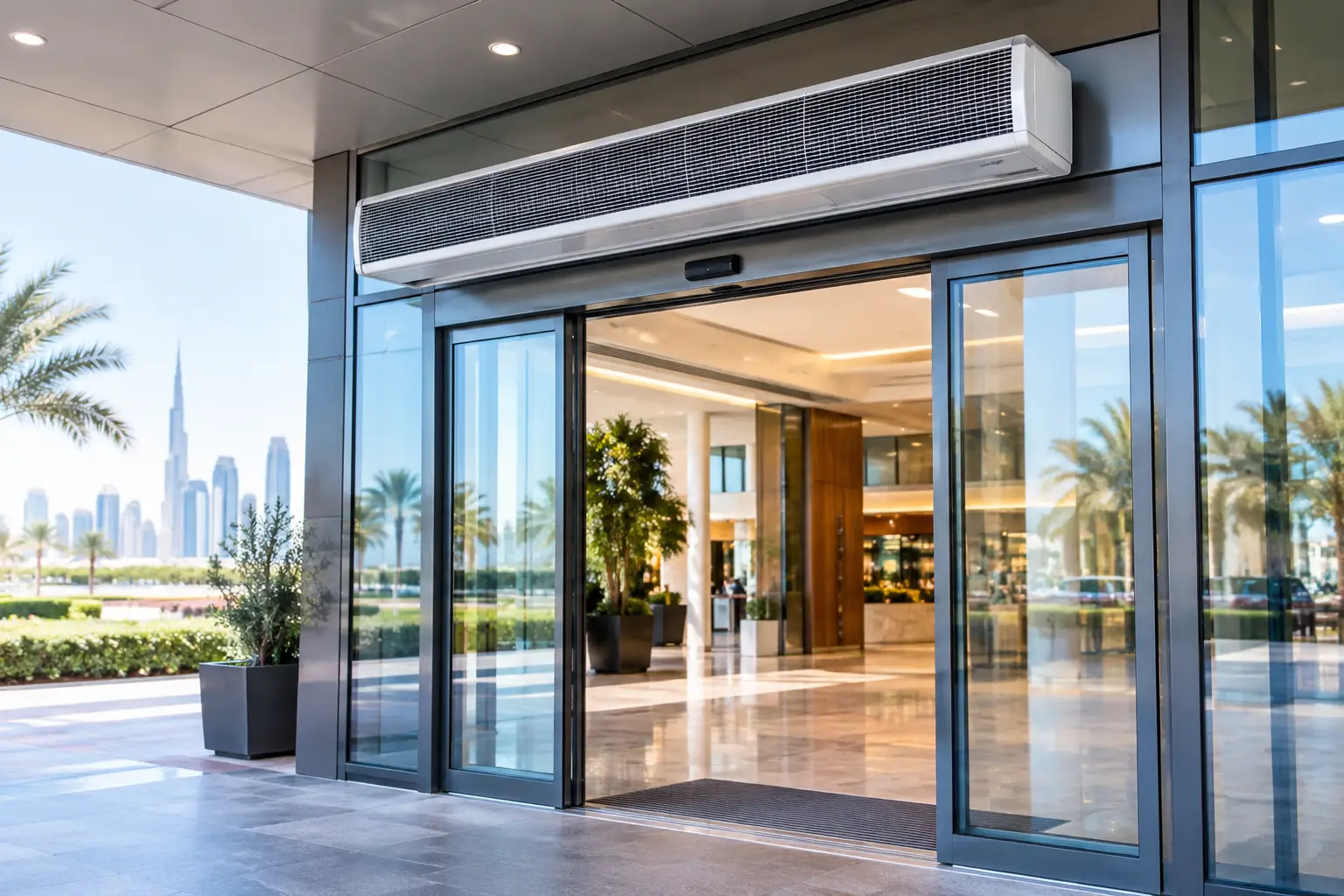
It is also unwise to assume that every loading bay needs the same type of unit. Commercial entrances, enclosed warehouse doors, and heavy industrial loading bays have different duty requirements. FreezeeX offers commercial and industrial air curtain ranges so project teams can align the system with the actual application rather than over-specifying or under-specifying the opening.
How Does Climate Affect Loading Bay Dust Control?
Climate has a direct impact on both dust intrusion and cooling loss. In desert environments, fine airborne dust can be persistent, particularly around active logistics yards and industrial estates. In tropical or coastal locations, humidity compounds the challenge by affecting indoor comfort and placing additional demand on conditioned spaces.
For this reason, a loading bay solution for the UAE, Saudi Arabia, Qatar, Oman, Egypt, Nigeria, Kenya, or other warm-climate markets should account for heat, dust, humidity, and high traffic together. The right air curtain is not simply an entrance accessory. It is part of the building’s operational boundary and HVAC efficiency strategy.
A productive loading bay does not need to be an uncontrolled opening. Share the bay dimensions, mounting constraints, traffic pattern, and climate exposure with FreezeeX to request a consultation and quotation for an air curtain solution suited to demanding industrial conditions.