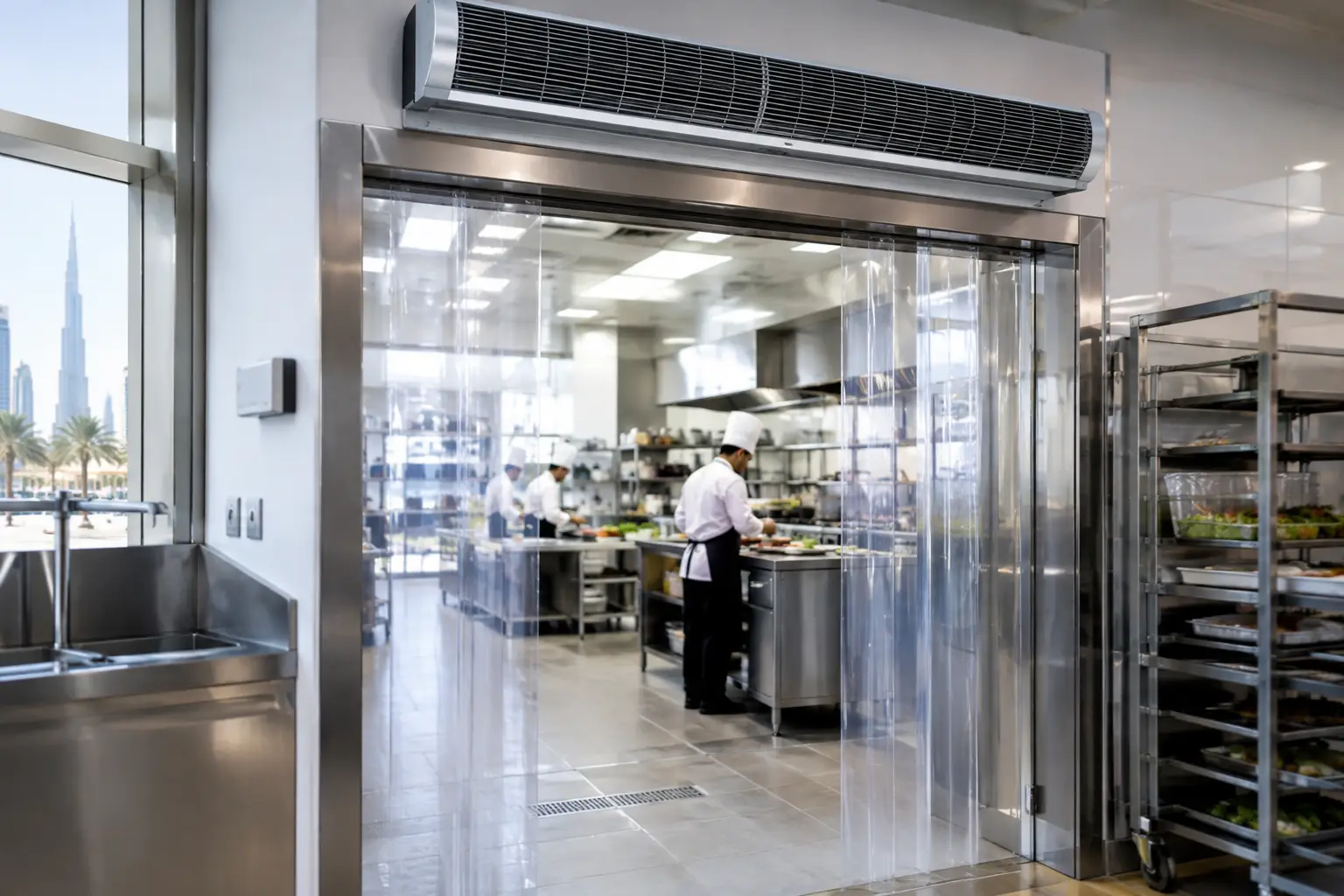
A delivery door opens for 30 seconds during a busy dinner service. Warm, humid outside air moves inward, carrying odors, dust, and flying insects toward food-preparation and dining areas. To prevent restaurant insect ingress, operators need more than a clean premises or a pest-control contract. They need a controlled entrance strategy that works while people, deliveries, and service staff are moving through the building.
For restaurants in Dubai, Riyadh, Doha, Muscat, Cairo, Lagos, and other hot or humid markets, open doors are a recurring contamination and comfort risk. A properly specified commercial air curtain can create a high-velocity air barrier across an entrance while preserving the access needed for operations. It is most effective when combined with sound door management, sanitation, and building maintenance.
Why restaurant entrances attract insect activity
Restaurants create the conditions that insects seek: food odors, moisture, warmth, waste, and frequent access points. Rear receiving doors, kitchen exits, waste-room doors, patio transitions, and delivery entrances are usually more vulnerable than the main customer entrance.
The issue is not simply whether insects are present outside. It is whether the pressure difference, airflow path, and operating routine at an opening make entry easy. When cooled indoor air escapes through an open door, replacement air is drawn in from outside. In desert and tropical climates, that incoming air can also bring heat, humidity, airborne dust, and insects into the restaurant.
Common conditions that increase ingress include:
- Doors held open during deliveries, cleaning, or waste removal
- Gaps around door edges, thresholds, frames, or roller shutters
- Exterior lighting and food waste located close to entrances
- Poorly managed receiving areas with frequent vehicle and pedestrian traffic
- Air conditioning systems that cannot maintain a favorable indoor pressure condition
- A barrier system that is undersized, incorrectly mounted, or switched off during peak use
Pest-management treatments remain necessary, but they address insect populations rather than stopping entry at the threshold. Entrance control reduces the opportunity for insects to reach sensitive areas in the first place.
How air curtains prevent restaurant insect ingress
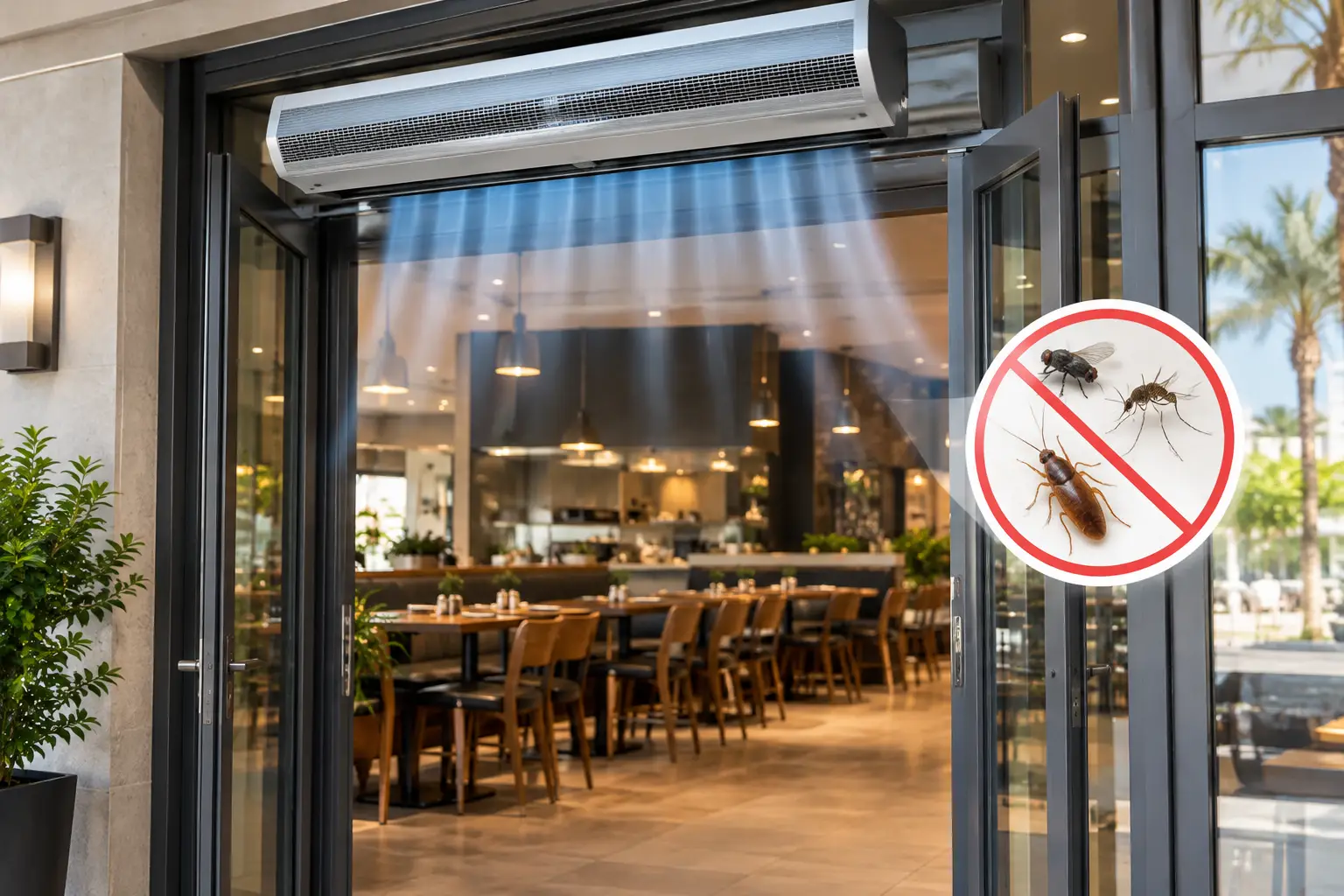
An air curtain projects a continuous stream of air downward or across an opening. When selected and installed correctly, the stream forms an air seal that helps separate indoor and outdoor environments without requiring the door to remain closed at all times.
For restaurant operations, this isolation has two practical purposes. First, it makes it harder for flying insects to cross an active entrance. Second, it reduces the loss of conditioned air that can otherwise encourage hot, humid outdoor air to enter the facility.
The performance depends on the whole entrance condition, not the unit nameplate alone. Mounting height, entrance width, crosswinds, door opening patterns, indoor cooling conditions, and nearby exhaust or supply air all affect whether the air stream reaches the floor and remains stable.
Air curtains are not a substitute for physical exclusion
An air curtain is a strong operational control, but it should not be treated as a replacement for well-maintained doors and basic hygiene practices. A damaged sweep, an open drain, or uncovered waste beside a receiving door can undermine even a well-designed air barrier.
The most reliable approach layers physical sealing, operational discipline, cleanliness, and air isolation. This is particularly relevant for restaurants with high-volume delivery activity, open kitchens, food courts, and back-of-house doors that cannot stay shut continuously.
Which restaurant doors need air isolation?
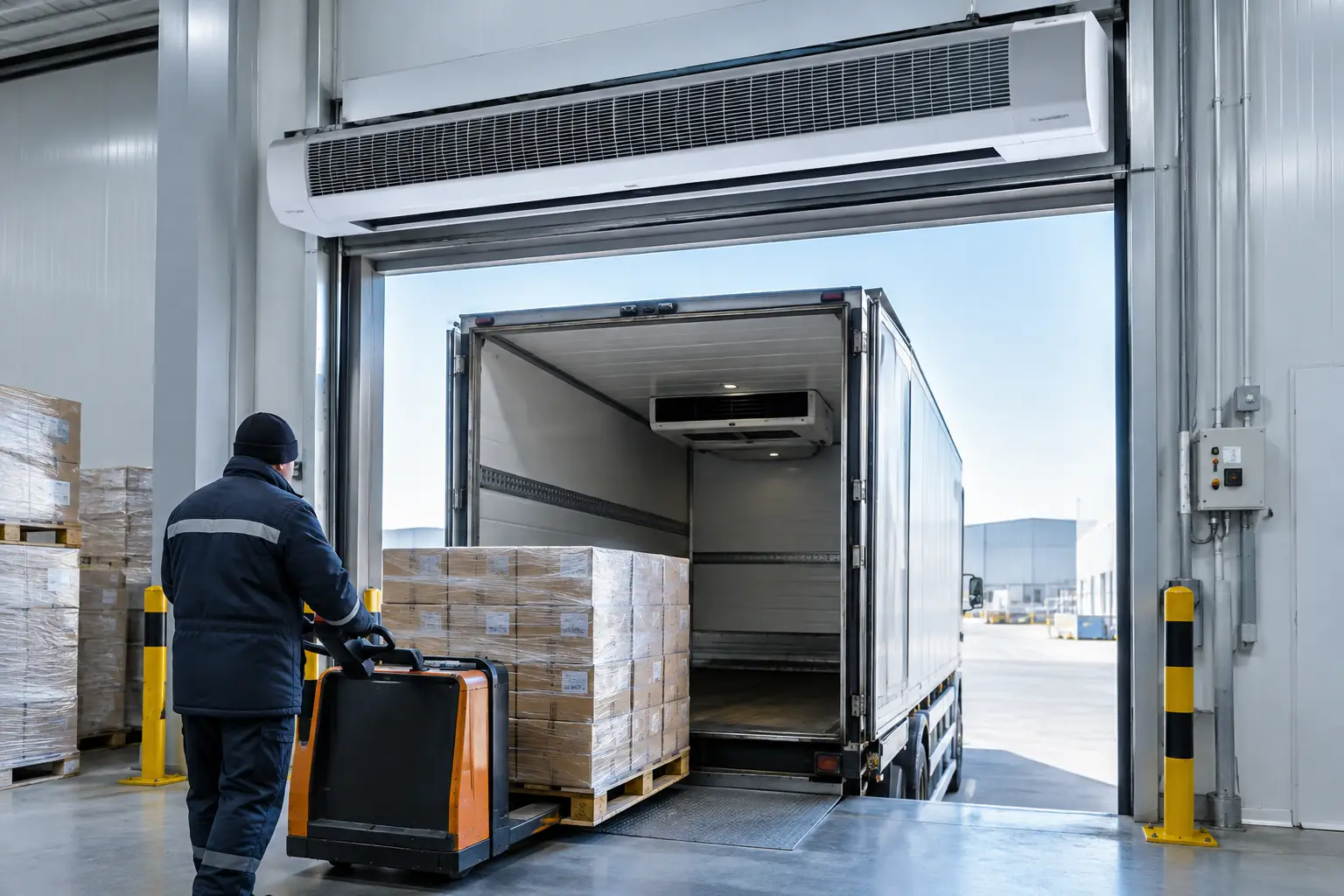
Not every opening needs the same solution. A guest entrance may prioritize appearance, low noise, and consistent comfort. A receiving dock or kitchen service entrance needs stronger air isolation that can tolerate longer opening times, higher traffic, and dusty outdoor conditions.
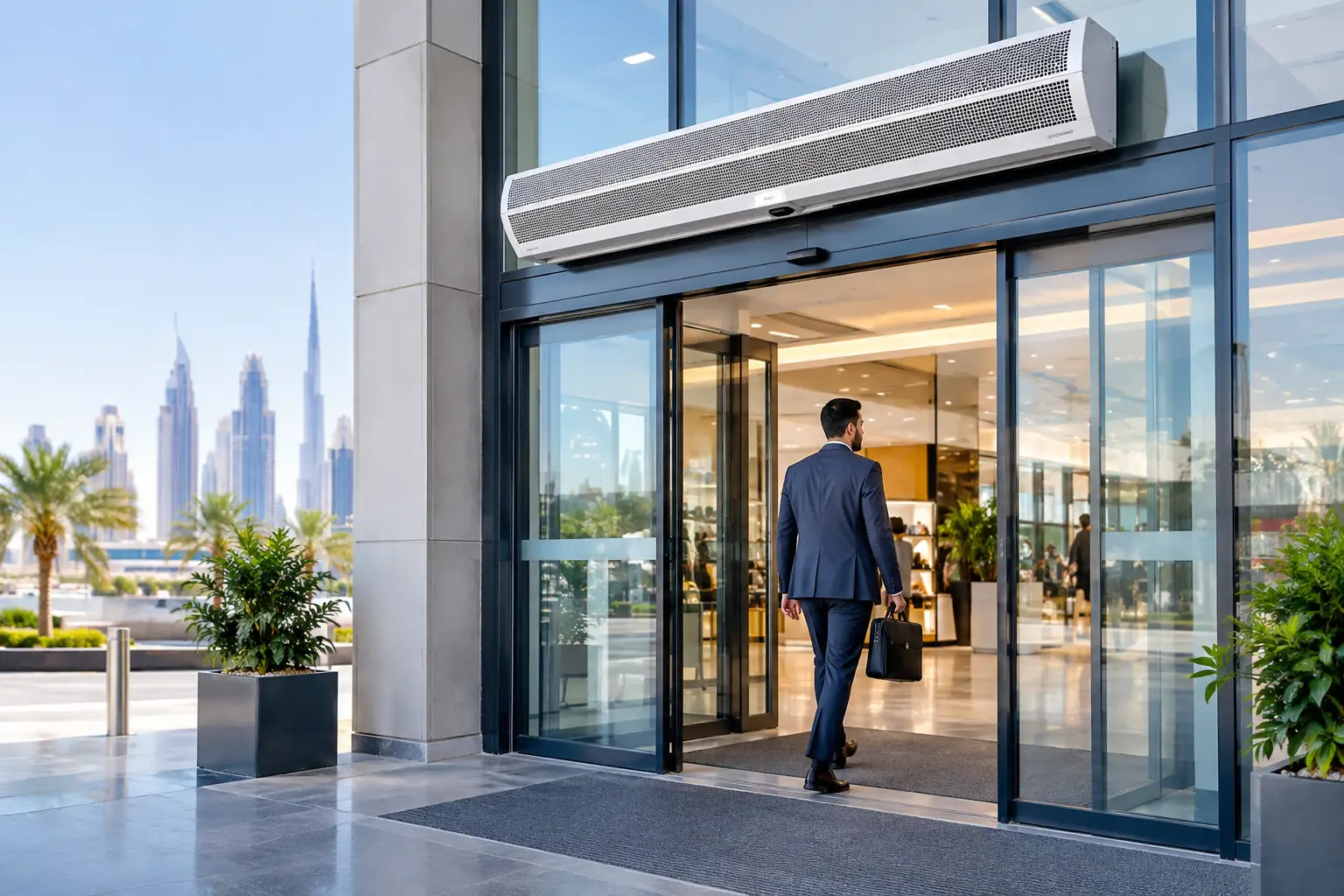
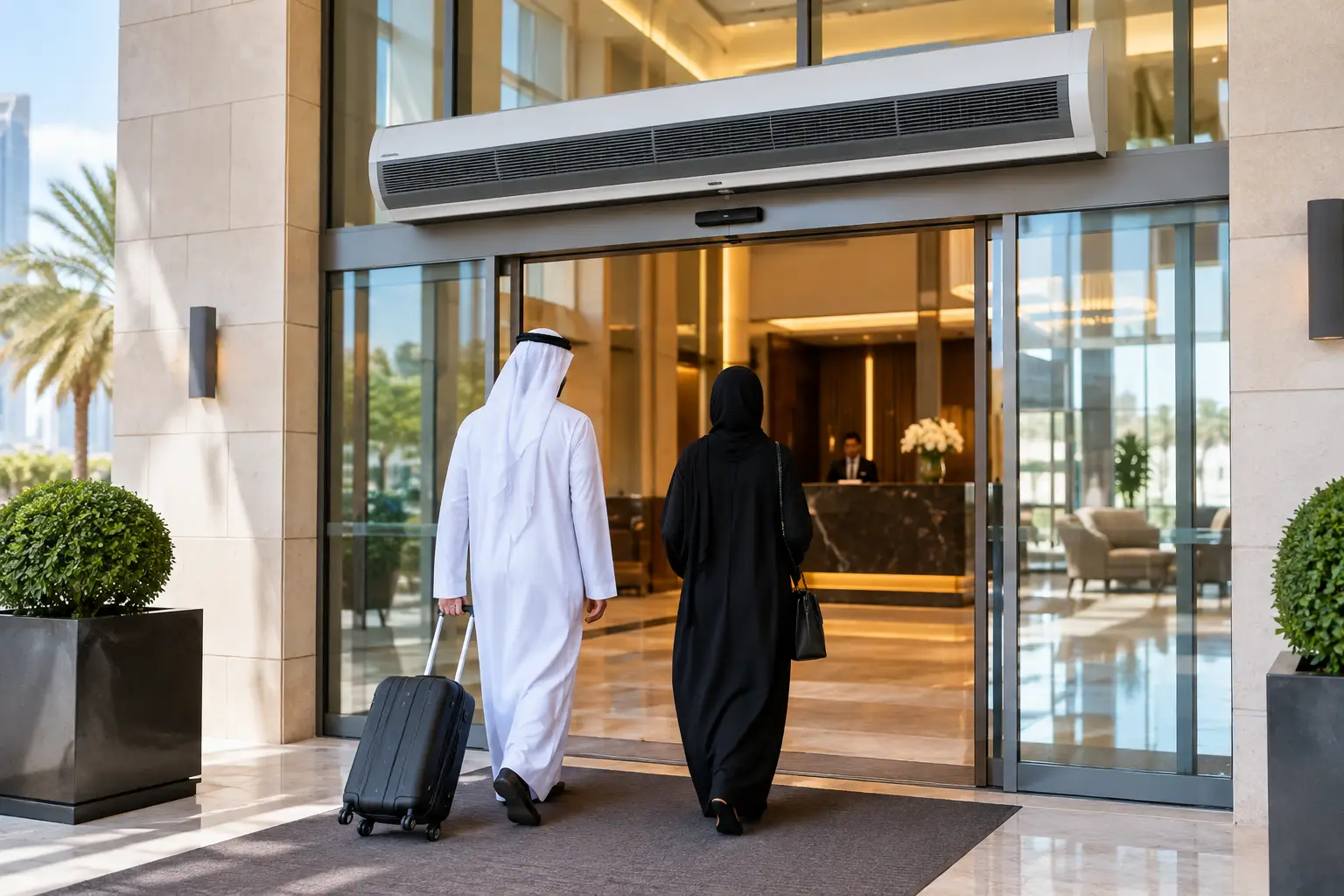
| Entrance area | Main insect-ingress risk | Air curtain selection priority | | — | — | — | | Main dining entrance | Frequent pedestrian traffic and visible insect activity | Appearance, noise control, coverage across the full opening | | Kitchen or staff entrance | Food odors, repeated short openings, operational traffic | Reliable activation and stable air coverage | | Delivery and receiving door | Long door-open periods, dust, heat, vehicle activity | Higher-duty performance matched to opening height and traffic | | Waste-room door | Odors and strong insect attraction | Continuous protection during access and coordinated sanitation | | Food court service opening | High public traffic and shared conditioned air | Compact fit, proper mounting, and coordinated HVAC design |
A recessed ceiling air curtain may suit an architecturally sensitive customer-facing entrance where the equipment should integrate into the ceiling line. A commercial centrifugal or HiFi Plus configuration may be appropriate where dependable daily performance and lower sound levels matter. For intensive receiving, warehouse-style, or industrial service openings, a heavier-duty centrifugal or Dynamic Series solution may be more suitable.
The correct choice depends on the application. Specifying a system solely by door width can leave the opening underprotected if the mounting height or surrounding air movement is not considered.
A practical entrance-control process for restaurants
Restaurant owners, facility managers, MEP consultants, and HVAC contractors should assess insect control as an operational workflow rather than a single equipment purchase.
- Identify every active opening. Record the door width, mounting height, type of traffic, how often it opens, and how long it stays open. Include doors used only during deliveries, waste removal, and staff shifts.
- Classify the risk at each entrance. A front door may need comfort-focused protection, while a rear kitchen door may need stronger resistance to heat, dust, humidity, and insect entry. Food handling proximity should raise the priority.
- Review the surrounding airflow. Check for outdoor wind exposure, nearby extract systems, air-conditioning discharge, adjacent shutters, and vehicle movement. These factors can deflect the air stream and reduce separation at the threshold.
- Select the air curtain around real operating conditions. Match the system to the opening dimensions, mounting position, traffic volume, and climate. In hot, humid, or dusty environments, this assessment is essential to achieve stable air isolation.
- Coordinate controls with door use. The air curtain must operate whenever the door is in use. Door contacts, switches, or building-management controls can support consistent operation where appropriate for the project.
- Confirm ongoing operational ownership. Assign responsibility for keeping the entrance clear, checking for physical gaps, and reporting changes in door behavior. Equipment performance cannot compensate for doors routinely propped open outside the protected airflow zone.
What specification mistakes reduce insect-control performance?
The most common mistake is treating an air curtain as a generic accessory. A unit that is too short for the opening can leave unprotected edges. A unit mounted too high may not produce an effective air stream at floor level. A system selected without considering crosswinds can lose stability at the very time the doorway is exposed.
Another issue is placing the system only at a front entrance while leaving the receiving area unprotected. In many restaurants, the back door creates the greater pest-management risk because it combines food deliveries, waste handling, warm air, and longer open periods.
Controls also matter. If employees must manually switch a unit on and off, use may become inconsistent during busy service. For high-traffic entrances, automatic or coordinated operation can be a practical specification discussion.
Finally, avoid making energy savings the only selection criterion. Reducing cooling loss is valuable, particularly in GCC and African markets with intense heat, but the selected system must also provide the air velocity and coverage needed for the entrance environment. The best result balances insect exclusion, thermal comfort, energy performance, acoustics, and visual integration.
Pair air isolation with restaurant hygiene controls
A well-specified air curtain supports, rather than replaces, a restaurant’s wider food-safety and facility-management program. Keep waste storage controlled and away from entrances where possible, clean spills promptly, maintain door seals and closers, and avoid leaving delivery doors open while staff organize stock.
Exterior lighting can also influence insect activity near an entrance. Where site conditions allow, review lighting placement and the location of waste containers, landscaping, and standing-water sources. These measures lower pressure on the entrance barrier and make daily pest-control programs more effective.
For multi-site restaurant groups, standardizing the assessment process across locations can reveal recurring issues. A branch with a narrow, sheltered door may need a different configuration than a high-traffic outlet with a tall receiving opening and direct exposure to hot desert winds.
Specify for the climate, not just the doorway
Restaurant air curtains in hot, tropical, humid, and desert climates must manage more than insects. They help limit the entry of heated air, humidity, dust, smoke, and airborne contaminants while supporting the performance of conditioned indoor spaces. That broader role is why site-specific selection matters.
FreezeeX Air Curtains works with project teams to assess entrance size, mounting conditions, traffic patterns, and environmental exposure before recommending a commercial or industrial air curtain solution. For a restaurant fit-out, refurbishment, or recurring insect-ingress issue, request a consultation and quotation based on the actual entrance conditions. A correctly engineered air barrier gives staff a practical way to keep doors usable without making the restaurant easier for insects to enter.