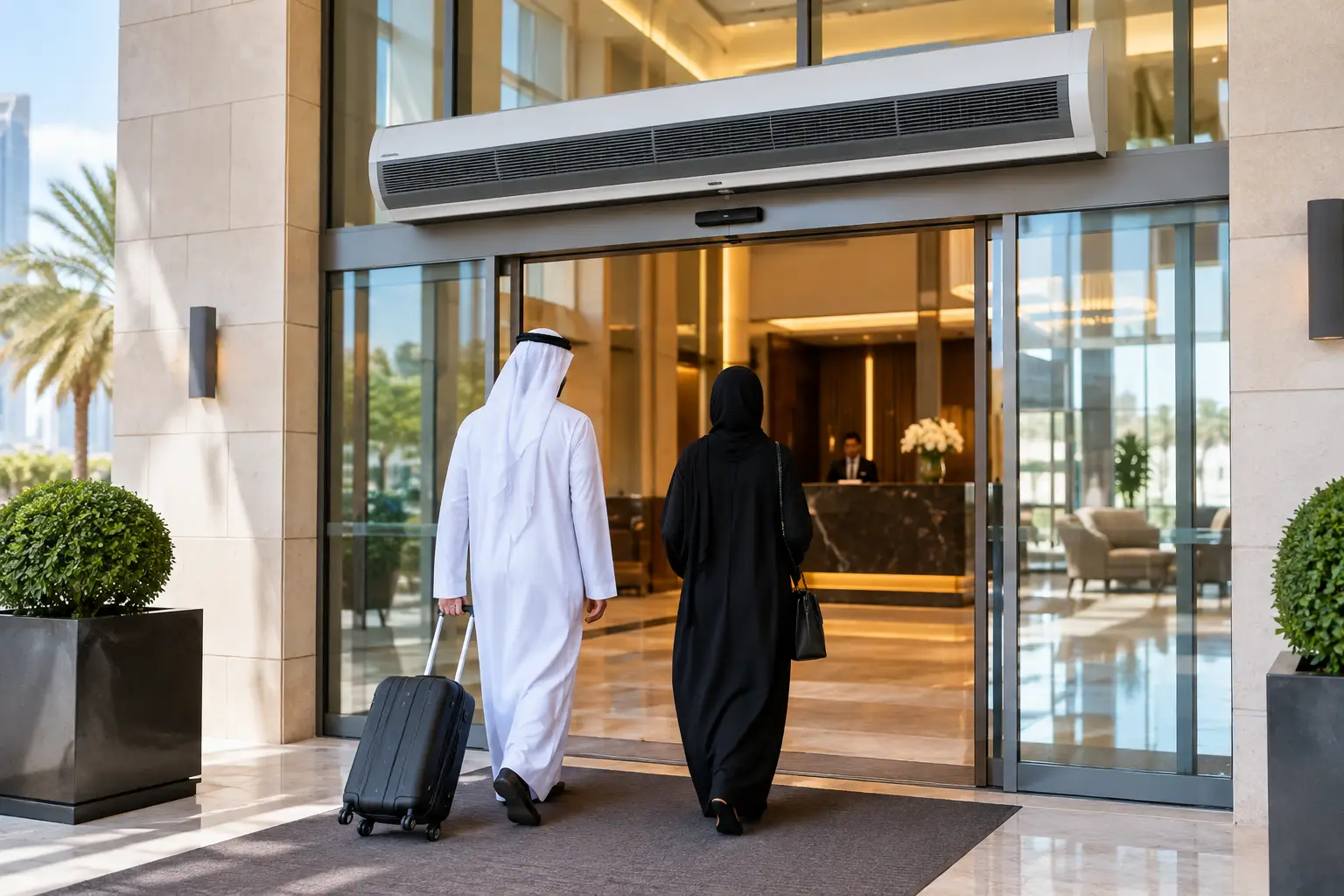
A hotel entrance can lose conditioned air faster than almost any other public-facing zone in the building. To manage heat at hotel entrances, operators need to address the moment exterior heat, humidity, dust, and contaminants enter each time sliding, revolving, or swing doors open. In Dubai, Riyadh, Doha, Muscat, Cairo, and other hot-climate markets, that problem is not limited to the afternoon rush. It can affect lobby comfort and HVAC load throughout the operating day.
An air curtain creates a directed air barrier across an open doorway. Properly selected and installed, it helps separate the cooled lobby from harsh outdoor conditions while allowing guests, staff, baggage, and service traffic to move freely. The result is a more controlled arrival experience without turning the entrance into a physical bottleneck.
Why Hotel Entrances Create a Cooling-Loss Problem
Hotels are designed to welcome people in, which makes the entrance difficult to isolate. Concierge teams, valet traffic, luggage handling, tour groups, restaurant visitors, and delivery activity can keep doors opening continuously. Even automatic doors that close quickly may open often enough to allow substantial heat transfer and infiltration.
The operational effects tend to appear in several places at once:
- The lobby perimeter feels warmer or more humid than the rest of the property.
- HVAC equipment works harder to maintain the intended indoor temperature.
- Dust, insects, odors, and outdoor airborne particles reach reception and public areas.
- Guest comfort suffers at the first point of arrival, particularly when guests wait for transport or check in near the door.
- Condensation risk can increase where warm humid air meets cool interior surfaces.
This is why entrance climate control should be considered as part of the hotel’s cooling strategy, not as a minor door accessory. A powerful air barrier can reduce the exchange of outdoor and conditioned indoor air, but its performance depends on correct application rather than a one-size-fits-all selection.
How Do Air Curtains Manage Heat at Hotel Entrances?
An air curtain discharges air downward across the doorway to form a moving barrier. That barrier resists the natural movement of hot exterior air into a cool lobby and limits the escape of conditioned air to the exterior. It also supports cleaner entry conditions by helping block dust, insects, humidity, and fumes that may be present near vehicle drop-off areas.
For hotels, the goal is not to create an uncomfortable blast of air at the threshold. The goal is controlled air isolation that works with the building’s HVAC design and guest flow. The air stream must reach the floor or threshold area with enough stability to remain effective, while noise and mounting appearance must suit a hospitality environment.
The entrance design changes the requirement
A recessed main entrance with automatic sliding doors calls for a different solution than an exposed porte cochere opening or a back-of-house receiving entrance. Door height, opening width, wind exposure, pressure differences, and traffic patterns all affect selection.
For example, a high-ceilinged hotel lobby may require greater throw capability than a compact restaurant entrance within the same property. A door exposed to desert wind and dust may need more attention to air barrier strength and installation position than a sheltered internal lobby door. The right recommendation always depends on the actual opening and operating environment.
What Should Be Assessed Before Specifying an Air Curtain?
A professional assessment should start with the door, but should not end there. HVAC consultants and facility teams should evaluate the surrounding entrance conditions before choosing a model or series.
| Assessment area | Why it matters for hotel performance | |—|—| | Door width and mounting height | Determines the coverage required across the full opening and the air stream’s ability to reach the threshold. | | Door type and opening frequency | High-use sliding and revolving doors create different infiltration patterns than occasional swing doors. | | Exposure to heat, wind, and dust | A covered entrance behaves differently from an exterior-facing entry exposed to desert conditions. | | Lobby HVAC and pressure conditions | Air curtains complement the HVAC system and should be considered alongside supply-air and pressure strategy. | | Guest-facing design requirements | Recessed or visually discreet placement may be appropriate for premium lobby architecture. | | Service and back-of-house traffic | Receiving doors may need a more industrial-duty approach than the main guest entrance. |
A site-specific review avoids two common problems: under-specifying the unit so the air barrier breaks down before reaching the floor, or selecting more equipment than the application requires. Both outcomes can compromise value.
Selecting the Right Air Curtain for Each Hotel Zone
Hotels often need more than one approach because they contain guest-facing, operational, and food-service entrances with very different priorities.
Main lobby and guest arrival doors
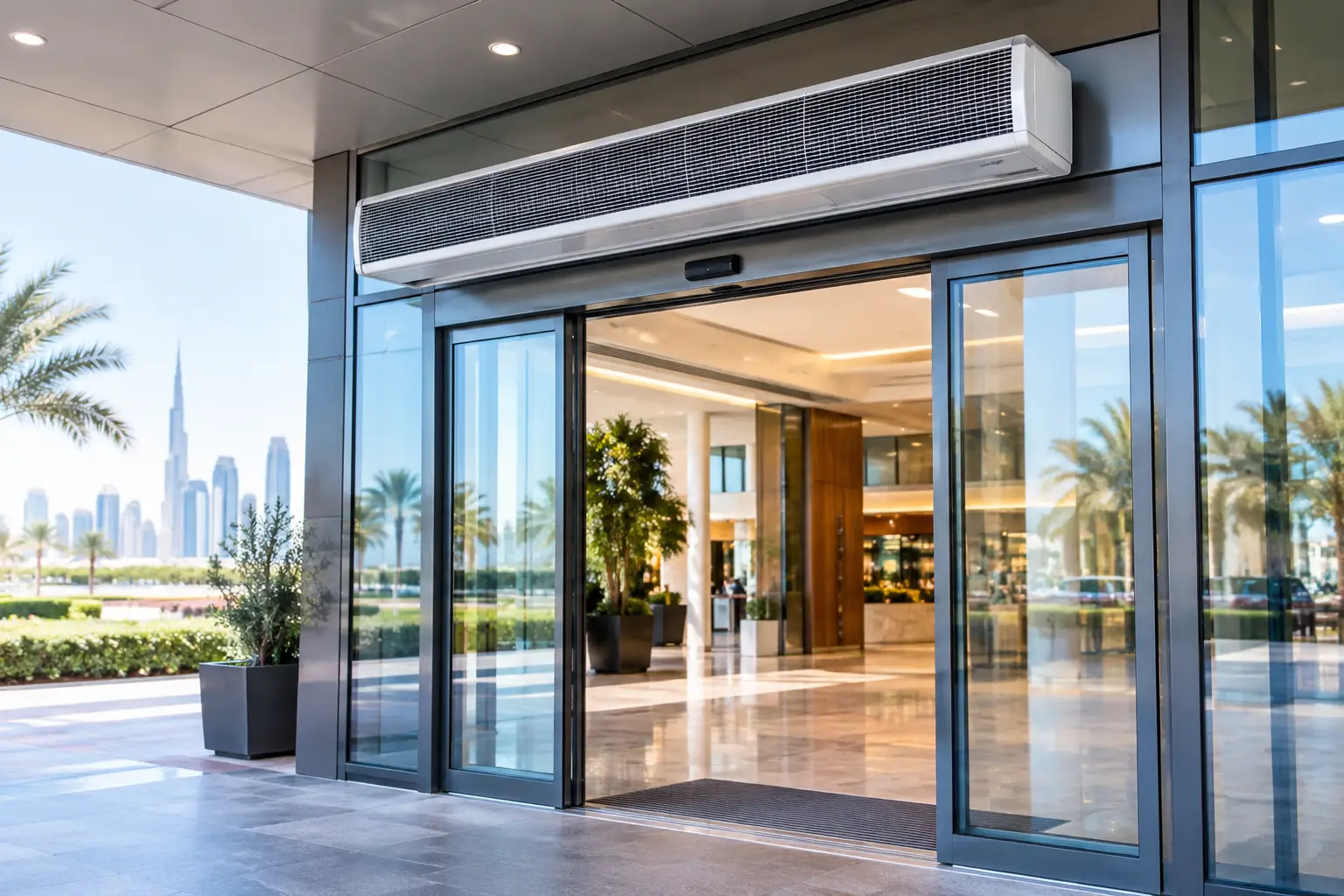
The lobby entrance is usually the most visible application. Equipment selection should balance barrier performance with the appearance and acoustics expected in a hospitality space. Recessed ceiling air curtains can be considered where the architectural design calls for a concealed finish. Commercial air curtain series may suit exposed mounting locations where service access and coverage are the primary priorities.
For revolving doors, air curtains are not automatically required in every case. Revolving doors can already limit air exchange relative to open swing doors, but adjacent swing doors, accessible entries, or frequent luggage access may still create a significant infiltration path. Assess each opening independently rather than treating the entire entrance as a single condition.
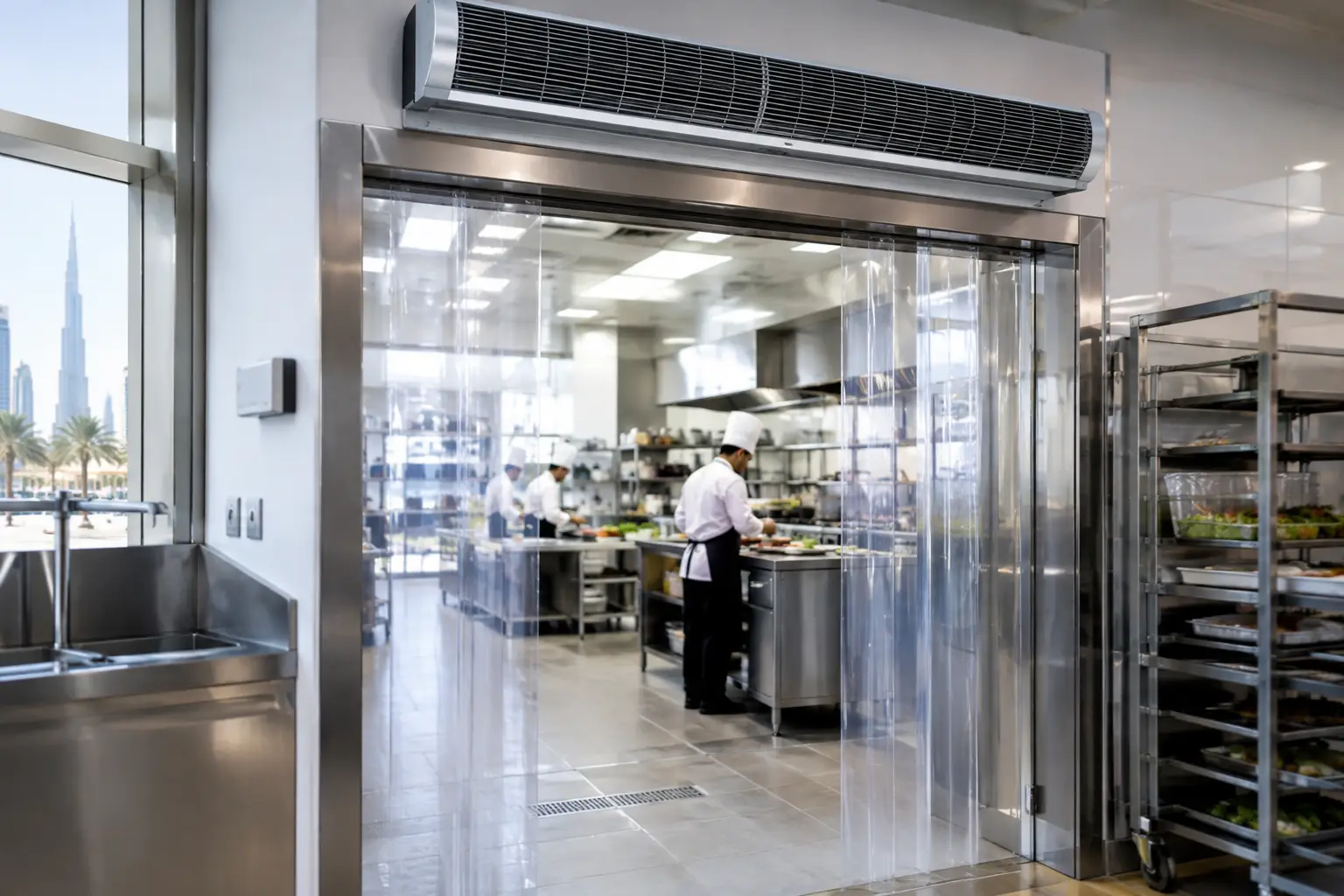
Restaurants, cafés, and banquet access
Hotel dining venues often open directly to terraces, pool decks, or busy public walkways. Here, heat management is closely tied to guest comfort and hygiene. An air curtain can help reduce warm air, dust, and insects entering when staff or guests pass through open doorways.
The selection must account for the use of the doorway. A guest entrance with intermittent traffic may need a different solution from a frequently used service door between a kitchen support area and an exterior loading route. In food-service environments, the air barrier should support operational flow rather than interfere with it.
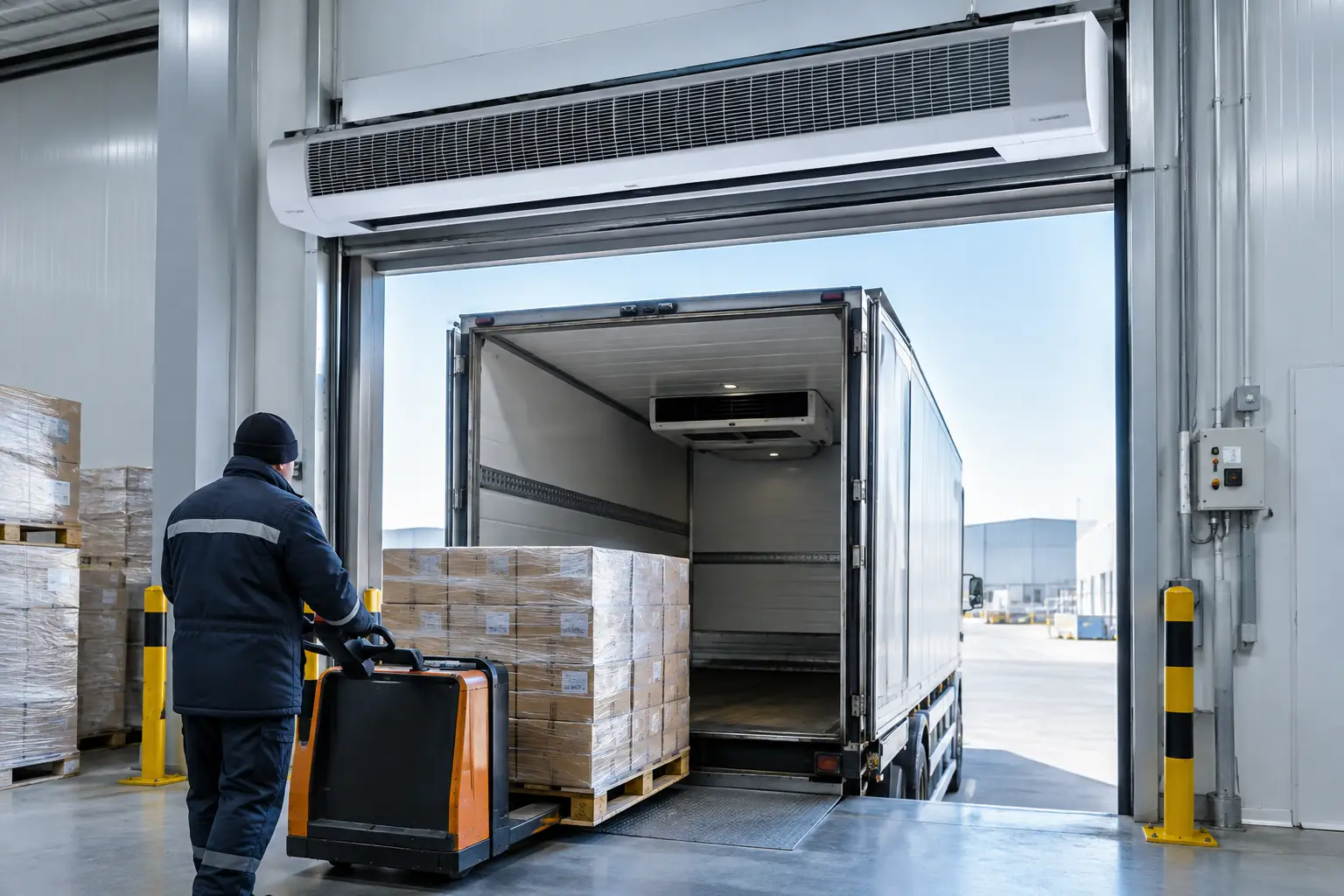
Loading docks and back-of-house entrances
Back-of-house doors are often overlooked because they are not visible to guests, yet they can place a heavy burden on hotel cooling systems. Linen deliveries, food receiving, waste handling, maintenance access, and staff movement can introduce heat, dust, fumes, and pests into corridors and work areas.
Where openings are taller, wider, or exposed to demanding traffic, an industrial-oriented solution may be more suitable than a guest-lobby unit. FreezeeX commercial and industrial ranges, including Commercial Centrifugal Flow, Commercial HiFi Plus, Industrial Centrifugal, and Dynamic Series options, are evaluated according to opening geometry, traffic volume, and environmental exposure rather than simply by application label.
A Practical Specification Process for Hotel Projects
Selecting an air curtain should be a coordinated project decision. The following workflow gives MEP consultants, contractors, and facility managers a reliable starting point.
- Map every exterior and semi-exterior opening. Separate lobby doors, restaurant doors, service entrances, loading areas, and staff access points. Record the opening width, height, door operation, and approximate traffic intensity.
- Identify the exposure level. Note direct solar gain, wind direction, dust exposure, proximity to vehicle lanes, and whether the opening is covered by a canopy or vestibule.
- Review the HVAC intent. Confirm the indoor comfort target and evaluate whether pressure imbalances or insufficient nearby air distribution are contributing to entrance discomfort.
- Choose the mounting strategy. Surface-mounted equipment can be practical for many commercial doors, while recessed ceiling placement may be preferred in architecturally sensitive public areas.
- Coordinate controls with door operation. Air curtains are commonly considered alongside door contacts and operating schedules so that they support actual traffic patterns rather than running without purpose.
- Plan for access and upkeep. Positioning should allow the maintenance team to inspect and service the system without disrupting hotel operations or damaging finished ceilings.
Avoid These Common Hotel Entrance Mistakes
The biggest mistake is treating an air curtain as a substitute for sound HVAC design. It is an entrance-control device that supports cooling efficiency and indoor comfort, not a replacement for correctly sized cooling capacity, appropriate air distribution, or well-managed building pressure.
Another mistake is selecting based only on doorway width. Width is essential, but mounting height, external wind, and the distance the air stream must travel are equally important. A unit that looks adequate above the entrance may deliver limited protection if its airflow cannot maintain a stable barrier across the full door height.
Finally, avoid using the same model at every opening. A hotel’s front lobby, terrace restaurant, staff corridor, and delivery area present different operating conditions. Zone-specific selection is usually the more effective long-term approach.
Air Isolation That Supports the Guest Experience
When guests walk from extreme outdoor heat into a hotel, the lobby should immediately feel calm, cool, and controlled. That experience starts at the door. Effective entrance air isolation also helps reduce the operational strain caused by continuous guest movement in tropical, humid, and desert climates.
For new hotel developments, renovations, or recurring lobby comfort issues, request a consultation and quotation based on your entrance dimensions, mounting conditions, traffic patterns, and HVAC requirements. A correctly specified air curtain can protect the cooled environment your hotel has invested in while keeping the welcome open.