
By 9:00 a.m., the lobby tells the story. The glass doors have opened hundreds of times, the reception area feels warmer than it should, and dust starts collecting near the entrance before the workday is fully underway. In hot, high-traffic markets, an air curtain for office building entrance areas is not a cosmetic add-on. It is a control measure for cooling loss, indoor comfort, and cleaner building operation.
For facility managers, consultants, and MEP contractors, the question is rarely whether entrance protection matters. The real question is which system will actually perform under constant door cycles, strong outdoor heat, and varying humidity levels. Office buildings in places such as Dubai, Riyadh, Doha, Cairo, Lagos, and Nairobi do not face mild operating conditions. Entrance equipment has to hold its line against desert heat, humid air, dust, and daily traffic peaks without becoming a maintenance problem of its own.
Why an air curtain for office building entrance matters
An office entrance is a pressure point. Every time the door opens, conditioned indoor air escapes and hot outdoor air pushes in. That exchange drives up HVAC load, creates temperature swings near reception desks and waiting areas, and makes the space feel less controlled than the rest of the building.
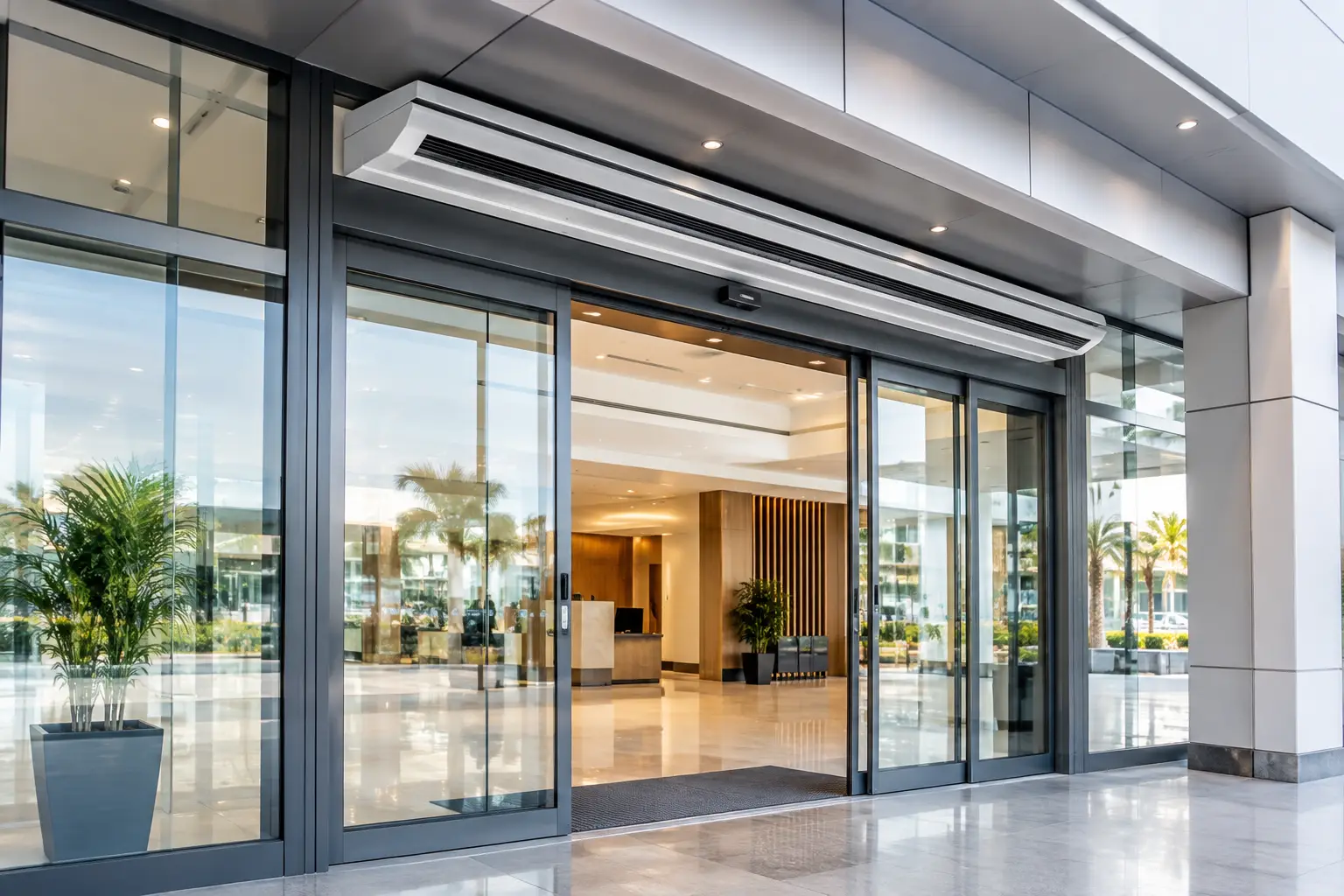
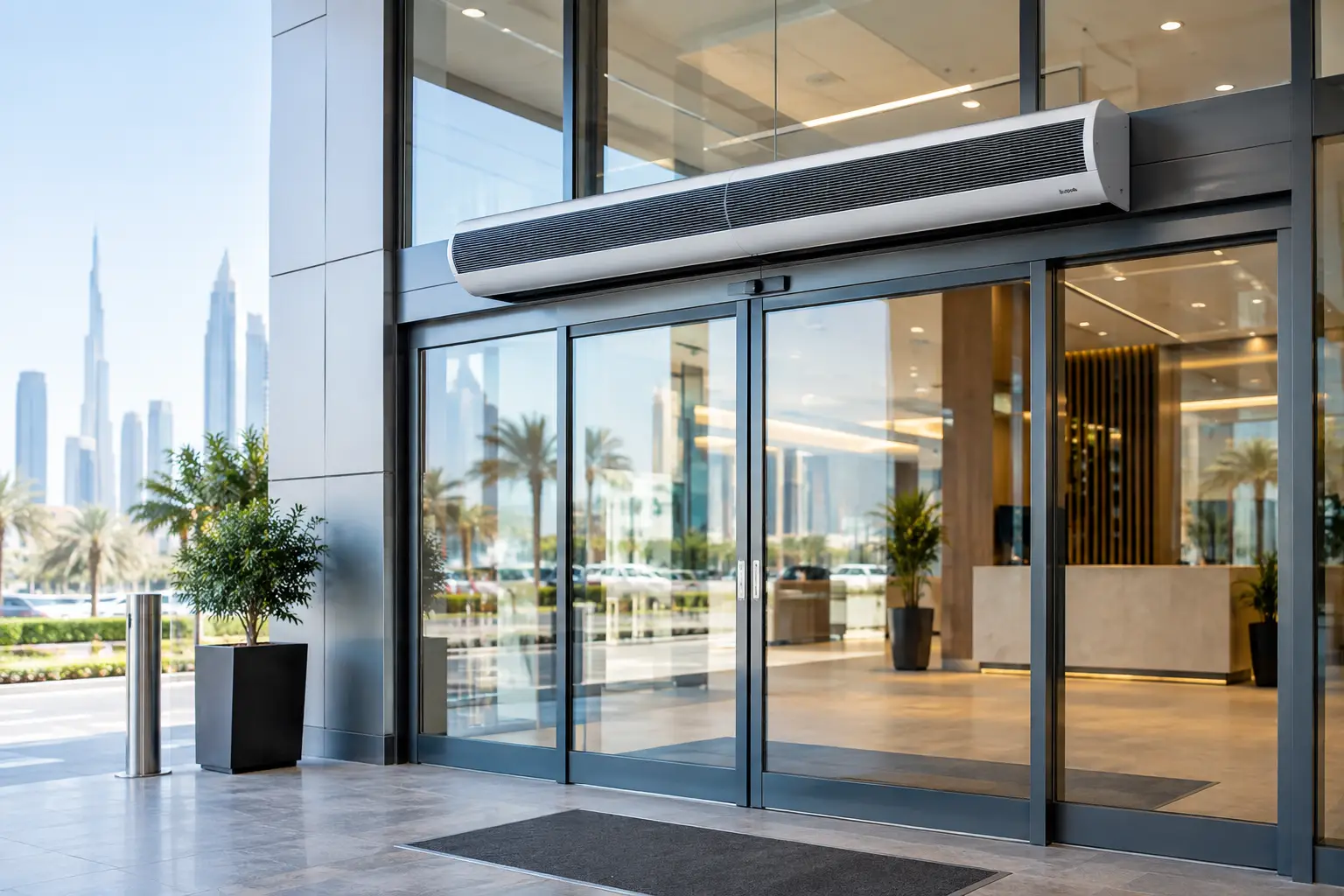
A properly selected air curtain creates a high-velocity air barrier across the doorway. It does not physically close the opening, but it reduces the transfer of heat, dust, airborne particles, humidity, and insects. In office settings, that translates into more stable lobby temperatures, lower strain on cooling systems, and a better arrival experience for staff and visitors.
This matters even more in tropical and desert climates. In these environments, outdoor air is not just warmer. It often carries fine dust, moisture, and contaminants that increase cleaning frequency and undermine indoor comfort. When a building entrance operates all day, small losses become a large operational cost.
What office buildings need from an entrance air barrier
Office applications sit in a middle ground. They usually do not require the extreme throw and heavy-duty construction of an industrial loading area, but they still need stronger performance than a light retail doorway with lower traffic. That is why application fit matters more than headline product claims.
For most office projects, airflow consistency is the first priority. The unit must cover the full door width and project enough air velocity to the floor or threshold zone. If the air stream breaks too early, hot air infiltration still occurs at the lower section of the opening, which is where many systems fail in real-world use.
Noise also matters in office environments. A lobby, reception area, or visitor entrance cannot tolerate the same sound profile as a warehouse or plant. That does not mean choosing the quietest unit on paper. It means balancing sound levels with actual barrier performance. A unit that is quiet but underpowered will cost more in cooling loss than it saves in acoustics.
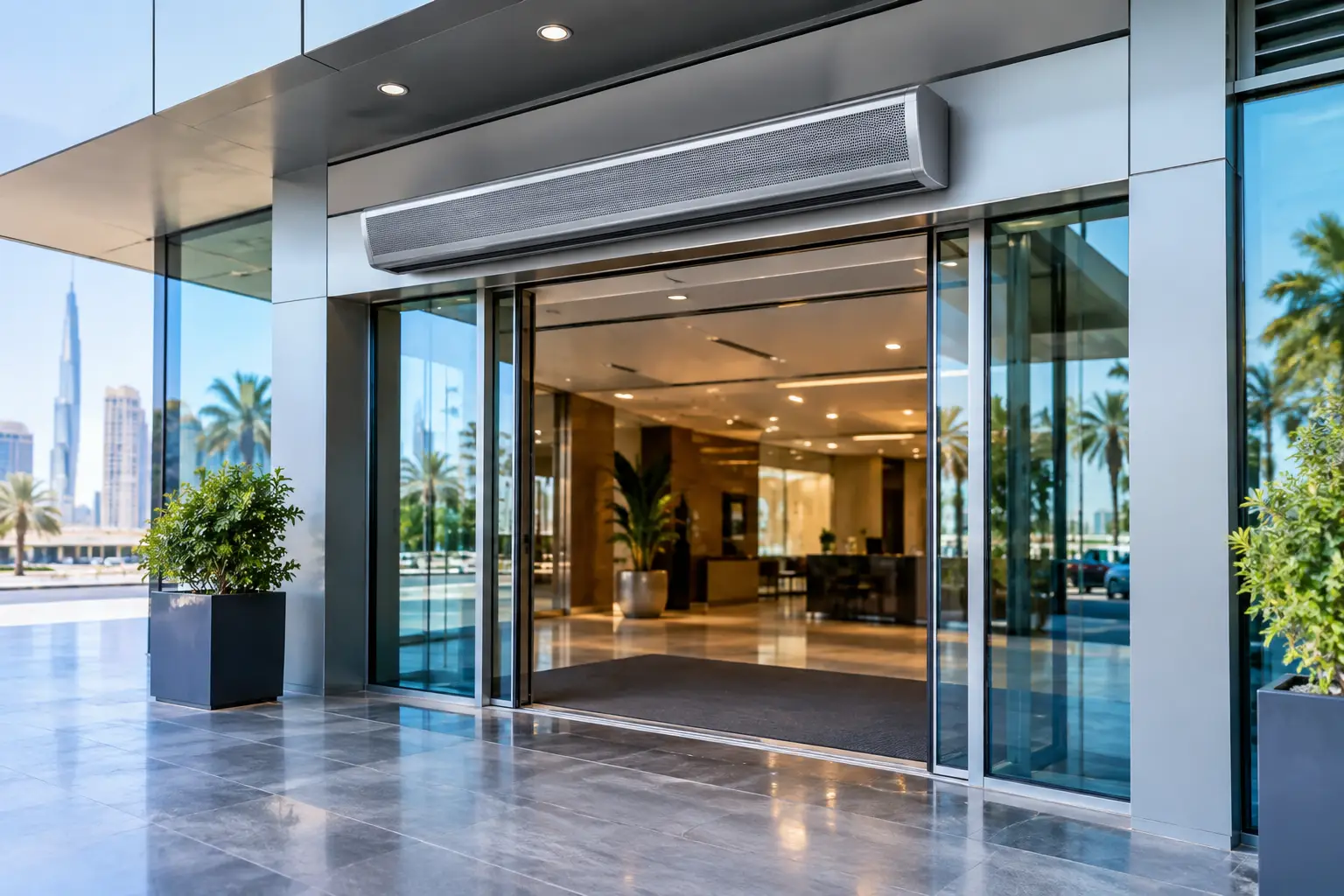
Appearance is another factor, especially for commercial towers, corporate headquarters, and premium mixed-use offices. In some projects, an exposed commercial air curtain is acceptable. In others, recessed ceiling integration is the better choice because it preserves the entrance design while maintaining performance.
Choosing the right air curtain for office building entrance design
The right selection starts with the opening, not the catalog. Door height, door width, traffic frequency, vestibule layout, ceiling conditions, and local climate all affect which unit should be specified.
Door dimensions and mounting height
Mounting height has a direct effect on performance. As doors get taller, the unit needs enough discharge strength to maintain an effective air stream all the way down. Many specification mistakes happen when a unit is chosen based on width alone, while the throw requirement is ignored.
For a standard office entrance, a commercial centrifugal air curtain is often a strong fit because it provides stable airflow, good coverage, and a practical balance of sound and performance. For higher aesthetic requirements, recessed models can deliver the same operational benefit with a cleaner ceiling finish, provided the plenum and servicing access are properly planned.
Traffic pattern and door cycle frequency
A side entrance used occasionally has very different needs from a main lobby with constant pedestrian flow. High-traffic office entrances need equipment designed for sustained operation. Motor reliability, blower quality, and airflow stability become more important than entry-level cost.
This is especially true in buildings that experience concentrated arrival and departure peaks. Staff start times, visitor traffic, and lunch-hour movement can turn the entrance into a continuous open-close cycle. In those conditions, the air curtain must maintain consistent discharge without noticeable performance drop.
Climate exposure
An office tower in a shaded central district and an office site exposed to open desert winds face different entrance conditions. In hotter regions with dust-heavy air or elevated humidity, the system must be selected for climate-adapted performance, not generic indoor use.
That is where tropical and desert climate design matters. Equipment built for these conditions is better positioned to handle high ambient temperatures, airborne dust, and long operating hours. For GCC, MENA, and African commercial buildings, this is not a secondary feature. It is part of the core specification.
Common mistakes in office entrance air curtain selection
The most common mistake is undersizing. Buyers sometimes choose a smaller unit to reduce upfront cost or fit a tight architectural layout. The result is usually weak lower-door protection, noticeable warm air ingress, and disappointment with energy savings.
Another mistake is treating all air curtains as interchangeable. They are not. Blower type, airflow pattern, casing design, motor quality, and mounting method all affect how a unit behaves at the entrance. A system that works well for a small retail shop may not perform well at a busy office tower entrance with taller doors and stronger pressure differences.
Poor placement is another issue. If the unit is offset, mounted too high for its rating, or obstructed by ceiling details, actual barrier performance drops quickly. On paper, the airflow may look sufficient. At the door, it may be missing the threshold entirely.
There is also the question of controls. In many office buildings, the best result comes from integrating the air curtain with the door cycle or building control logic. Continuous operation may be suitable for some sites, but smart activation can improve efficiency where traffic patterns are predictable.
Performance trade-offs decision-makers should weigh
There is no single best unit for every office building. The right choice depends on what the entrance is being asked to do.
If aesthetics are a major concern, recessed air curtains offer a cleaner visual result. The trade-off is that they require better coordination during fit-out and ceiling planning. If easy access and simpler installation are more important, exposed commercial models may be the stronger choice.
If the building entrance is extremely busy, a more powerful commercial unit can improve barrier strength, but sound level and visual presence need to be considered. If the space is quieter and more executive in feel, lower-noise models may be preferred, provided they still meet door height and air throw requirements.
The best specification usually comes from matching the unit to the entrance conditions rather than forcing the entrance to suit the unit.
Where the business case becomes clear
An office air curtain often gets evaluated as an accessory. That is a mistake. In high-temperature regions, it directly affects energy use, indoor comfort, hygiene, and first-impression quality.
When cooling loss is reduced at the entrance, the HVAC system does not need to work as hard to maintain lobby setpoints. That can help reduce wasted energy, especially in buildings with long operating hours and frequent traffic. At the same time, blocking dust and outside air reduces housekeeping pressure and helps maintain a cleaner reception environment.
There is also a comfort issue that matters to tenants and staff. Reception teams, security staff, and front-desk personnel spend long hours near the doorway. Without effective air separation, they feel the temperature fluctuation first. Over time, that becomes a building performance complaint, not just an entrance issue.
For consultants and contractors, this is why air curtains should be approached as part of the entrance climate-control strategy, not as a late-stage add-on. Correctly specified equipment supports the building’s cooling design and improves day-to-day operation.
Specification support matters as much as the equipment
The difference between a successful installation and a disappointing one often comes down to early application review. Door dimensions, mounting constraints, environmental exposure, and expected traffic all need to be considered before the model is selected.
That is particularly relevant for project teams working across hot-weather commercial markets. A building in Abu Dhabi, Muscat, Casablanca, or Lagos may share the same broad challenge of heat and infiltration, but the entrance conditions can still differ significantly. Product category, air velocity, finish, and installation method should reflect the site, not just the budget line.
If you are specifying an air curtain for office building entrance performance, the practical route is to review the opening conditions with a supplier that understands commercial airflow behavior in tropical and desert climates. FreezeeX supports consultants, contractors, and facility teams with application-based recommendations and quote-led supply for office, commercial, and industrial entrances.
If you are planning a new office project or correcting a weak entrance barrier in an existing building, request a consultation and technical quotation based on your actual door dimensions, traffic level, and climate exposure. The right system should not just fit the opening. It should protect the building every hour the doors stay in use.

One Response