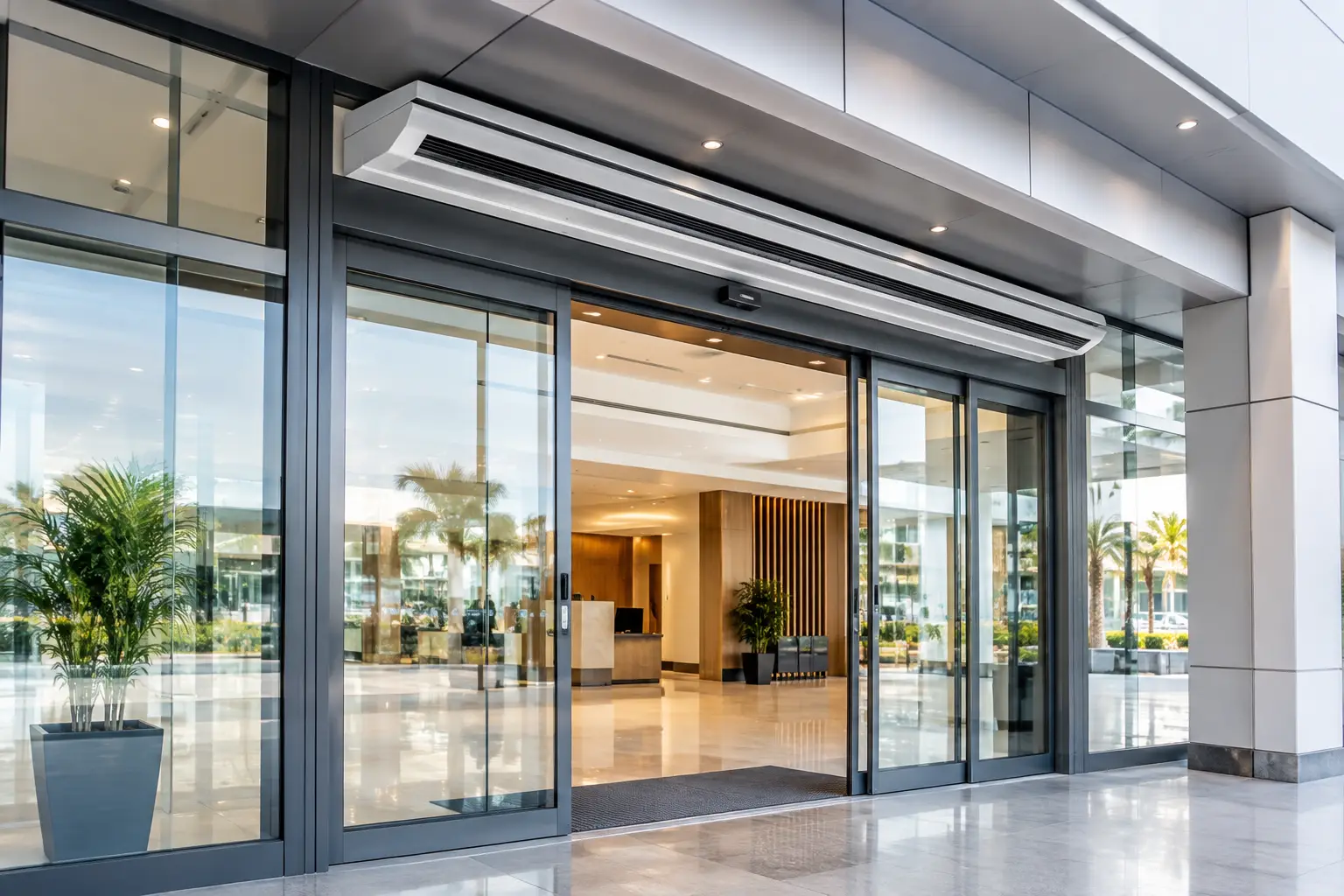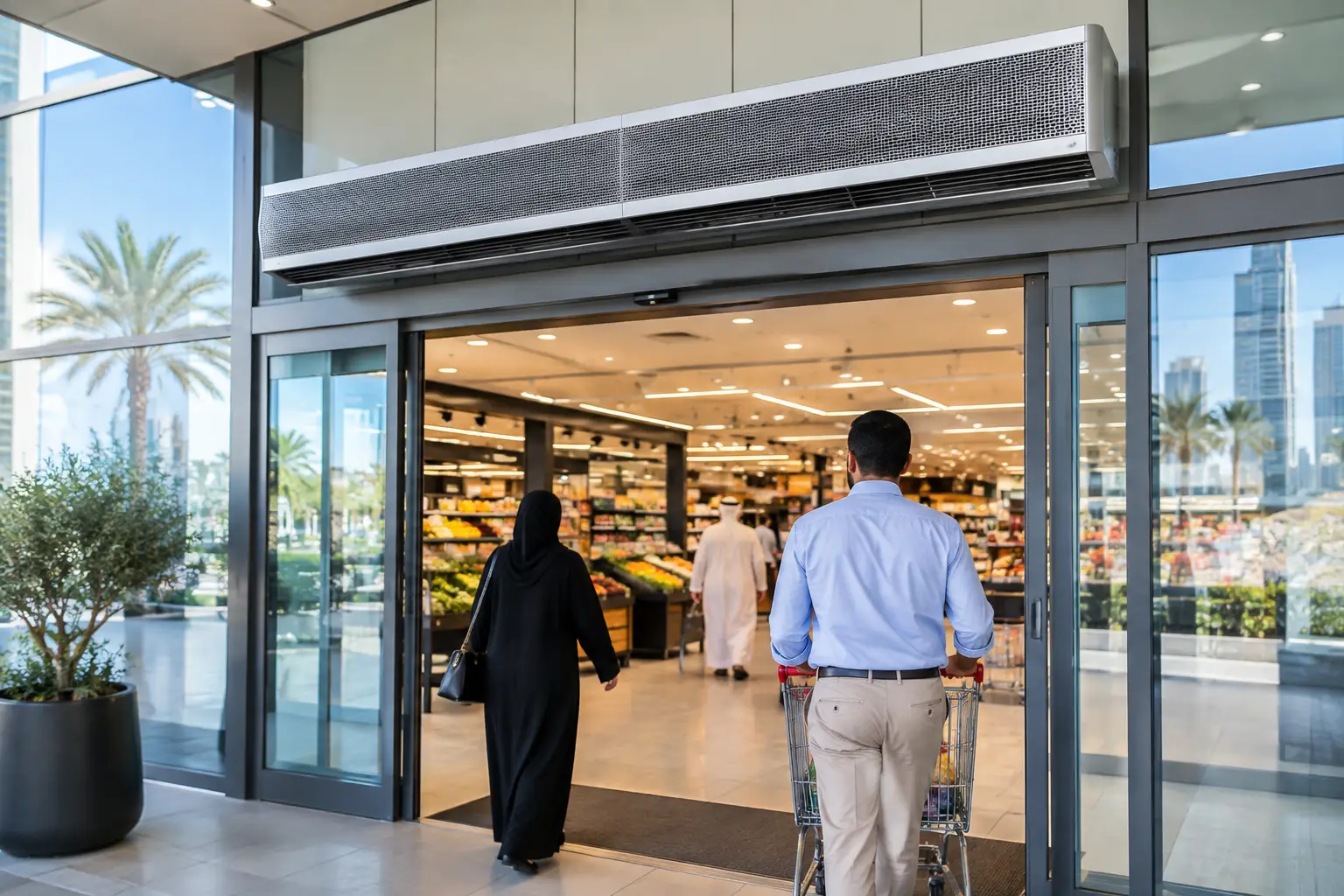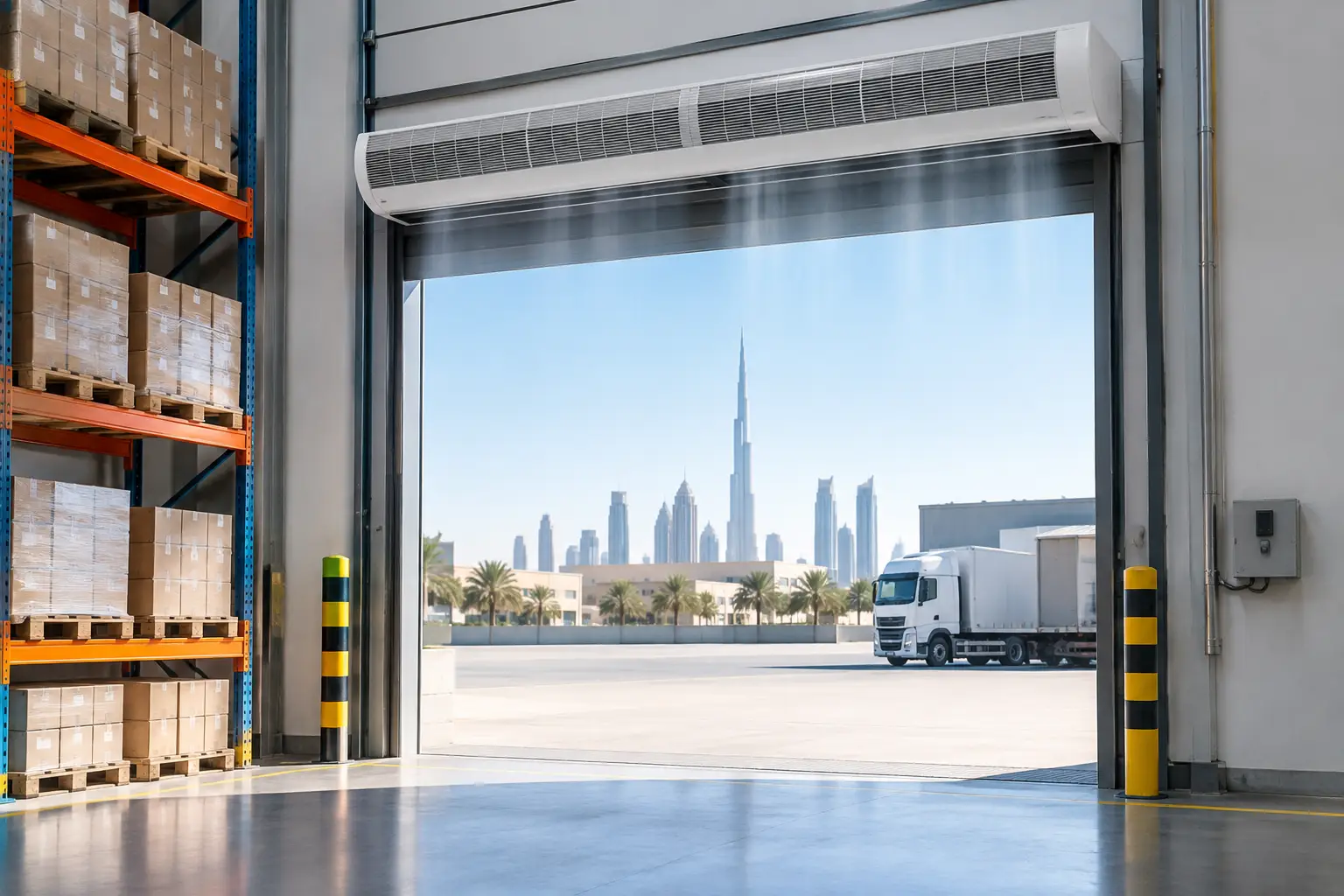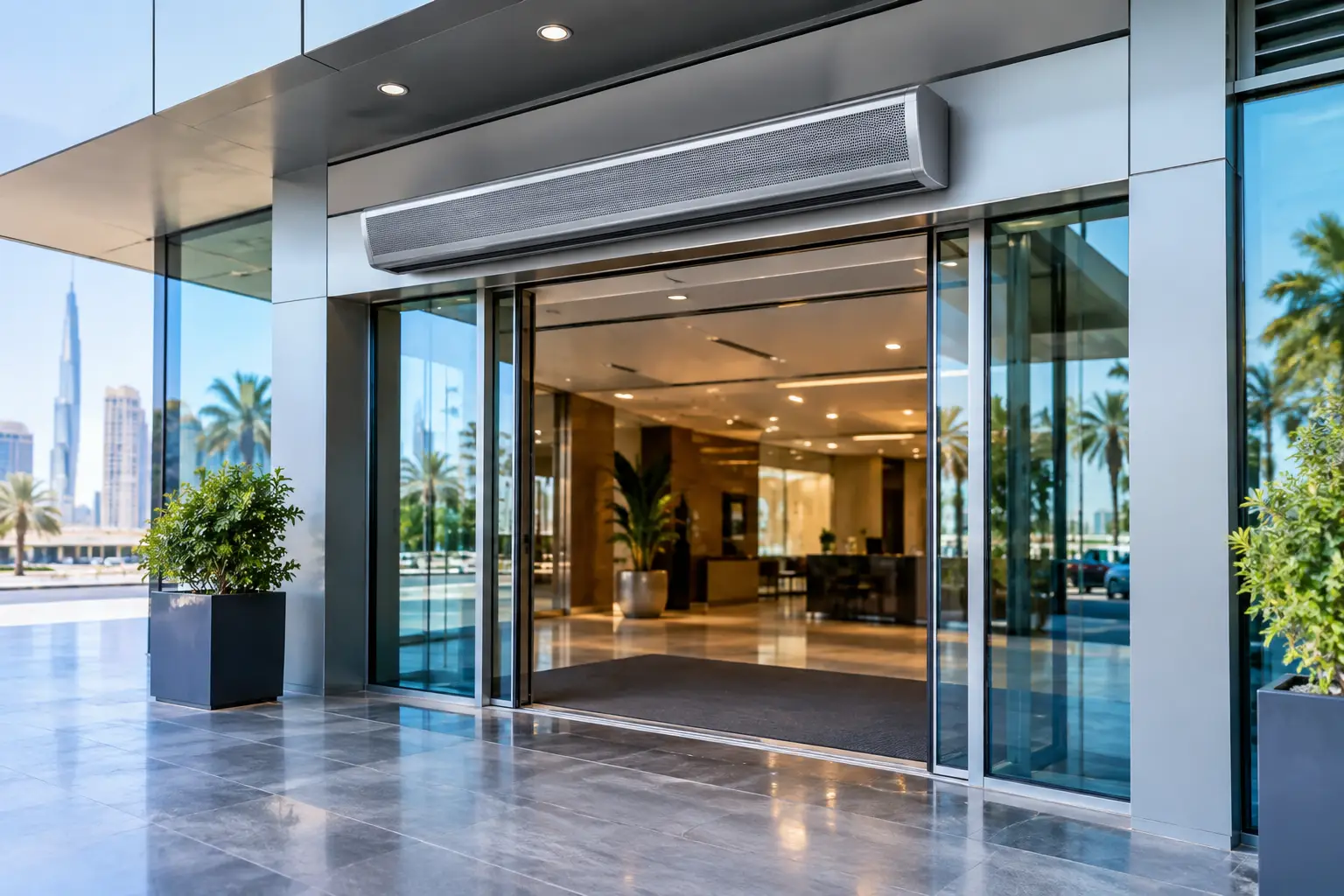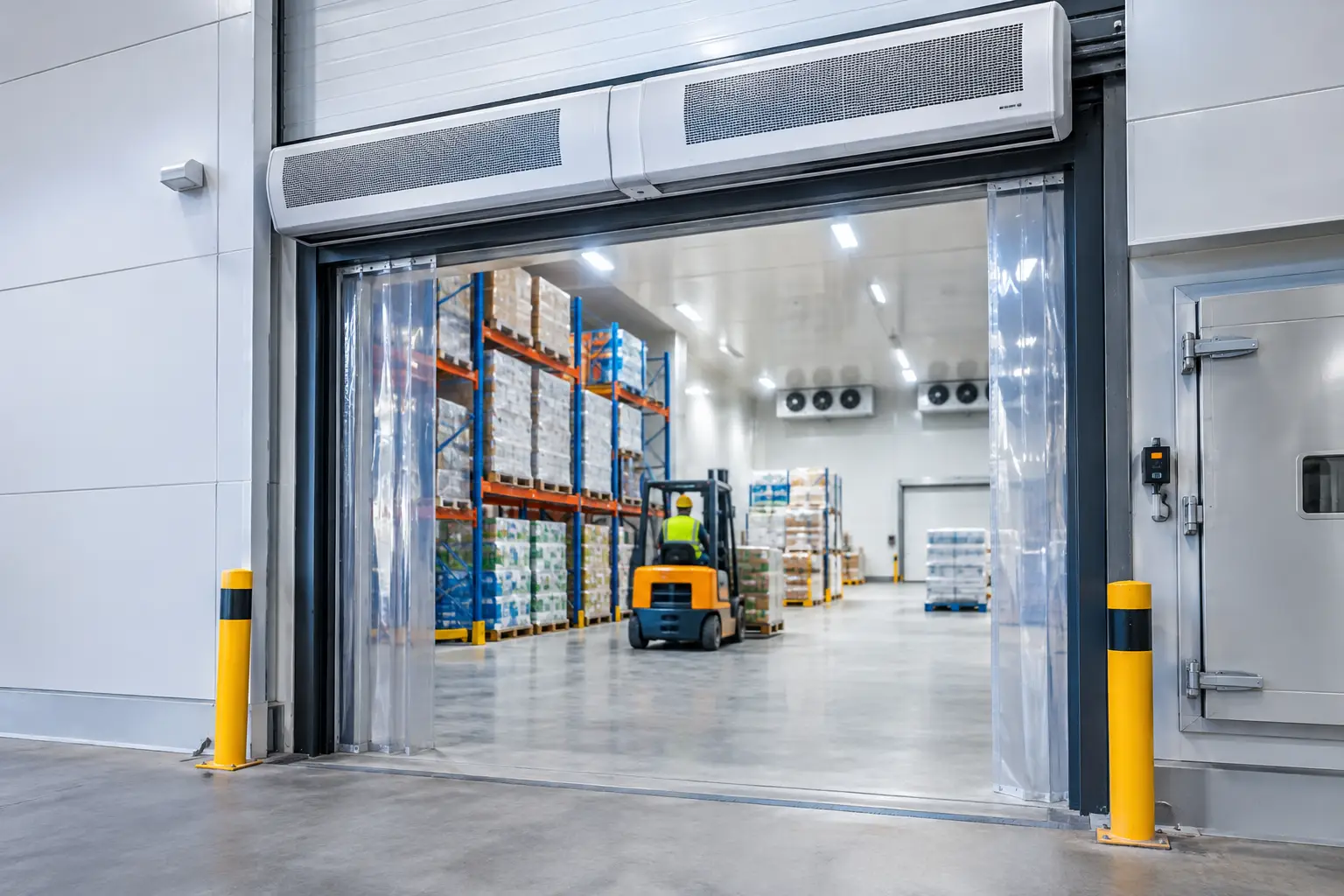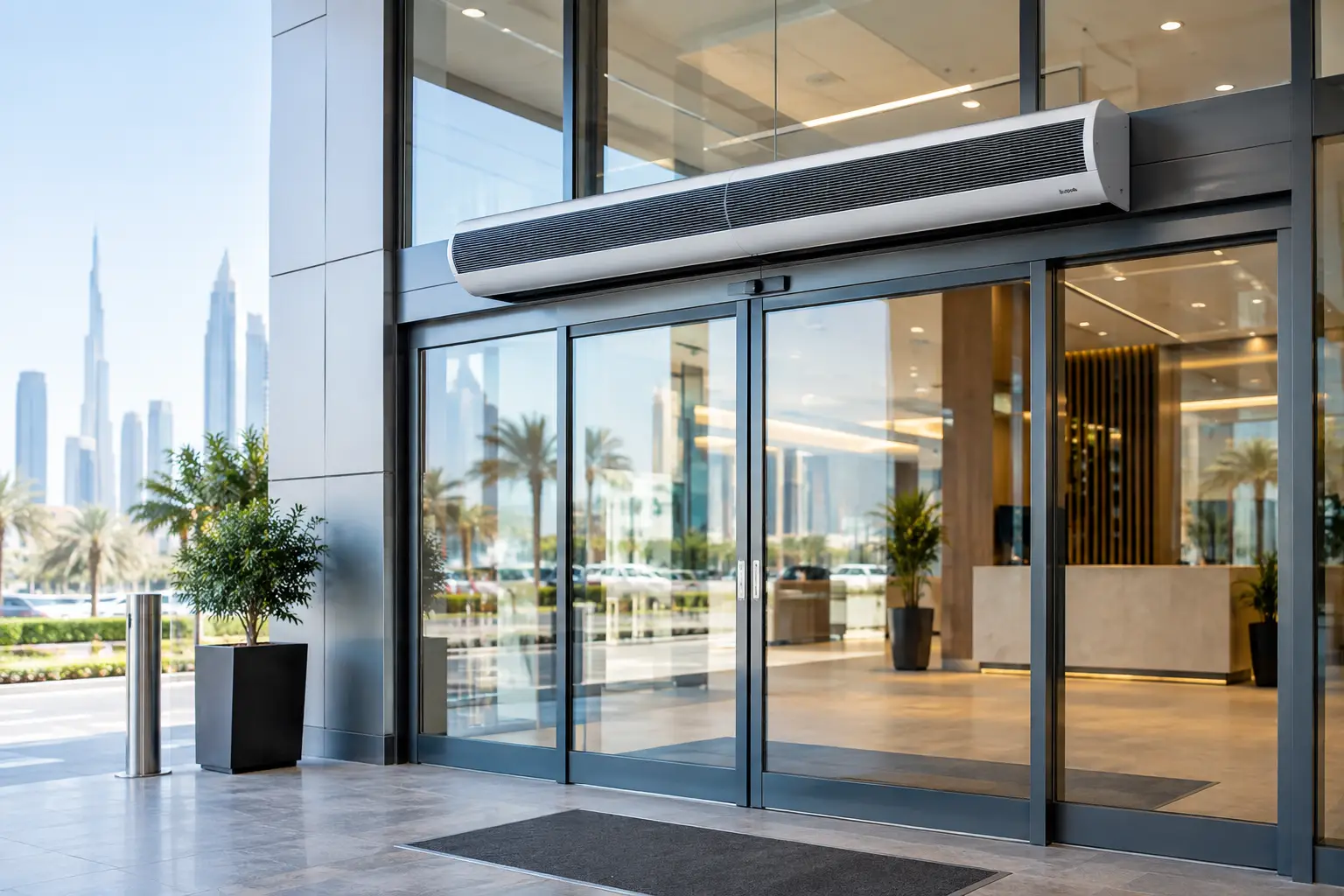
A supermarket entrance in Dubai can open hundreds or thousands of times each day. A warehouse loading door in Riyadh may face hot, dust-laden air for hours. In either case, an air curtain that looks acceptable on a schedule but cannot maintain an effective air barrier at the doorway will increase cooling loss and compromise indoor comfort. That is why essential air curtain procurement features must be evaluated as a connected performance specification, not as a simple comparison of unit price and nominal door width.
For contractors, consultants, and facility teams, the goal is to specify a system that matches the entrance, traffic pattern, mounting constraints, and local climate. The right unit helps reduce the transfer of hot air, humidity, dust, insects, and airborne contaminants while allowing people, carts, and goods to move freely.
Start With Air Barrier Performance, Not Cabinet Size
The defining procurement question is whether the air stream will reach the floor with enough velocity and coverage to resist the pressure and temperature differences across an open doorway. This depends on more than the stated air volume. Mounting height, discharge geometry, fan type, entrance width, crosswinds, and HVAC pressure balance all affect real performance.
Request documented airflow data, air velocity information, and the recommended installation height for the selected model. A unit installed above a 3-meter retail entrance has different requirements from one installed above a 5-meter logistics door. If the air stream loses momentum before reaching the floor, outdoor air can pass below the barrier even when the motor is operating at full speed.
For wide openings, confirm how multiple units will be arranged and controlled. The air discharge must form a continuous curtain without dead zones between sections. Door width should not be treated as an approximate sizing exercise, especially in high-traffic stores, airports, factories, and distribution centers.
Essential Air Curtain Procurement Features for Climate
Hot, humid, and desert environments place unusual demands on entrance equipment. Facilities in the UAE, Saudi Arabia, Qatar, Oman, and across Africa often contend with high outdoor temperatures, fine dust, humidity, and frequent door operation. A specification that works in a mild operating environment may not hold up in these conditions.
Key procurement factors include:
- Fan and motor construction
- Dust resistance and service access
- Corrosion-appropriate materials
- Mounting position and discharge direction
- Controls that reflect operating conditions
- Noise requirements
- Whole-system energy performance
- Complete technical submittal documentation
Fan and Motor Construction
Centrifugal fan systems are commonly appropriate where greater throw and static-pressure capability are needed, including warehouses, industrial entrances, and taller doorways. They can maintain a more focused stream than designs intended only for lower mounting heights. For customer-facing commercial spaces with lower ceilings, the required balance may lean toward compact dimensions, lower sound output, and a clean architectural finish.
Ask for the motor duty rating, thermal protection, bearing arrangement, and expected operating conditions. Continuous operation at a busy entrance is materially different from occasional operation at a low-traffic service door. The motor and blower assembly should be selected for the anticipated duty cycle, not merely for intermittent demonstration use.
Dust Resistance and Service Access
Dust accumulation can reduce airflow, raise noise, and increase mechanical wear. This is a practical procurement issue in desert and industrial locations, not an optional maintenance detail. Evaluate whether the unit provides suitable intake protection where required and whether filters or nets can be accessed without removing the complete installation.
Service access also affects lifecycle cost. A recessed ceiling air curtain may offer a refined appearance in a hotel lobby or mall, but access panels and maintenance clearance must be resolved during design coordination. For exposed industrial installations, the cabinet should tolerate the working environment and permit practical inspection of motors, impellers, wiring, and controls.
Corrosion-Appropriate Materials
Humidity, coastal air, food-processing washdown exposure, and airborne contaminants can accelerate corrosion. Procurement documents should identify cabinet finishes, coated components, and the intended environment rather than assuming a standard painted enclosure is suitable everywhere. The correct material specification depends on the site. A dry inland warehouse and a humid coastal loading entrance do not present the same risk profile.
Match Mounting and Discharge to the Entrance
A correctly selected air curtain can underperform when installed in the wrong position. Procurement teams should confirm the available mounting height, the structure available for support, the location of ceiling bulkheads, lighting, sprinklers, signage, and automatic door mechanisms before finalizing the model.
The discharge should be positioned as close as practical to the opening and directed to create a stable vertical barrier. Recessed units are useful where ceiling integration and visual presentation matter. Surface-mounted commercial units may suit supermarkets, retail stores, restaurants, and back-of-house entrances. Industrial centrifugal systems are generally better suited to larger openings, demanding traffic, and higher mounting positions.
Door configuration matters as well. Sliding entrances, hinged doors, roller shutters, and loading bays create different airflow conditions. A door that is deeply recessed or exposed to prevailing winds may need additional assessment. In these cases, treating the air curtain as a standard accessory can lead to poor results. It should be coordinated with the overall entrance and HVAC design.
Specify Controls That Reflect Operating Reality
An air curtain should run when it delivers a measurable operational benefit. Controls determine whether that happens consistently. At a minimum, identify the preferred operating logic: manual control, door switch activation, building-management integration, timed operation, or a combination of these methods.
Door-contact control is often appropriate for entrances that open intermittently because it limits unnecessary runtime. For a continuously open retail entrance in extreme heat, continuous or scheduled operation may be more appropriate. Variable-speed control can help facilities balance performance and sound levels during different traffic periods, but only if the selected speed still produces effective floor-level coverage.
Procurement documentation should also clarify electrical supply, isolation requirements, control interfaces, and whether the unit is supplied with a controller. These details prevent late-stage variations and avoid a common problem: an otherwise suitable air curtain installed without a practical method to coordinate operation with the door.
Treat Noise as a Design Requirement
Sound level should be assessed in the context of the occupied space, not as an isolated catalog figure. A higher sound output may be acceptable above a busy warehouse door, while a reception area, restaurant, healthcare facility, or hotel entrance may require more careful selection.
Ask where and how sound levels were measured. The number can vary by fan speed, distance, mounting method, and room acoustics. It is also worth considering that air turbulence from an incorrectly aimed or oversized unit can create an uncomfortable perceived noise level even when the published motor sound rating appears acceptable.
The trade-off is straightforward: quieter operation is desirable in customer and patient areas, but it cannot come at the expense of air barrier performance. Select the unit and operating speed according to the entrance’s real load.
Evaluate Energy Value Through the Whole System
Air curtains do consume electricity, so procurement should consider total operating energy rather than assuming every unit automatically produces savings. Their value comes from reducing the cooling load created by unmanaged infiltration through open doors. The greatest benefit usually appears where conditioned indoor air meets frequent access, high outdoor heat, humidity, dust, or contamination exposure.
Request power consumption data at the intended operating speed and compare it with expected runtime. Then consider the operational consequences of uncontrolled infiltration: higher HVAC demand, uneven temperatures near entrances, humidity discomfort, dust ingress, and reduced customer or staff comfort. For cold storage, food handling, and pharmaceutical environments, the performance discussion should also account for process protection and hygiene requirements.
A lower-cost unit that requires replacement early, runs at full speed without adequate control, or fails to protect the opening is rarely the lower-cost choice over its service life. Lifecycle evaluation should include expected durability, parts availability, warranty terms, ease of maintenance, electrical consumption, and the consequences of downtime.
Ask for a Complete Submittal Before Approval
A procurement decision is stronger when suppliers provide a clear technical submittal instead of a generic product sheet. The review package should confirm the recommended model, quantity, unit length, mounting height, air volume, velocity, motor power, sound data, controls, finish, electrical requirements, and dimensional drawings.
It should also state the assumptions behind the selection. For example, has the model been selected for an exposed entrance, a high-traffic supermarket doorway, or a dust-prone industrial loading area? Are crosswinds, negative building pressure, and door operating hours part of the recommendation? These questions make it easier for MEP consultants and project teams to validate the specification before installation.
FreezeeX supports this consultation-led approach because entrance conditions determine performance. A model suitable for a retail doorway may not be appropriate for a high-bay warehouse or a humidity-sensitive production area, even if the opening widths appear similar.
Build Procurement Around the Actual Doorway
The most reliable specification begins with site information: clear opening dimensions, mounting height, door type, traffic volume, outdoor exposure, indoor temperature target, and the contaminants or climate loads that need to be controlled. This information allows a supplier to recommend a practical commercial or industrial configuration rather than forcing a standard model onto an unsuitable application.
For projects in tropical, humid, and desert climates, request a consultation and quotation based on those real operating conditions. A properly matched air curtain can protect comfort, support HVAC efficiency, and keep a demanding entrance working as the building intends.