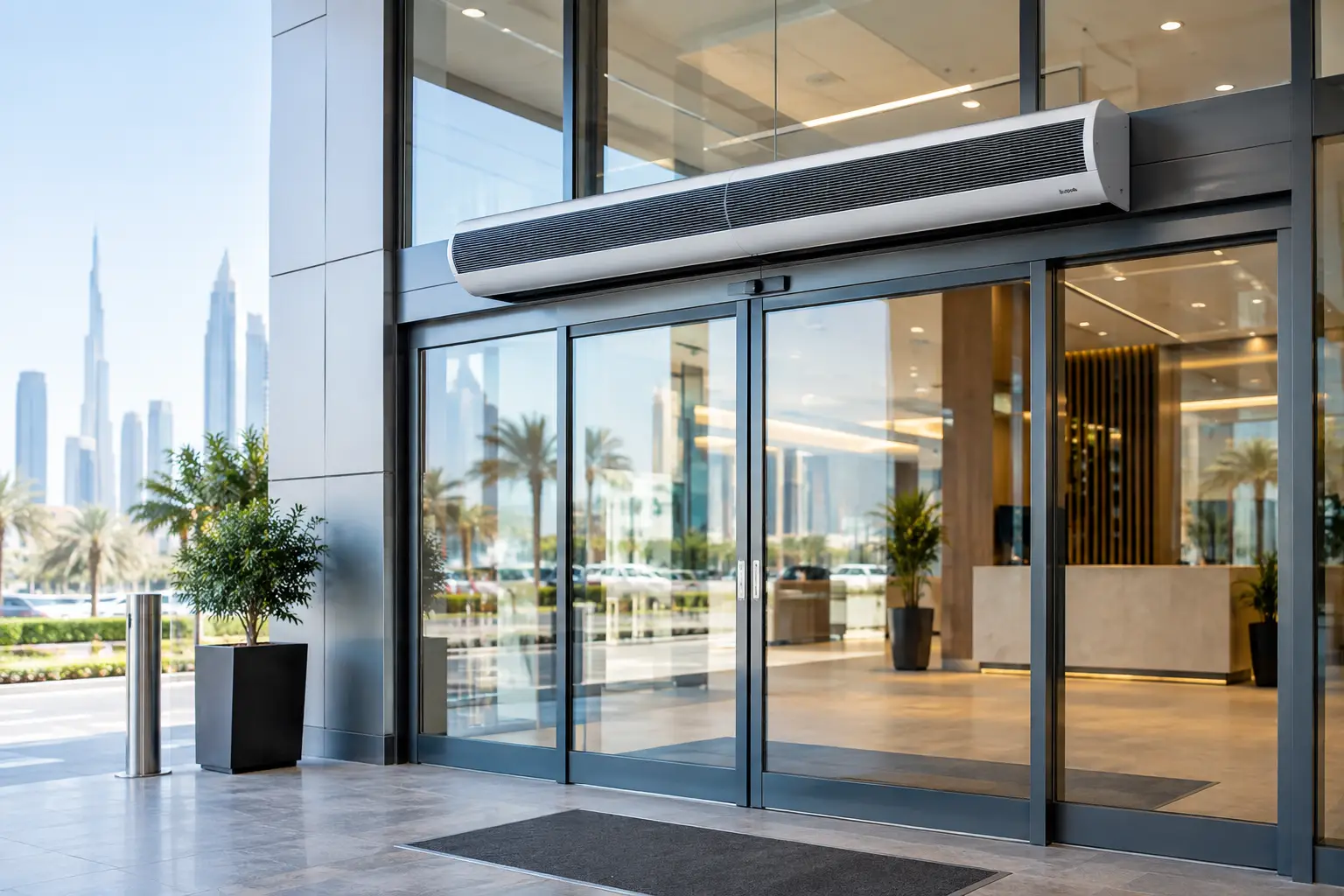
A loading-bay door left open during peak activity can pull hot, dusty, humid outdoor air into a conditioned building faster than most HVAC systems can recover. That is why the air curtain versus exhaust ventilation decision matters: these systems solve different air-management problems, and specifying one as a substitute for the other can increase energy use while leaving the entrance exposed.
For commercial and industrial sites in Dubai, Riyadh, Doha, Muscat, Cairo, Lagos, and similar hot-climate markets, the correct approach starts with the contaminant, airflow path, and operational purpose of the door. An air curtain protects an opening. Exhaust ventilation removes air from a space. In many facilities, both are required, but they must be designed to work together rather than compete.
Air Curtain Versus Exhaust Ventilation: The Core Difference
An air curtain produces a high-velocity, directional stream of air across an open doorway. The stream creates an aerodynamic barrier that limits the exchange of indoor and outdoor air while people, trolleys, forklifts, or deliveries pass through. It is primarily an entrance climate-control solution.
Exhaust ventilation draws air out of a room or process area. It is used to remove internally generated heat, moisture, odors, smoke, fumes, airborne particles, or contaminants. Because exhausted air must be replaced, the system also affects building pressure and the amount of outdoor air entering through doors, cracks, and intentional make-up-air paths.
The distinction is practical. If a supermarket entrance is admitting heat, dust, insects, and humidity whenever automatic doors open, exhaust alone is not the answer. Pulling more air from the building can create negative pressure, which may increase uncontrolled infiltration through that same entrance. A correctly selected air curtain addresses the doorway directly.
If a food preparation zone, factory process area, or chemical handling room contains fumes or heat generated inside the space, an air curtain cannot remove that pollutant source. Exhaust ventilation, often supported by dedicated make-up air and containment measures, is the relevant engineering control.
When an Air Curtain Is the Better Fit
Air curtains are most effective where the dominant problem begins at an opening. They preserve indoor conditions without restricting traffic flow, making them well suited to high-use commercial entrances and operational doors that cannot remain closed.
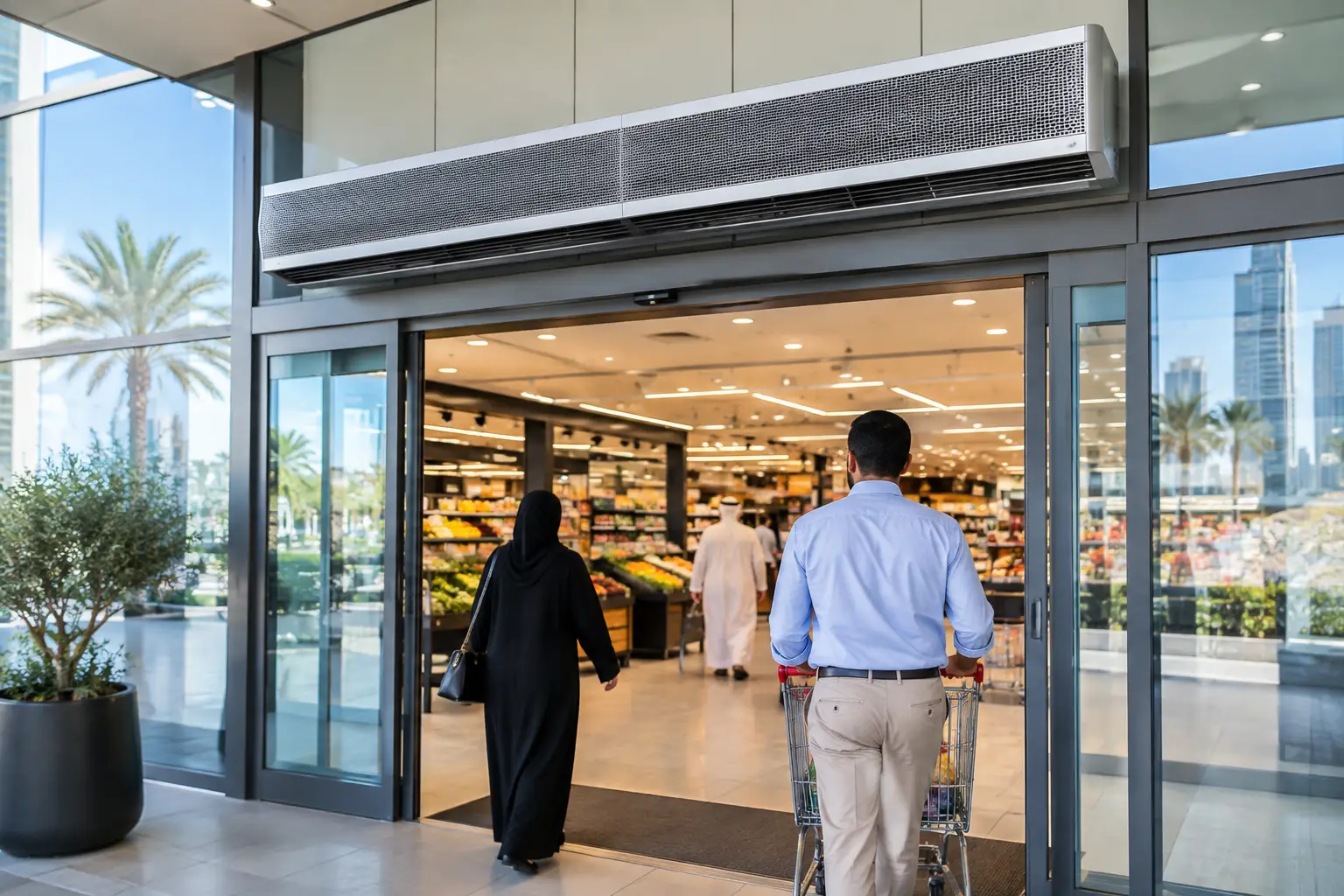
In desert and tropical climates, an entrance air curtain can reduce the inflow of hot air, fine dust, humidity, and insects. That reduces the cooling load imposed on the HVAC system and helps maintain more stable temperatures near the entrance. For facilities with strict comfort, hygiene, or product-protection requirements, that stability can be operationally significant.
Retail, hospitality, and public entrances
Retail stores, malls, hotels, hospitals, airports, and supermarkets commonly need an unobstructed customer entrance. Here, the priority is maintaining a comfortable indoor environment despite continuous pedestrian movement. A commercial unit should be matched to the installed height, width, door cycle frequency, and local external conditions.
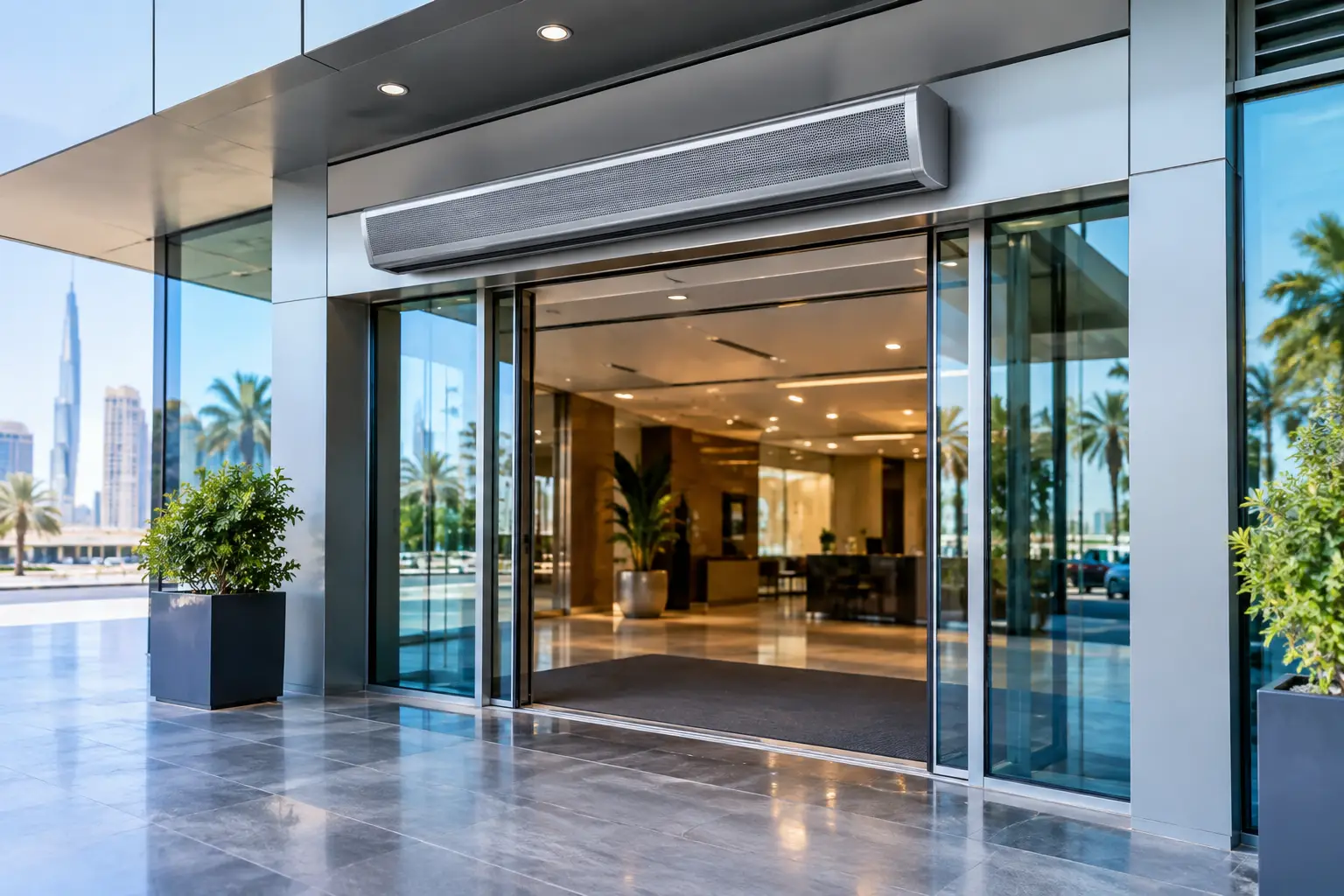
A recessed ceiling air curtain can suit premium entrances where visual integration matters. For wider or more demanding openings, centrifugal-flow commercial systems provide stronger coverage and better throw characteristics. The selected unit must create a continuous air stream across the full opening, not simply produce noticeable air movement near one side of the door.
Warehouses, logistics, and industrial doors
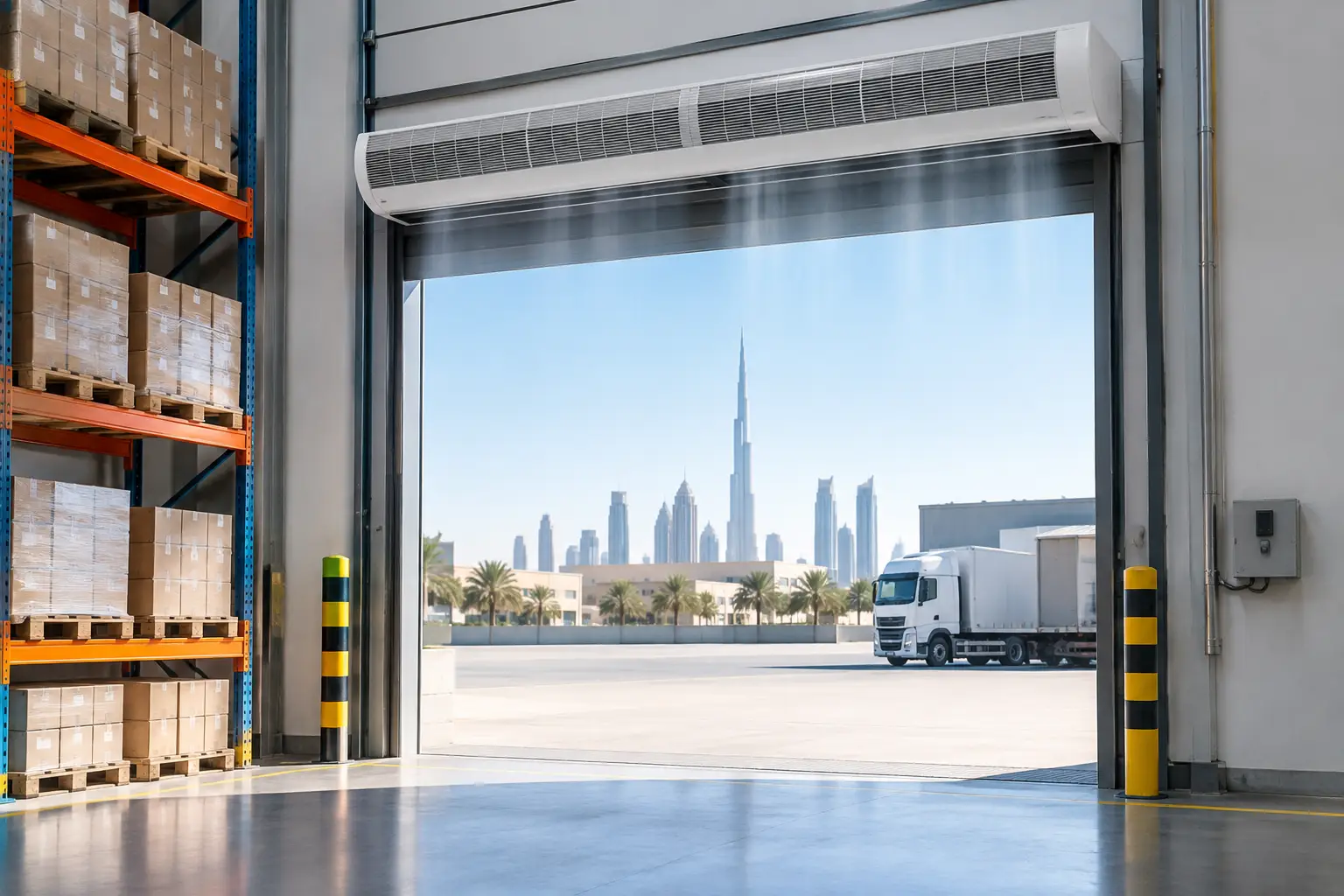
At warehouses, distribution centers, factories, and loading zones, open doors can introduce intense heat and dust while allowing cooled air to escape. Forklift traffic also makes physical strip barriers impractical in some operations. Industrial air curtains can protect these openings while preserving vehicle and personnel access.
The specification should account for door height, wind exposure, dock layout, and traffic volume. A unit that performs adequately on a sheltered retail door may be undersized at a high-bay warehouse entrance exposed to crosswinds. Industrial centrifugal systems are typically selected when duty cycle, mounting height, and air-throw requirements exceed standard commercial conditions.
Cold storage and temperature-sensitive operations
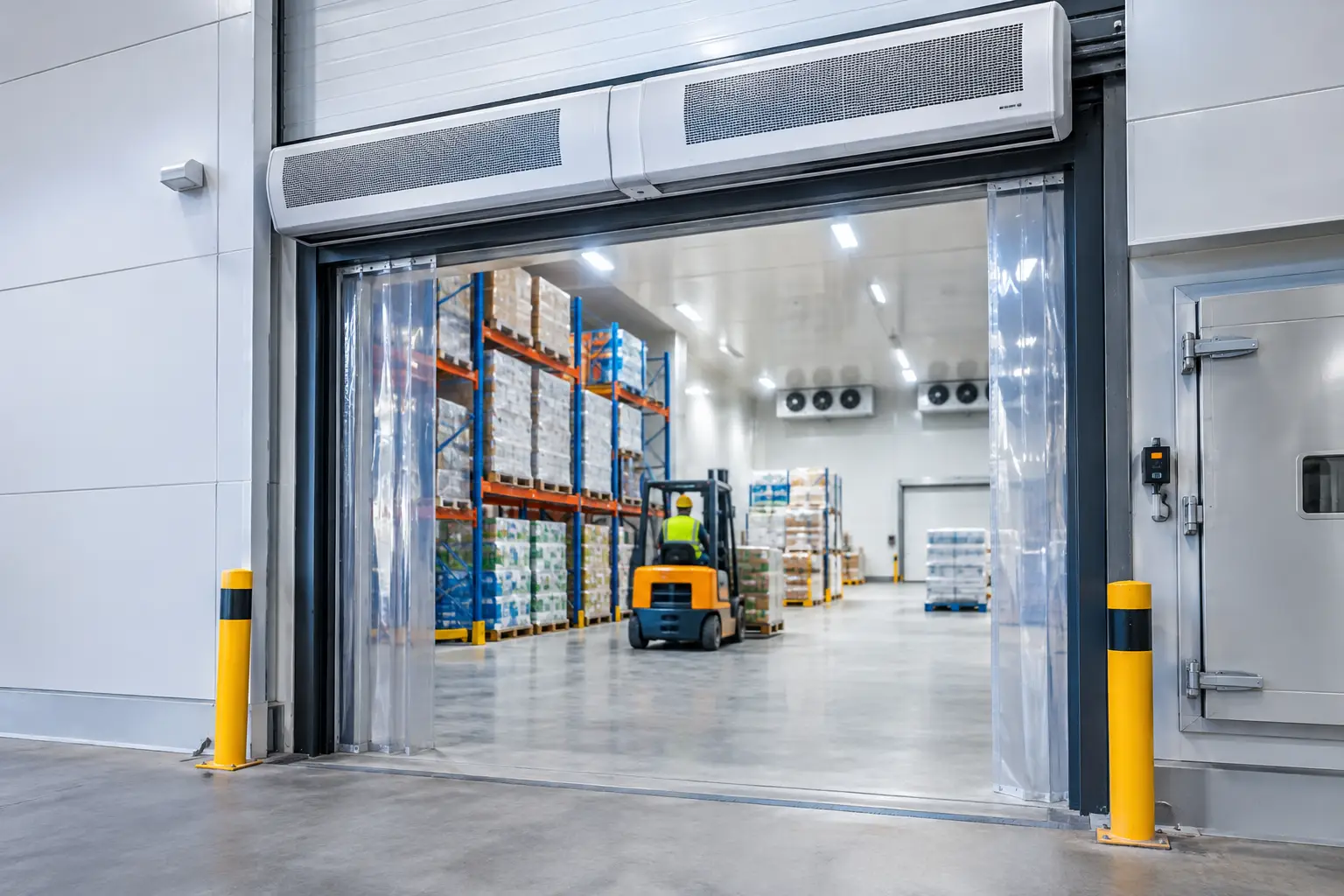
For cold storage, food processing, pharmaceutical areas, and temperature-controlled logistics rooms, the goal is to slow thermal exchange and limit moisture ingress during door openings. The air curtain must be coordinated with the door type, temperature differential, traffic pattern, and hygiene requirements.
An air curtain does not replace a closed insulated door or a controlled-door protocol. It reduces losses during necessary openings. Where chilled or frozen zones have frequent forklift movement, proper air velocity and full-width coverage are essential to prevent warm, humid air from entering around the edges of the opening.
When Exhaust Ventilation Is Necessary
Exhaust ventilation is necessary when a space needs to remove internally generated contaminants or heat. Typical examples include commercial kitchens, waste handling rooms, workshops with localized emissions, production zones, and rooms where moisture or odor must be controlled at the source.
The exhaust system should be designed around capture and removal, not simply total air movement. A hood, canopy, or localized extraction point near the source is generally more effective than attempting to pull contaminants across an occupied room. The resulting exhausted volume must then be balanced with controlled replacement air to avoid excessive negative pressure.
Negative pressure can affect door operation, increase infiltration, and draw dust or untreated outdoor air into adjacent conditioned zones. In hot and humid environments, this can raise latent cooling demand and reduce comfort. That is why a ventilation calculation should never stop at exhaust airflow alone.
Why Exhaust Alone Can Worsen Entrance Infiltration
An exhaust system removes air from the building. If make-up air is not provided in a managed way, replacement air will enter wherever the building offers the least resistance. Open entry doors and loading doors are often the largest available paths.
At a restaurant entrance, for example, kitchen exhaust may create a pressure deficit that draws outdoor heat, dust, and humidity through the customer doorway. Installing a stronger exhaust system may improve kitchen capture but make the entrance draftier and increase the load on air conditioning.
This does not mean exhaust ventilation is wrong. It means it needs pressure control. A balanced design may include dedicated make-up air for the exhaust system and an air curtain at the public entrance or service door. Each component then performs its intended job: exhaust removes internal pollutants, while the air curtain limits external intrusion.
Can an Air Curtain Replace Exhaust Ventilation?
No. An air curtain can help isolate an entrance from outdoor conditions and can reduce the migration of air between adjacent zones, but it is not a replacement for source-capture exhaust or room ventilation where contaminants are generated indoors.
For example, a factory receiving dust from an open loading door may benefit from an industrial air curtain. A factory producing airborne contaminants through a process still requires appropriate extraction. Similarly, an air curtain at a restaurant door can improve customer comfort, but it does not replace kitchen exhaust requirements.
The opposite is also true: exhaust ventilation should not be expected to protect a high-traffic entrance. Its airflow direction and pressure effects are fundamentally different from the focused downward or horizontal air stream created by an air curtain.
How to Specify the Right Combination
The correct selection begins with an operational review, not a product category. Engineers and facility teams should assess the opening dimensions, mounting location, daily opening time, traffic type, indoor temperature target, outdoor temperature and humidity, wind exposure, and existing HVAC pressure balance.
Key factors to review before specifying the system:
- Opening dimensions and mounting location
- Daily opening time and traffic pattern
- Indoor temperature target
- Outdoor temperature, humidity, and wind exposure
- Existing HVAC pressure balance
- Air curtain discharge and coverage requirements
- Exhaust airflow, contaminant source, and make-up air requirements
For air curtains, the key performance question is whether the discharge stream reaches the floor or opposing side with enough velocity to resist infiltration under actual site conditions. Installation height, nozzle design, fan type, and coverage width all influence results. Mounting a unit too high, undersizing its width, or allowing gaps between units can compromise the air seal.
For exhaust ventilation, the priority is contaminant capture, airflow rate, discharge arrangement, and make-up-air strategy. The design team should also consider whether exhaust from one zone could pull air from cleaner spaces or create unwanted drafts through frequently used doors.
A combined design is common in supermarkets, hotels, hospitals, food facilities, warehouses, and industrial plants. The air curtain protects the entrance. Exhaust handles localized pollutant, moisture, odor, or heat removal. HVAC and make-up air maintain stable pressure and temperature across the facility.
Selecting for Hot, Humid, and Dusty Conditions
Climate makes the comparison more consequential. In Gulf, MENA, and African markets, outdoor air often carries high sensible heat, high humidity, dust, or all three. Every uncontrolled entry of outdoor air raises the demand placed on cooling and filtration systems.
Choose equipment built for sustained commercial duty, with an airflow profile suitable for the opening and environment. A sheltered mall entrance requires a different solution from a dusty warehouse door or a humid food-distribution area. Noise expectations, maintenance access, finish requirements, and controls integration should also be evaluated during specification.
For projects where doors remain open for long periods, an air curtain should be treated as a building-performance component, not an accessory. Its sizing must align with the door and the HVAC design. This is particularly relevant when peak visitor traffic, delivery cycles, or wind conditions occur during the hottest part of the day.
FreezeeX can review opening dimensions, operating conditions, mounting constraints, traffic volumes, and local climate exposure to recommend an appropriate commercial or industrial air curtain system. Request a consultation and quotation before finalizing the ventilation and entrance-control strategy, especially where a project must handle desert dust, humidity, heavy traffic, and high cooling loads at the same time.