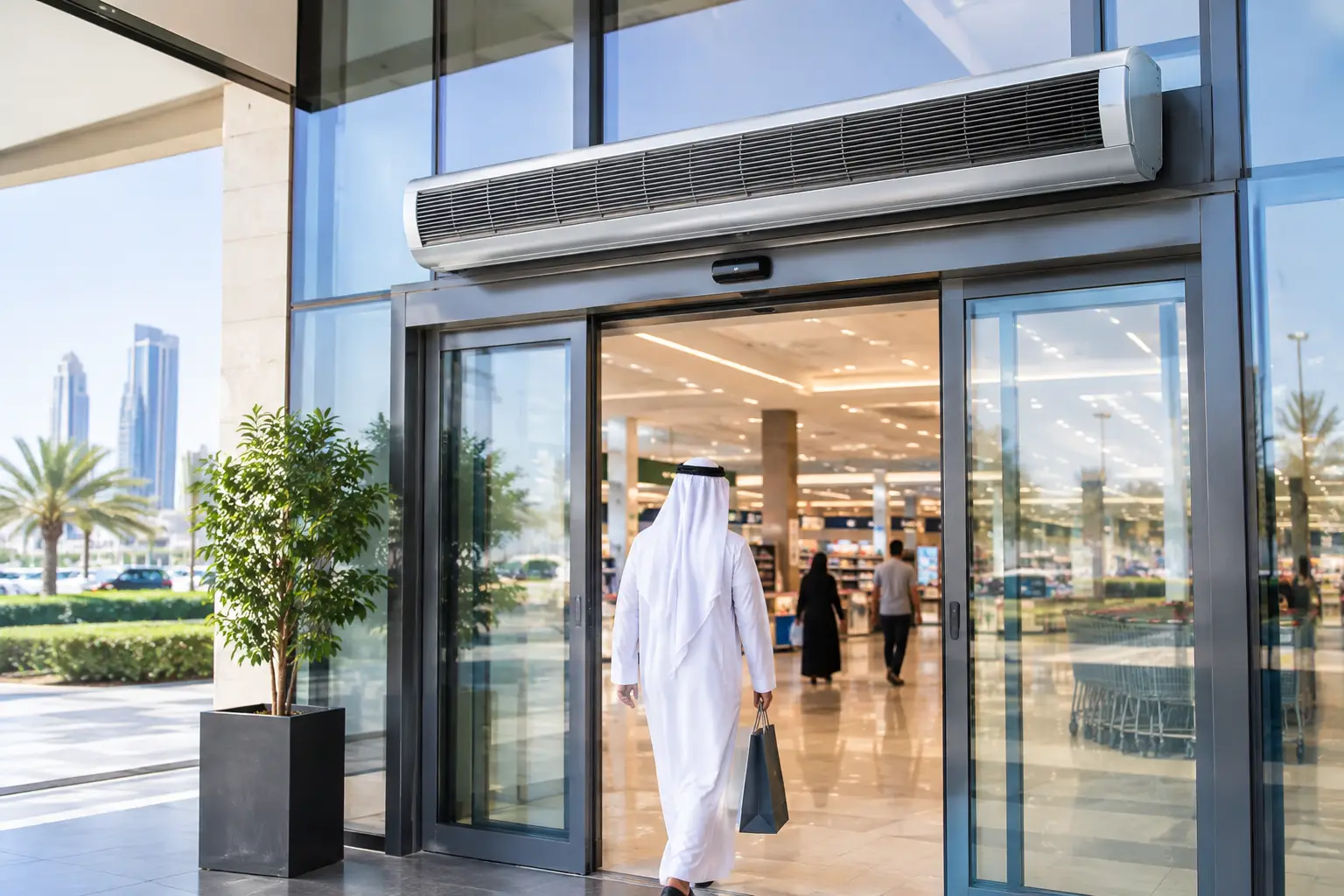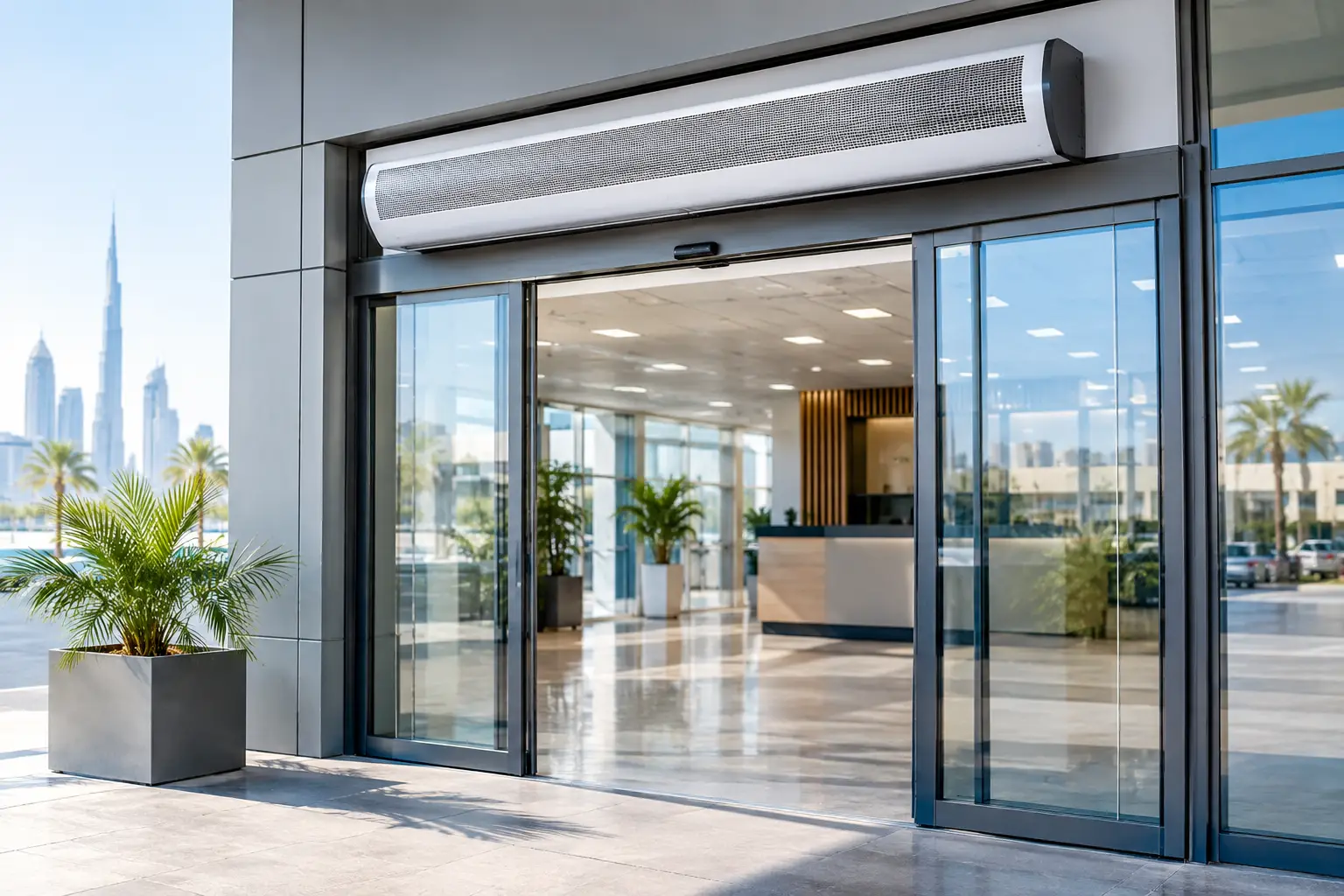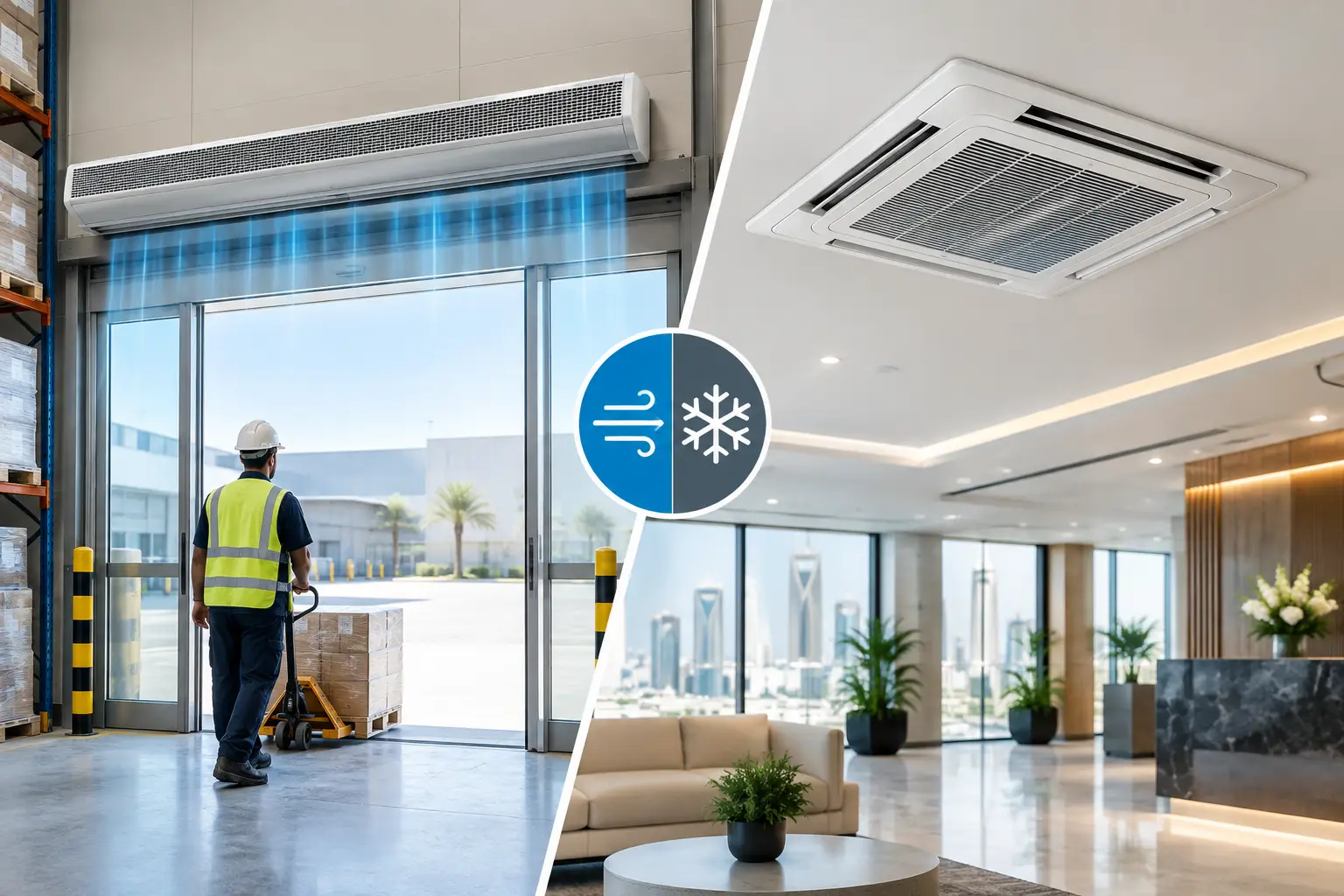
A supermarket entrance in Dubai at 2 p.m. and a cold room loading door in Lagos do not need the same air curtain settings. That is where an air curtain airflow velocity guide becomes useful. Velocity is not just a catalog figure. It determines whether the air barrier actually holds against heat, humidity, dust, insects, and pressure shifts at the doorway.
For facility managers, MEP contractors, and procurement teams, airflow velocity is one of the most misunderstood parts of air curtain selection. Higher is not always better. Too little velocity and the barrier collapses before it reaches the floor. Too much and you create noise, turbulence, and wasted power. The right target depends on door height, mounting position, outside conditions, traffic pattern, and what the site is trying to block.
What airflow velocity really means
Airflow velocity is the speed of the air stream discharged by the unit, usually measured in meters per second or feet per minute. In practical terms, it tells you how much momentum the air curtain has as it travels from the unit toward the floor or opposite side of the opening.
That momentum matters because the air stream loses strength as it moves downward. If the initial discharge velocity is too low, the stream breaks apart before it seals the opening. If the velocity profile is properly engineered, the stream remains stable enough to form a working barrier at occupied level and near the floor, where infiltration often becomes obvious first.
For commercial and industrial entrances, the question is not simply, “What is the top velocity at the outlet?” The better question is, “What velocity remains where protection is needed most?” That is why specifiers should look beyond headline figures and focus on usable performance across the full doorway height.
Air curtain airflow velocity guide for real entrances
A low-mounted retail entrance and a high industrial shutter opening behave very differently. As door height increases, the unit needs enough discharge strength to carry the air stream farther without losing stability. In hot, exposed markets such as Riyadh, Cairo, or Nairobi, external wind and temperature differences make that job harder.
For standard commercial doors, moderate to high outlet velocity is often enough when the opening is relatively short, traffic is frequent, and the aim is to reduce cooling loss and dust entry. Offices, hotel lobbies, pharmacies, and street-facing retail spaces usually fall into this category.
For taller doors in logistics areas, cold storage transitions, workshops, or plant entrances, the requirement shifts. The air stream must travel farther and remain coherent in harsher operating conditions. That generally calls for a more powerful unit, stronger fan design, and better nozzle control rather than just a larger motor.
This is where many projects go off track. A unit may show attractive airflow volume on paper, but without enough effective velocity at the opening, it will not perform in desert heat, humid loading bays, or high-traffic industrial operations.
Why door height changes everything
The taller the opening, the more time gravity, cross-drafts, and turbulence have to weaken the air stream. A recessed unit above a modest entrance can perform well at one velocity range, while a surface-mounted industrial model over a tall roller door may need significantly more discharge strength.
That does not mean every tall opening needs maximum speed. It means the unit must be selected for throw distance and barrier stability. In some cases, splitting a very wide entrance across multiple correctly matched units produces a better result than one oversized machine pushing excessive velocity.
Why climate conditions matter in GCC, MENA, and Africa
Hot-weather performance is not a side issue. It is the main issue. In tropical and desert climates, the air curtain is resisting intense sensible heat, humidity migration, airborne dust, and flying insects while doors open repeatedly throughout the day.
An entrance in Doha or Abu Dhabi may face strong temperature contrast between conditioned indoor space and extreme outdoor heat. A site in Lagos or Casablanca may also deal with humidity and particulate load. Under those conditions, airflow velocity must be strong enough to maintain separation, but controlled enough to avoid blowing conditioned air outward and increasing energy waste.
The trade-off between velocity, comfort, and energy use
There is a common assumption that more speed automatically means better protection. In reality, excessive velocity can create its own problems. It may cause uncomfortable drafts at pedestrian entrances, raise sound levels, and disturb the doorway instead of stabilizing it.
At customer-facing sites such as hotels, malls, and premium retail, comfort matters alongside performance. The air curtain should protect the opening without feeling aggressive to people entering the building. At industrial and logistics sites, acceptable noise and draft thresholds may be different, but energy efficiency still matters.
That is why correct air curtain design balances velocity with airflow pattern, blower type, installation height, and operating mode. Centrifugal systems, for example, are often selected where a more stable and controlled air stream is needed across wider commercial and industrial applications.
How to judge whether velocity is sufficient
Specifying the right unit starts with the opening, not the brochure. First, confirm the clear door height and width. Then consider whether the door is exposed to wind, whether the building runs negative or positive pressure, and whether the main concern is dust, insects, conditioned air loss, or cold room separation.
Next, assess the traffic pattern. A hypermarket entrance with constant pedestrian flow needs a different operating profile from a warehouse service opening used by pallet traffic. Frequency of opening affects how often the barrier must recover and how much turbulence it must handle.
Finally, compare the unit’s discharge performance with the application. The best selections account for outlet velocity, air volume, and expected residual velocity at the protected zone. If the data only presents one peak figure without context, it is not enough for serious specification work.
Signs the selected velocity is too low
A weak air curtain usually shows itself quickly. Conditioned air spills outward. Dust tracks appear inside the entrance. Insects enter more easily at lower levels. Staff near the opening notice hot air rolling in, especially during peak afternoon conditions.
Cold storage operators often see condensation or unstable temperature at the threshold when the air stream cannot hold the separation line. In retail and hospitality settings, the result is often hidden in higher HVAC load and reduced comfort rather than one dramatic failure.
Signs the selected velocity is too high
When velocity is excessive, the doorway can feel harsh rather than protected. Customers may notice strong drafts. The unit may generate unnecessary noise. In some cases, the air stream deflects too aggressively and loses efficiency instead of improving the seal.
That is why a proper air curtain airflow velocity guide should never treat speed as an isolated target. The useful measure is controlled barrier performance under actual site conditions.
Installation quality affects velocity performance
Even the right unit can underperform if it is installed poorly. Gaps across the door width, mounting too high above the opening, incorrect discharge angle, or mismatch between unit length and doorway width will weaken the barrier.
For best results, the air curtain should cover the full opening as closely as practical. The discharge should be aligned to support barrier formation rather than scatter the stream. On exposed doors, fine adjustment can make a measurable difference in how the air stream lands at floor level.
This is another reason consultation matters. Commercial and industrial air curtains are not commodity boxes. Performance depends on how the product line, fan design, and mounting arrangement fit the site.
Choosing by application, not by a single number
For hospitality, retail, offices, and supermarkets, the priority is usually a clean entrance experience with lower cooling loss and better comfort. Velocity should be high enough to resist heat and dust, but controlled for noise and pedestrian comfort.
For factories, workshops, loading bays, and high-use service doors, the operating target shifts toward stronger barrier integrity under larger openings and rougher conditions. Industrial-grade units with higher throw and more durable construction are usually the better fit.
For cold rooms and temperature-controlled back-of-house areas, consistency is critical. Here, airflow velocity must support temperature separation without creating avoidable turbulence around handling operations.
In all three cases, climate-specific design matters. Systems selected for tropical and desert environments must deal with harsher external conditions than generic specifications often assume.
If you are sizing an entrance for a project in Dubai, Riyadh, Doha, Cairo, Lagos, Nairobi, or Casablanca, the right answer will come from the opening conditions, the climate load, and the operating pattern together – not from outlet velocity alone. If you need specification support for a commercial or industrial site, FreezeeX can help evaluate the doorway and recommend an air curtain solution built for hot-climate performance. Request a consultation or quote based on your project conditions.