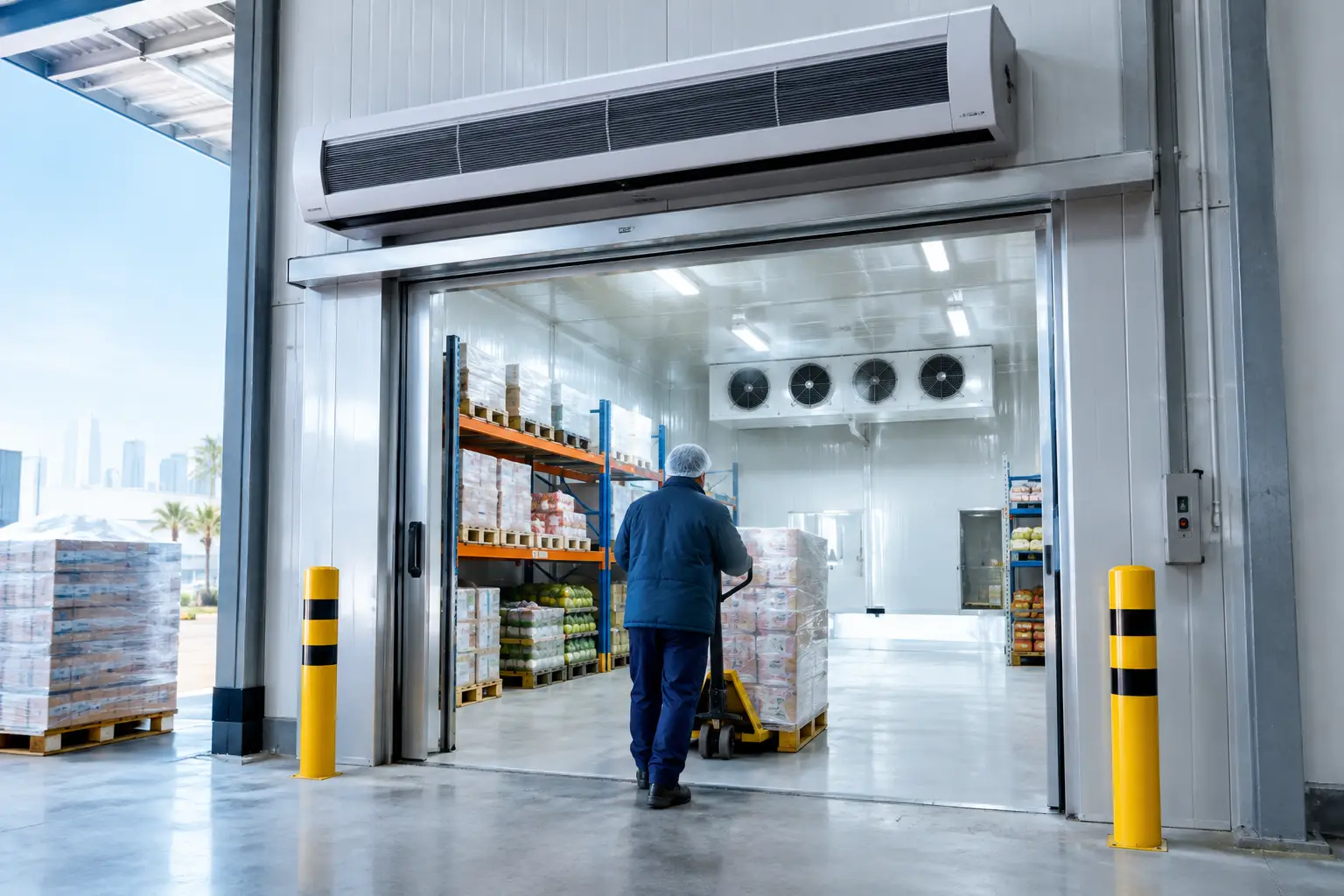
A cold store can lose operational control in a few seconds at the doorway. Every pallet movement, picking run, or staff passage exposes the room to warm, moisture-laden air. Well-designed cold storage entrances reduce that exposure without creating a bottleneck for logistics teams – a critical balance for food distribution, pharmaceutical handling, and temperature-sensitive manufacturing.
For facilities in Dubai, Riyadh, Doha, Muscat, Cairo, Lagos, and other hot or humid markets, the outside air is not a minor variable. High ambient temperatures, humidity, dust, and frequent door cycles can put sustained pressure on refrigeration systems and product-handling procedures. The entrance must be treated as part of the cold-chain design, not as an opening left for operations to manage alone.
Why are cold storage entrances a high-risk zone?
The temperature difference between a chilled or frozen room and an adjacent loading area creates a strong tendency for air to move through an open doorway. Warm air enters low in the opening while cold, dense air escapes. If that incoming air carries moisture, condensation and ice can follow on floors, door hardware, stored goods, and surrounding surfaces.
The operational effects are interconnected:
- Refrigeration equipment must work harder to recover the required internal temperature after door openings.
- Moisture ingress can raise condensation and icing risks near the threshold and inside the cold room.
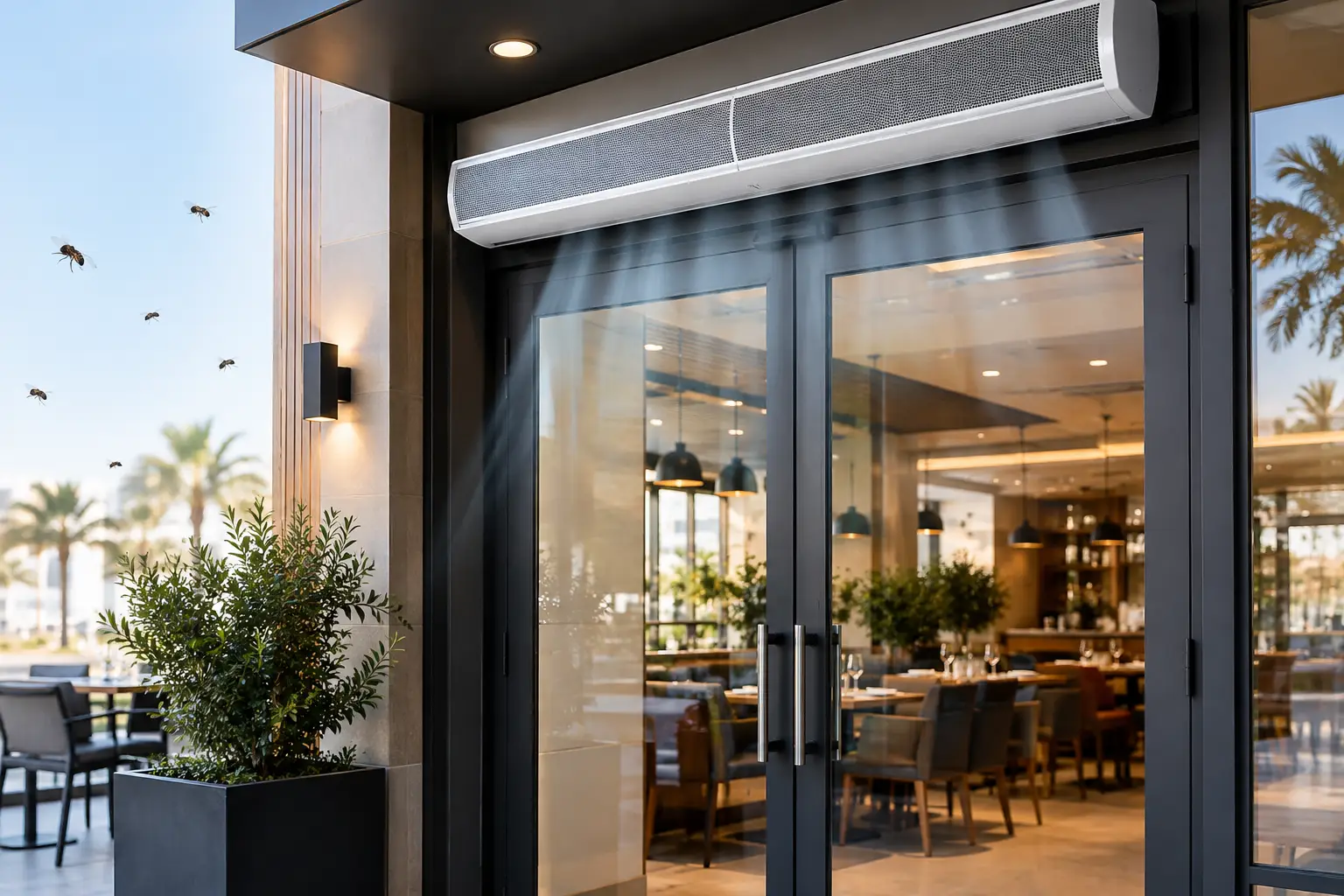
- Dust, insects, and airborne contaminants may enter from loading bays, warehouses, or external service areas.
- Forklift and pedestrian traffic can be delayed when entrances are poorly matched to the workflow.
- Temperature-sensitive products face more exposure during receiving, dispatch, and internal transfers.
A conventional hinged or sliding door remains essential for sealing an inactive opening. But when that door must stay open for routine traffic, it cannot provide continuous separation by itself. This is where an air curtain can support the entrance strategy.
How an air curtain supports cold storage entrances
An air curtain projects a controlled airstream across an open doorway. Properly selected and installed, it forms an air barrier that helps limit the exchange between the cold room and the warmer adjoining space. It is not a refrigeration system and should not be specified as a substitute for insulated doors, appropriate refrigeration capacity, or disciplined door management. Its role is to reduce infiltration while access is required.
At cold storage entrances, the practical objective is straightforward: preserve the conditioned environment for longer during each opening and reduce the volume of warm, humid, or contaminated air crossing the threshold.
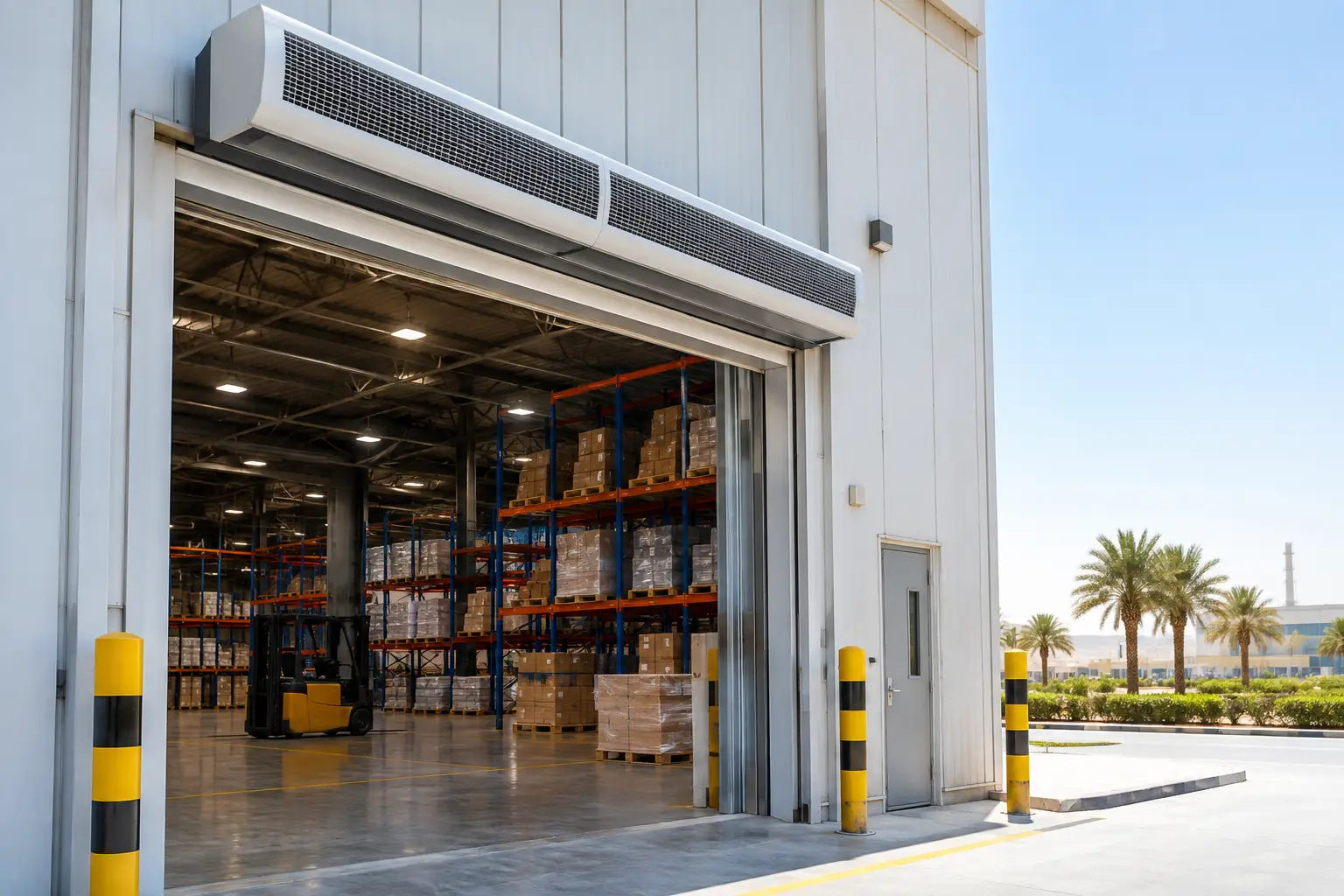
This approach is particularly relevant where a warehouse operates in high ambient heat or desert dust. A loading door opening into a hot distribution area in the Gulf faces a different air pressure and climate challenge than an internal door between two similarly conditioned zones. That distinction affects the required air curtain type, mounting arrangement, and control strategy.
Air barriers are not all suited to heavy traffic
A light-duty commercial unit may be appropriate for a staff doorway or a low-traffic chilled preparation room. It is rarely the right answer for a tall opening used by forklifts, pallet jacks, and frequent dispatch movements. The air stream must reach the floor area with enough stability to resist cross-drafts and pressure differences.
For heavy-use entrances, the selection discussion should include:
- Clear opening height and width, including any irregular door geometry.
- Whether the air curtain is mounted above the opening or vertically at the sides.
- Traffic pattern, vehicle clearance, and average duration of door-open events.
- Temperature difference between the two spaces and the humidity level of the adjacent area.
- Cross-drafts from loading docks, nearby doors, make-up air systems, or vehicle movement.
- The presence of dust, insects, fumes, or washdown conditions that affect the surrounding environment.
These factors determine whether a commercial or industrial air curtain configuration is appropriate. In active logistics and production settings, an industrial solution is often needed because the entrance is part of a continuous material flow, not an occasional access point.
Choosing a solution by entrance type
Cold storage facilities seldom have one universal doorway condition. Receiving docks, dispatch doors, personnel access points, and internal transfer openings operate differently. The table below provides a practical starting point for project discussions.
| Entrance condition | Primary concern | Air curtain consideration | | — | — | — | | Personnel door to chilled room | Repeated short openings and comfort | A properly sized commercial unit can help reduce air exchange without obstructing staff movement. | | Forklift access to cold store | Long, frequent openings and cross-drafts | Consider an industrial air curtain designed for wider or taller openings and demanding traffic. | | Loading dock to refrigerated area | High heat, humidity, dust, and external air pressure | Assess the full dock environment, door controls, and airflow disturbances before selection. | | Internal transfer opening | Product protection between zones | Match the unit to the temperature differential, opening dimensions, and hygiene requirements. |
The table is a screening tool, not a final specification. A narrow opening can still require a powerful solution if pressure imbalance is severe. Conversely, a wider internal opening may have a more manageable airflow challenge if both spaces are closely conditioned and traffic is controlled.
What should be specified before selecting an air curtain?
A quotation based only on door width leaves too many variables unresolved. The most reliable process is to assess the entrance as an operating condition rather than a piece of architecture.
1. Record the physical opening
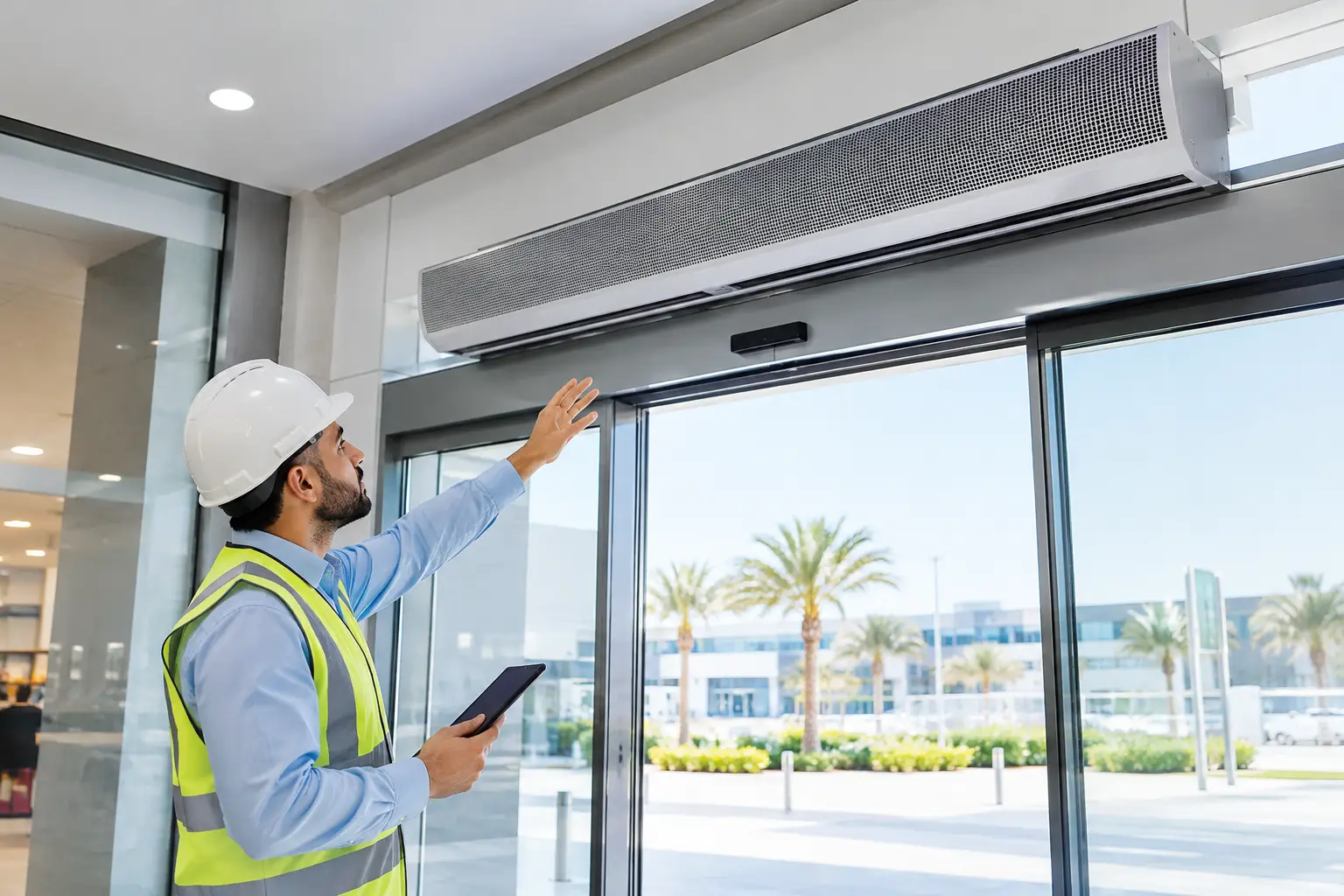
Confirm the clear width, height, headroom, and available mounting position. Identify obstructions such as rails, signage, door tracks, lighting, sprinkler coordination, or structural members. Side mounting may be worth evaluating where overhead space is limited, but it must still suit the traffic path and door operation.
2. Map how the door is used
Establish whether the entrance is used by people, trolleys, forklifts, or multiple vehicle types. Note peak traffic periods, the typical duration of openings, and whether doors are manually operated or tied to sensors. A doorway that opens 20 times per hour requires a different approach from one held open through a full loading cycle.
3. Assess the adjoining environment
The room outside the cold store may be an ambient warehouse, a dispatch hall, a production space, or an exposed loading bay. Its temperature, humidity, cleanliness, and air movement influence the required barrier performance. In tropical and desert climates, this assessment is especially important because warm air and airborne dust can place a heavier burden on the cold-room boundary.
4. Coordinate controls with door operation
Air curtains should operate in a way that supports actual workflow. Door-linked activation can avoid running equipment unnecessarily when the opening is closed, while manual or centralized control may suit other operating models. The control approach should be coordinated with the facility team, refrigeration design, and safety requirements.
5. Specify for service access
An entrance protection system must remain practical to inspect and maintain. Confirm access for cleaning, routine checks, and future service before finalizing the mounting arrangement. In food and pharmaceutical operations, the location should also support site hygiene procedures.
Where projects go wrong
The most common error is treating an air curtain as a catalog item rather than an engineered entrance solution. Selecting solely by width, installing a unit too high for its intended coverage, or overlooking a cross-draft can limit its effectiveness.
Another mistake is expecting the air barrier to compensate for wider operational problems. Damaged door seals, doors left open beyond the handling requirement, poor loading-bay segregation, and insufficient refrigeration capacity all need their own corrective measures. Air curtains work best as one layer in a coordinated cold-chain entrance design.
There is also a trade-off between access and isolation. A tightly controlled door procedure may reduce infiltration but slow dispatch. A permanently open door improves traffic flow but increases the refrigeration burden. The correct approach is usually a combination of insulated door systems, operating discipline, traffic planning, and a suitably selected air curtain that supports productive movement.
A practical standard for hot-climate cold storage
For facilities across the GCC, MENA, and Africa, entrance equipment must perform under high heat, humidity, dust exposure, and intensive commercial traffic. The project question should not be, “Which unit fits above this door?” It should be, “How can this entrance protect product conditions while keeping the operation moving?”
FreezeeX evaluates entrance size, mounting position, traffic volume, operating environment, climate conditions, and HVAC requirements before recommending a commercial or industrial air curtain solution. For a cold store, provide the opening dimensions, internal and adjacent-area conditions, door type, and traffic profile when requesting a consultation or quotation. That information enables a recommendation built for the real entrance – and for the demanding tropical or desert climate around it.