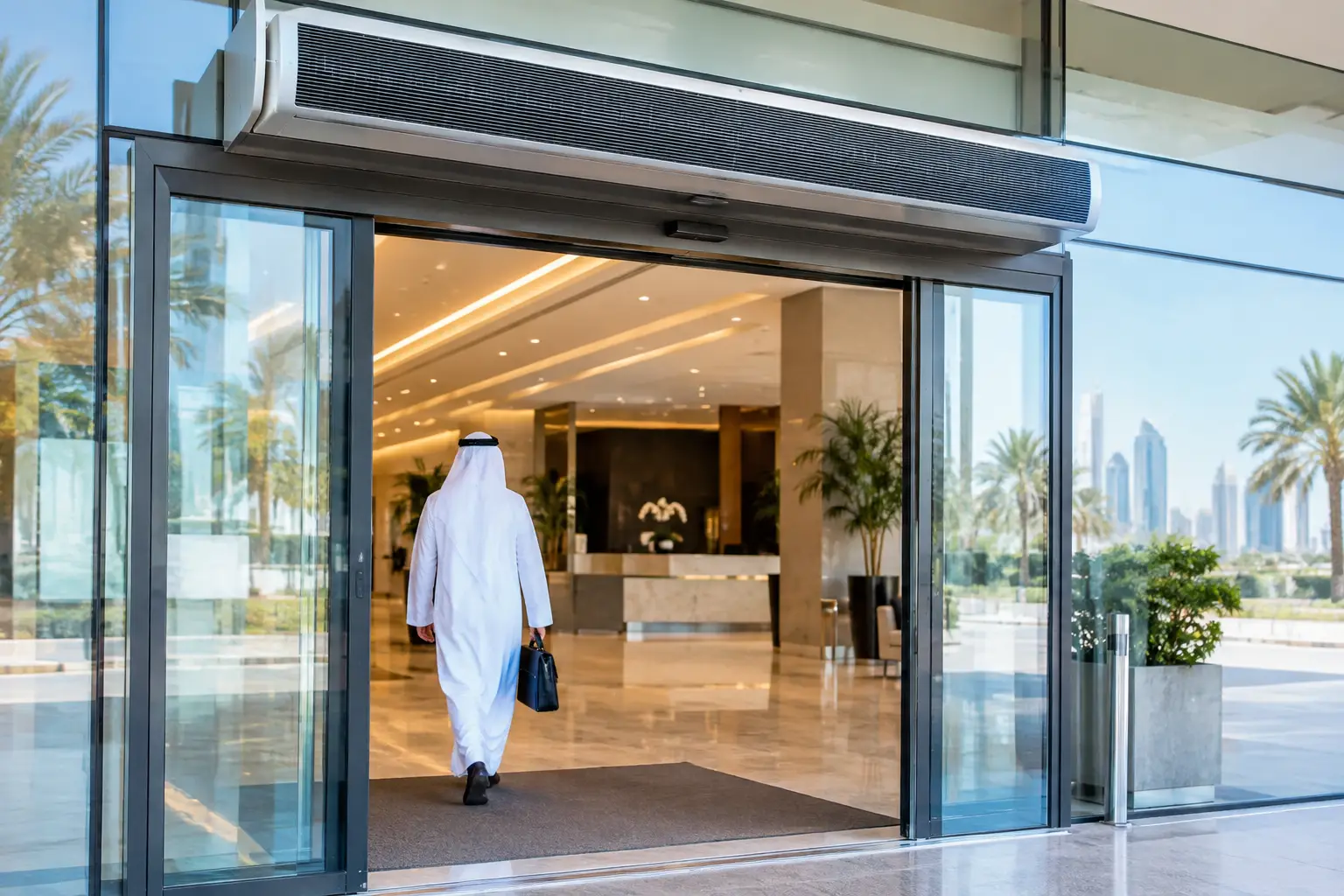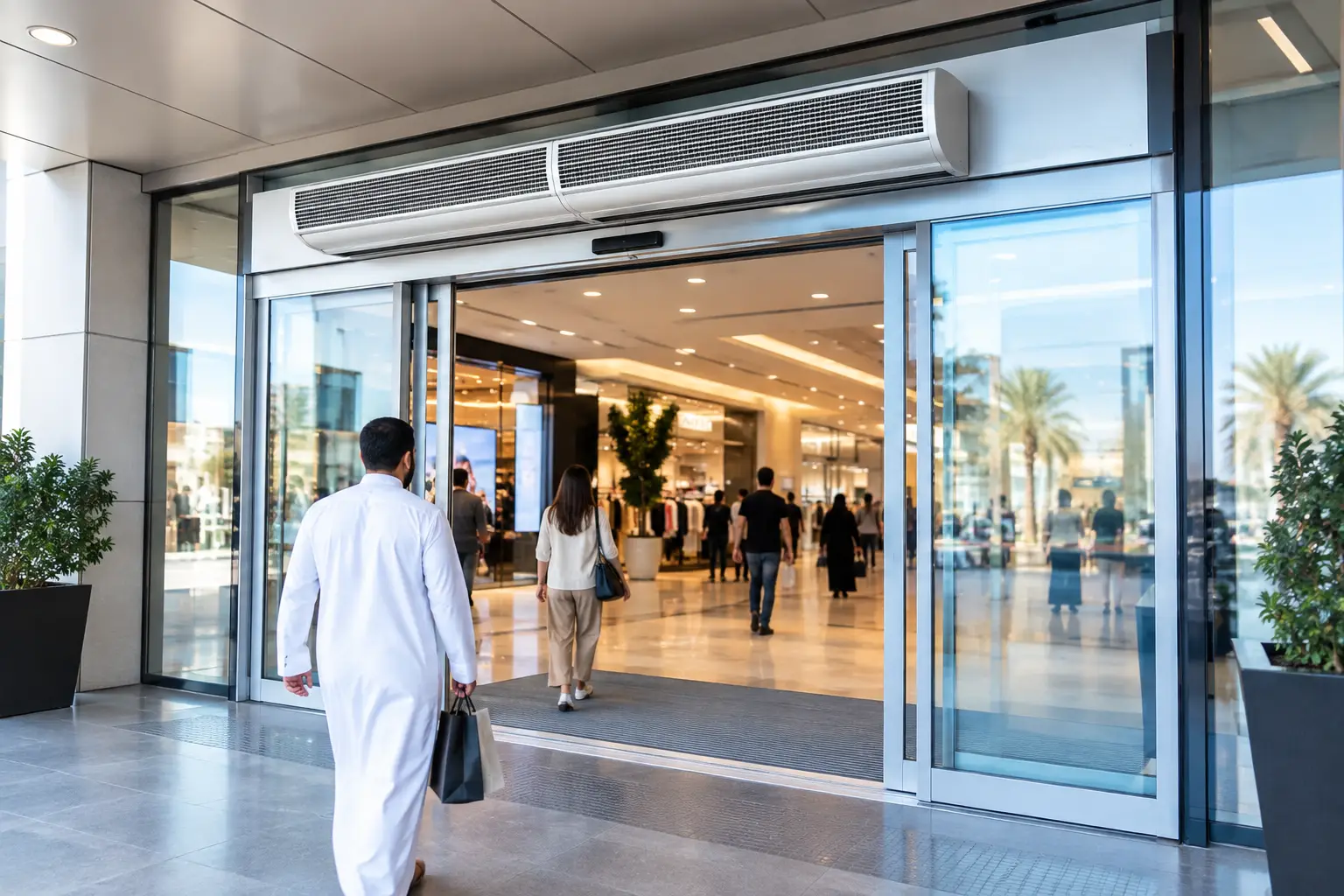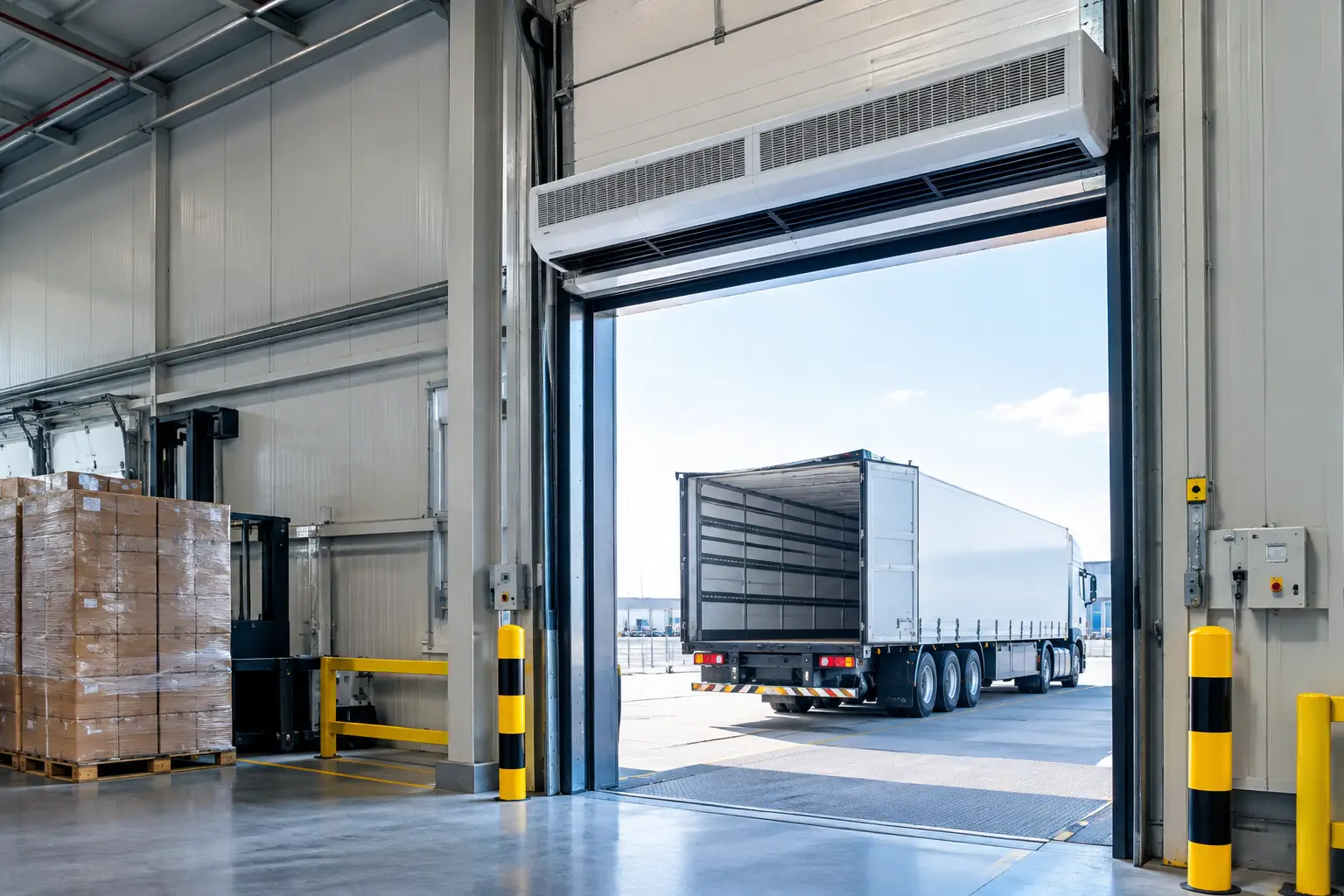
A loading-bay door that opens every few minutes can become an unplanned cooling outlet. At a supermarket entrance, hotel lobby, or warehouse dispatch point, conditioned air escapes while hot, humid, dusty outdoor air enters. Air curtain ROI is the financial measure of how effectively an air curtain reduces that operating penalty relative to its purchase, installation, and ongoing running costs.
For facility managers and project teams in the GCC, MENA, and African markets, the calculation is rarely limited to electricity savings. The right system can also support indoor comfort, reduce contaminants at the entrance, and ease the operational strain created by high traffic and demanding tropical or desert-climate conditions. The key is to build a business case from site data, not generic savings claims.
What does air curtain ROI actually measure?
Return on investment measures the value created by an air curtain against the cost of deploying it. It is commonly expressed as a percentage, while payback period shows how long it takes for cumulative benefits to recover the initial investment.
A basic annual ROI calculation is:
`Annual ROI (%) = (Annual financial benefit – Annual operating cost) / Total project cost x 100`
A basic payback calculation is:
`Payback period = Total project cost / Net annual financial benefit`
These equations are simple. The professional work lies in defining the inputs correctly. An entrance air curtain does not replace properly sized HVAC equipment or resolve every building-envelope issue. Its purpose is to create an airflow barrier at an opening, helping separate indoor and outdoor conditions while people, carts, or goods move through the door.
For a commercial facility, the financial benefit may come from reduced cooling loss, fewer comfort complaints near the entrance, lower cleaning pressure from dust ingress, or better protection of controlled environments. Which benefits should be monetized depends on the application and the data the operator can verify.
Which costs belong in an air curtain ROI calculation?
A credible calculation starts with full project cost, rather than treating the quoted unit price as the whole investment. Procurement teams should account for the installed solution and the cost of operating it over the evaluation period.
| Cost area | What to include | Why it matters | |—|—|—| | Equipment | Selected air curtain system and required controls | The model must suit the opening and duty cycle, not just the budget. | | Installation | Mounting, electrical connection, access equipment, and coordination | High or recessed mounting positions can affect installation scope. | | Commissioning | Professional setup and verification of operating mode | Airflow direction and activation strategy affect practical performance. | | Operating energy | Motor energy during scheduled or sensor-based operation | Long operating hours can materially influence net savings. | | Planned maintenance | Cleaning and inspection within the facility maintenance program | Dusty and high-traffic environments require consistent upkeep. |
The selection decision affects both sides of the equation. An undersized unit may cost less initially but provide an incomplete barrier across a wide or high opening. An oversized or poorly controlled system can add operating cost without proportional benefit. That is why specifications should consider entrance width, mounting height, door type, traffic frequency, prevailing outdoor conditions, and the building’s HVAC arrangement.
How do you quantify the financial return?
The most reliable approach is to compare operational conditions before and after installation, or to model the impact using measured site information. A cold storage entrance, for example, has a different loss profile from a retail entrance that opens continuously during peak hours. A warehouse with large vehicle doors requires a different assessment again.
Start with the doorway, not the product range
Record the actual opening dimensions, mounting location, door-open duration, daily traffic pattern, and nearby HVAC supply or return locations. Also document the outdoor conditions affecting the entrance. In Dubai, Riyadh, Doha, Muscat, Cairo, Lagos, or Nairobi, the mix of heat, humidity, dust, and traffic can vary considerably by site and season.
The objective is not to create a perfect theoretical model. It is to establish an honest operating baseline. If the door remains open for long periods, that behavior may be the largest source of load. If the door is usually closed and opens briefly, the opportunity and system control strategy will be different.
Identify benefits that can be measured
Cooling-energy reduction is often the primary return driver in air-conditioned commercial buildings. To estimate it responsibly, use utility data, HVAC operating schedules, and where possible, monitored temperature or energy trends. Avoid assigning all changes in electricity use to the air curtain when occupancy, setpoints, equipment maintenance, or operating hours also changed.
Depending on the site, the business case may include the following measurable value areas:
- Reduced cooling demand associated with repeated doorway air exchange.
- Lower cleaning labor or consumables where dust and debris entering through open doors are a persistent issue.
- Less product or process exposure to humidity, insects, smoke, fumes, or airborne contaminants in sensitive operations.
- Fewer comfort-related interventions near customer-facing entrances.
- Improved consistency at the building threshold, supporting the intended use of the space.
Not every item should be given a monetary value. For hospitals, pharmaceutical facilities, food processing areas, and certain logistics operations, air separation can have operational value that is important but difficult to price. In those cases, separate the financial ROI from the operational justification instead of forcing uncertain assumptions into the payback figure.
Calculate net annual benefit
Once annual benefits are estimated, subtract the air curtain’s annual operating and maintenance costs. This produces the net annual financial benefit used in the payback calculation.
For example, a facility may identify reduced HVAC energy use and a modest reduction in entrance-area cleaning costs. The operator should then deduct the expected electrical cost of running the air curtain under its chosen control schedule. The resulting figure is more useful than gross energy savings because it reflects the cost of achieving the benefit.
What affects air curtain ROI most in hot and humid climates?
In FreezeeX’s operating markets, climate is not a background detail. High outdoor temperatures increase the value of retaining conditioned air, while humidity and dust can introduce separate comfort and cleanliness concerns. Still, climate alone does not guarantee a fast payback. Door behavior and system fit remain decisive.
Opening size and mounting height
A wide retail entrance, a high industrial doorway, and a recessed architectural opening need different air delivery approaches. The air stream must cover the usable opening effectively from its installed position. If coverage is weak at floor level or disrupted by cross drafts, the expected energy and contamination-control benefits may not materialize.
Commercial entrances may suit options within the Commercial Centrifugal Flow Series, Commercial HiFi Plus Series, or recessed solutions where ceiling integration is required. Heavy-use warehouse, factory, and logistics entrances may call for assessment against the Industrial Centrifugal Series or New Dynamic Series. The appropriate choice depends on the project conditions, not on a one-size-fits-all category.
Traffic volume and operating controls
A door that opens 20 times per day should not be assessed the same way as a supermarket entrance or airport service opening with continual movement. Control logic has a direct effect on ROI. Running only when the opening is in use may reduce electrical consumption, while some environments may require longer operation to maintain the intended separation.
Project teams should review whether the air curtain will be coordinated with door status, building schedules, or a suitable control strategy. The goal is to align run time with exposure, without creating unnecessary energy use.
HVAC condition and building operation
An air curtain performs best as part of a functioning entrance and HVAC strategy. Poorly maintained doors, uncontrolled adjacent openings, unfavorable air pressure relationships, or HVAC systems operating outside their intended conditions can reduce the apparent return.
This is a trade-off worth addressing early. If a facility has multiple envelope issues, an air curtain may still be worthwhile, but projected savings should be conservative until those issues are corrected. For major projects, an MEP consultant can incorporate the entrance condition into the wider building-performance assessment.
A practical process for evaluating air curtain ROI
Use a structured evaluation before issuing a specification or requesting final quotations.
- Define the operating problem. Identify whether cooling loss, humidity, dust, insects, fumes, comfort complaints, or a combination of factors is driving the project.
- Survey the opening. Confirm width, height, mounting constraints, door type, traffic pattern, and nearby air movement.
- Collect baseline data. Review operating schedules, utility information, cleaning records, and relevant environmental observations.
- Select an application-matched system. Assess commercial, recessed, or industrial configurations based on the actual site duty.
- Estimate net annual benefit. Use conservative assumptions and subtract operating and planned maintenance costs.
- Review payback alongside operational value. Consider comfort, cleanliness, process protection, and customer experience separately from direct energy savings.
- Verify performance after commissioning. Confirm that the installed system operates as intended during real traffic conditions.
When is a longer payback still justified?
A short payback is attractive, but it should not be the only decision criterion. At a food processing entrance, pharmaceutical facility, hospital access point, or dusty industrial site, the avoided operational disruption may be more consequential than a simple energy calculation. At customer-facing retail and hospitality entrances, consistent indoor comfort can also protect the experience that the facility is designed to provide.
The strongest projects balance financial discipline with application risk. A facility with low traffic and modest HVAC exposure may not need a complex solution. A high-use entrance facing intense heat, humidity, or dust may justify a more carefully engineered air barrier even if its direct energy payback takes longer.
For an air curtain ROI assessment that reflects your opening, HVAC operation, and local climate, request a consultation and quotation from FreezeeX. A site-specific recommendation can help ensure the selected system supports measurable energy control and reliable entrance performance where it matters most.