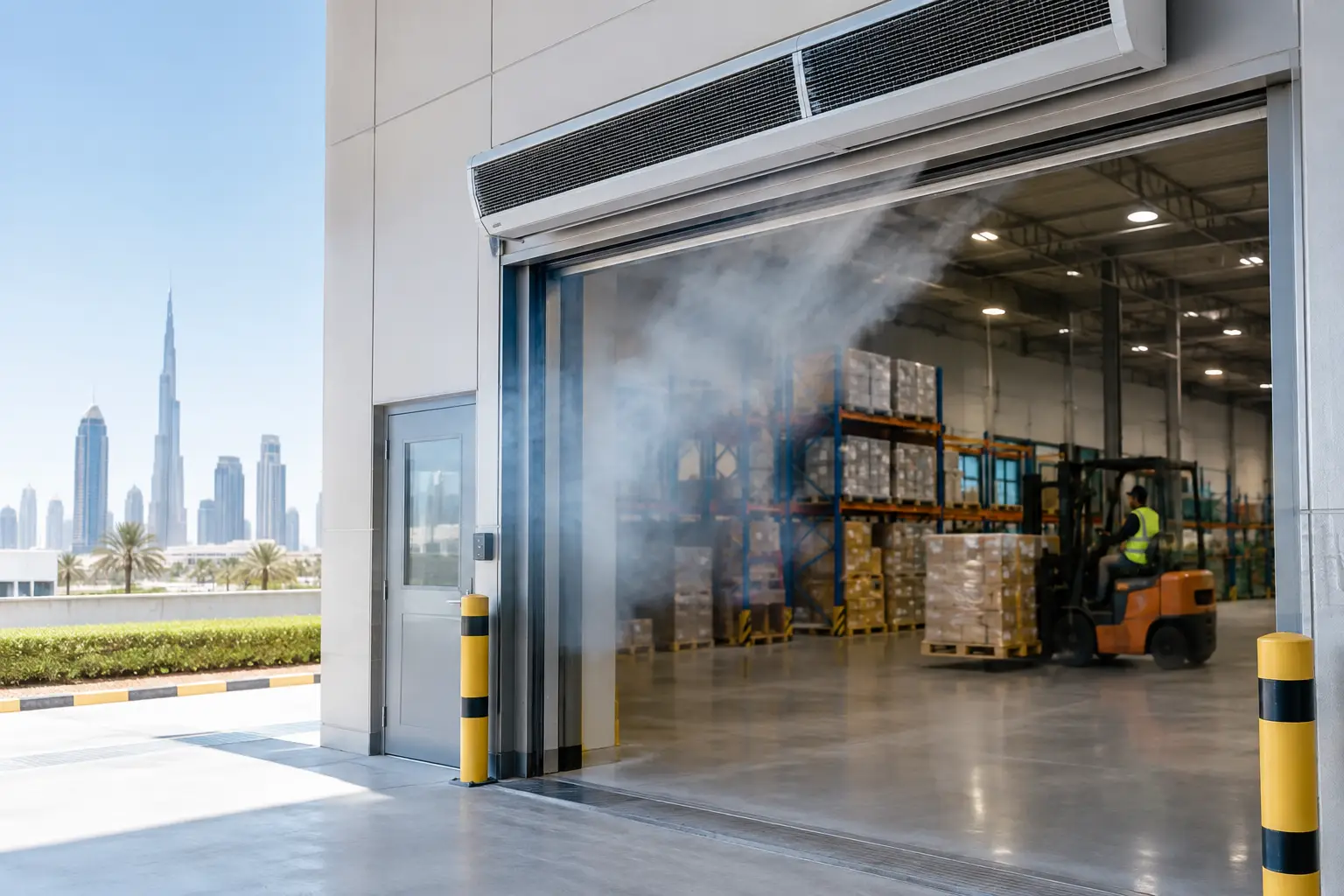
A frequently opened entrance can become a major humidity path long before it is recognized as an HVAC problem. Understanding how entrance airflow reduces humidity helps facility teams address moisture at its source: the continuous exchange of hot, moisture-laden outdoor air with conditioned indoor air. For supermarkets, warehouses, hotels, hospitals, factories, and cold-chain sites in Dubai, Doha, Riyadh, Lagos, or coastal markets, this exchange can quickly affect comfort, condensation risk, and cooling costs.
An air curtain does not dehumidify air in the same way as a dedicated HVAC dehumidification system. Its role is different and highly valuable: it creates a controlled, high-velocity air barrier across an open doorway, limiting the volume of humid outdoor air that crosses into the building. When correctly selected and installed, this air barrier reduces the latent cooling load placed on indoor HVAC equipment.
How Entrance Airflow Reduces Humidity Through Air Separation
Humidity enters a commercial facility primarily through infiltration. When an entrance is open, pressure differences, wind, temperature contrast, and pedestrian or vehicle traffic allow outside air to move indoors. In hot and humid climates, that outdoor air carries a substantial moisture load.
At a busy supermarket entrance, for example, every door opening can introduce warm, humid air. The air-conditioning system must then remove both sensible heat, which raises air temperature, and latent heat, which is the energy associated with moisture. Latent loads are often overlooked because the immediate symptom may be a sticky entrance zone, fogging on refrigerated cases, or condensation on nearby surfaces rather than an obvious temperature failure.
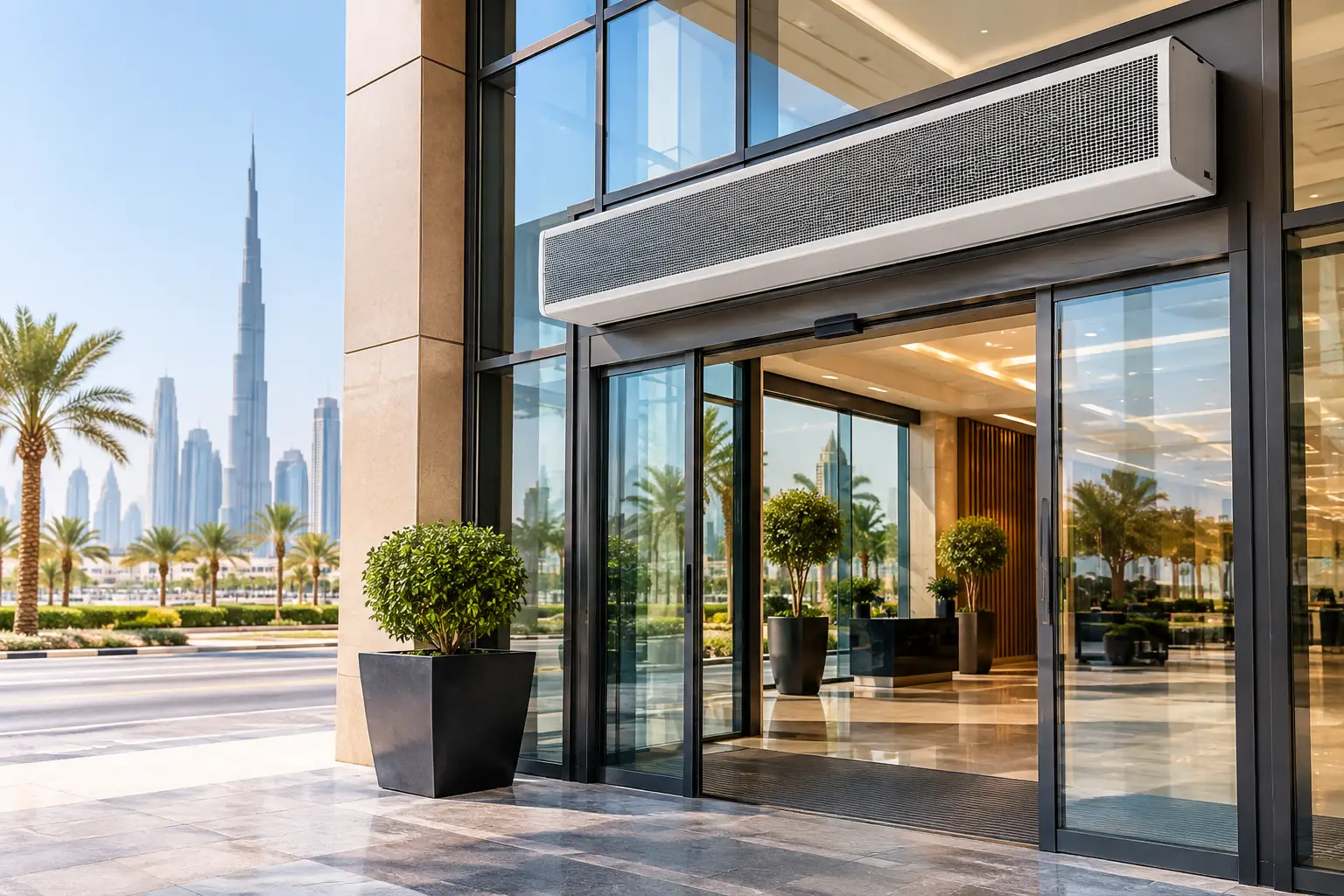
An air curtain projects a continuous stream of air from the top of the opening toward the floor. This stream acts as a separation plane between indoor and outdoor air masses. It does not create an absolute seal, particularly at very wide or high openings, but it disrupts crossflow and reduces infiltration significantly compared with an unprotected open doorway.
The result is less humid outdoor air reaching the conditioned space. Indoor equipment can devote more of its available capacity to maintaining the required temperature and relative humidity rather than constantly recovering from entrance-related moisture gains.
The Air Barrier Must Reach the Floor
Humidity control performance depends on the integrity of the air stream. If airflow loses momentum before reaching the floor, humid air can pass beneath the curtain. If the discharge angle is incorrect, the stream may be pushed outward or inward, reducing its ability to separate the two air zones.
For this reason, air curtain selection should be based on mounting height, opening width, door configuration, local wind exposure, and traffic type. A narrow personnel door in an air-conditioned retail store requires a different approach from a high warehouse shutter with forklift traffic. Higher openings typically require industrial-grade airflow with sufficient throw and velocity to maintain an effective barrier over the full door height.
Why Humid-Air Infiltration Creates Operational Problems
Humidity is not just a comfort issue. In commercial and industrial buildings, repeated moisture infiltration can affect product protection, hygiene, safety, and asset condition.
In food retail and cold storage environments, humid air entering a cooled zone can contribute to condensation near entrance areas and increase the load on refrigeration and cooling equipment. In pharmaceutical facilities, laboratories, and hospitals, uncontrolled moisture can make it harder to maintain environmental conditions required for sensitive operations. In hotels, shopping centers, and restaurants, it can create an uncomfortable transition zone near the entrance and make the entire cooling system work harder during peak traffic periods.
Warehouses and manufacturing facilities face a different but related issue. Moisture entering through large loading doors can contribute to condensation on cooler surfaces, affect packaging, and increase the chance of slippery floors. Where outdoor conditions are dusty as well as humid, uncontrolled entrance air can also carry particles into the building.
A properly specified air curtain addresses several of these exposure routes at once. It supports air isolation while allowing operations to keep doors open for customers, deliveries, staff movement, or equipment access.
Airflow Direction, Velocity, and Pressure Matter
The principle behind entrance airflow is straightforward, but actual performance depends on engineering details. The air stream must be strong enough to resist pressure forces at the opening without becoming unnecessarily turbulent or disruptive to occupants.
The required airflow velocity depends on the application. A customer-facing hotel or retail entrance may prioritize a comfortable, low-noise air stream while still limiting humid-air ingress. A loading bay or industrial workshop may require a more powerful unit that can withstand stronger crosswinds and the pressure effects created by large open doors.
Building pressure is equally relevant. A strongly negative indoor pressure condition will pull outdoor air inward, making humidity control more difficult even with an air curtain installed. Conversely, sensible pressure management combined with a correctly sized air curtain gives the entrance barrier a better operating environment.
This is why an air curtain should not be specified by door width alone. Consultants and contractors should evaluate the full entrance condition, including door height, wind exposure, adjacent HVAC supply and return locations, operating hours, and whether the opening serves pedestrians, carts, or forklifts.
Recirculated and Heated Air Are Different Questions
For hot-climate commercial applications, the central requirement is usually air separation, not heating. The key concern is whether the unit can project an effective air stream that limits the entry of hot, humid outside air while protecting conditioned indoor air.
In some applications, recirculated indoor air is appropriate because it supports the temperature and moisture conditions already established inside the facility. The preferred configuration depends on the building’s HVAC arrangement and the purpose of the entrance. A consultant should assess these variables rather than applying the same solution to every doorway.
Where Air Curtains Make the Greatest Difference
Air curtains deliver the strongest humidity-related benefit where doors stay open frequently or for extended periods. The more traffic an entrance receives, the more likely it is to become a persistent infiltration point.
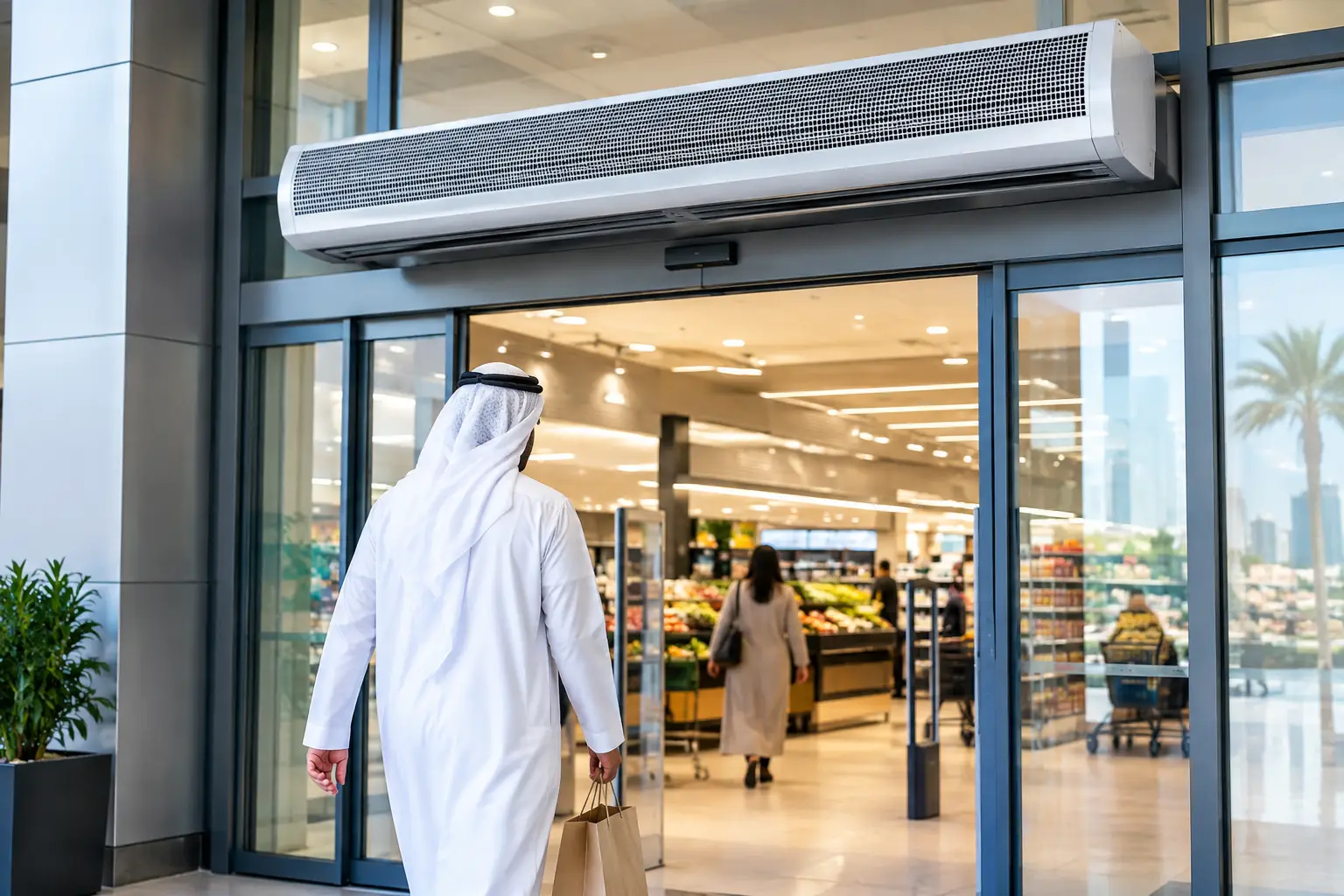
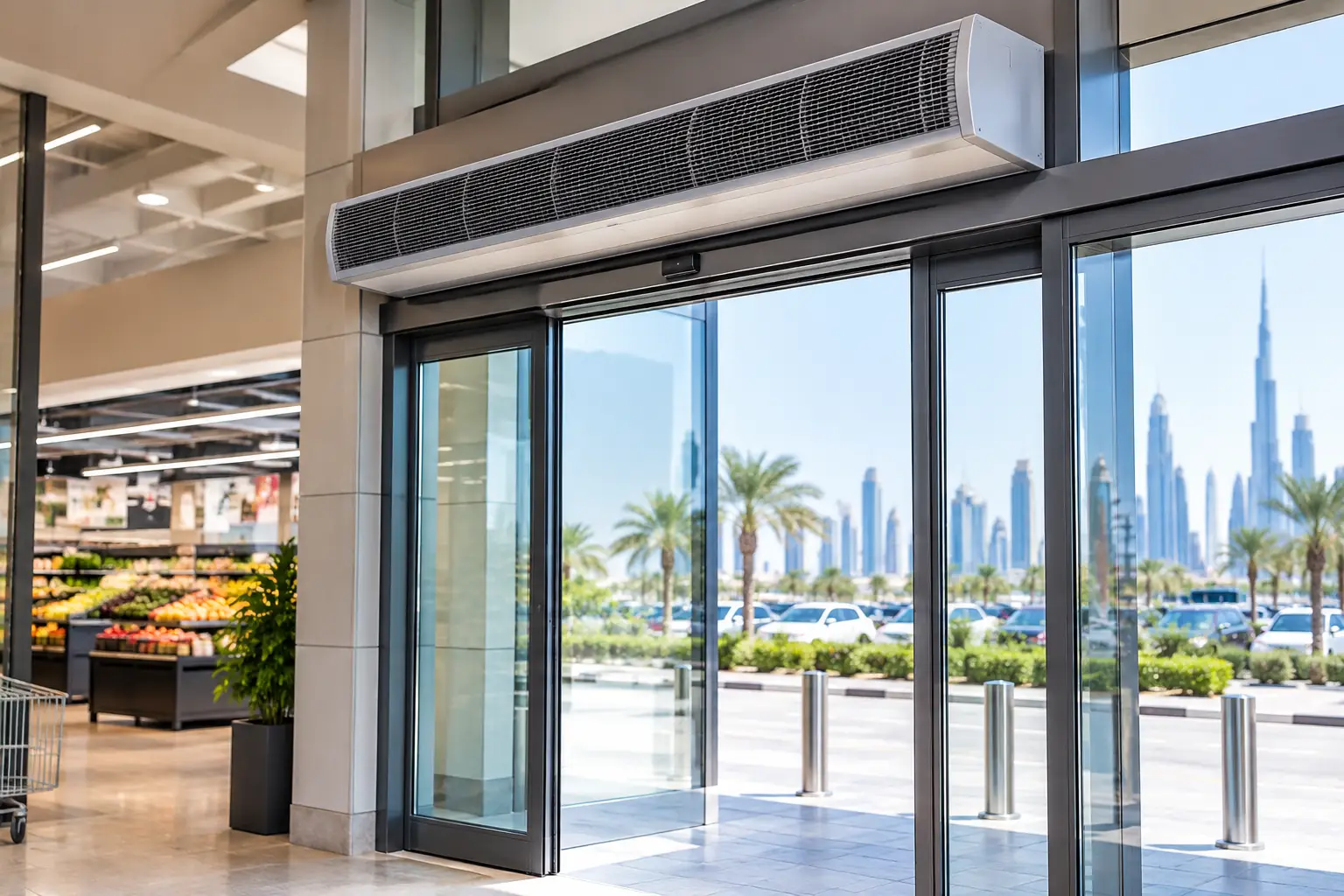
Supermarkets and hypermarkets benefit because customer entrances are active throughout the day and indoor temperature stability affects shopper comfort and refrigerated merchandising. Restaurants and hotels benefit at main entrances, service doors, and high-traffic receiving areas where humid outdoor air can quickly disturb conditioned spaces.
For warehouses, logistics centers, and factories, the application is often focused on loading bays and roller shutter openings. These doors are larger, exposed to stronger external conditions, and frequently used by forklifts. Industrial centrifugal air curtain systems are typically better suited to these demanding openings because airflow performance must remain effective over greater mounting heights.
Hospitals, pharmaceutical plants, and food processing facilities may have additional hygiene and environmental-control objectives. Here, air curtains can support the separation of interior conditions from outdoor contaminants, insects, dust, and humidity, but they should be coordinated with the facility’s wider pressure and filtration strategy.
Matching the Air Curtain to the Entrance
The wrong air curtain can create the appearance of protection without delivering meaningful humidity control. A light-duty unit installed over a tall, wind-exposed industrial opening may not provide sufficient throw. A powerful industrial unit over a quiet reception entrance may be unnecessarily noisy or visually unsuitable.
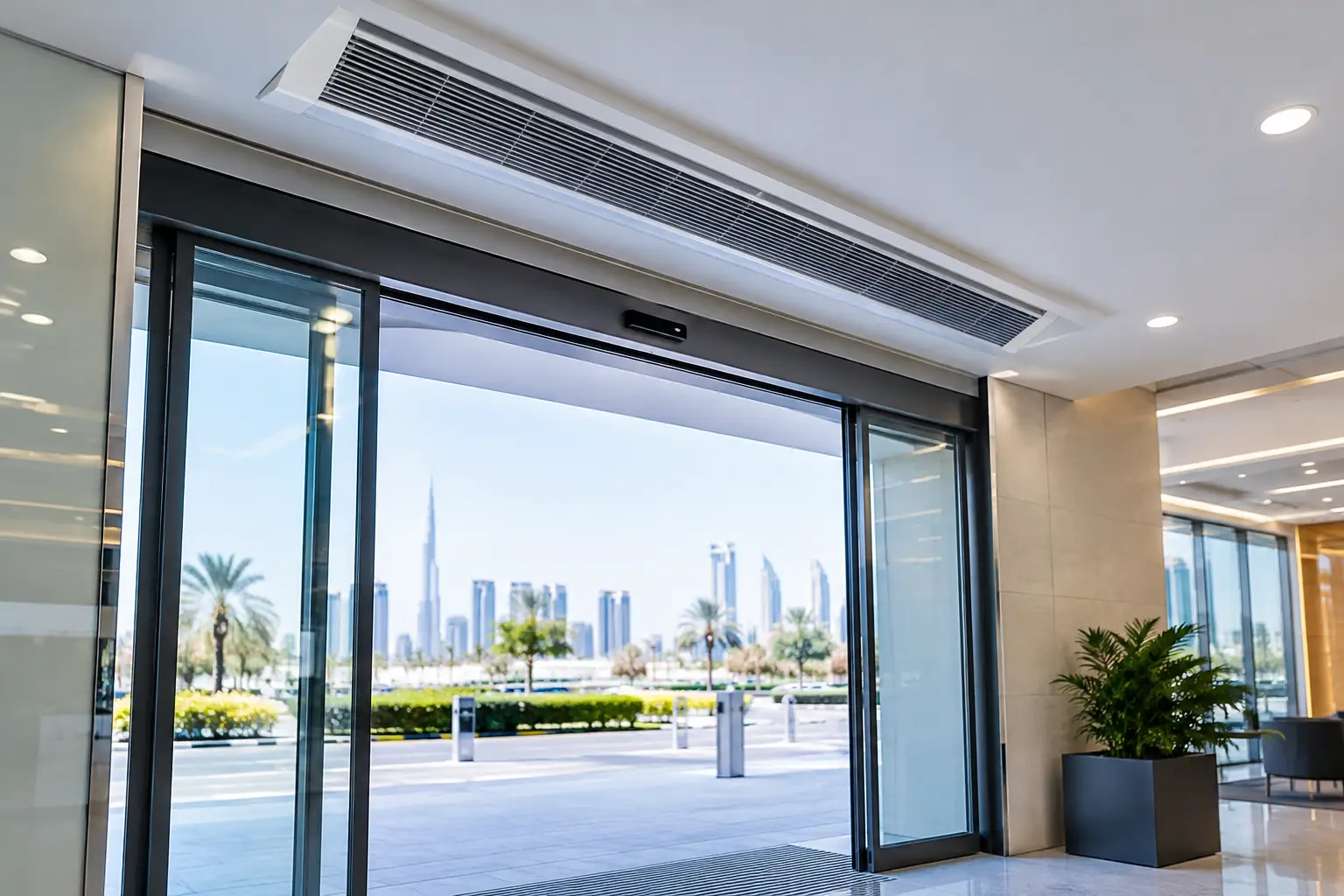
For visible commercial entrances, recessed ceiling air curtains can provide a more integrated finish while maintaining a continuous barrier at the doorway. Commercial centrifugal and high-performance models are suited to retail, hospitality, and public-facing facilities that need reliable operation during sustained traffic. For loading docks, factories, and high-door warehouse applications, industrial units should be selected for mounting height, opening dimensions, and outdoor exposure.
Selection should also account for maintenance access. A neglected intake screen, blower section, or control setup can reduce performance over time. Facility managers should include air curtains in planned maintenance schedules and verify that the unit operates whenever the entrance is exposed, whether through door interlocks, sensors, or an operating schedule aligned with the facility.
Air Curtains Support HVAC Capacity, Not Replace It
An air curtain is most effective when viewed as an entrance climate-control measure within a broader HVAC strategy. It reduces the moisture and heat that enter through open doors, but it cannot correct an undersized cooling system, poor building pressure control, or a humidity problem caused elsewhere in the building.
That distinction matters during specification. If indoor relative humidity remains high even when entrances are controlled, the HVAC design and operating conditions should be reviewed. If humidity spikes mainly during busy periods at doors, an air curtain can be a practical and targeted solution because it addresses the infiltration source directly.
For projects in tropical, coastal, and desert climates, the right system begins with the real conditions at the opening, not a generic product size. FreezeeX can assess entrance dimensions, traffic levels, mounting constraints, and environmental exposure to recommend an air curtain configuration that supports lower humidity infiltration and more stable indoor performance. Request a consultation or project quotation to match the airflow solution to your facility’s operating demands.