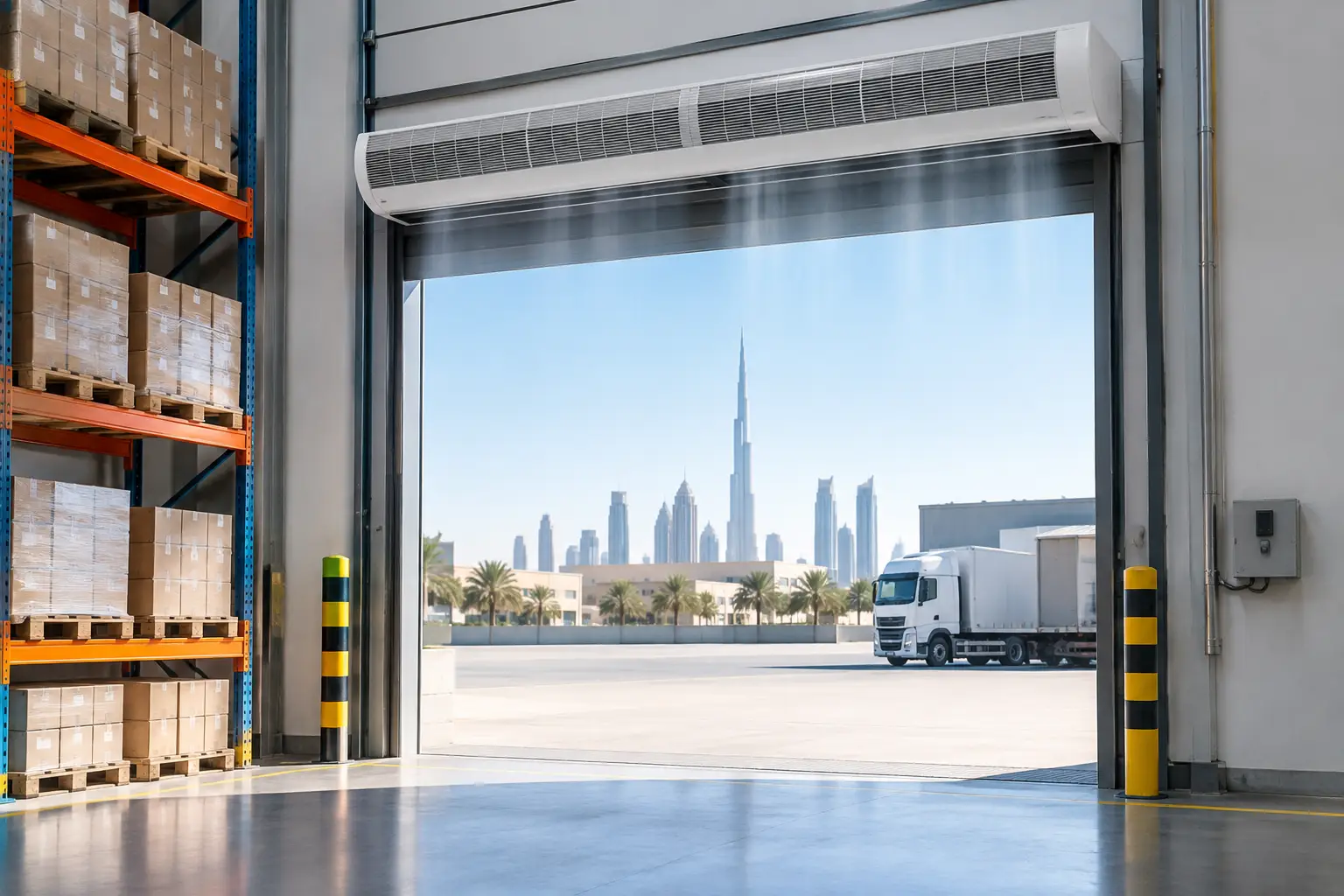
A 4-meter warehouse opening in Dubai does not need simply “more air.” It needs an air stream that remains stable enough to reach the floor despite heat pressure, vehicle movement, and outdoor dust. That is the real answer to what airflow suits tall doors: airflow with sufficient throw, volume, and pressure resistance for the full opening height and the operating conditions around it.
For commercial and industrial facilities, air curtain selection should be based on measured entrance conditions rather than door height alone. A unit that appears powerful at the discharge grille may lose velocity before it reaches the protected zone. At a tall opening, that leaves a weak lower section where hot air, humidity, dust, insects, and airborne contaminants can enter.
What airflow suits tall doors in commercial buildings?
Tall doors usually require a high-velocity, high-volume air curtain with verified jet reach to floor level. In practice, the correct solution is often an industrial centrifugal air curtain or a commercial centrifugal system designed for higher mounting positions, rather than a light-duty unit intended for standard retail doors.
The key requirement is not maximum outlet velocity in isolation. It is effective air velocity at the bottom of the opening. The discharged air must form a continuous barrier from the unit to the floor or threshold area. If the jet breaks up or bends significantly before reaching that point, outside air can pass beneath it.
For a tall warehouse, logistics center, factory, airport service entrance, or loading-area doorway, specification should account for five connected factors:
- Clear opening height and width
- Mounting height and available installation position
- Required terminal velocity at floor level
- Pressure difference between indoor and outdoor areas
- Traffic pattern, including forklifts, trolleys, pedestrians, or open-door dwell time
A 3-meter entrance in a sheltered shopping mall has very different demands from a 5-meter loading door exposed to desert wind and high outdoor temperatures. Both may be described as tall doors, but the air curtain duty is not comparable.
Why door height changes air curtain performance
As mounting height increases, an air curtain jet travels farther before it reaches the floor. Along that path, the jet entrains surrounding air and loses speed. This natural reduction in velocity is why a unit that works well over a standard commercial entrance may perform poorly over a high industrial opening.
The higher the installation point, the more attention must be paid to throw distance. Manufacturers may refer to this as effective mounting height, jet reach, or air projection. For specification purposes, ask for performance data that shows the unit can maintain an adequate terminal velocity at the actual mounting height, not only at the grille.
Terminal velocity matters because the air curtain must resist infiltration at the bottom of the doorway. This is especially relevant in hot climates, where warm outdoor air naturally pushes toward cooler, conditioned interiors. In coastal locations such as Dubai, Doha, Muscat, or Lagos, humidity adds another load. In drier industrial locations such as Riyadh, dust and wind exposure can be the dominant issue.
A tall entrance can also create a stronger stack effect when indoor and outdoor temperatures differ. Although stack effect varies by building design and operating conditions, it can pull air through open doors and weaken a marginal air barrier. A properly selected system compensates for these forces with a stable, directed jet rather than relying on fan speed alone.
Air velocity is only one part of the answer
High velocity helps an air stream reach the floor, but excessive velocity can create noise, discomfort near pedestrian doors, or turbulence that reduces barrier quality. The aim is a controlled, coherent jet, not an uncontrolled blast of air.
Air volume is equally important. A wider door needs enough total airflow to provide uniform coverage along its full width. For large openings, this may mean using multiple correctly matched units in a continuous line. Gaps between units, uneven discharge patterns, and incorrect alignment can create weak points even when each individual unit has adequate capacity.
The fan and discharge design also affect performance. Centrifugal air curtains are commonly selected for demanding commercial and industrial openings because they can provide stronger pressure capability and better resistance to adverse entrance conditions. For high doors with frequent traffic or exposed loading areas, this is often more relevant than nominal airflow volume alone.
Match the air curtain to the door environment
A tall door inside a climate-controlled mall, a cold storage entrance, and a factory loading bay require different airflow strategies. The opening dimensions establish the baseline, but the environment decides how much performance margin is needed.
High-traffic retail and supermarket entrances
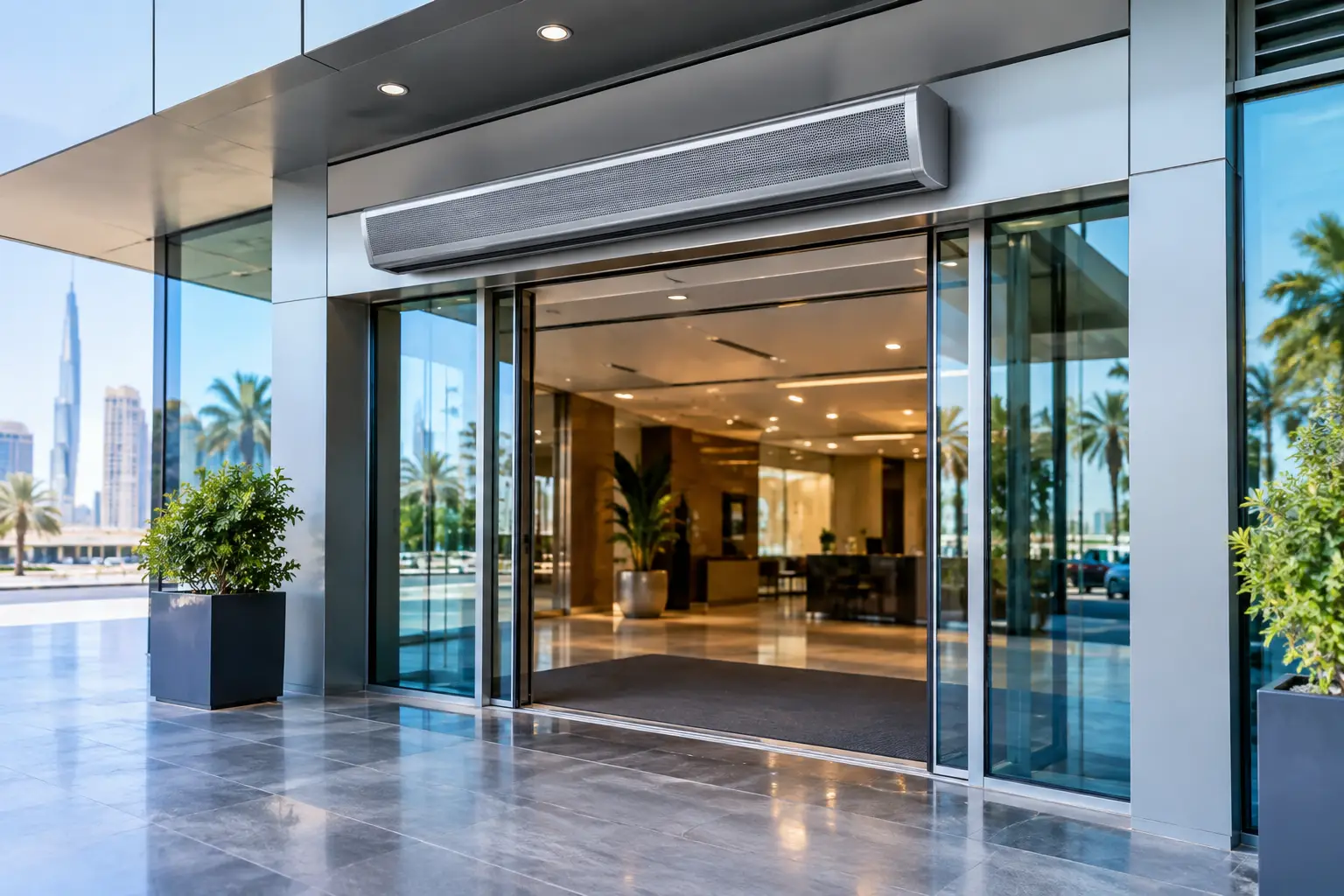
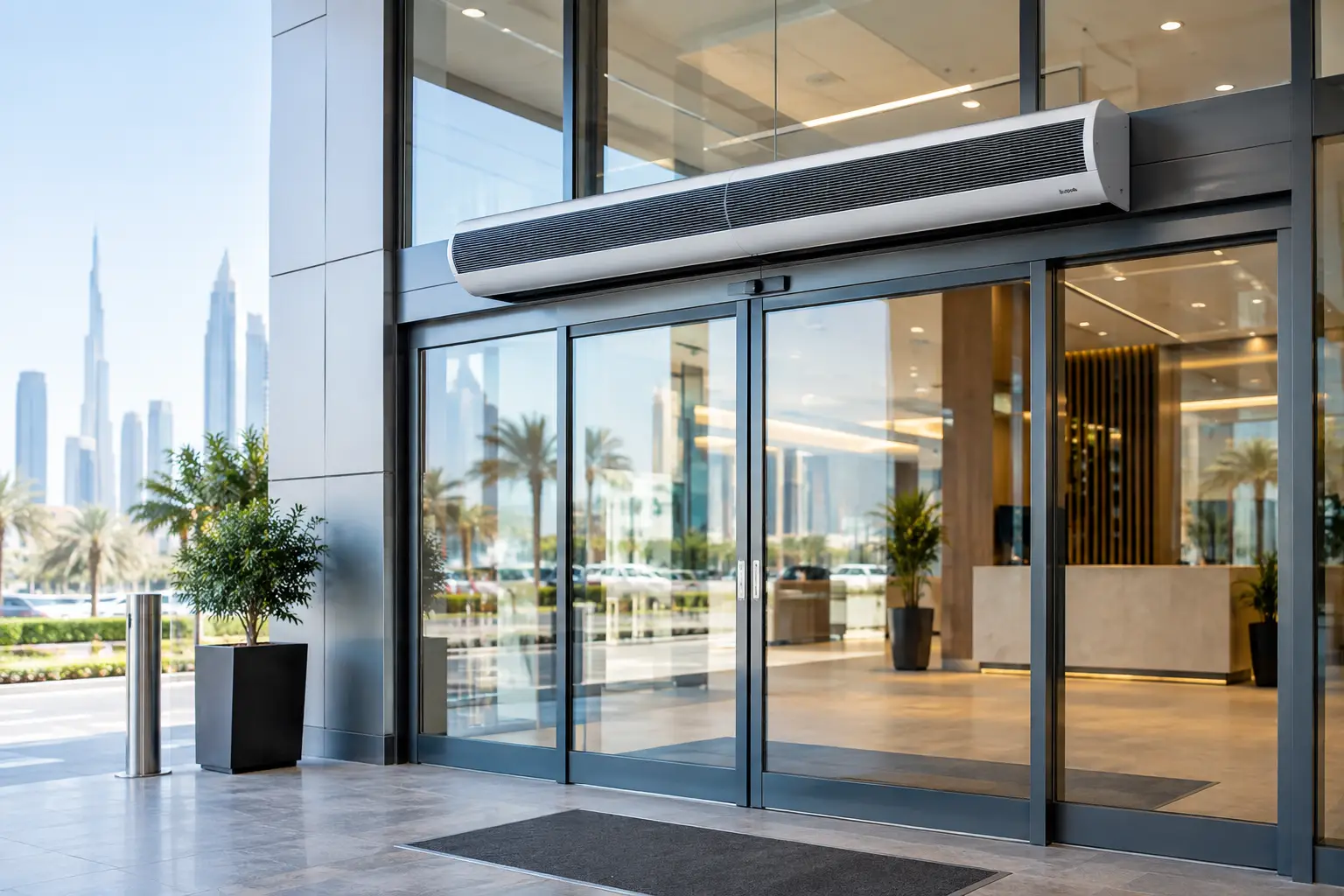
Tall glazed entrances in supermarkets, hypermarkets, hotels, and malls often need an air curtain that protects customer comfort without producing excessive noise. Where doors open frequently, the unit must respond to repeated infiltration events while maintaining a clean, even discharge across the entrance.
For these applications, mounting constraints can be as important as airflow. A recessed ceiling air curtain may suit an architectural entrance where the ceiling has adequate depth and the mounting height remains within the equipment’s rated range. If the opening is taller or more exposed than the ceiling-mounted option can support, a higher-capacity commercial centrifugal model may be the more appropriate choice.
Warehouses, factories, and logistics doors
Warehouse and factory openings face more demanding conditions: tall doors, forklifts, pressure changes, dust, and longer door-open periods. A high-output industrial centrifugal air curtain is generally more suitable where the barrier must work across a greater height and withstand frequent operational disruption.
Loading areas require careful assessment of side winds and vehicle movement. Forklifts passing through can disturb the air stream briefly, while a dock door facing prevailing winds may need a stronger system, side protection, or an adjusted discharge angle. An air curtain reduces infiltration while the door is open, but it cannot overcome every condition if the entrance is fully exposed to sustained high winds.
Cold storage and temperature-controlled areas
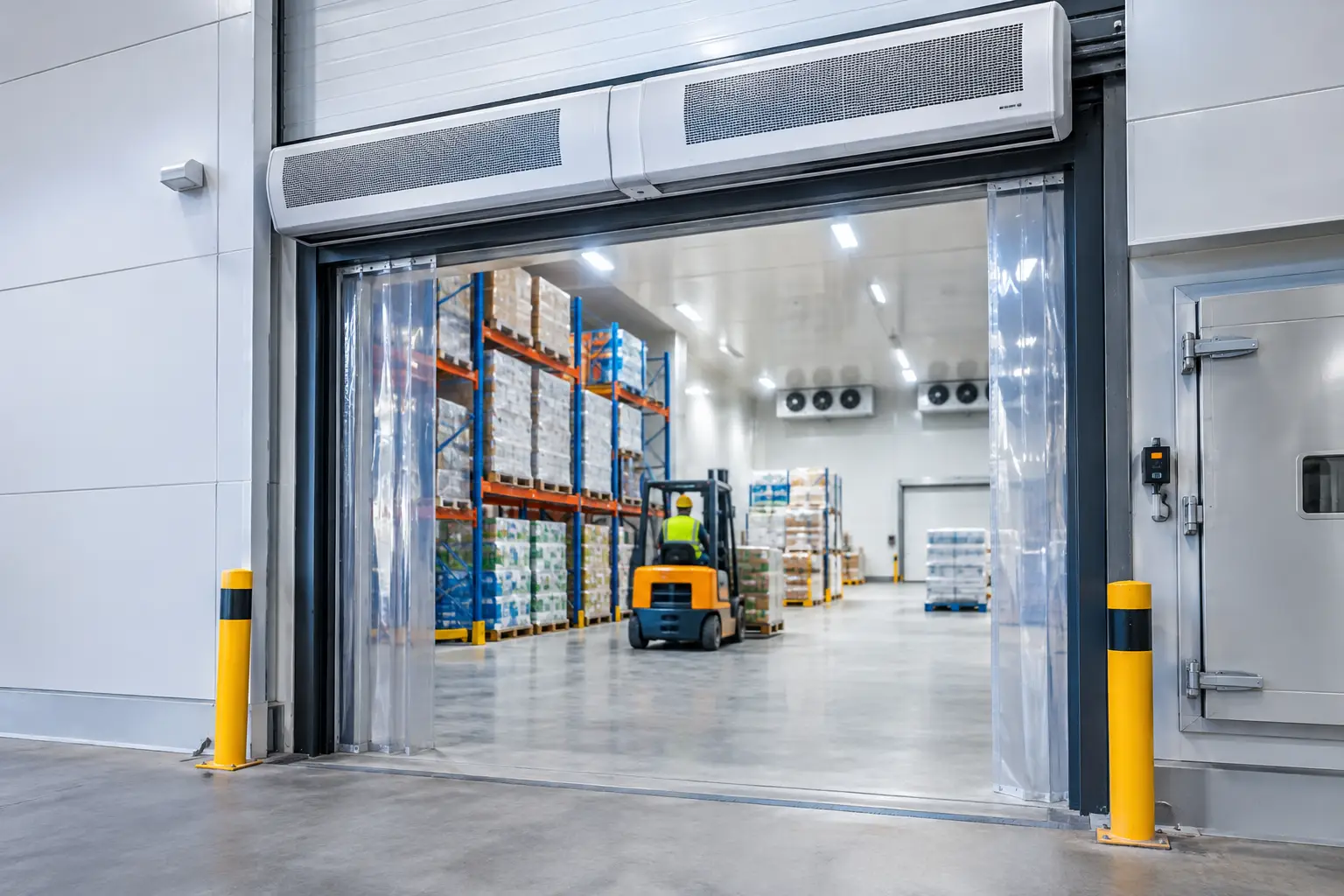
At cold storage or food-processing entrances, the consequence of air leakage is greater. The objective is to limit warm, humid air entering the controlled zone, which can increase refrigeration load and contribute to condensation near the doorway. These applications need an air curtain selected around the temperature differential, door cycle frequency, hygiene requirements, and opening geometry.
A system with insufficient throw can allow humid air to enter beneath the jet, even if it appears effective at eye level. For tall cold-room doors, engineers should prioritize full-height coverage and confirm performance at the installed height.
Consider external pressure, wind, and building airflow
Door height does not tell the whole story. A tall door on a protected internal corridor may need less forceful airflow than a shorter door exposed to prevailing wind, negative indoor pressure, or vehicle-generated drafts.
Before selecting equipment, review whether the building is positively or negatively pressurized. Negative pressure pulls outdoor air inward and raises the demand on the air curtain. Nearby extraction systems, large HVAC supply imbalances, and open service doors can all influence entrance behavior.
Discharge angle is another useful adjustment. A slight outward angle can help counter inward infiltration under certain conditions. However, angle should be determined during professional selection and commissioning. Too much angle can drive the jet away from the protected zone, while too little may not resist the incoming pressure.
For facilities in desert and tropical climates, filter protection and practical maintenance access should also be considered. Dust accumulation reduces airflow over time, and reduced airflow directly affects throw. Selecting a unit with appropriate filtration provisions and a maintenance plan helps preserve the designed performance.
A specification checklist for tall door airflow
When requesting a quotation, provide the clear door width and height, proposed mounting height, indoor and outdoor temperature conditions, and the type of door operation. Also identify whether the entrance is pedestrian-only, used by forklifts, exposed to wind, or connected to a pressure-sensitive area such as cold storage or a pharmaceutical facility.
It is useful to include the expected number of door cycles, typical open duration, and whether the location experiences dust, humidity, insects, fumes, or smoke. These details allow the supplier to determine whether a commercial centrifugal, industrial centrifugal, recessed, or Dynamic Series configuration is appropriate.
Do not specify only by horsepower, motor rating, or an airflow figure measured at the unit. Ask for confirmation of effective mounting height, discharge coverage, terminal velocity expectations, noise considerations, and installation arrangement. For wide tall doors, confirm whether multiple units will create a continuous air barrier with no unprotected gaps.
Choose performance margin, not an oversized guess
The correct airflow for a tall door is the lowest practical level that produces a stable, floor-reaching barrier under real operating conditions. Undersizing leads to cooling loss and contaminant entry. Oversizing without control can raise energy use, noise, and turbulence without delivering better isolation.
For projects across the UAE, Saudi Arabia, Qatar, Oman, and wider MENA and African markets, climate exposure must be part of the selection process. High heat, humidity, desert dust, and busy industrial traffic make verified air curtain performance more valuable than a generic airflow rating.
FreezeeX can review your opening dimensions, mounting arrangement, traffic pattern, and site conditions to recommend a quotation-ready air curtain configuration. Share the project details before procurement so the selected system delivers the air reach and entrance protection your tall door actually requires.