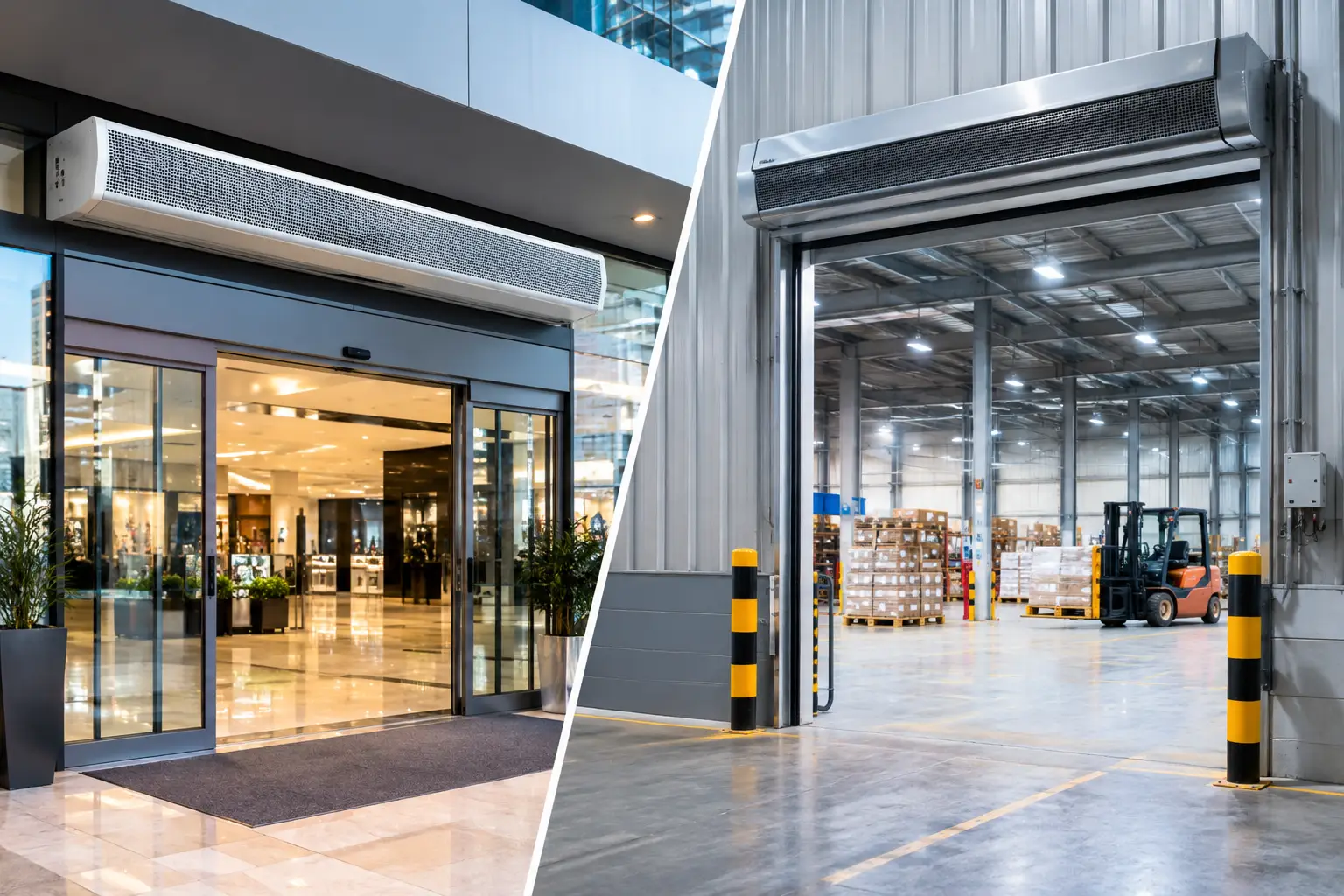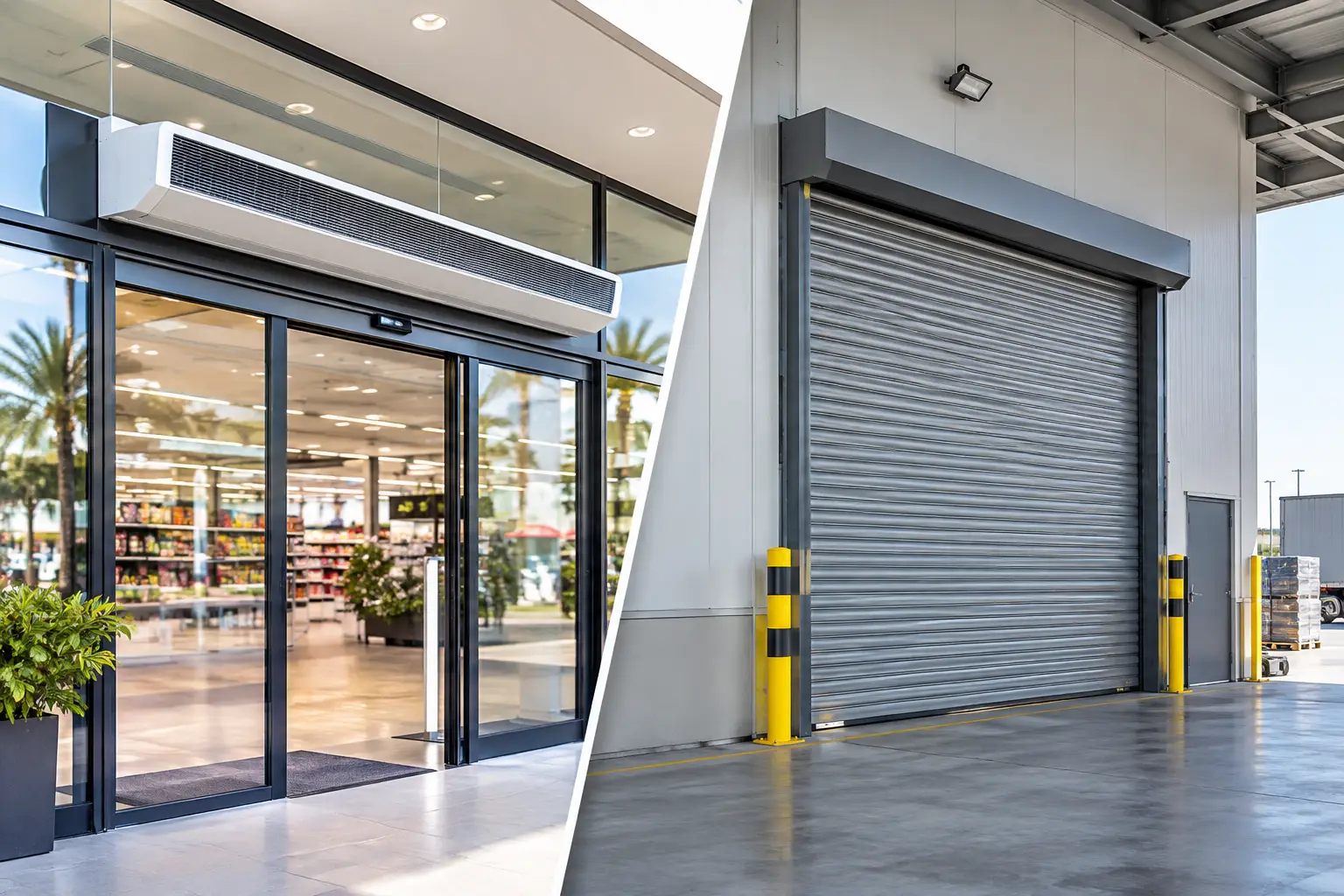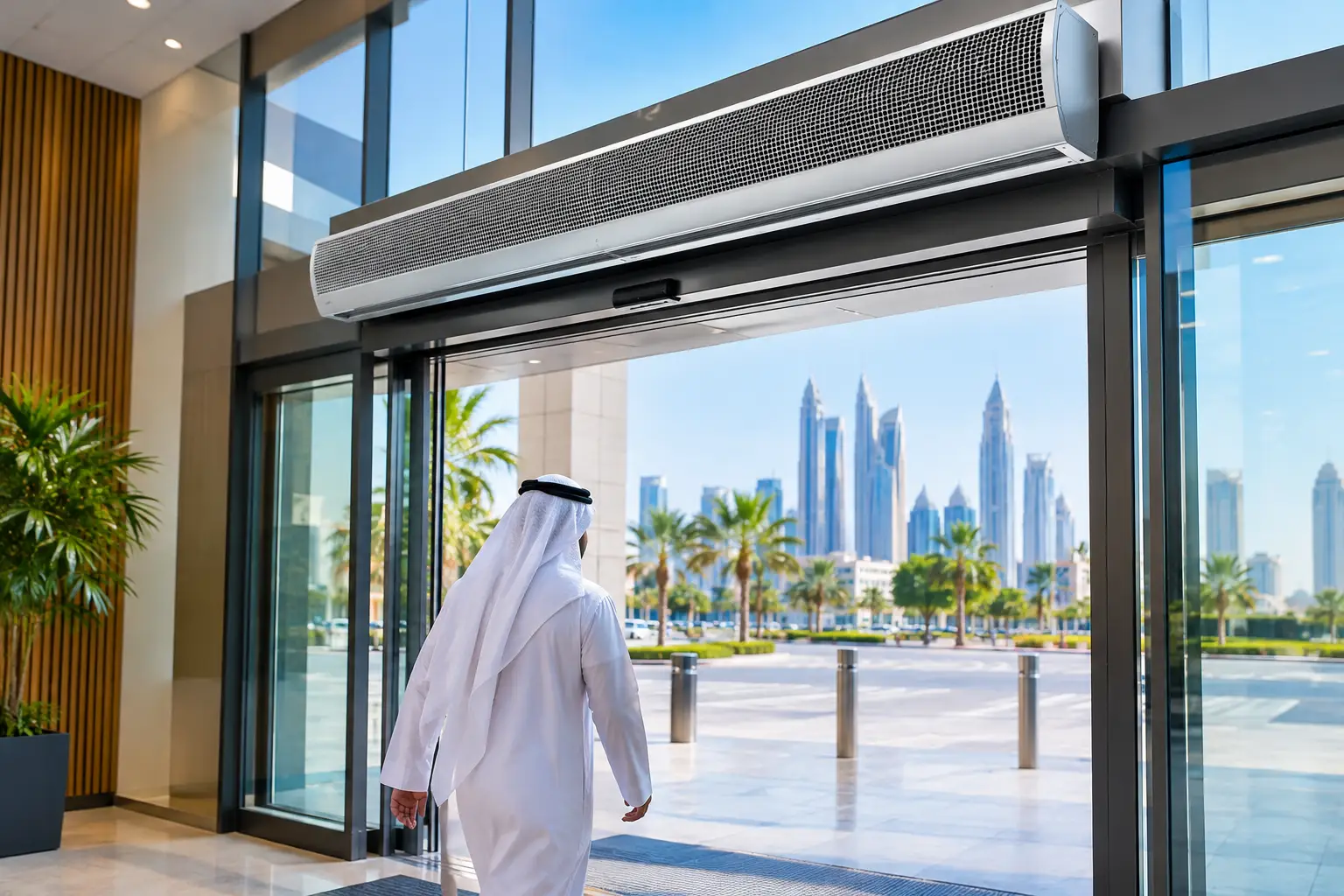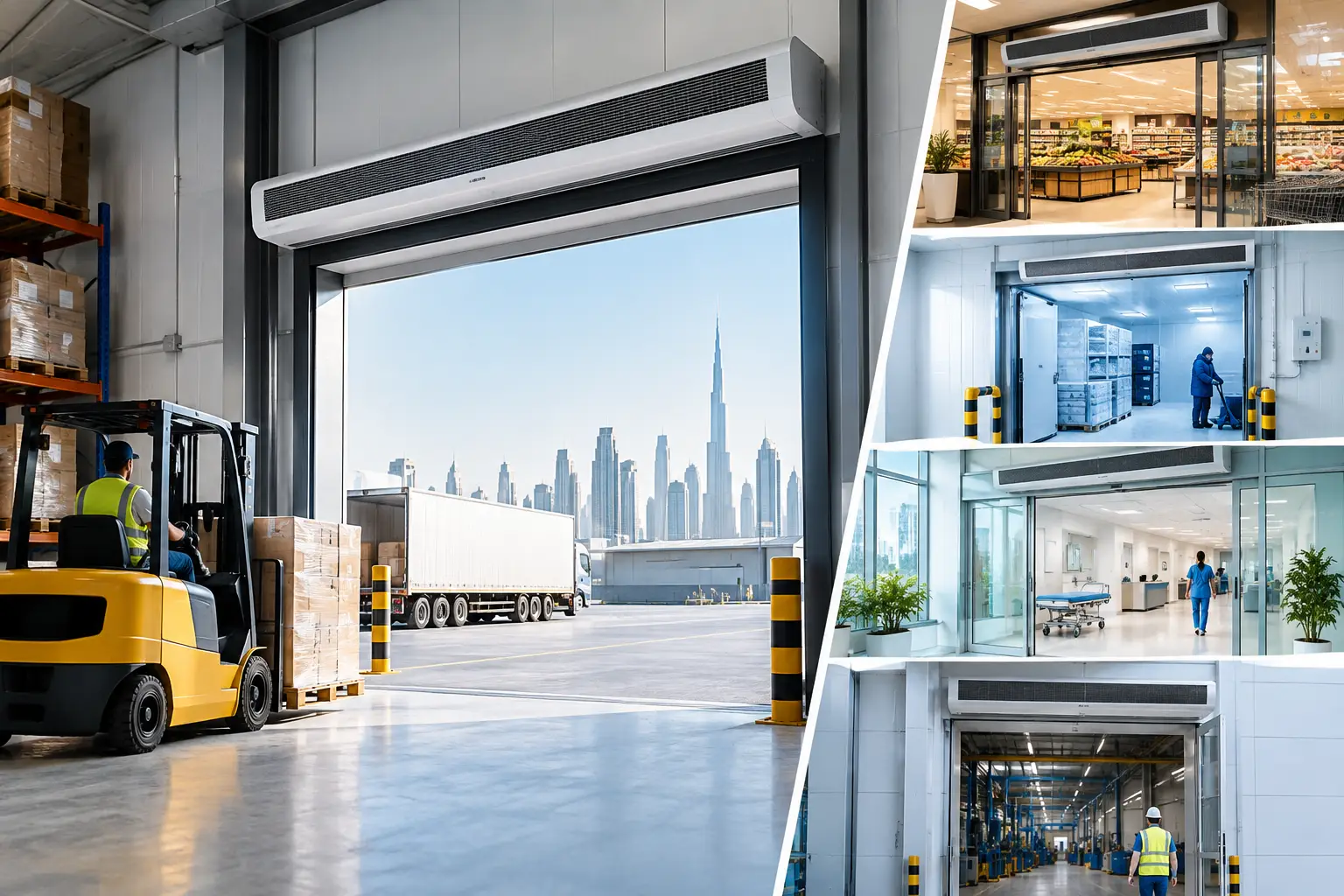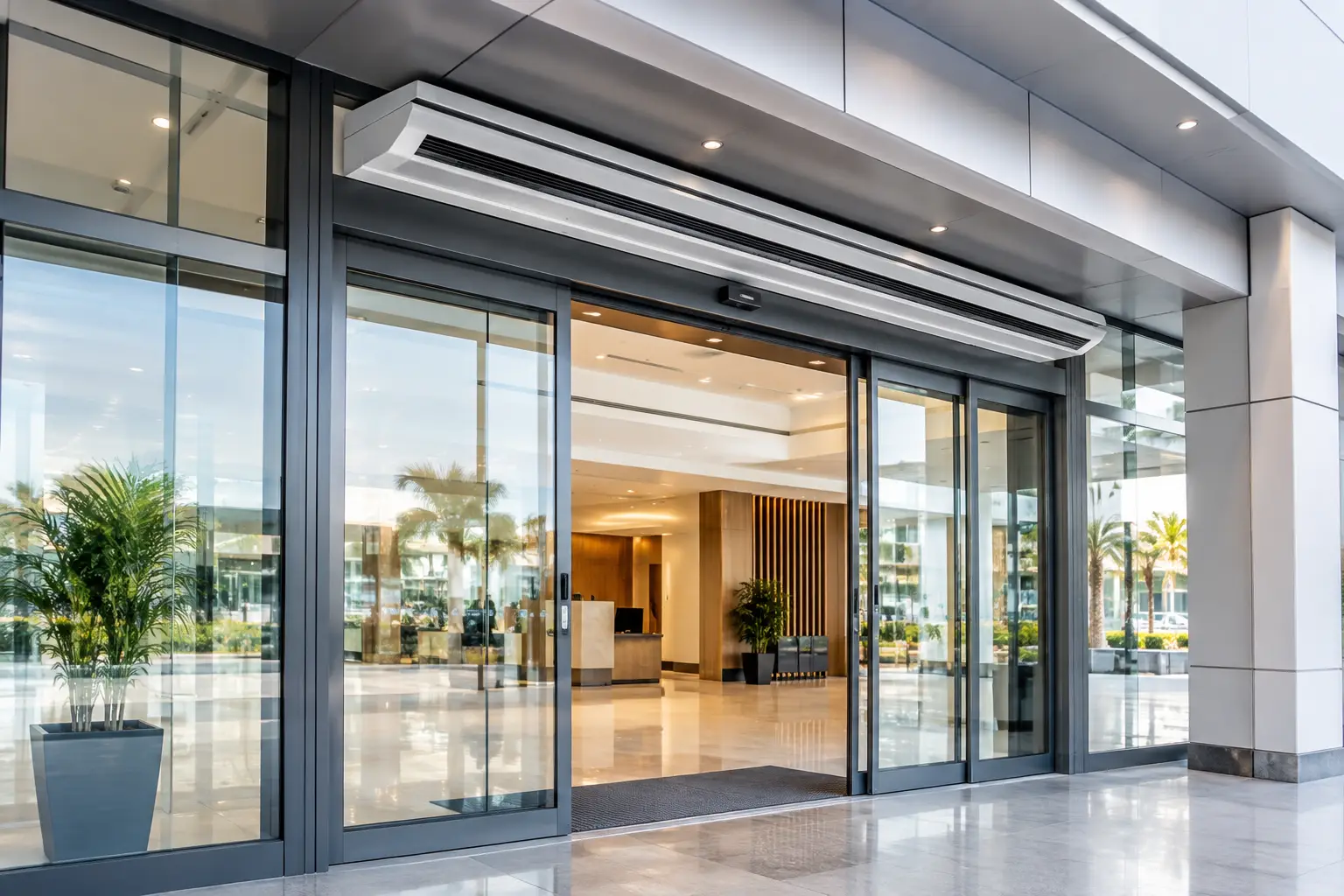
A supermarket entrance in Dubai and a loading bay in Riyadh may both lose conditioned air through an open doorway, but they do not require the same solution. The decision between commercial versus industrial air curtains comes down to more than door width. Traffic frequency, mounting height, pressure conditions, contaminants, operating hours, and the consequences of temperature loss all affect the specification.
For B2B projects across the GCC, MENA, and Africa, the wrong category can create a weak air barrier, unnecessary noise, or an installation that cannot sustain the operating environment. The right system helps maintain indoor comfort while limiting the entry of heat, humidity, dust, insects, smoke, and airborne contaminants.
Commercial versus industrial air curtains: the core difference
Both system types create a directed stream of air across an opening. This air barrier separates indoor and outdoor conditions without requiring staff, visitors, or goods to pass through a physical door. It supports HVAC performance by reducing the amount of hot, humid, or dusty outside air that enters whenever a doorway is open.
The difference is application intensity. Commercial air curtains are generally selected for customer-facing and people-focused entrances, where appearance, acoustic comfort, and integration with the building interior matter alongside air separation. Industrial air curtains are intended for more demanding openings and operating conditions, where higher traffic, larger doors, airborne debris, and longer duty cycles can place greater demands on the equipment.
Neither category is automatically better. A compact retail entrance does not benefit from an oversized industrial unit, while a warehouse dispatch door may overwhelm a commercial model that was selected only by opening width.
| Selection factor | Commercial air curtain | Industrial air curtain | |—|—|—| | Typical environment | Retail, hospitality, healthcare, offices, malls | Warehouses, factories, logistics, processing facilities | | Primary traffic pattern | Pedestrians, shopping carts, guests, staff | Forklifts, pallet movement, goods vehicles, intensive operations | | Design priority | Comfort, presentation, controlled noise | Air isolation under demanding operational conditions | | Typical opening context | Main entrances, service counters, interior transitions | Loading bays, production access doors, large operational openings | | Operating conditions | Regular daily use in managed public spaces | Frequent or extended use in dusty, humid, high-traffic environments |
Where commercial air curtains perform best
Commercial air curtains are appropriate where an entrance is part of the customer or visitor experience. In supermarkets, shopping centers, hotels, restaurants, hospitals, airports, and office facilities, doors may open continuously during business hours. That creates a direct path for external heat and humidity to enter, particularly in Dubai, Doha, Muscat, and other hot-climate locations.
A well-matched commercial system protects the conditioned zone close to the entrance. It can help the HVAC system maintain more consistent temperatures, reduce the discomfort of hot air rushing through doors, and discourage flying insects from entering food-service or retail areas.
Commercial applications commonly prioritize the following:
- A clean visual fit with the entrance architecture
- Effective coverage across standard pedestrian doorways
- Suitable sound levels for public-facing spaces
- Compatibility with the mounting position and ceiling design
- Consistent operation during normal business hours
For projects where visual integration is especially important, recessed ceiling air curtains can be considered during the design stage. In applications that need a more conventional exposed installation, commercial centrifugal-flow and Commercial HiFi Plus Series options may be evaluated according to opening conditions and operational priorities.
Commercial use is not limited to retail
Hospitals, pharmaceutical facilities, and food-related businesses may use commercial air curtains at controlled personnel entrances, receiving areas, or public access points. The purpose is not simply cooling retention. A properly engineered air barrier can also support cleaner entrance conditions by reducing the infiltration of dust, insects, and humid outdoor air.
However, hygiene-sensitive environments should not be specified by category alone. The mounting location, door behavior, cleaning regime, room pressure requirements, and facility process must all be reviewed before a recommendation is made.
When does an industrial air curtain make more sense?
Industrial air curtains are built for entrances where the air barrier faces more severe conditions. Think warehouse doors that open repeatedly for pallet movements, factory access points exposed to dust, distribution centers with constant loading activity, or food-processing facilities with busy operational transitions.
At these openings, the external environment often works against the air curtain. Desert dust, high outside temperatures, humidity, wind effects, vehicle movement, and pressure differences between spaces can disrupt a weak or poorly positioned air stream. The system must be matched to the real opening and its working pattern, not a simplified floor plan.
Industrial selection becomes more appropriate when a project involves:
- Large or high openings beyond standard pedestrian-door conditions
- Frequent forklift, trolley, or pallet traffic
- Dusty, tropical, humid, or desert-climate exposure
- Extended operating hours or continuous process activity
- Operational zones where heat, fumes, or contaminants must be managed at the doorway
- A need to protect cold storage or temperature-controlled process areas from infiltration
FreezeeX Industrial Centrifugal Series and New Dynamic Series are suited to consultation-led evaluation for these types of projects. The preferred model depends on the entrance dimensions, mounting height, traffic volume, site exposure, and the facility’s HVAC and process requirements.
Loading docks require more than a powerful unit
It is tempting to specify the largest available air curtain for a loading dock. That approach can be wasteful and may not solve the underlying issue. An oversized unit can introduce unnecessary noise or energy use, while an undersized unit may fail to project an effective air barrier to the floor.
Door operation matters just as much. A dock door that remains open for long periods, faces prevailing wind, or experiences simultaneous vehicle movements may require a different design approach from a door that opens briefly for scheduled dispatches. Site-specific consultation is the practical way to account for these variables.
How climate changes the specification
In hot, tropical, humid, and desert climates, air curtains perform an especially valuable role at building entrances. The barrier is not trying to address a minor difference between indoor and outdoor conditions. It is limiting the constant infiltration of hot air, moisture, dust, and insects into spaces that are actively cooled.
In coastal humidity, uncontrolled moist air can affect occupant comfort and add load to air-conditioning systems. In desert environments, fine dust can compromise the cleanliness of retail floors, food areas, production zones, and stored goods. In high-heat cities such as Abu Dhabi, Kuwait City, Cairo, Lagos, and Nairobi, repeated door opening can quickly affect the entrance zone if the air barrier is not properly selected.
That does not mean every entrance needs industrial equipment. It means climate conditions must be part of the engineering brief. A commercial store with a wide, constantly open entrance may need a more demanding solution than a small factory side door that remains closed most of the day.
A practical selection process for specifiers
The best air curtain decision starts with the opening and the operation around it. Avoid choosing from a product image or a generic label alone. Use a structured evaluation before requesting a quotation.
- Document the opening. Confirm door width, height, mounting position, ceiling constraints, and whether the installation is recessed or exposed.
- Map traffic behavior. Identify who and what passes through the opening, how often the door opens, and whether it stays open during deliveries or peak periods.
- Assess the outside conditions. Consider heat, humidity, dust, wind, insects, fumes, and the exposure of the doorway.
- Define the indoor objective. The priority may be cooling retention, occupant comfort, pest control, contaminant reduction, or protection of a controlled process area.
- Review HVAC and pressure conditions. Air curtains complement the wider HVAC strategy. They do not replace correct cooling capacity, door control, or required ventilation measures.
- Select the category and configuration. Match a commercial or industrial series to the actual use case, then confirm the final recommendation through a professional project review.
Common specification mistakes to avoid
The most costly errors tend to originate early in the project. Selecting solely by doorway width ignores mounting height and the need for the air stream to reach and protect the opening effectively. Selecting only by price can overlook duty requirements and the cost of cooling loss over the life of the installation.
Another common mistake is treating an air curtain as a substitute for operational controls. If a warehouse door is permanently open, exposed to strong wind, and used for continuous vehicle access, equipment selection must be coordinated with how that bay operates. The air curtain is one part of entrance climate control, not an isolated fix.
Architects and MEP consultants should also coordinate the unit early where recessed mounting, electrical provisions, controls, or ceiling coordination are involved. Early planning usually produces a cleaner installation and prevents last-minute compromises around the entrance.
Choose for the opening you operate
Commercial air curtains serve public-facing entrances where comfort, presentation, and everyday traffic control are central. Industrial air curtains serve harder-working operational openings where traffic, contaminants, size, and duty cycles demand a stronger application fit. The boundary is not absolute, which is why a consultation-based recommendation is more reliable than a one-size-fits-all choice.
For a project in a hot, humid, or desert climate, provide the entrance dimensions, mounting details, operating schedule, and environmental conditions for a FreezeeX consultation and quotation. A properly matched air curtain can protect the conditions your HVAC system is working hard to create.