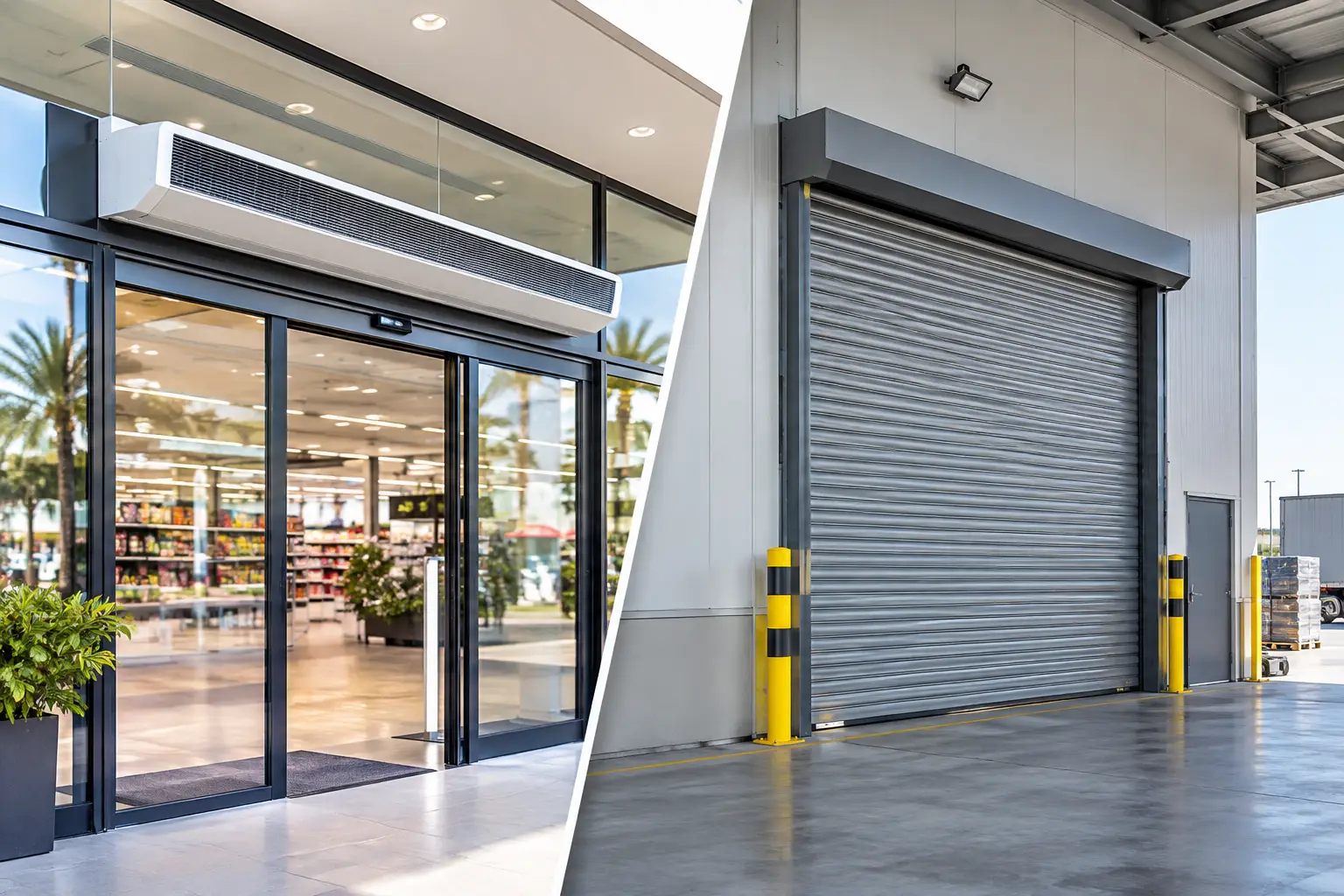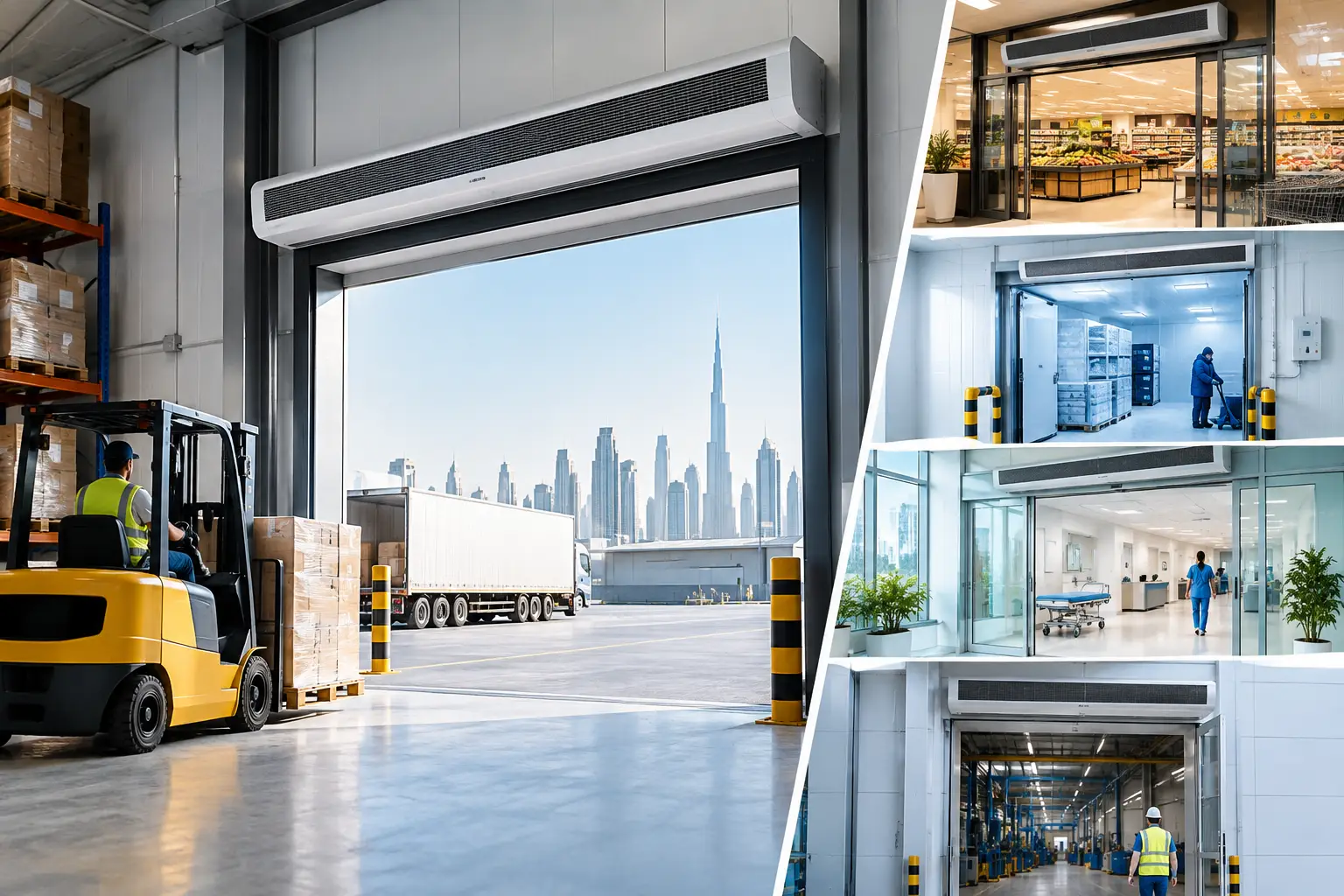
A loading bay in Dubai, a supermarket entrance in Riyadh, or a food-processing access point in Lagos faces a familiar operating conflict: the doorway must stay open for people and goods, but the conditioned interior must stay protected. When evaluating air curtains versus roller shutters, the right answer is rarely one product replacing the other. They solve different problems, and many commercial facilities need both.
An air curtain creates a controlled air barrier across an open doorway. A roller shutter creates a physical closure when the doorway is not in use. Understanding that distinction helps HVAC consultants, facility managers, and project teams specify equipment that supports access, energy performance, hygiene, and security without compromising daily operations.
Air Curtains Versus Roller Shutters: The Core Difference
Air curtains are designed for active entrances. Positioned above or alongside an opening, they direct a high-velocity stream of air across the doorway to reduce the exchange between indoor and outdoor air. This supports comfort and HVAC efficiency while people, trolleys, forklifts, or deliveries move through the entrance.
Roller shutters are designed for closure. Their primary role is to secure an opening, separate spaces, and protect a facility when an entrance is closed. They are useful at storefronts, warehouses, service counters, and industrial openings after business hours or during inactive periods.
The practical question is not which product is universally better. It is whether the entrance needs environmental separation while remaining open, physical security while closed, or both.
| Decision factor | Air curtain | Roller shutter | |—|—|—| | Entrance status | Operates while the doorway is open | Protects the opening while it is closed | | Primary purpose | Limits air exchange and airborne intrusion | Provides physical closure and security | | Traffic flow | Supports continuous pedestrian and vehicle movement | Requires opening and closing for passage | | HVAC impact during access | Helps reduce conditioned-air loss | Offers no active protection when left open | | Best role | Climate control, comfort, hygiene, and access | Security, closure, and controlled access |
When Does an Air Curtain Make More Sense?
An air curtain is the more relevant solution where an open door is part of normal operations. Retail entrances, supermarkets, hotels, restaurants, hospitals, airports, distribution centers, and manufacturing facilities often cannot keep doors shut without disrupting customer service or material flow.
In hot, humid, and desert-climate markets, an open entrance can introduce intense heat, humidity, dust, insects, fumes, and airborne contaminants. That outdoor air increases the load on the building’s HVAC system and can make the area immediately inside the entrance uncomfortable. A correctly selected commercial or industrial air curtain helps reduce this unwanted transfer without restricting access.
Air curtains are particularly appropriate when a facility needs to address several operational issues at once:
- Maintain customer, staff, forklift, or delivery traffic through an open doorway.
- Reduce loss of cooled indoor air in extreme outdoor heat.
- Limit the entry of dust, insects, humidity, smoke, and fumes.
- Support cleaner conditions at food, pharmaceutical, healthcare, and processing entrances.
- Improve comfort near reception areas, retail doors, dispatch zones, and loading points.
For a high-traffic commercial entrance, the selection must account for opening width and height, mounting position, traffic pattern, pressure differences, and surrounding HVAC conditions. A unit selected only by door width may not create an effective air stream at the threshold, especially in exposed or demanding industrial locations.
Why climate conditions change the specification
A facility in Abu Dhabi, Doha, Muscat, or Cairo does not face a mild outdoor environment for much of the year. High ambient heat, humidity in coastal areas, and windblown dust can make entrance protection a significant building-performance issue.
For these conditions, an air curtain should be evaluated as part of the entrance and HVAC strategy, not as a decorative accessory above a door. The required air pattern, installation location, and unit category depend on the specific exposure and duty cycle. FreezeeX focuses on systems intended for demanding tropical, humid, and desert-climate commercial and industrial applications.
When Is a Roller Shutter the Better Choice?
A roller shutter is the right choice when the opening must be physically secured or fully closed. This is common for warehouses after operating hours, retail frontages, storage rooms, industrial bays, and restricted-access areas.
It also makes sense where the doorway is used only intermittently. If a service opening is closed for long periods and only opened for scheduled deliveries, a shutter provides a practical barrier between operations. However, once it is opened for loading, dispatch, or frequent personnel movement, it no longer protects the indoor environment on its own.
This limitation matters most at busy logistics and industrial sites. Leaving a roller shutter open to avoid repeated opening cycles can expose the facility to heat gain, dust, pests, and humidity for extended periods. In that scenario, the operational behavior of the doorway points toward an air curtain as a complementary measure.
Why Many Facilities Specify Both
For loading docks, warehouse doors, food distribution centers, and industrial production areas, combining an air curtain with a roller shutter is often the strongest specification. The shutter handles security and closure outside operating periods. The air curtain supports environmental separation during active hours when the shutter must remain open.
This combined approach is valuable where there is a clear difference between day and night operation. A logistics center may keep dock doors active during deliveries, then close and secure them after dispatch is complete. A supermarket may require a physically secured rear delivery entrance overnight but need airflow protection while receiving stock.
The combination should not be treated as automatic. If a door opens only briefly and infrequently, the additional air curtain may not be necessary. Conversely, if a door remains open for long intervals, relying on the shutter alone is unlikely to address cooling loss and contaminant ingress during operations.
How Should Project Teams Make the Choice?
The most reliable decision comes from reviewing how the opening actually operates rather than choosing based on the building type alone. A warehouse can have a low-traffic personnel entry, a heavily used loading door, and a secure storage opening, each requiring a different approach.
Use this evaluation sequence during planning or retrofit projects:
- Define the doorway’s operating pattern. Establish how long it stays open, how often it cycles, and whether pedestrians, carts, forklifts, or palletized goods pass through it.
- Identify the primary risk. Determine whether the key issue is cooling loss, dust, insects, humidity, fumes, hygiene, security, or a combination of these factors.
- Assess environmental exposure. Consider external heat, wind, humidity, vehicle activity, dust levels, and pressure differences between adjacent spaces.
- Review the HVAC and operational objective. Clarify whether the project aims to improve comfort, reduce HVAC load, protect sensitive processes, maintain cleanliness, or secure the site after hours.
- Specify the equipment around the real conditions. Select the air curtain category, mounting arrangement, and shutter requirement based on the opening and its daily duty cycle.
Avoid the common specification mistake
The most common mistake is treating an air curtain as a security door or treating a roller shutter as an active climate-control device. Neither is designed to perform the other’s main job.
A second mistake is selecting an air curtain without considering installation height, door exposure, and traffic. A light-duty commercial entrance and a heavily used industrial loading opening require different airflow strategies. Recessed ceiling units may suit certain architecturally sensitive commercial entrances, while industrial applications may require a solution built for greater operational demand.
What This Means for HVAC Efficiency and Operations
Air curtains do not replace properly designed HVAC systems or physical security measures. Their value comes from reducing the penalty of keeping a necessary entrance open. By limiting the exchange of indoor and outdoor air, they can help HVAC systems maintain intended interior conditions more effectively while preserving access.
For supermarkets, hospitality venues, healthcare facilities, and food-related operations, that operational benefit extends beyond comfort. Entrance protection can support a cleaner, more controlled environment where dust, insects, humidity, and outdoor pollutants create avoidable risks.
For warehouses and factories, the benefit is often tied to workflow. Teams can keep goods moving without accepting the full environmental impact of an open dock or production doorway. The appropriate solution depends on the building, but the operational principle remains consistent: protect the opening during the state in which it is actually used.
A project team planning an entrance in a hot, humid, or dusty location should request a consultation before finalizing the specification. Share the opening dimensions, mounting constraints, traffic volume, operating environment, and HVAC goals to receive a quotation and air-curtain recommendation suited to the facility’s real operating conditions.