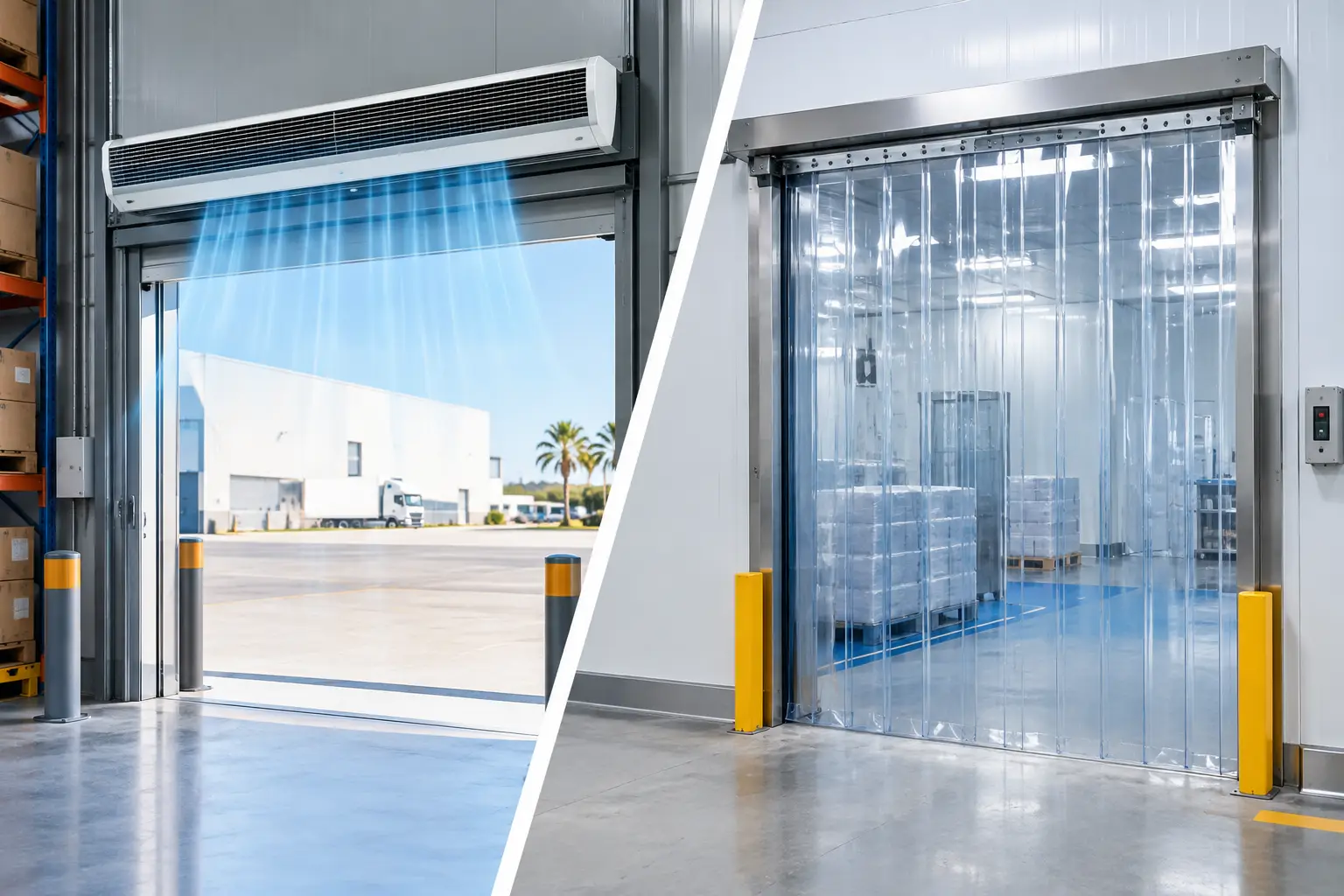
A loading-bay door that stays open for deliveries can quickly become an energy and hygiene weak point. The air curtain versus strip doors decision affects how people and goods move, how much conditioned air escapes, and how well a facility limits dust, insects, humidity, and airborne contaminants. For commercial and industrial sites in Dubai, Riyadh, Doha, Cairo, Lagos, and other hot or humid markets, the right answer depends less on product preference than on the operating conditions at the doorway.
Air Curtain Versus Strip Doors: The Core Difference
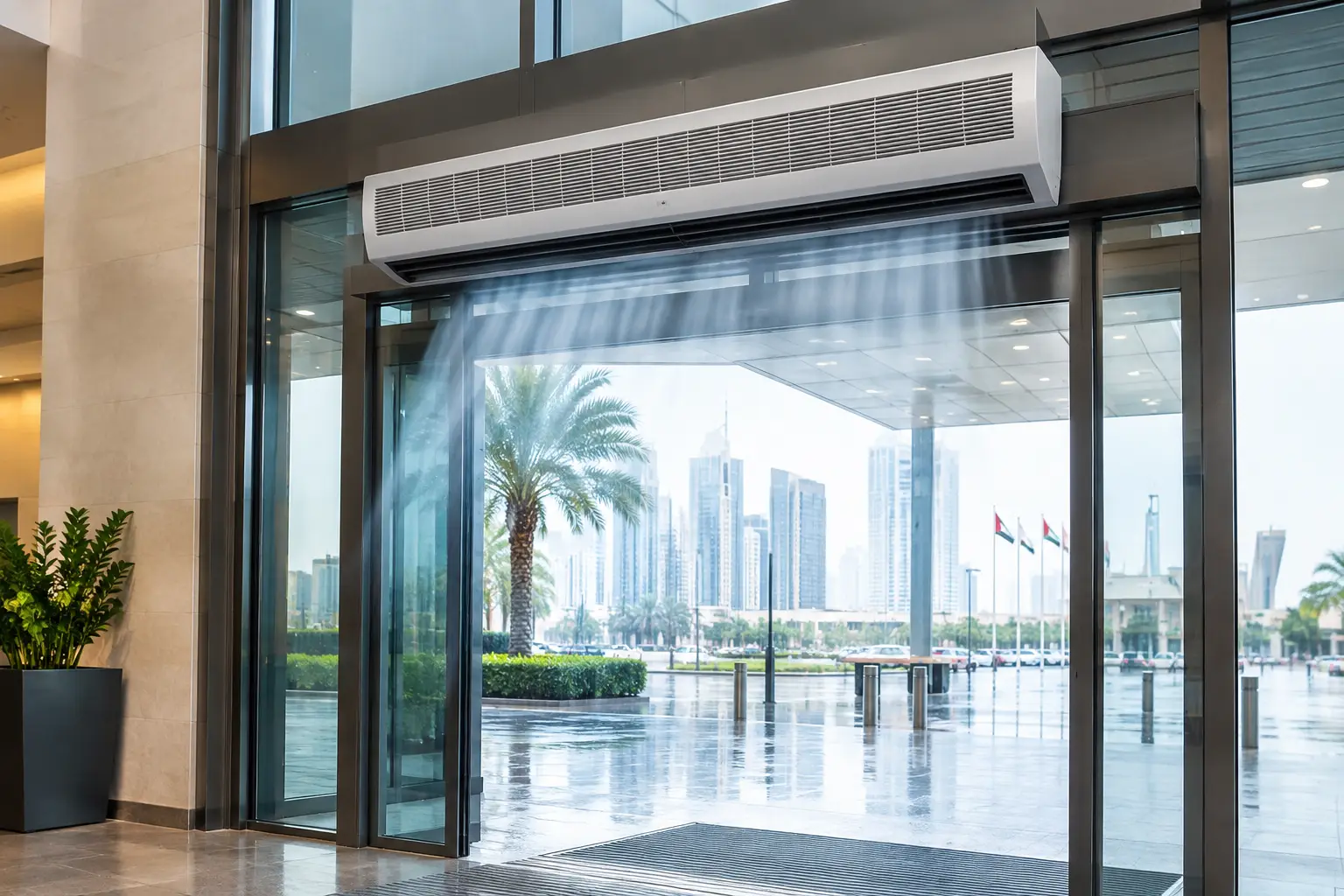
An air curtain creates a directed stream of air across an open doorway. It is designed to form an active barrier between indoor and outdoor environments while allowing people, carts, and vehicles to pass without touching a physical obstruction. In a conditioned retail entrance, hotel lobby, food-service receiving area, or high-traffic warehouse, this supports access while helping reduce the ingress of outdoor heat, dust, humidity, insects, and fumes.
Strip doors, also called PVC strip curtains, use overlapping flexible strips to create a physical barrier. People, pallet jacks, and forklifts push through the strips, which fall back into place after passage. They are commonly considered for internal openings, low-to-medium traffic zones, and certain cold storage or warehouse applications where a physical separation is acceptable.
Neither solution is automatically better. The practical question is whether the doorway needs contact-free access, a physical barrier, or a combination of both.
| Decision factor | Air curtain | Strip doors | |—|—|—| | Barrier type | Active, directed airflow | Physical overlapping strips | | Pedestrian access | Open passage with no contact | Users pass through strips | | Forklift and trolley movement | Suitable when correctly specified for door height and traffic | Can be practical, but strips may impede or contact loads | | Visibility and customer experience | Maintains an open entrance appearance | Can reduce visibility and feel restrictive at public entrances | | Dust, heat, and humidity control | Helps limit infiltration while the door is open | Creates a physical separation, subject to gaps and traffic movement | | Best-fit environments | Retail, hospitality, healthcare, restaurants, busy commercial and industrial doors | Internal warehouse openings, lower-traffic separation points, selected cold-chain areas |
When Is an Air Curtain the Better Choice?
An air curtain is usually the stronger option where the entrance is frequently open and uninterrupted movement matters. This is common in supermarkets, shopping malls, airports, restaurants, hospitals, pharmaceutical facilities, and logistics buildings with active dispatch areas.
At a busy public entrance, strip doors can create hesitation for visitors and can be difficult for carts, luggage, or wheeled equipment. An appropriately selected air curtain keeps the doorway visually open while supporting indoor comfort. That matters in desert and tropical climates, where outside air can carry intense heat, sand, dust, and moisture directly into a cooled building.
Air curtains are particularly appropriate when a facility needs to address several operating priorities at once:
- Maintain a welcoming, unobstructed customer or staff entrance.
- Reduce cooling loss from an air-conditioned interior.
- Limit infiltration of dust, insects, humidity, smoke, or fumes.
- Support hygienic operations in food handling, healthcare, and pharmaceutical environments.
- Preserve clear sightlines at security-sensitive or high-traffic access points.
The result depends on correct engineering. Door width, mounting height, discharge angle, crosswinds, air-conditioning capacity, and traffic patterns all influence air-barrier performance. A unit selected only by doorway width may not deliver the intended isolation effect.
Commercial Entrances Need Comfort Without Obstruction
For a retail store entrance in a shopping center or a hotel lobby, access is part of the customer experience. A physical strip barrier may be technically functional, but it can look industrial and create an awkward threshold. A commercial air curtain is normally a more natural fit when the objective is to protect the conditioned space without changing how visitors enter.
Recessed ceiling air curtains can suit projects where the design calls for a discreet finish, while commercial centrifugal flow and HiFi Plus series options can be considered where entrance performance and presentation both matter. Final selection should always be based on the actual opening and duty cycle, not appearance alone.
Industrial Doors Need Airflow That Matches the Opening
At factories, warehouses, workshops, and distribution centers, the door may be taller, wider, exposed to outdoor wind, or open for extended periods. These conditions require an industrial approach. A standard commercial unit may not be suitable for a high-bay loading door with forklift traffic and strong pressure differences.
Industrial centrifugal and Dynamic Series air curtains are intended for demanding commercial and industrial environments. The specification process should examine the door dimensions, mounting arrangement, surrounding air movement, and how frequently the opening remains open. This is how an air barrier is matched to the real operational load rather than simply installed above a door.
When Do Strip Doors Make Sense?
Strip doors remain a practical option in the right location. Their strength is straightforward physical separation, particularly where appearance and touch-free access are less important than dividing spaces.
They can be suitable for internal warehouse routes, back-of-house openings, selected production zones, and cold storage transitions. In these cases, the facility accepts that users and equipment will contact the strips as they pass through.
However, strip doors introduce trade-offs. They can become scuffed, displaced, or damaged in active forklift routes. They may also create a slower passage point for pedestrians, trolleys, and goods. At entrances exposed to harsh heat, humidity, dust, or heavy public traffic, their physical design often makes them less suitable than an engineered air curtain.
For cold storage, the decision needs particular care. Strip doors may help maintain separation when the opening is mostly closed and traffic is controlled. Where traffic is frequent, a properly designed air curtain can help improve movement and reduce the time a physical barrier is displaced. Some facilities may use both, but this should be assessed as a complete doorway system rather than assumed to be necessary.
How Should You Choose Between Air Curtains and Strip Doors?
Use the doorway itself as the starting point. A specification review should follow a logical sequence:
- Define the opening and traffic. Record door width, height, mounting position, opening duration, and whether traffic is pedestrian, trolley, forklift, or mixed.
- Identify the outside conditions. Consider extreme heat, humidity, dust, insects, fumes, and wind exposure. These factors are especially relevant across GCC, MENA, and African industrial and commercial sites.
- Set the operational priority. Decide whether the main need is cooling retention, contamination control, uninterrupted access, physical separation, or a combination of these goals.
- Assess the HVAC relationship. The air curtain should support the building’s cooling strategy. It is not a substitute for properly designed air conditioning or door management.
- Select the system category. Match the unit to the application, from a finished commercial entrance to a heavy industrial opening, then confirm mounting and controls as part of the project design.
This process prevents a common mistake: specifying strip doors because they appear simple, or selecting an air curtain because it appears convenient, without accounting for traffic intensity and local climate exposure.
Can Air Curtains and Strip Doors Be Used Together?
Yes, but only where the combined arrangement solves a clear operational problem. A cold storage or food-processing facility may require a physical barrier during lower-traffic periods while also needing active air isolation during frequent movement. In a warehouse, a strip barrier may be appropriate for an internal opening while an industrial air curtain protects the external loading entrance.
Using both at every door is not automatically more effective. Additional barriers can complicate traffic flow, cleaning, visibility, and daily operations. The better approach is to assign each solution to the doorway where it performs a specific function.
The Best Choice Is Based on the Door, Not the Product
Air curtains and strip doors solve different access-control problems. Strip doors provide a tangible physical divider and can work well in controlled, industrial, or internal separation zones. Air curtains are built for open-door operation, helping businesses protect conditioned interiors without placing a barrier in the path of people or goods.
For high-traffic commercial entrances and demanding external doors in hot, humid, dusty, or desert climates, an air curtain is often the more operationally efficient choice. FreezeeX evaluates entrance size, mounting position, traffic volume, climate exposure, and HVAC requirements to recommend a system suited to the application.
For a project-specific recommendation or quotation, speak with the FreezeeX team before finalizing the doorway specification. The right air barrier should support the way your facility actually operates, not force operations to work around the barrier.