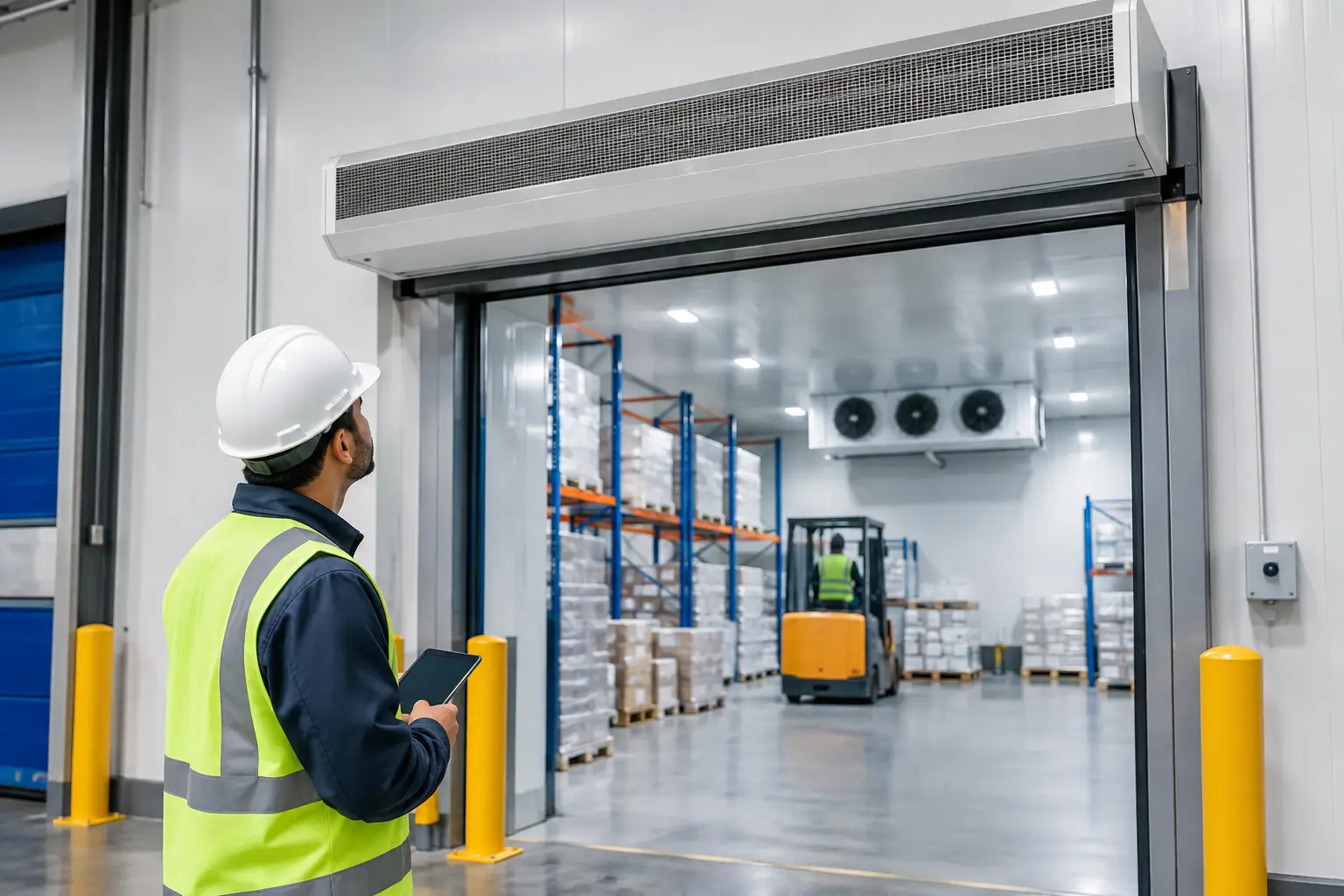
A cold-room door left open for even a short loading cycle can introduce a large volume of hot, humid outside air. In facilities across Dubai, Riyadh, Doha, and other hot-climate markets, cold storage efficiency is often determined less by the refrigeration system itself than by how effectively the doorway is controlled.
For food distribution centers, pharmaceutical stores, food processing facilities, and temperature-controlled warehouses, uncontrolled infiltration creates a chain reaction. Refrigeration equipment runs longer, humidity rises, frost and condensation become more likely, and staff may face a less stable working environment near the entrance. A properly selected commercial or industrial air curtain can help reduce this exposure while keeping essential vehicle, pallet, and personnel traffic moving.
Why Loading Doors Challenge Cold Storage Efficiency
A closed insulated door limits heat transfer. An open doorway does not. Warm air naturally moves toward colder spaces, while humid outdoor air can be drawn into the cold room as forklifts, pallets, and personnel pass through the opening. In desert and tropical climates, the temperature and moisture difference across that opening can be especially severe.
The result is not simply a temporary rise in room temperature. Moisture entering the facility can condense or freeze on surfaces, affect visibility, create slippery-floor risks, and increase the refrigeration load required to return the room to its operating setpoint. The higher the traffic volume and the wider the opening, the more consequential that infiltration becomes.
Common operating conditions that weaken cold storage performance include:
- Frequent pallet movements through dock doors and dispatch bays
- Doors held open during receiving, picking, staging, or cleaning activity
- High ambient heat at external loading areas
- Humid air entering chilled or frozen storage zones
- Pressure differences between adjacent rooms, corridors, and loading docks
- Dust, insects, and airborne contaminants entering with outside air
An air curtain does not replace an insulated cold-room door. Its role is to create a controlled air barrier during the period when the physical door must remain open. That distinction matters when evaluating the expected operational benefit.
How Air Curtains Support Cold Storage Efficiency
An air curtain projects a directed stream of air across an opening. When the unit is correctly sized, positioned, and commissioned, that stream helps separate two environments that would otherwise mix freely. At a cold storage door, the objective is to reduce the movement of warm, humid external air into the conditioned space and limit the escape of cold air.
This approach can support refrigeration efficiency because the system has less unwanted heat and moisture to remove after each traffic event. It can also help protect product handling conditions near the entrance, particularly where chilled goods are transferred between storage areas and dispatch zones.
The barrier must match the opening
Cold storage applications are not one-size-fits-all. A narrow personnel entrance has very different requirements from a tall industrial roller shutter used by forklifts. Air velocity, discharge pattern, mounting height, opening width, traffic type, and surrounding pressure conditions all affect whether the air stream reaches the floor and maintains separation.
A unit selected only by door width may underperform. Conversely, specifying a higher-capacity industrial unit where traffic is limited may add unnecessary energy use or noise. The right approach is to match the air curtain to the real doorway condition, not simply to the room size.
Humidity control matters as much as temperature
In hot and humid locations, moisture infiltration can be as damaging operationally as sensible heat gain. When humid air enters a colder area, it can lead to condensation on floors, packaging, door frames, and nearby equipment. In freezer-adjacent spaces, moisture can contribute to ice formation and related housekeeping demands.
By helping limit uncontrolled outside-air entry, an air curtain supports a more manageable moisture load. It should be considered part of an overall entrance-control strategy alongside suitable doors, dock procedures, room pressure management, and refrigeration design.
Where an Air Curtain Delivers the Most Value
The strongest case for an air curtain is usually a doorway that must remain open repeatedly and cannot depend on a physical door alone. Facilities with predictable but frequent traffic often see the clearest operational benefit because the barrier works during the exact periods when infiltration risk is highest.
| Application | Primary doorway challenge | Air curtain objective | |—|—|—| | Cold warehouse loading dock | Forklift and pallet traffic through wide openings | Reduce warm-air and humidity ingress during dispatch cycles | | Food processing transfer point | Movement between chilled production and handling areas | Maintain separation while supporting fast workflow | | Supermarket back-of-house cold room | Frequent staff access and delivery activity | Limit cooling loss and help control dust and insects | | Pharmaceutical temperature-controlled store | Sensitive environmental conditions near receiving areas | Reduce contamination exposure and thermal disturbance | | Distribution center staging area | Repeated opening between cold zones and ambient dock space | Lower refrigeration recovery demand after traffic events |
For external doors exposed to sun, dust, and extreme ambient temperatures, industrial-grade selection is especially important. Internal transfer doors may need a different configuration because pressure relationships and ambient conditions are less severe. This is why a site review should consider the full movement path of goods, not just the cold-room entrance.
What Should Be Assessed Before Specification?
For MEP consultants, contractors, and facility teams, a cold storage air curtain should be specified as an entrance-performance solution. The following evaluation process helps avoid common mismatches.
- Measure the clear opening and mounting position. Confirm the usable width, door height, available headroom, obstructions, and whether the unit will be surface-mounted, recessed, or installed in another suitable position.
- Map traffic behavior. Identify how often the door opens, how long it stays open, and whether pedestrians, hand trolleys, pallet jacks, or forklifts pass through. Traffic patterns influence both product selection and control strategy.
- Compare both sides of the doorway. Record the cold-room temperature, adjacent-area temperature, humidity exposure, and whether the door connects to an external dock, warehouse, corridor, or processing space.
- Review the existing door system. Air curtains work best when paired with effective door discipline. Assess whether high-speed doors, sectional doors, strip barriers, or other controls are already present and how they are actually used.
- Define the operational objective. The project may prioritize refrigeration-load reduction, humidity control, dust and insect exclusion, staff comfort, or a combination of these outcomes. Clear priorities guide the recommended configuration.
- Coordinate controls with operations. Automatic activation linked to door movement can prevent the unit from operating unnecessarily. Control logic should reflect real traffic, not assumed traffic.
Selecting the Right Air Curtain for Cold Rooms
The product category should reflect the demand placed on the entrance. Commercial air curtains can be appropriate for smaller back-of-house openings and moderate traffic. Industrial centrifugal systems are generally better suited to higher mounting positions, wide doors, demanding loading operations, and environments where a more powerful, consistent barrier is needed.
FreezeeX offers commercial and industrial air curtain series designed for demanding entrances in hot, humid, and dusty operating conditions. For cold storage projects, selection should be based on the actual opening, duty cycle, mounting condition, and climate exposure rather than selecting a model from a generic schedule.
Commercial versus industrial applications
| Selection factor | Commercial cold-room access | Industrial cold-storage loading door | |—|—|—| | Typical traffic | Staff and smaller deliveries | Continuous pallet, forklift, or vehicle-related movement | | Opening condition | Lower and narrower doors | Taller, wider, and more exposed openings | | Environmental exposure | Often internal or partially protected | Frequently external, hot, dusty, or humid | | Recommended approach | Match airflow to moderate daily use | Prioritize powerful air isolation and duty-appropriate construction |
The key trade-off is straightforward. More airflow is not automatically better if it is poorly directed, excessively noisy for the space, or operating when the door is closed. But too little airflow at a high, exposed loading door will not create a meaningful barrier. Correct selection balances performance with operating practicality.
Design Details That Affect Real-World Results
Air curtains are often treated as an accessory added late in the project. That can lead to poor mounting height, blocked discharge paths, limited maintenance access, or controls that do not align with door operation. For cold storage efficiency, these details can determine whether the installed system performs as intended.
Mount the unit where it can discharge evenly across the entire opening. Avoid structural beams, signage, cable trays, or door hardware that interrupt the air stream. The discharge direction should be set to address the pressure and temperature difference across the entrance, with final adjustment carried out during commissioning by qualified project personnel.
Maintenance also deserves attention. Dust accumulation, damaged intake protection, or neglected components can reduce airflow quality over time. In dusty warehouse and desert-edge environments, facility managers should include air curtain inspection in planned maintenance routines and review performance whenever traffic patterns or door operations change.
Build Entrance Control Into the Cold Storage Strategy
Cold storage efficiency is not achieved by refrigeration capacity alone. Every frequently opened doorway is a potential source of heat gain, humidity, contaminants, and avoidable operating cost. Treating that doorway as part of the thermal envelope gives project teams a practical way to improve daily performance without restricting the movement that keeps the facility productive.
For a new facility, expansion, or retrofit in the UAE, GCC, MENA, or African markets, request a consultation and quotation based on the doorway dimensions, mounting position, traffic volume, and temperature conditions. A correctly specified air curtain can provide powerful air isolation where hot, humid, or dusty outdoor conditions place the greatest pressure on cold storage operations.