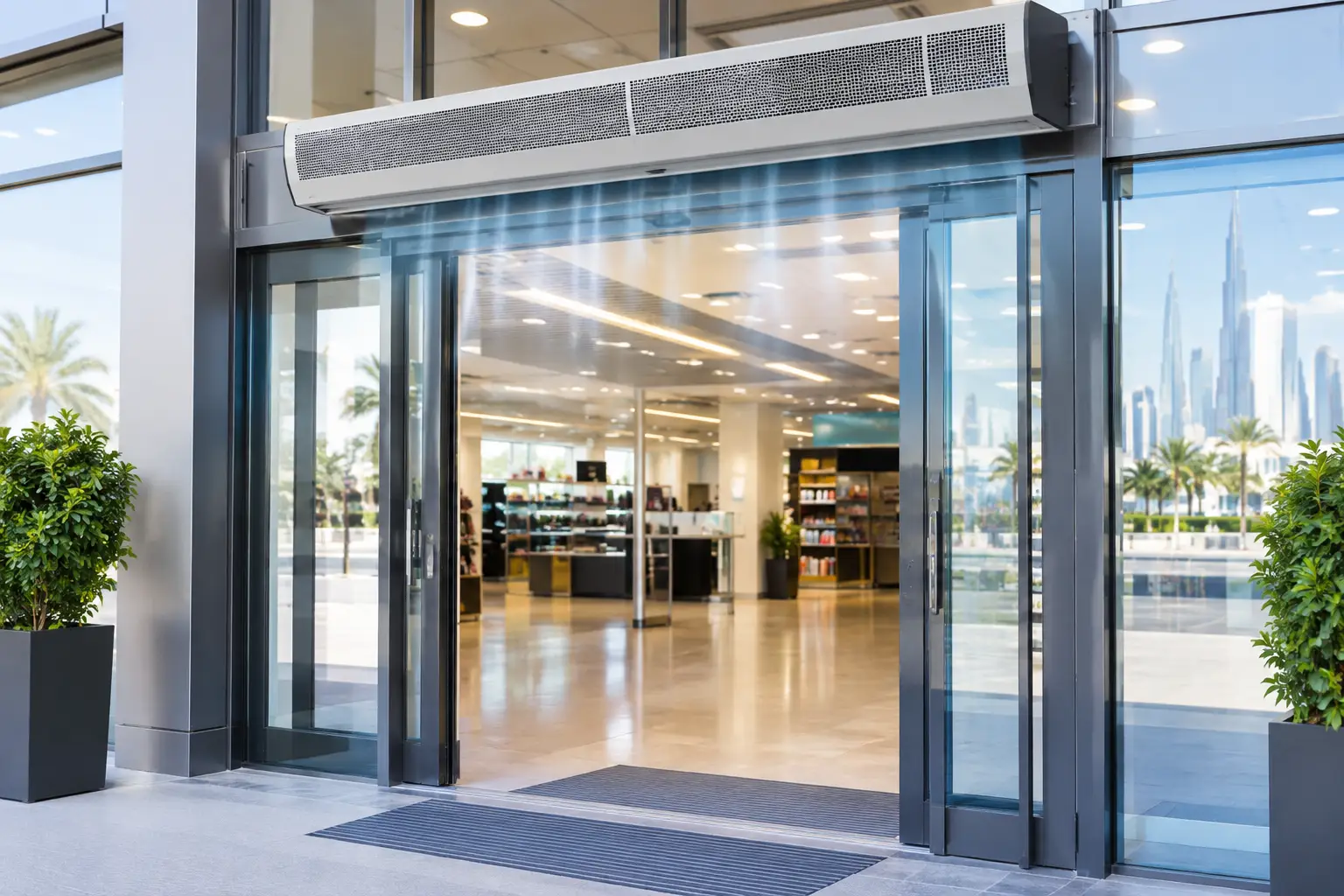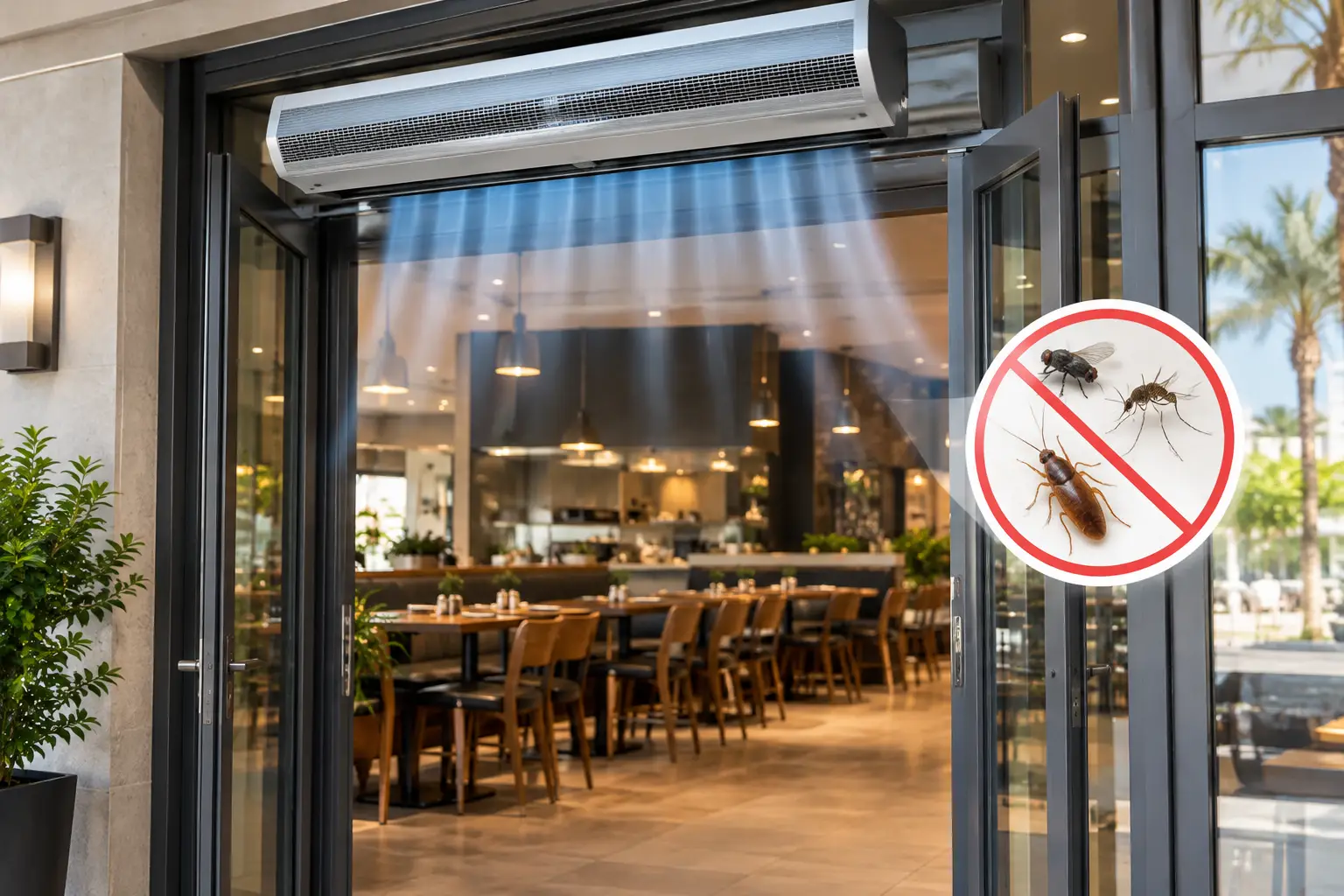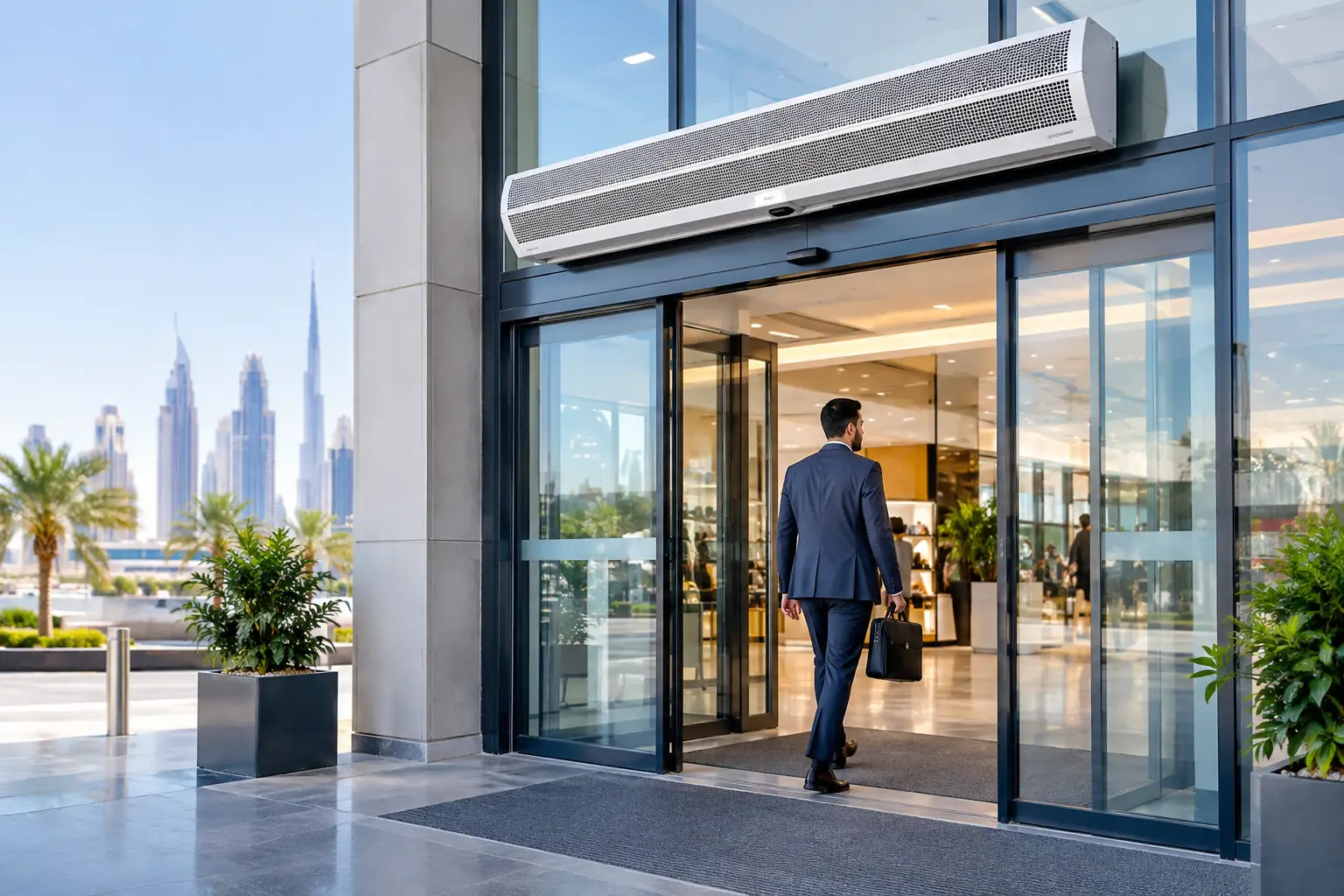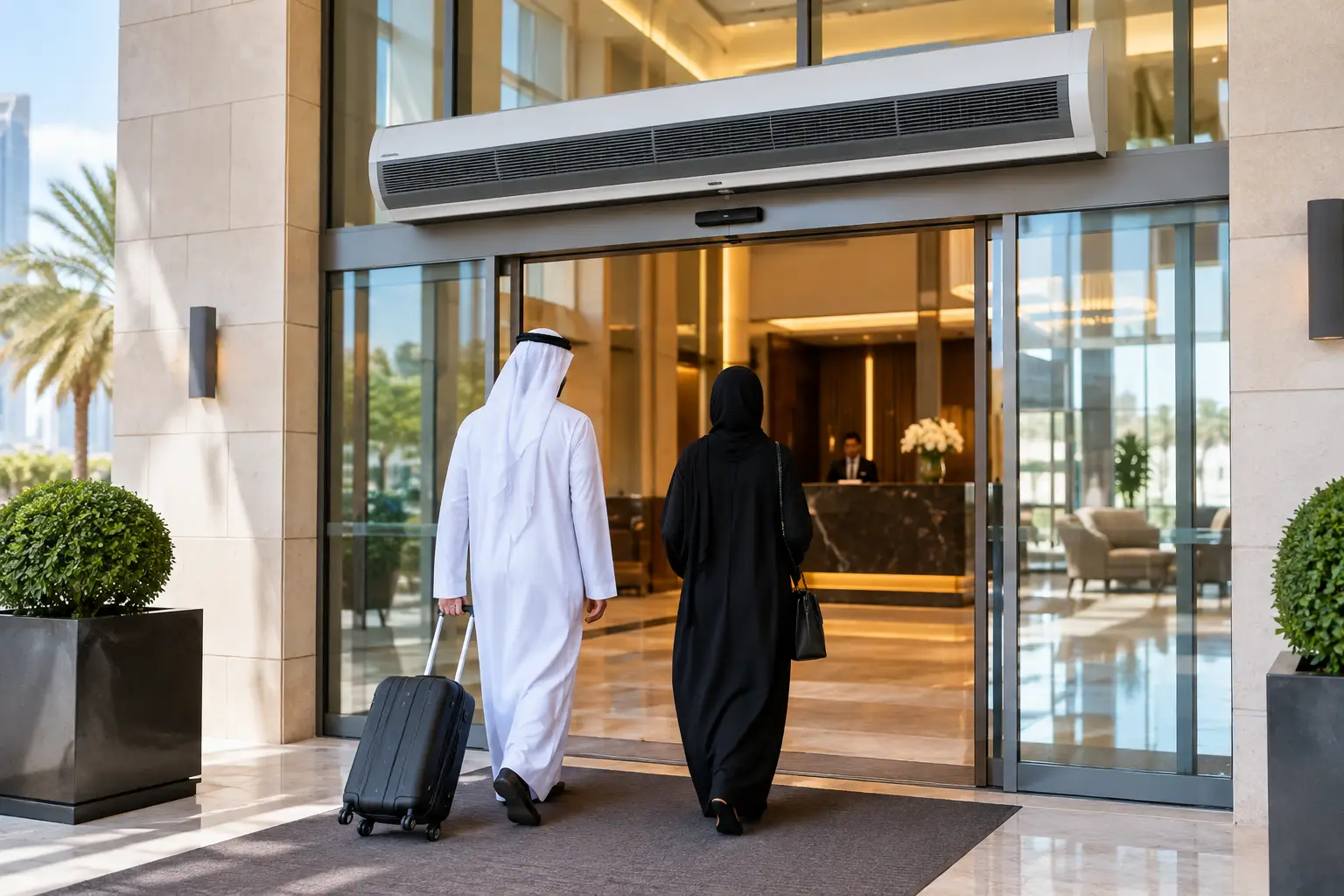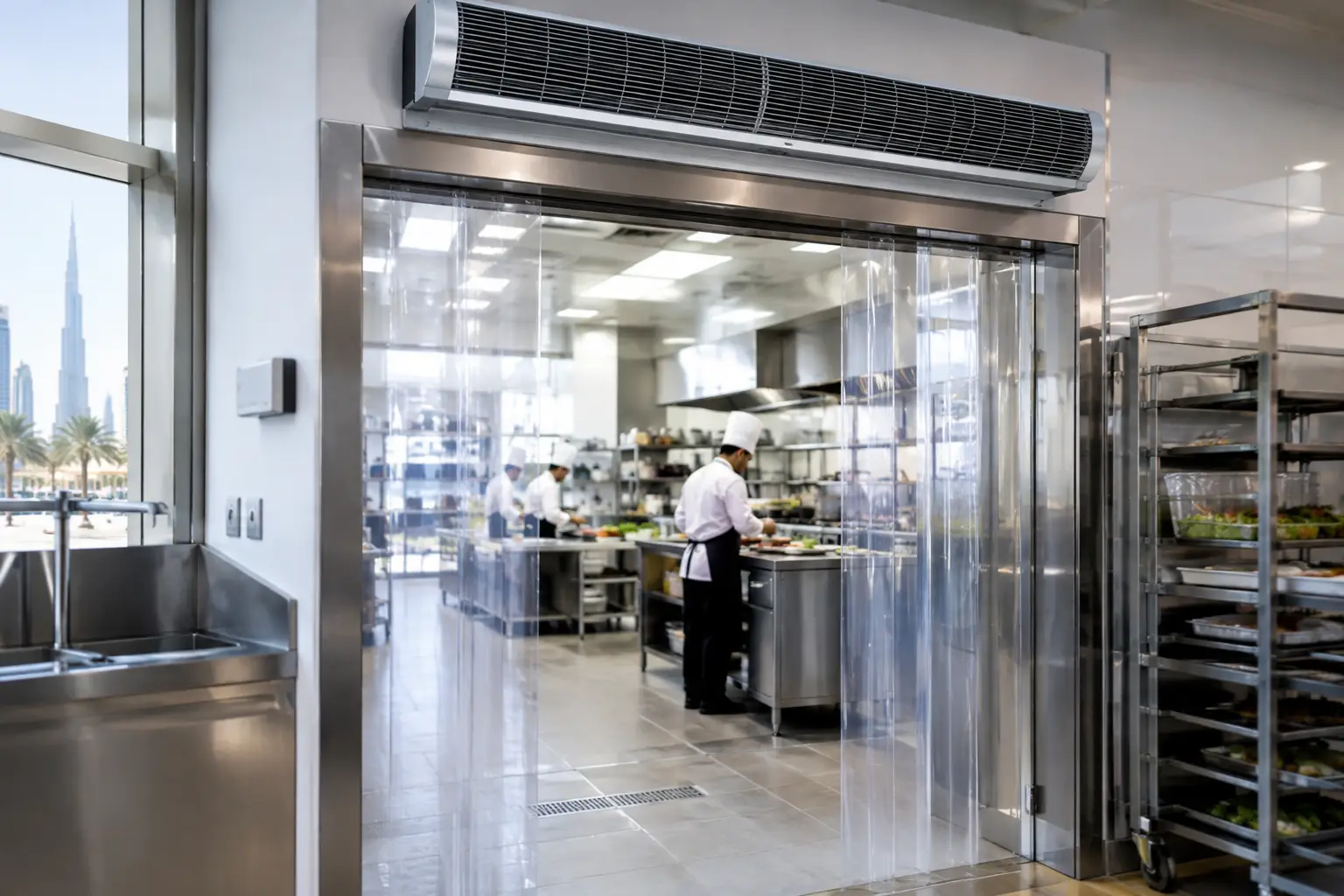
The entrance should respond to the building, not run blindly
A loading-bay door that opens repeatedly in Dubai, a supermarket entrance in Riyadh, or a humid restaurant doorway in Doha can quickly become a major path for hot air, dust, moisture, and insects. Air curtain automation gives facility teams control over when an air curtain operates and how it responds to real entrance conditions.
The objective is not simply to switch a unit on and off. The right control strategy keeps the air barrier active when doors are open or traffic is high, while avoiding unnecessary operation during quiet periods. For commercial and industrial facilities, that can support indoor comfort, protect conditioned spaces, and reduce the strain created by constant infiltration at busy entrances.
Automation must be planned alongside air curtain selection. A control system cannot compensate for an undersized unit, poor mounting position, or an air stream that does not reach the floor effectively. It should reinforce a correctly specified entrance solution for the door, building use, and local climate.
What does air curtain automation control?
An automated air curtain uses a signal, schedule, or building control command to determine when it should operate. In larger facilities, the control approach may need to coordinate with automatic doors, security doors, shutters, HVAC operating schedules, and building management systems.
The most suitable method depends on how the entrance is used. A public-facing retail entrance has different requirements from a pharmaceutical receiving area or a warehouse vehicle door.
| Control method | How it is typically used | Best-fit applications | |—|—|—| | Door interlock | Activates the air curtain when a door opens | Retail doors, supermarkets, restaurants, hospitals | | Time scheduling | Sets operation around known business or shift hours | Offices, malls, hotels, predictable facilities | | Manual speed control | Allows authorized staff to select an operating level | Service entrances, smaller commercial sites | | Building management system integration | Coordinates operation with wider building controls | Airports, large malls, hospitals, major developments | | Sensor-based activation | Responds to occupancy or traffic conditions where appropriate | High-traffic public entrances and controlled access points |
Not every project needs every control method. Overcomplicating a low-traffic entrance can add cost and operational confusion without improving performance. Conversely, relying on a basic manual switch at a frequently used logistics door may leave the air curtain off precisely when the building needs protection most.
Why automation matters in hot, humid, and dusty markets
In GCC, MENA, and African commercial environments, open doors can introduce more than outside heat. Depending on the site, the incoming air may carry humidity, fine dust, odors, insects, smoke, or airborne contaminants. This affects customer comfort, product handling conditions, cleanliness, and cooling demand.
A properly automated air curtain can help facility teams maintain a more consistent entrance barrier during active periods. The practical benefits often include:
- Reduced exposure to outdoor heat when doors open frequently
- Better support for HVAC efficiency in heavily conditioned commercial spaces
- More reliable protection against dust, humidity, insects, and odors
- Less dependence on staff remembering to operate the air curtain manually
- Operation that better matches actual trading hours, shift patterns, or door movement
These outcomes are especially relevant where outside conditions are severe for long periods. In desert locations, dust and high ambient temperatures can make entrance control a daily operational concern. In tropical and coastal areas, humidity can be equally disruptive, particularly for food service, hospitality, healthcare, and temperature-sensitive operations.
Automation does not create energy savings by itself. Savings depend on door-open duration, air curtain performance, indoor and outdoor conditions, HVAC design, and the discipline of the selected control logic. However, automation helps make sure the specified system is used consistently rather than being treated as an optional piece of equipment.
Which automation strategy fits each entrance?
Door-linked control for high-traffic entrances
Door interlocking is often the clearest choice for entrances that open repeatedly throughout the day. When the door signal triggers the air curtain, the unit can operate during the period when air exchange is most likely to occur.
This approach can suit supermarkets, retail stores, hotel entrances, healthcare facilities, and restaurant service doors. For automatic sliding doors, the project team should coordinate the air curtain control requirements with the door supplier and the electrical or controls contractor early in the design process.
A common consideration is response timing. The air curtain should support the open-door event without being set up in a way that causes excessive switching or fails to provide useful coverage during continuous traffic. The right approach depends on the door cycle and control capability.
Scheduled operation for predictable business hours
For facilities with stable operating hours, time scheduling can be practical and easy to manage. It may be appropriate for an office reception, hotel lobby, retail unit, or mall entrance that follows a consistent daily timetable.
Scheduling is less effective when door use extends well beyond normal hours or varies sharply by shift. A distribution center may operate overnight, while a restaurant may experience intense but short lunch and evening peaks. In those cases, schedules can be combined with door signals or overridden by authorized facility personnel.
Building management integration for complex facilities
Large developments may benefit from connecting air curtain operation to a building management system. This gives facility teams greater visibility and allows air curtains to follow planned operating modes across a site.
Integration should have a clear operational purpose. For example, a hospital may need coordinated entrance operation across public, staff, and service access points. An airport or shopping mall may need central control across multiple entrances with different traffic patterns. The controls scope should identify responsibility for wiring, interfaces, commissioning, and future adjustments.
Specify the air curtain before specifying the controls
Air curtain automation works best when it is built around the correct unit and application. The selection process should begin with the physical entrance and operating environment, not with the controller.
Before approving a system, project teams should assess:
- Entrance dimensions and mounting location. Width, height, recessed or exposed mounting, and the available installation position affect coverage and unit selection.
- Door type and traffic pattern. A revolving, sliding, hinged, sectional, or shutter door creates different control and airflow requirements.
- Pressure conditions around the entrance. Nearby supply air, extraction, loading activity, and wind exposure can influence the air stream.
- Environmental risks. Extreme heat, humidity, dust, insects, smoke, fumes, and hygiene requirements should shape the recommendation.
- Operational priorities. The facility may prioritize customer comfort, dust control, food protection, loading-bay separation, or HVAC support.
- Control ownership and maintenance access. Someone must be responsible for schedules, overrides, fault reporting, and seasonal or operational adjustments.
For a finished retail or hospitality entrance where appearance matters, a recessed ceiling solution may be considered during design coordination. High-traffic commercial locations may require a commercial air curtain selected for dependable daily use. Warehouses, factories, and logistics facilities often need an industrial-duty approach based on door size, traffic, and exposure.
FreezeeX evaluates these variables through a consultation-led process rather than treating every doorway as the same. That matters because a unit suited to a customer entrance may not be appropriate for a heavy industrial opening, even if both are controlled by a door signal.
Common automation mistakes that weaken performance
The most frequent issue is treating the controller as a substitute for engineering. If the air curtain is mounted too high, incorrectly positioned, or selected without considering door traffic, automation only makes an unsuitable configuration operate more consistently.
Another mistake is using a single schedule for a facility with several different entrance types. A mall service door, public entrance, receiving dock, and staff access point rarely follow the same usage pattern. Grouping all entrances under one command may be convenient, but it can create unnecessary operation in some areas and missed protection in others.
Facility teams should also avoid control logic that is difficult to understand. A practical automation plan should make it clear when the unit is expected to operate, who can override it, and how staff can recognize an abnormal condition. Straightforward controls are often more reliable in busy operational environments than elaborate programming that no one manages after handover.
Plan automation into the project early
For new construction and refurbishment projects, air curtain automation should be addressed during MEP coordination rather than after the entrance is complete. Early planning helps align the mounting arrangement, power supply, door interface, control panel location, and building management requirements.
For existing buildings, the process begins with an entrance survey. Facility managers should document door dimensions, opening frequency, outdoor exposure, indoor cooling conditions, and any recurring problems such as dust ingress or uncomfortable drafts near the doorway. This gives the supplier and consultant a stronger basis for recommending an appropriate commercial or industrial air curtain and a realistic control strategy.
The best automated system is not necessarily the most complex one. It is the one that delivers powerful air isolation when the entrance is active, fits the operating reality of the site, and remains practical for the people responsible for the building.
For a project in Dubai, Riyadh, Doha, Cairo, Lagos, Nairobi, or another demanding hot-climate market, request a FreezeeX consultation and quotation based on your entrance dimensions, traffic pattern, mounting conditions, and automation requirements.