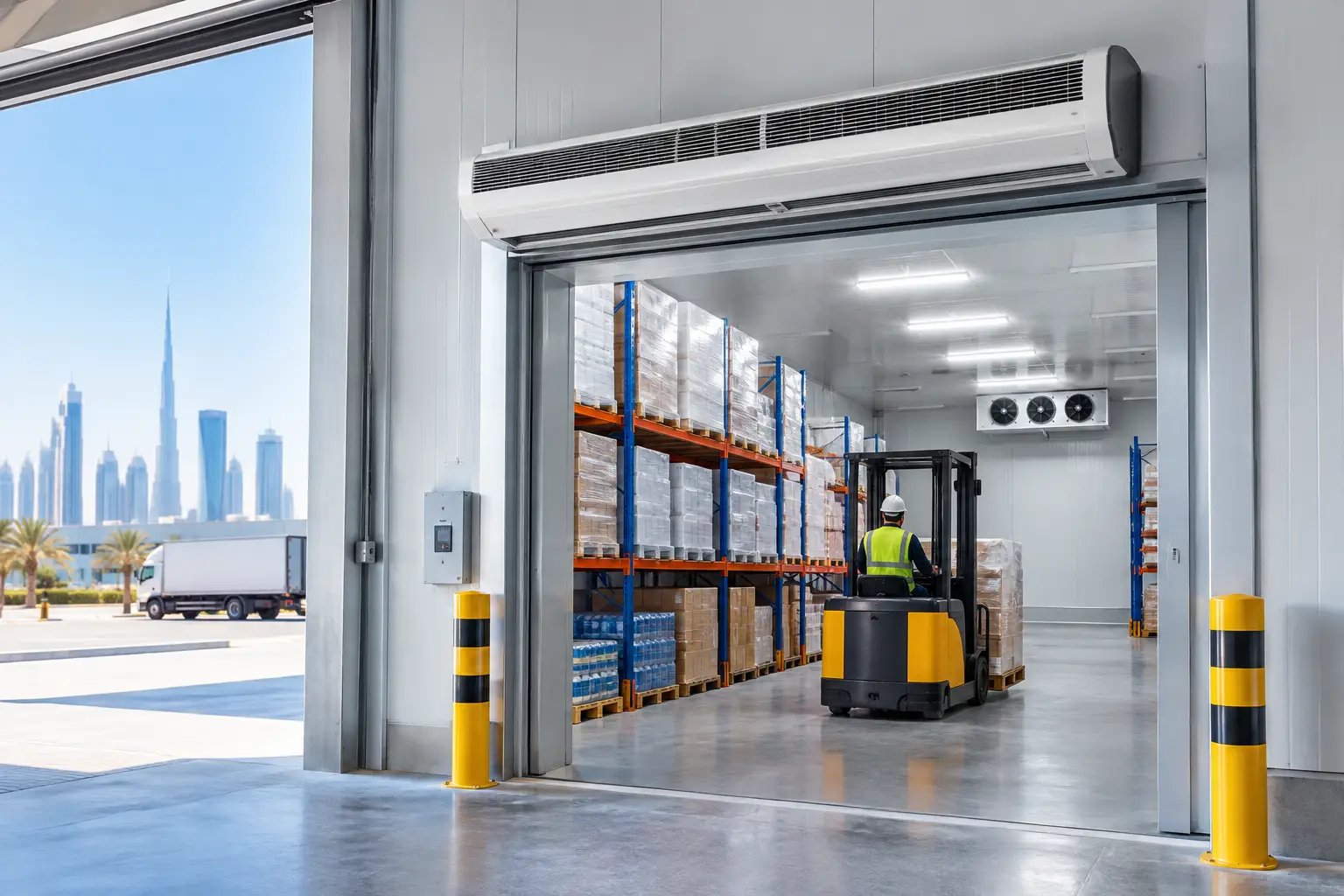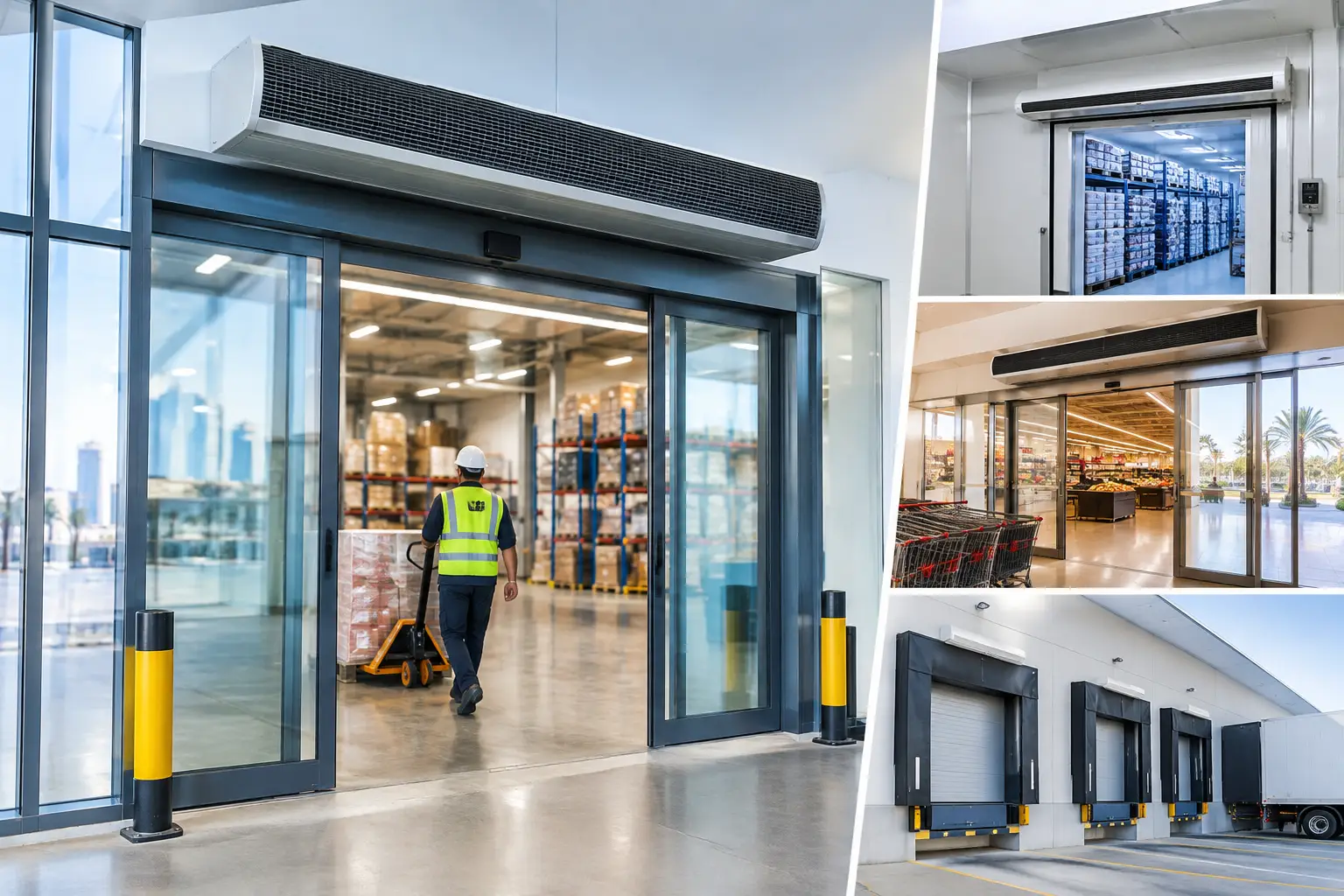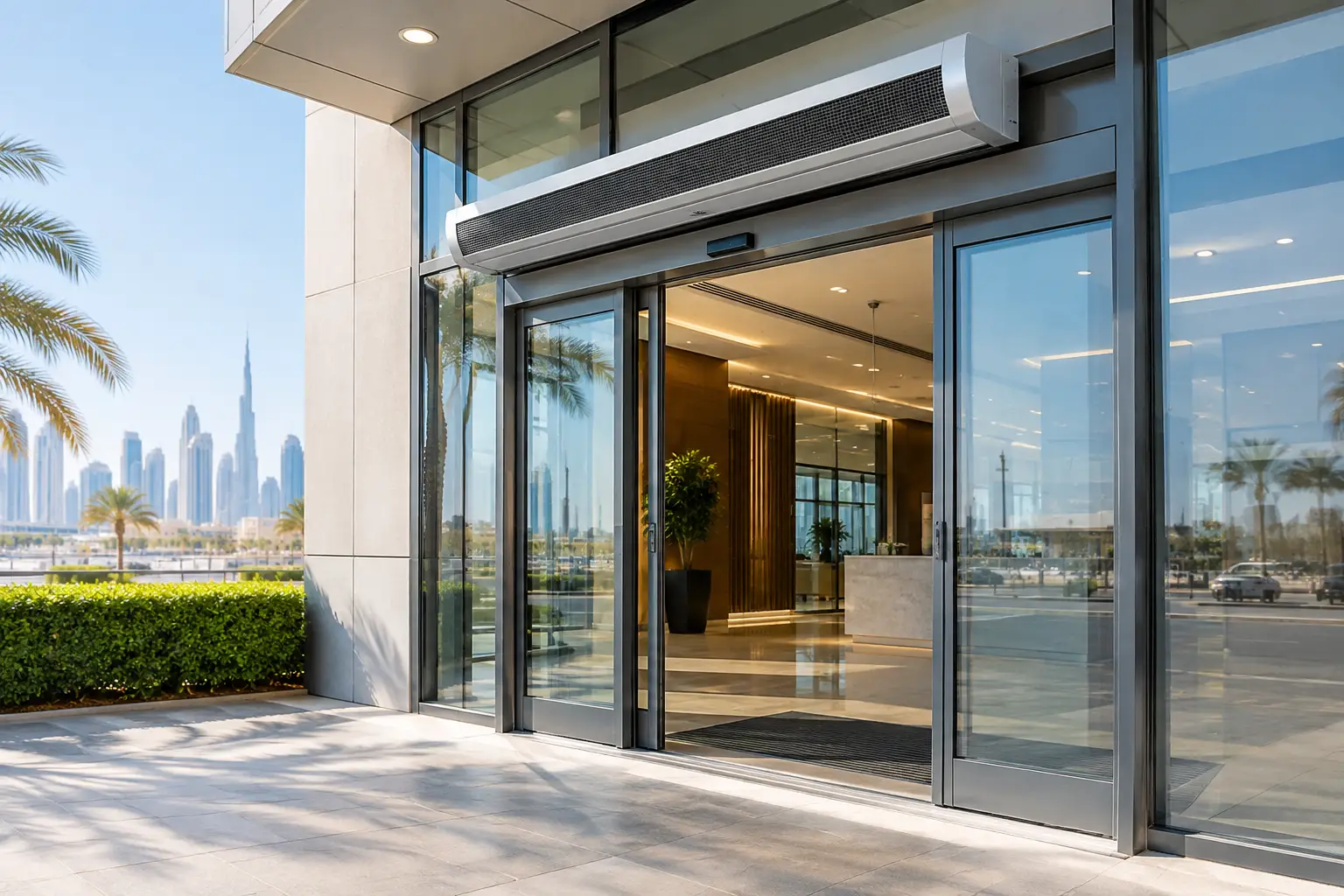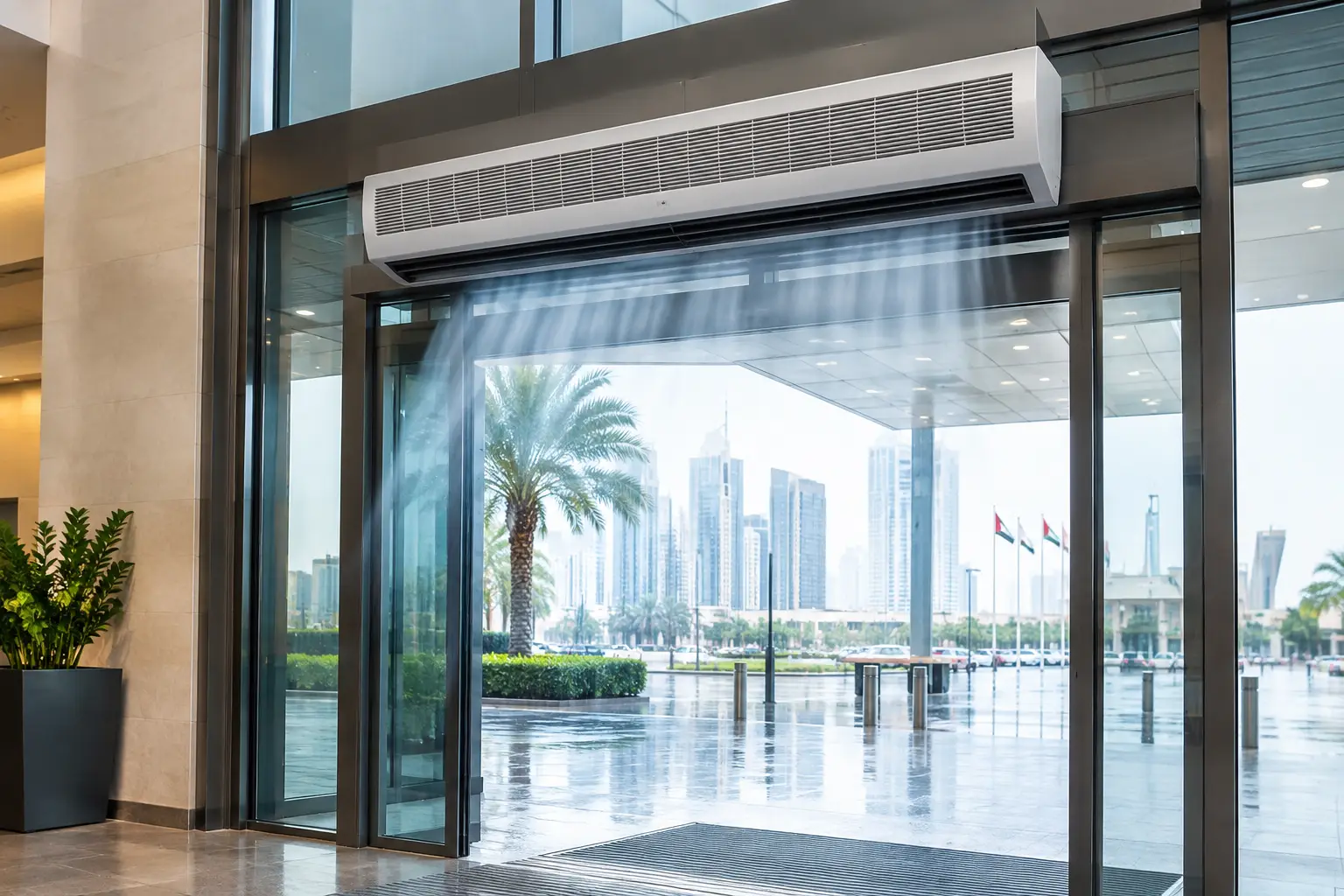
A supermarket entrance in Dubai can open hundreds of times in a single trading day. A warehouse loading door in Riyadh may remain open during vehicle movements. In both cases, doorway climate control is not a cosmetic improvement. It is a practical part of protecting conditioned space, maintaining operational comfort, and limiting the outdoor air, dust, humidity, and insects that enter with every open door.
For facilities across the GCC, MENA, and Africa, the issue is intensified by extreme heat, desert dust, coastal humidity, and high traffic volumes. The right air curtain creates a controlled air barrier across the opening, helping the HVAC system hold indoor conditions without obstructing people, carts, goods, or equipment.
What Is Doorway Climate Control?
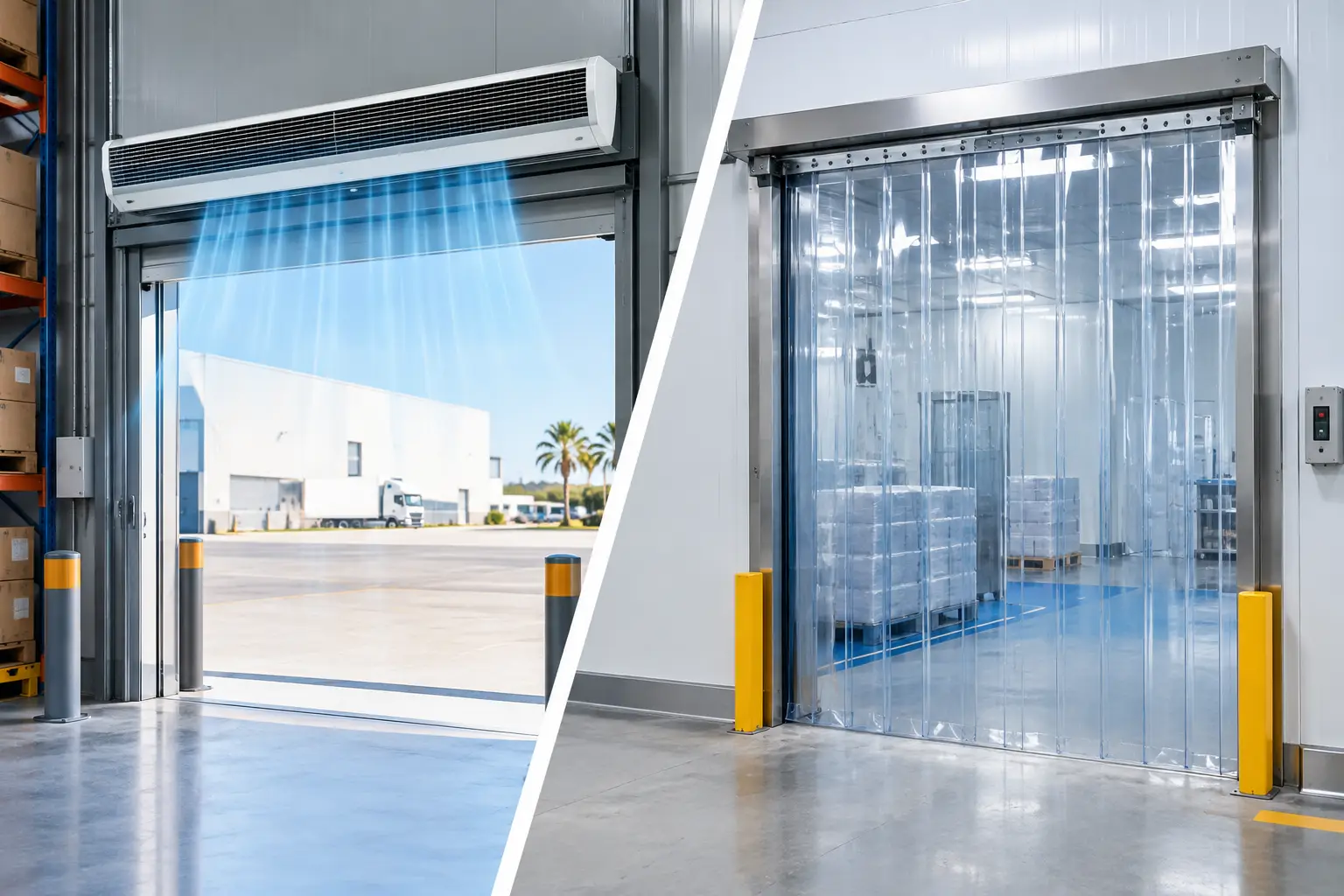
Doorway climate control is the management of air movement at an open entrance. Rather than relying on a physical door being closed at all times, it uses a correctly engineered air curtain to project a directed stream of air across the doorway. This barrier helps separate indoor and outdoor environments while preserving access.
An air curtain is particularly valuable where a conventional door cannot stay closed because of customer traffic, material handling, service activity, or operational safety requirements. It is not a replacement for proper HVAC design or well-fitted doors. It is an entrance-performance measure that supports both.
The objective changes slightly by site, but it generally includes:
- Reducing the escape of cooled indoor air through open entrances
- Limiting infiltration of hot air, humidity, dust, insects, smoke, and odors
- Supporting more stable comfort conditions near the entrance
- Reducing the demand placed on air conditioning equipment during busy periods
- Creating a more suitable separation between public, production, storage, and loading areas
In hot and humid climates, these outcomes affect both occupant comfort and operating costs. In food, pharmaceutical, and health-care environments, they can also support cleaner, more controlled entrance conditions.
Why Open Doorways Create a Major HVAC Load
Conditioned buildings naturally lose air through openings. When a door opens, the pressure difference between the indoor and outdoor environment encourages air exchange. Hot exterior air enters, while cooled interior air escapes. In coastal locations such as Doha, Muscat, or Lagos, moisture carried with incoming air can add a humidity burden as well.
At a high-traffic entrance, the effect is continuous rather than occasional. The HVAC system then has to cool and dehumidify replacement air while serving the rest of the building. This is why a reception area, retail entrance, or dispatch door can feel uncomfortable even when the main system is operating correctly.
Dust adds another operational concern in desert and industrial locations. Fine particles entering through open doorways can affect housekeeping demands, merchandise presentation, indoor air quality, and sensitive processes. An air curtain does not eliminate the need for building filtration or cleaning procedures, but it can reduce direct airborne intrusion at a major access point.
How Air Curtains Support Doorway Climate Control
An air curtain works only when it matches the opening and operating conditions. The discharge air must travel from the unit to the floor or opposing side with enough stability to form an effective barrier. If the airflow is too weak, poorly aimed, or interrupted by crosswinds and pressure imbalance, outside air can still pass through the opening.
For this reason, commercial doorway climate control is a specification question, not a simple equipment selection. The project team should consider opening height and width, installation position, traffic pattern, ambient conditions, and the relationship between the entrance and the HVAC system.
Airflow Pattern Matters More Than a Generic Rating
A narrow retail doorway and a tall logistics door need fundamentally different air management. Commercial units may be appropriate for customer entrances and internal openings, while industrial centrifugal systems are often better suited to demanding loading, warehouse, factory, and process areas.
Centrifugal airflow designs are commonly selected where higher installation heights, wider entrances, or harsher operating environments require stronger air delivery. For architectural settings where appearance and integration matter, recessed ceiling air curtains can provide entrance protection while preserving a clean ceiling line.
The best selection depends on the site. A high-output unit is not automatically the right answer for every door. Excessive air velocity can create discomfort near an entrance, while insufficient coverage will fail to protect the opening. The aim is effective air isolation matched to actual conditions.
Which Applications Benefit Most?
Air curtains are most effective where doors are open frequently or held open as part of normal operations. They are especially relevant when interior temperatures, hygiene standards, or product conditions must be protected from external air.
| Application | Main doorway challenge | Air curtain selection focus | |—|—|—| | Retail stores and supermarkets | Continuous customer access and cooled-air loss | Quiet operation, appearance, opening coverage | | Hotels, restaurants, and malls | Comfort at public entrances and service doors | Visitor comfort, humidity and insect control | | Warehouses and logistics centers | Large doors, forklift movements, dust exposure | Industrial airflow, mounting height, traffic pattern | | Food processing and cold storage | Temperature separation and hygiene sensitivity | Air isolation, process conditions, door use frequency | | Hospitals and pharmaceutical facilities | Controlled environments and public circulation | Entrance separation, low-disruption operation, application fit | | Factories and workshops | Heat, fumes, dust, and repeated material movement | Durable industrial performance and site-specific airflow |
A store entrance and a loading bay should not be treated as the same project simply because both have an open door. The building purpose, opening geometry, and surrounding conditions determine the appropriate solution.
How Should a Project Team Specify an Air Curtain?
A structured evaluation avoids the common mistake of selecting by door width alone. HVAC contractors, MEP consultants, and facility teams should assess the entrance as part of the wider building air-management strategy.
- Measure the opening and mounting conditions. Record the clear width, height, available mounting location, ceiling configuration, and whether the unit will be exposed to wind or vehicle activity.
- Define how the doorway is used. Identify whether the opening serves customers, staff, forklifts, delivery vehicles, carts, or a combination. Also consider peak opening frequency and how long doors remain open.
- Assess the external environment. Desert dust, high ambient heat, humidity, smoke, and nearby industrial activity all influence the level of air separation required.
- Review HVAC and pressure conditions. An air curtain performs best when the wider HVAC arrangement is considered. Significant pressure imbalance, return-air limitations, or uncontrolled adjacent openings can undermine results.
- Match the unit series to the application. Recessed Ceiling Air Curtains suit projects that need concealed integration. Commercial Centrifugal Flow and HiFi Plus ranges address many commercial entrances. Industrial Centrifugal and Dynamic Series solutions should be evaluated for more demanding, high-traffic, or larger-opening conditions.
- Confirm professional installation and commissioning requirements. Mounting angle, height, wiring coordination, controls, and final adjustment influence real-world performance. This work should be coordinated by qualified project professionals.
Common Specification Mistakes to Avoid
The first mistake is treating an air curtain as a general-purpose fan. Its value comes from controlled, directional air delivery across an opening, not simply moving air around the entrance.
The second is overlooking mounting height. A unit may appear sufficient on paper but lose effectiveness if the discharge stream cannot reach the protected zone with adequate stability. Wide openings also require complete coverage, not a unit that protects only the center of the doorway.
The third is ignoring local climate. A facility in Abu Dhabi or Kuwait City may prioritize heat and dust control. A coastal site in Jeddah, Doha, or Mombasa may have greater humidity concerns. A logistics hub in Nairobi or Cairo may need to balance heat, dust, loading activity, and operational schedules. The selection should reflect those realities.
Finally, do not make a product decision without understanding traffic. An entrance used by pedestrians differs from a door used by forklift trucks, and a door held open for dispatch differs from one that cycles frequently. Traffic behavior is central to effective doorway climate control.
A Better Approach for Hot, Dusty, and Humid Sites
The strongest results come from treating the doorway as a controlled boundary rather than an unavoidable source of energy loss. This means combining a suitable air curtain with appropriate door practices, HVAC coordination, and a realistic assessment of outdoor conditions.
FreezeeX Air Curtains Ltd. supports consultation-led selection for commercial and industrial facilities operating in tropical, humid, and desert climates. A site-specific recommendation can account for entrance dimensions, mounting position, traffic volume, operating environment, and HVAC requirements before a system is quoted.
For a new project, refurbishment, or persistent entrance comfort issue, request a consultation and quote based on the actual doorway conditions. The right air barrier can turn a frequently open entrance from a weak point in building performance into a controlled transition between demanding outdoor conditions and the indoor environment.