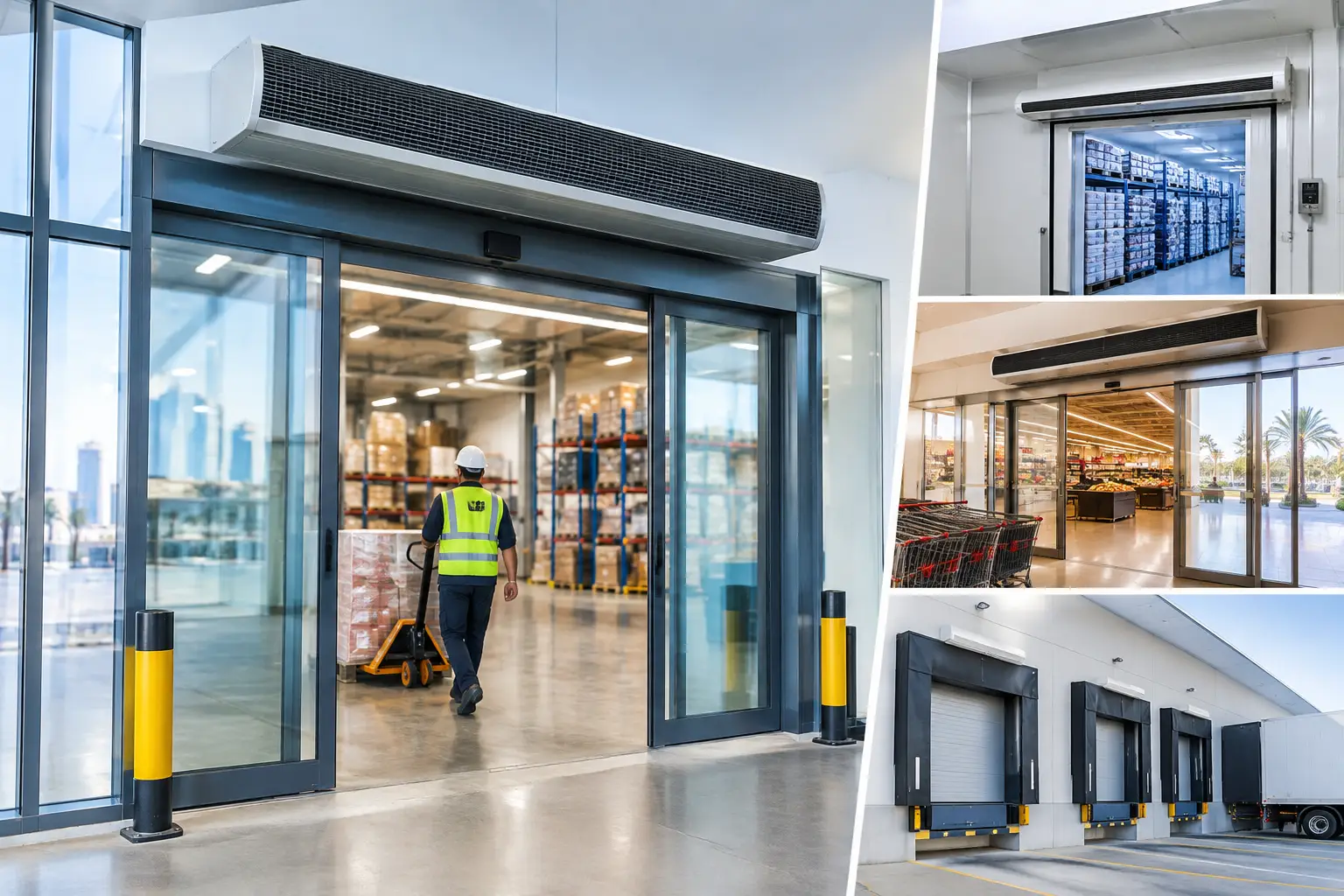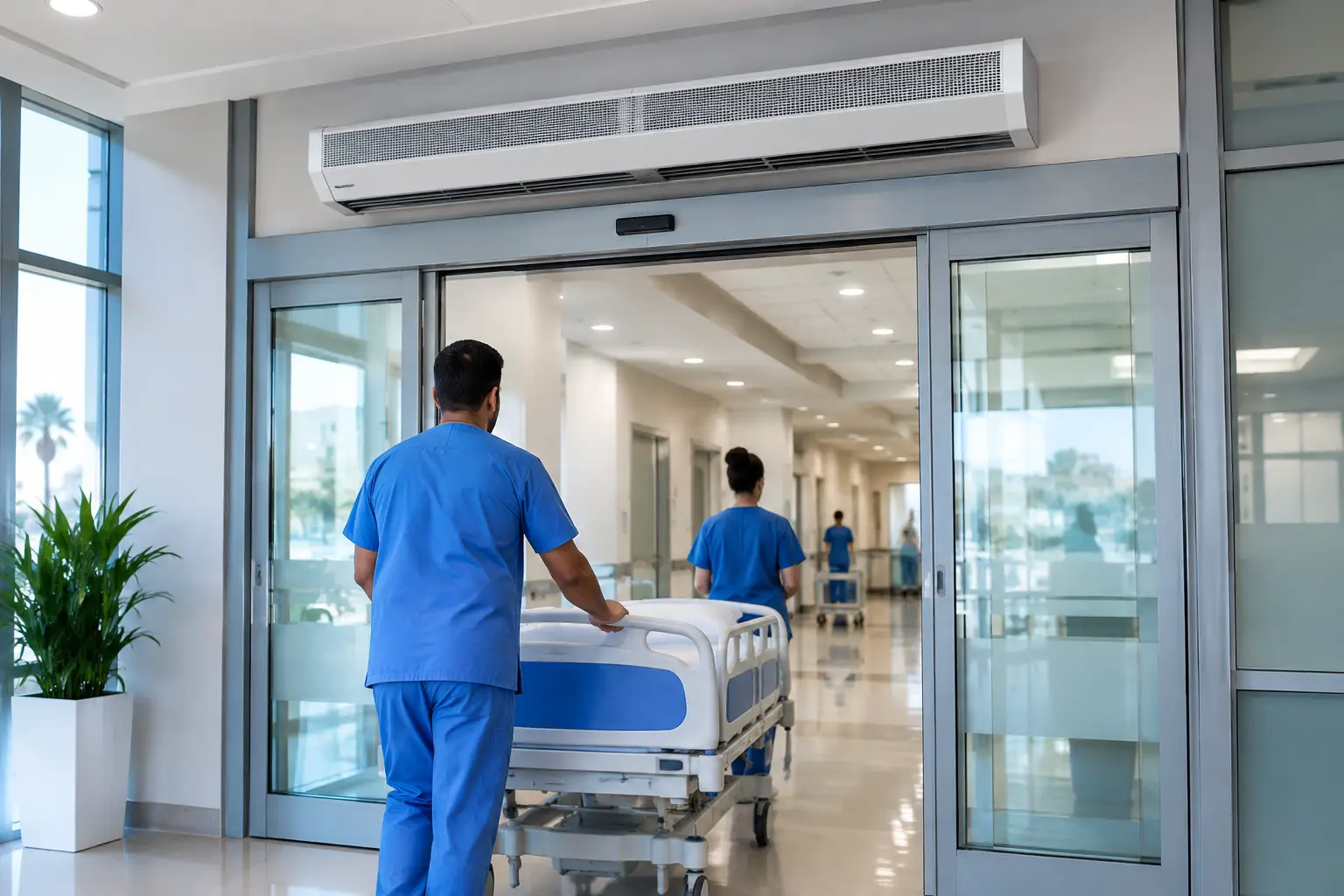
A commercial air curtain lifecycle review should begin before a unit is specified, not when performance starts to decline. At a busy supermarket entrance in Dubai, a warehouse loading door in Riyadh, or a hotel lobby in Doha, the air curtain is part of the building’s operating envelope. Its job is to help preserve conditioned air while limiting the entry of heat, humidity, dust, insects, and airborne contaminants through frequently opened doors.
For facility managers and project teams, lifecycle value is not simply the length of time equipment remains installed. It is the period during which the air curtain delivers an effective air barrier, fits the entrance’s traffic pattern, supports HVAC performance, and remains practical to inspect and maintain. That outcome depends on selection, installation coordination, operating conditions, and planned review.
Why Review the Full Air Curtain Lifecycle?
An air curtain can appear to be running while no longer delivering the level of air isolation the entrance requires. A changed tenant layout, higher footfall, altered door operation, dust accumulation, or a revised HVAC schedule can all affect real-world results. This is especially relevant across GCC, MENA, and African sites where intense heat, desert dust, and high humidity place a continuous load on entrances.
A lifecycle review shifts the conversation from “Is the unit on?” to “Is the entrance still protected as intended?” It gives MEP consultants, procurement teams, and facility managers a clearer basis for prioritizing maintenance budgets, improving operating conditions, and planning future replacement without reacting to a failure.
The Commercial Air Curtain Lifecycle Review Framework
A useful review looks at five connected stages rather than treating selection, operation, and renewal as separate decisions.
| Lifecycle stage | Review question | Commercial impact | |—|—|—| | Specification | Does the selected system suit the door size, mounting position, and environment? | Determines whether the air stream can protect the opening effectively. | | Installation and commissioning | Is the unit positioned and set up in line with the entrance design? | Prevents gaps in coverage and avoids avoidable performance loss from day one. | | Daily operation | Does the operating schedule reflect actual door traffic and HVAC use? | Helps control cooling loss without running equipment unnecessarily. | | Planned maintenance | Are airflow paths and accessible components being professionally inspected? | Supports consistent operation in dusty, humid, and high-traffic conditions. | | Renewal planning | Does the unit still meet current building needs? | Reduces the risk of carrying an undersized or unsuitable system into the next operating cycle. |
1. Start With the Entrance, Not the Product Series
The initial specification has the strongest influence on lifecycle performance. A compact retail doorway, a recessed hotel entrance, and a heavy industrial loading opening do not present the same air-barrier challenge. Selecting only by the width of the opening can overlook the factors that decide whether the equipment will work effectively.
A professional assessment should account for:
- Clear opening width and mounting height
- Mounting position and available ceiling or wall space
- Door type, opening frequency, and duration of door-open periods
- Indoor and outdoor temperature and humidity conditions
- Exposure to dust, insects, smoke, fumes, or industrial contaminants
- Existing HVAC supply patterns and pressure conditions near the entrance
- Required access for inspection and planned maintenance
For example, a food processing facility or logistics center may need a more demanding application assessment than a low-traffic office entrance. Where traffic is frequent and openings are larger, the specification should prioritize reliable air isolation under actual site conditions rather than nominal door dimensions alone.
FreezeeX systems are selected through project consultation because the right solution may differ between a recessed ceiling installation, a commercial centrifugal application, and a heavy-duty industrial entrance. The Commercial Centrifugal Flow Series, Commercial HiFi Plus Series, Industrial Centrifugal Series, Recessed Ceiling Air Curtains, and New Dynamic Series address different installation and operational requirements. The appropriate choice depends on the project brief, not a one-size-fits-all product decision.
2. Review Installation Coordination Before Handover
An air curtain is only one part of the entrance climate-control strategy. Installation coordination matters because door geometry, nearby obstructions, false ceilings, signage, lighting, and HVAC discharge locations can influence the air stream at the opening.
During handover, the project team should confirm that the installed arrangement reflects the approved design intent. This includes checking that the equipment is mounted in the planned position, the full entrance is addressed, and access remains available for future professional servicing. A unit that is difficult to access may receive less frequent inspection, creating a preventable lifecycle risk.
Commissioning should also consider how the door is used during the business day. A shopping mall entrance that experiences short, repeated openings needs an operational approach different from a warehouse door that stays open for loading activity. The air curtain should support the building’s traffic reality rather than an assumed pattern.
What Changes Performance Over Time?
Lifecycle reviews are particularly valuable when an entrance environment changes gradually. Because those changes often happen in stages, teams can miss their effect until complaints increase, indoor comfort drops, or contamination at the doorway becomes more noticeable.
Environmental exposure
Dusty desert conditions can affect the cleanliness of airflow paths. Humid coastal conditions can increase the burden on a cooled interior when doors remain open. In restaurants, factories, hospitals, and logistics sites, airborne particles, fumes, and intensive traffic may add further demands. These are not identical risks, so review intervals should reflect the site rather than a generic calendar.
Operating behavior
Door use is a common reason an originally suitable installation becomes less effective. Extended opening periods, new delivery schedules, changes to automatic door timing, or increased visitor volumes can alter the protection required at the threshold. If the operation changes, the air curtain strategy should be reassessed alongside HVAC operation and door controls.
Building modifications
A lobby renovation, a new storage process near a loading bay, or changes to interior partitions can alter air movement around the entrance. Facilities should include air curtains in post-project checks whenever work affects the doorway or the conditioned zone directly behind it.
A Practical Review Process for Facility Teams
A lifecycle review does not require a disruptive shutdown of the operation. It requires a structured assessment that combines visual condition, operating behavior, and the facility’s current needs.
- Document the entrance use. Record door type, peak traffic periods, delivery activity, and any changes since the system was installed.
- Inspect the operating environment. Identify dust exposure, humidity, heat ingress, insect activity, smoke, fumes, or other contaminants that affect the entrance.
- Confirm the installation context. Check whether building alterations, signage, ceiling work, or nearby equipment have changed the original air path.
- Review observed performance with operations staff. Reception teams, security personnel, warehouse supervisors, and store managers often identify changes at entrances first.
- Evaluate maintenance access and service planning. Ensure the system can be professionally inspected without compromising safe access or business continuity.
- Decide whether optimization, continued service, or replacement planning is appropriate. The right outcome depends on condition, operating demand, and whether the current equipment still matches the opening.
This approach is more useful than setting replacement solely by age. A well-matched unit in a controlled commercial entrance may have a different review profile from equipment serving a high-traffic industrial opening exposed to heat and dust every day.
When Should Replacement Be Considered?
Replacement planning becomes relevant when the installation no longer aligns with operational needs, when recurring performance concerns cannot be resolved through normal professional maintenance, or when a site’s entrance has changed significantly. It may also be appropriate during major HVAC upgrades, retail refits, warehouse expansions, or compliance-driven facility improvements.
The key question is not whether an existing air curtain can continue to operate. It is whether it remains the right tool for the present opening. An underspecified unit can place unnecessary demand on cooling systems and leave a busy threshold more exposed to outside conditions. Conversely, specifying beyond the real requirement may add cost without proportional operational benefit.
For new projects and replacement evaluations, prepare a concise entrance brief with opening dimensions, mounting details, traffic patterns, climate exposure, and the control objective. This enables a more accurate recommendation and avoids relying on assumptions that do not hold up in a hot, humid, or dusty commercial environment.
Build Lifecycle Value Into the Specification
The best time to improve lifecycle outcomes is while the project can still accommodate the right mounting arrangement, access provisions, and application-specific equipment. A considered air curtain specification supports Powerful Air Isolation at the entrance while helping the HVAC system maintain indoor comfort more efficiently.
If your facility operates in the UAE, Saudi Arabia, Qatar, Oman, Kuwait, Bahrain, or other demanding tropical and desert-climate markets, request a FreezeeX project consultation or quotation. Share the entrance dimensions, application, traffic profile, and site conditions so the recommended system can be matched to the operating reality of your building.