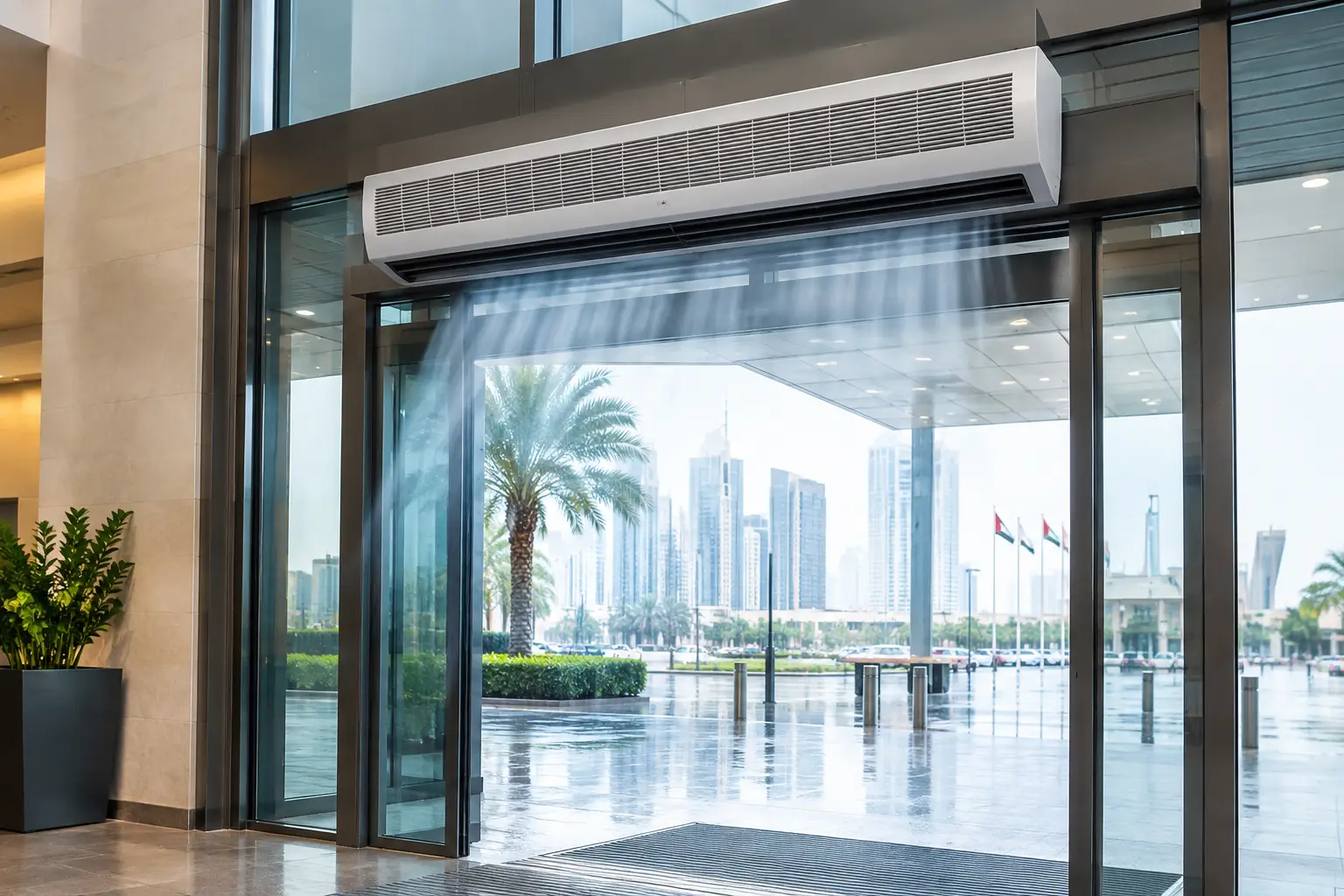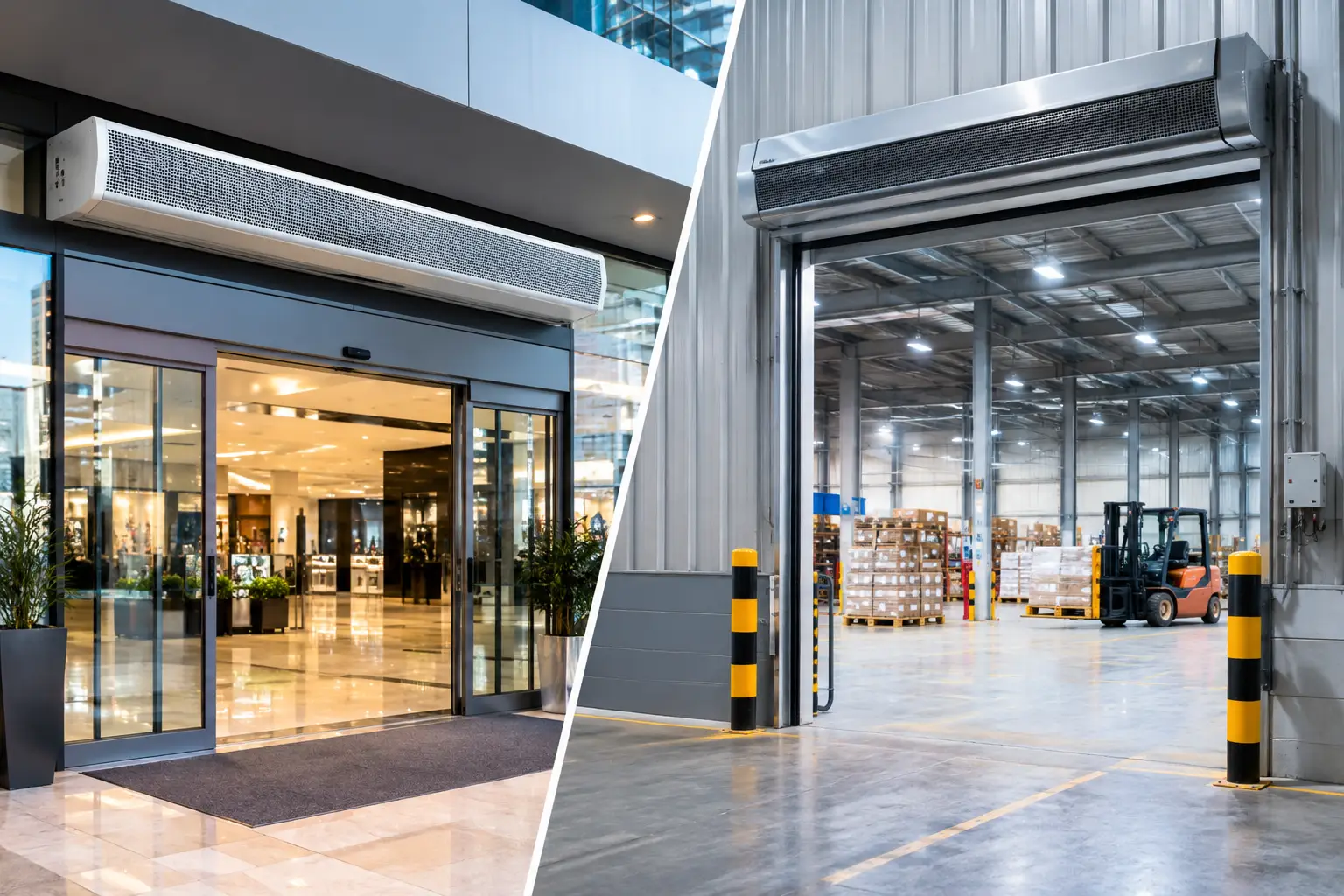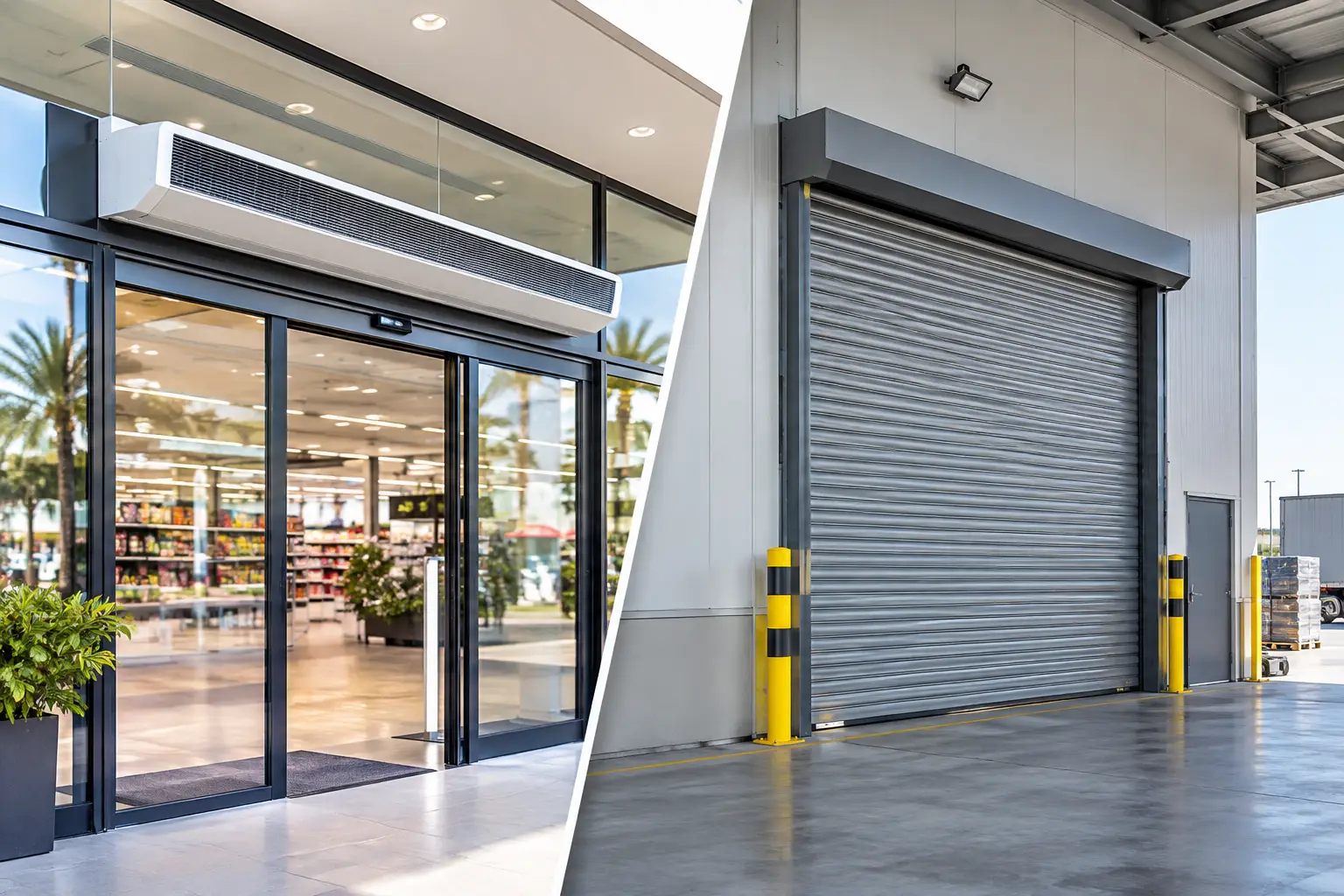
A supermarket entrance in Dubai can open hundreds of times in a day. A hotel lobby in Doha may face humid outdoor air for hours, while a warehouse in Jeddah cycles forklifts and goods through large loading doors. Each opening allows warm, moisture-laden air to enter the conditioned space. Effective entrance humidity control reduces that exchange at the threshold, helping commercial facilities protect comfort, product conditions, and HVAC performance.
Humidity at an entrance is not merely a comfort issue. When outdoor moisture enters a cooled building, the air-conditioning system must remove both heat and latent moisture. This increases the cooling load, contributes to damp floor conditions near doors, and can affect sensitive operational areas. For facilities in hot, tropical, coastal, and desert climates, the entrance should be treated as a critical part of the building envelope.
Why does humidity enter through commercial doors?
Whenever a door is open, pressure differences, foot traffic, wind, and the natural movement of warm air can pull outside air indoors. In coastal cities such as Dubai, Abu Dhabi, Doha, Muscat, Lagos, and Nairobi, that outside air can carry significant moisture. In desert markets, the primary concern may shift between intense heat, dust, and seasonal humidity, but the open doorway remains a point of exposure.
The effect is often most visible at busy entrances. Condensation may appear around glass, cold display cases, or metal surfaces. Floors can feel sticky or become slippery. Guests and staff near the entrance may experience a noticeable shift in comfort, even if the rest of the building is properly cooled.
For operations with frequent traffic, the consequences can extend beyond the lobby or sales floor:
- Higher latent cooling demand on the HVAC system
- More difficult temperature and humidity stability near the entrance
- Increased risk of wet or slippery entrance floors
- Greater exposure to dust, insects, smoke, and airborne contaminants
- Potential disruption to food, pharmaceutical, and cold-chain handling areas
An air curtain does not replace a correctly designed HVAC and dehumidification strategy. It supports that strategy by reducing the volume of untreated outside air that crosses an open doorway.
How air curtains support entrance humidity control
A commercial air curtain creates a directed stream of air across an opening. When selected and installed correctly, that stream forms an air barrier between indoor and outdoor conditions while allowing people, carts, and goods to pass without a physical door interruption.
For entrance humidity control, the goal is not to make a doorway airtight. That is impossible while the opening is in use. The practical objective is to reduce infiltration during door-open periods, so conditioned indoor air is retained more effectively and humid outside air has less opportunity to enter.
The barrier must match the opening
Performance depends on the relationship between the air curtain and the actual entrance. A unit that is too short, too weak for the mounting height, or poorly positioned can leave gaps where humid air enters. Likewise, an oversized solution may create avoidable noise or operating cost if the application does not require it.
MEP consultants and facility teams should evaluate the full doorway condition, including door width, clear opening height, mounting position, traffic pattern, nearby supply air, and exposure to outdoor wind. A recessed installation can suit finished retail and hospitality entrances where appearance matters, while a more heavy-duty configuration may be needed for loading bays, factories, or logistics facilities.
Which entrances need the closest humidity control?
Not every opening faces the same moisture risk. A small office entrance with automatic sliding doors has a different operating profile from a hypermarket delivery entrance or a food processing access point. The best specification starts with how the opening is actually used.
| Entrance environment | Main humidity-related concern | Air curtain selection priority | |—|—|—| | Retail stores and malls | Customer comfort, cooling loss, damp entrance zones | Quiet operation, appearance, continuous coverage | | Supermarkets and hypermarkets | High traffic, nearby refrigerated displays, wet floors | Consistent barrier performance and traffic compatibility | | Hotels and restaurants | Guest comfort, lobby appearance, outside air exposure | Discreet installation and controlled airflow | | Warehouses and logistics centers | Large doors, vehicle movement, long open periods | Industrial-duty coverage suited to the opening and activity | | Food and pharmaceutical facilities | Controlled internal conditions and contamination exposure | Application-specific specification and operational discipline | | Cold storage transition areas | Moisture migration and condensation risk | Strong air isolation coordinated with cold-room operations |
A loading door that remains open for several minutes at a time demands a different approach from a pedestrian door that opens briefly but repeatedly. Traffic volume matters as much as door size. A facility with constant movement may benefit more from an air curtain designed for sustained commercial or industrial duty than from a unit selected only by nominal opening width.
What should be reviewed before specifying an air curtain?
Entrance humidity control works best when it is considered during design, refurbishment, or HVAC optimization rather than after persistent condensation has become a complaint. The selection process should be practical and site-specific.
- Assess the opening and mounting conditions. Confirm the door width, clear height, headroom, ceiling type, and whether the unit will be surface-mounted or recessed.
- Map traffic and door-open time. Record pedestrian volume, carts, pallet movement, automatic door cycles, and periods when doors are held open for deliveries.
- Understand the outdoor climate exposure. Consider humidity, heat, dust, wind, rain exposure, and whether the entrance faces prevailing weather conditions.
- Review indoor environmental requirements. Identify whether the space is customer-facing, temperature-sensitive, hygienic, refrigerated, or affected by internal pressure relationships.
- Coordinate with the HVAC design. Air curtain operation, control logic, return-air locations, and cooling capacity should support one another rather than work at cross-purposes.
- Select the appropriate product category. The final choice should reflect commercial appearance, acoustic expectations, airflow requirement, and the intensity of the application.
FreezeeX consults on these variables rather than treating all entrances as identical. Its recessed ceiling air curtains can be considered for visually integrated commercial installations, while commercial centrifugal, HiFi Plus, industrial centrifugal, and Dynamic Series options can be assessed against the demands of the site. The correct choice depends on the application, not a generic product ranking.
Why humidity control is a building-performance decision
Facilities sometimes address entrance discomfort by lowering the thermostat. This may make the interior feel cooler, but it does not solve the source of infiltration. It can also increase energy use while leaving humidity and condensation issues unresolved near the doorway.
A properly specified air curtain addresses the point where conditioned and outdoor air meet. That can help the HVAC system maintain intended conditions more consistently, particularly in facilities where entrance doors cannot remain closed. For retail operators, this supports shopper comfort. For hospitals, food handling areas, and pharmaceutical environments, it can complement broader environmental control measures. For warehouses and industrial buildings, it helps reduce the operational impact of large, active openings.
There are trade-offs. Higher traffic and larger openings can require more substantial air movement, and the resulting acoustic profile must be appropriate for the space. A premium hotel entrance may prioritize discreet integration and low perceived noise, while a factory shipping door may prioritize durable air isolation under demanding traffic. Neither approach is universally better. The requirement should follow the operating environment.
Avoid common specification mistakes
The most common error is selecting an air curtain based on door width alone. Width is essential, but it does not establish whether the airflow will reach the floor effectively, resist crosswinds, or suit the mounting height. Another frequent issue is overlooking door activation and operating schedules. Running strategy should reflect actual use, especially at entrances that are active from early morning through late evening.
It is also important not to describe an air curtain as a standalone dehumidifier. Moisture already inside the building must still be managed through the HVAC system. The air curtain’s value is preventative: it reduces the incoming humidity load while the entrance is open.
For facilities in the GCC, MENA, and African markets, climate exposure should be central to the brief. Systems suited to tropical and desert conditions must account for heat, humidity, dust, and the sustained use patterns common in high-traffic commercial and industrial sites.
Specify the entrance, not just the equipment
Strong entrance humidity control begins with a clear definition of the operational problem: what enters through the door, when it enters, and what it affects inside. From there, an air curtain can be selected as part of a coordinated entrance and HVAC strategy.
If your project involves a busy commercial entrance, warehouse door, hospitality lobby, supermarket, cold storage transition, or controlled industrial area, request a consultation and quotation from FreezeeX. Share the opening dimensions, mounting details, traffic pattern, and climate exposure to receive a recommendation designed for real tropical and desert operating conditions.