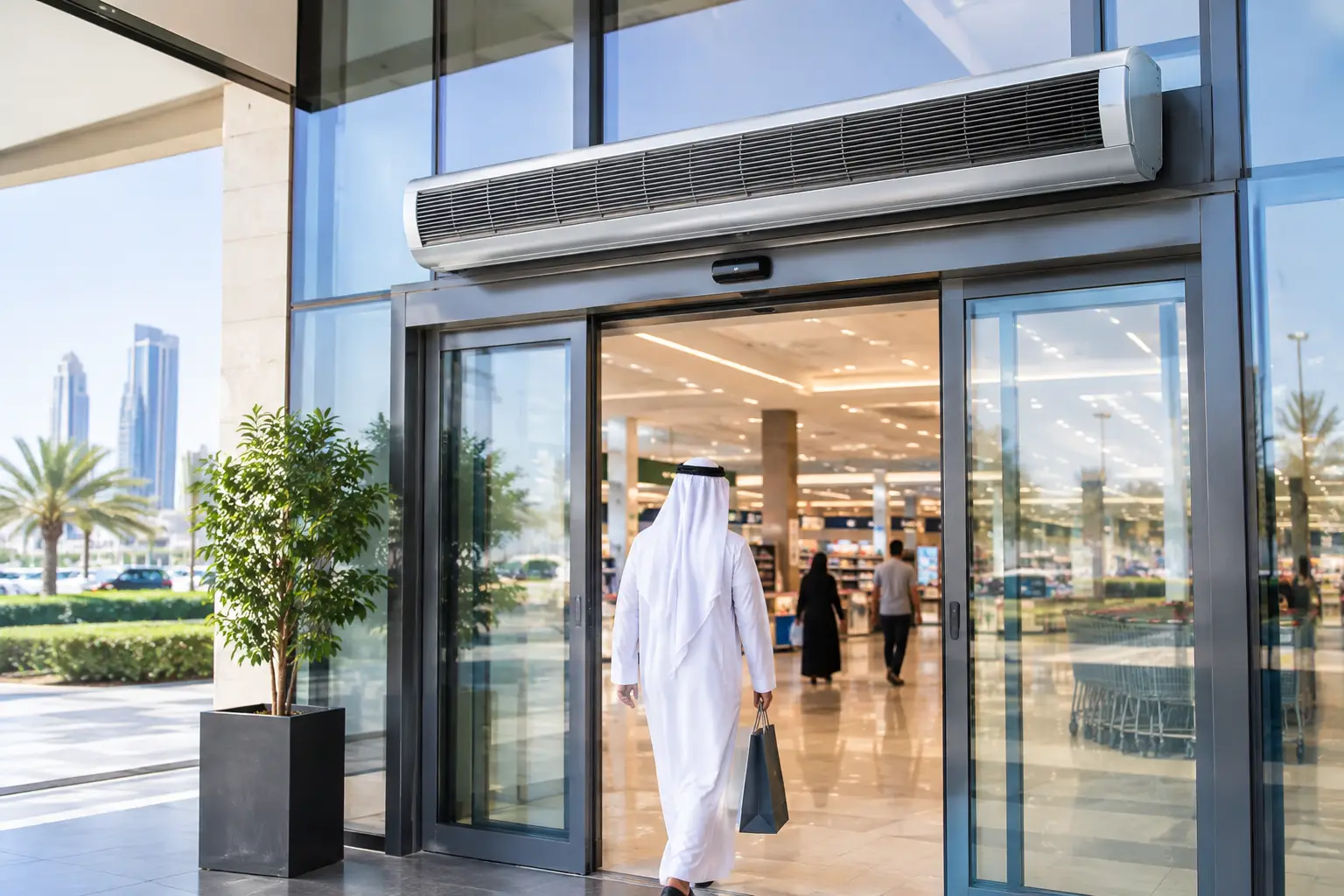
A supermarket entrance in Dubai can open hundreds of times a day. Each opening exposes conditioned space to hot outdoor air, humidity, dust, and insects. That is why the question of air curtains versus air conditioning is not really about choosing one technology over the other. In commercial buildings, they perform different jobs that work best together.
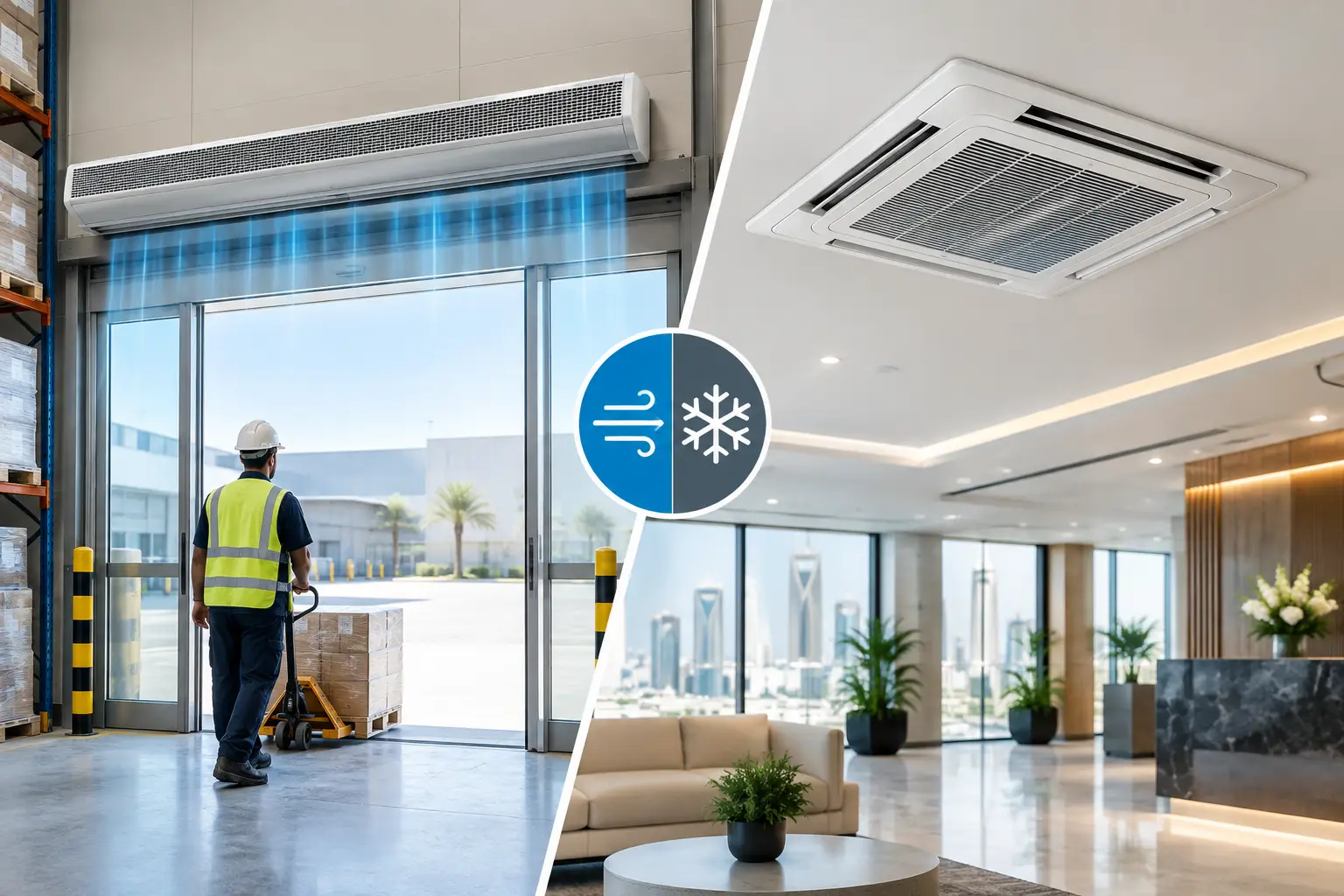
Air conditioning conditions the indoor environment. An air curtain protects that environment at an opening. Understanding the distinction helps facility teams, MEP consultants, and contractors specify systems that reduce cooling loss without disrupting customer access, loading activity, or daily operations.
Air Curtains Versus Air Conditioning: The Core Difference
Commercial air conditioning removes heat and, where designed to do so, moisture from indoor air. It maintains a target temperature and supports occupant comfort across a sales floor, lobby, kitchen service entrance, production area, or warehouse office. However, an HVAC system cannot prevent outdoor air from entering every time a door is opened.
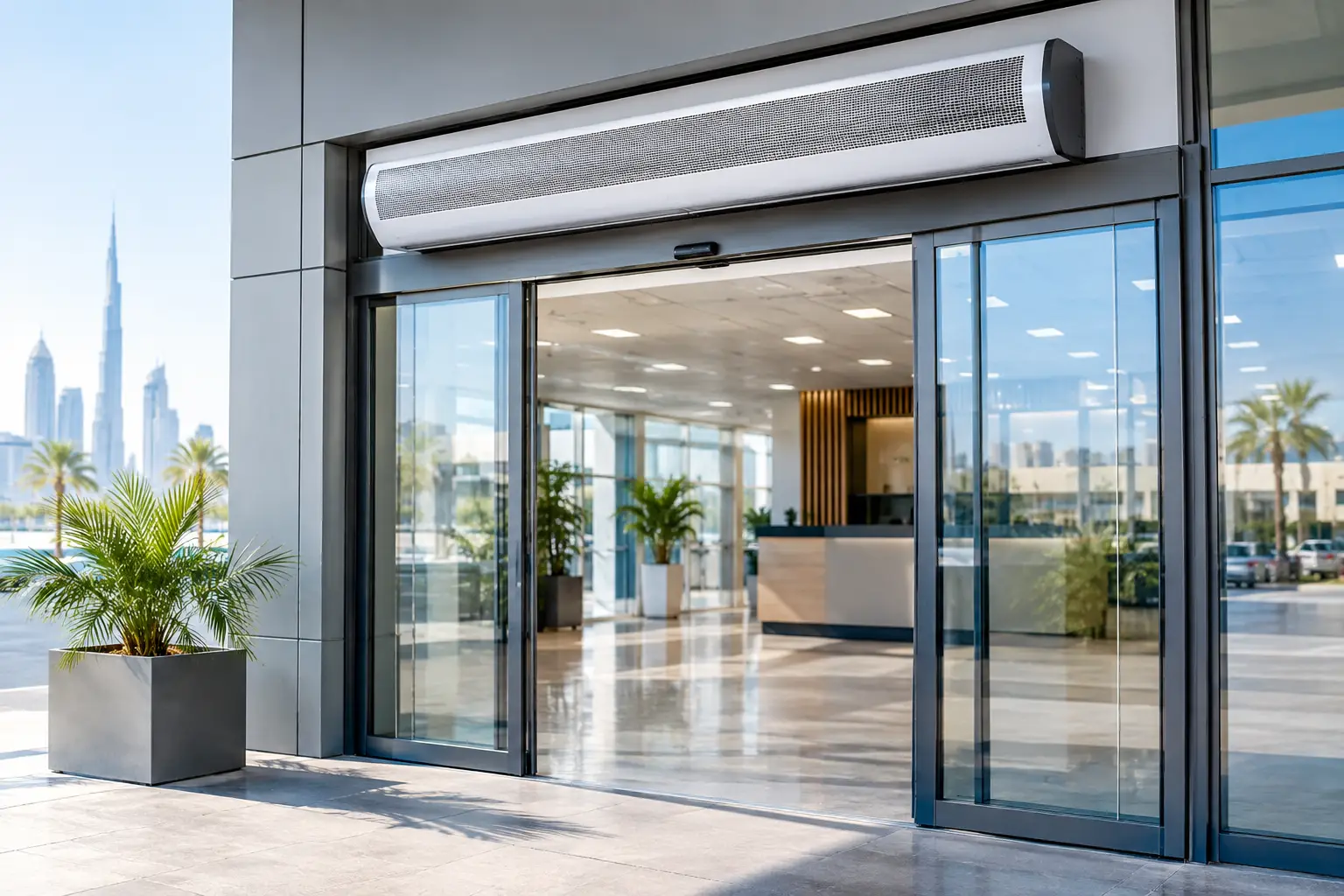
An air curtain creates a high-velocity stream of air across an open doorway. This air stream forms an aerodynamic barrier that limits the exchange between indoor and outdoor air. It does not replace the cooling capacity of an air-conditioning system. Instead, it reduces the load that open doors place on that system.
This distinction matters most in GCC, MENA, and African operating conditions. In Riyadh, Doha, Abu Dhabi, Muscat, Cairo, Lagos, or Nairobi, external temperatures, humidity, dust, and traffic patterns can place continuous pressure on entrance areas. A properly selected air curtain helps keep the cooling that a business is already paying for inside the building.
Why Air Conditioning Alone Struggles at Open Entrances
An HVAC system is typically sized around building heat gain, occupancy, lighting, equipment, infiltration assumptions, and operating schedules. Frequent door openings can increase infiltration beyond those assumptions. Warm air enters, conditioned air escapes, and the system must run longer to recover the indoor setpoint.
The result is often visible at the entrance before it appears in an energy report. Customers feel a blast of heat near the door. Condensation may develop where humid air reaches cool surfaces. Staff at cash registers, reception desks, or loading zones experience inconsistent comfort. In food retail, dust and flying insects can become an operational concern.
Increasing cooling capacity may appear to be the obvious response, but it does not address the source of the problem. More air conditioning can condition infiltrated air after it enters. It cannot create a barrier at the threshold. This can lead to unnecessary energy use and still leave the entrance exposed during peak traffic.
An air curtain is particularly effective when doors must remain open for convenience, deliveries, public access, or workflow. It supports the HVAC design by reducing the volume of unwanted outdoor air crossing the opening.
What an Air Curtain Adds to a Commercial HVAC Strategy
The value of an air curtain is not limited to temperature control. The air stream can help separate zones with different air conditions, making it useful at retail entrances, hotel lobbies, restaurant doors, loading bays, factory access points, and cold-room openings.
For many commercial facilities, the operational benefits include:
- Reduced loss of cooled indoor air through frequently opened doors
- Lower heat, humidity, dust, insects, smoke, and odor infiltration
- More stable comfort near entrances and customer-facing areas
- Less demand on air-conditioning equipment during high-traffic periods
- Improved hygiene control for food handling, healthcare, and pharmaceutical environments
The actual outcome depends on the quality of specification. Door height and width, installation height, external pressure, indoor-outdoor temperature difference, traffic volume, and door type all affect barrier performance. A light-duty unit above a tall warehouse shutter, for example, will not provide the same separation as an industrial system engineered for that opening.
When Air Curtains Are the Stronger Investment
Air curtains are most compelling where an entrance is repeatedly open or cannot be kept closed. Supermarkets and hypermarkets are common examples because customer access must remain frictionless while refrigerated and air-conditioned spaces need protection from warm, humid outdoor air.
Hotels benefit at main entrances, service doors, and receiving areas, where comfort and presentation matter. Restaurants can use air curtains to reduce the entry of dust, insects, and hot air at public or back-of-house openings. Hospitals, pharmaceutical plants, and food processing facilities may specify them as part of broader hygiene and contamination-control measures.
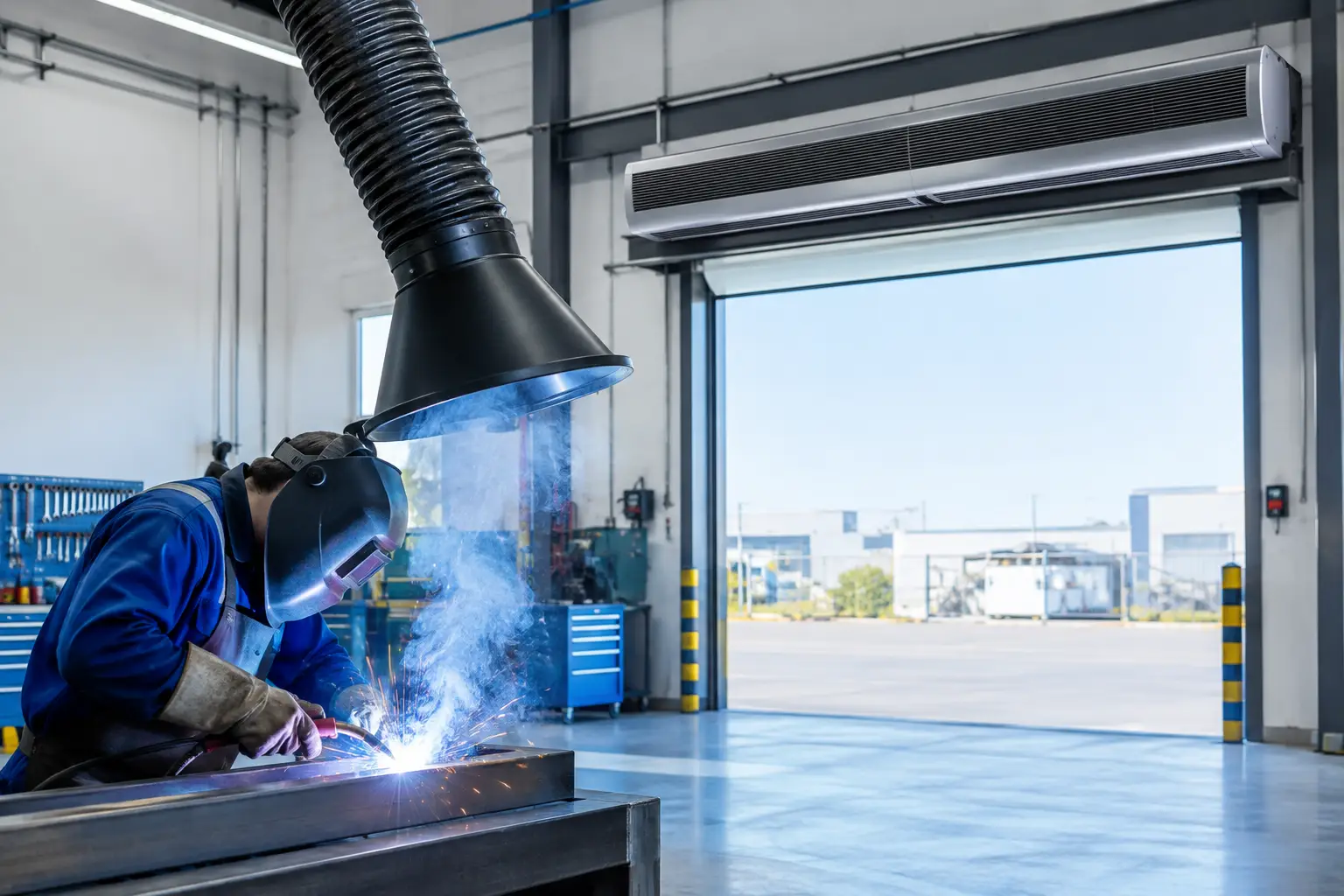
Industrial sites have a different challenge. Warehouses, logistics centers, factories, and distribution hubs may have large openings and prolonged vehicle or pallet movement. In these applications, air curtain selection should prioritize throw, airflow volume, installation height, and duty cycle. A commercial entrance model may suit a retail door, while an industrial centrifugal unit is generally more appropriate for demanding loading or manufacturing environments.
Cold storage is another specialized case. Here, an air curtain can help reduce the exchange of warm, moist air at access points, supporting temperature stability and reducing frost-related operational pressure. It should be selected as part of the facility’s complete door and refrigeration strategy, not treated as a stand-alone fix.
Where Air Conditioning Remains Essential
An air curtain has no practical value as a substitute for commercial cooling. It does not lower the temperature of an entire occupied space, remove internal heat from people and equipment, or provide the moisture control required in humid environments. A facility still needs appropriately designed air conditioning to meet comfort, process, and air-quality objectives.
This is especially relevant in facilities with long operating hours, high internal heat loads, or strict indoor conditions. A busy restaurant kitchen-adjacent dining area, a hospital reception zone, or a pharmaceutical production space needs HVAC capacity designed for its internal operation. The air curtain protects the entrance boundary, while the HVAC system manages the environment behind it.
The practical decision is therefore not air curtain or air conditioning. It is whether the existing HVAC investment is being protected at the building’s most vulnerable openings.
Selecting the Right Air Curtain for the Entrance
Correct specification begins with the opening, not a generic product size. Engineers and facility managers should assess clear door width, mounting height, door position, opening duration, expected traffic, prevailing wind or pressure conditions, and the level of separation required.
A recessed ceiling air curtain may be appropriate where visual integration is important in a hotel, office, premium retail store, or mall. Commercial centrifugal-flow models are suited to busy storefronts and medium-duty entrances where stronger airflow and reliable daily operation are required. High-traffic retail and food-service environments may need a model that balances performance with acceptable noise levels.
For factories, warehouses, logistics facilities, and tall loading openings, industrial centrifugal systems are generally the more appropriate category. Their application calls for stronger air projection and construction suited to sustained use. In dusty, tropical, humid, and desert climates, equipment selection should also consider durable components, service access, and filtration arrangements where applicable.
Installation position is equally important. An air curtain must be mounted and aligned so the discharge air reaches the floor or threshold area with enough velocity to resist infiltration. Poor placement, incorrect sizing, and unsuitable airflow direction can reduce performance even when the unit itself is capable.
Energy Savings Depend on Operating Conditions
It is reasonable to expect an air curtain to support energy savings, but responsible planning avoids a single promised percentage for every site. Savings vary with door usage, outside conditions, HVAC capacity, building pressure, and how effectively the air curtain is matched to the opening.
A mall entrance that remains open throughout the day has a different opportunity from a warehouse door opened only for scheduled dispatches. Likewise, humid coastal conditions can create a different HVAC burden than dry desert heat. The key measure is avoided infiltration: less hot or humid air entering means less cooling and dehumidification work for the HVAC system.
For project planning, assess the entrance as a system. Review operating hours, traffic counts, door dimensions, indoor setpoints, and nearby HVAC supply performance. This produces a more credible basis for selecting air curtain capacity and estimating operational value than relying on a standard rule of thumb.
A Better Way to Plan Entrance Climate Control
The strongest commercial approach is to treat the doorway as part of the HVAC envelope. Doors, automatic controls, building pressure, cooling distribution, and air curtains should be considered together. This is particularly valuable in hot and dusty markets, where a small failure at a high-traffic entrance can affect comfort, cleanliness, and energy use throughout the day.
For new projects, specify the air curtain early enough to coordinate ceiling space, electrical supply, controls, and mounting details. For existing facilities, focus first on entrances where occupants notice heat intrusion, where HVAC recovery is slow, or where dust, insects, and humidity are creating operational complaints.
FreezeeX can review entrance dimensions, mounting constraints, traffic volume, local climate exposure, and HVAC requirements to recommend an appropriate commercial or industrial air curtain configuration. Request a consultation or project quotation to protect conditioned space where it is most often lost: at the door.