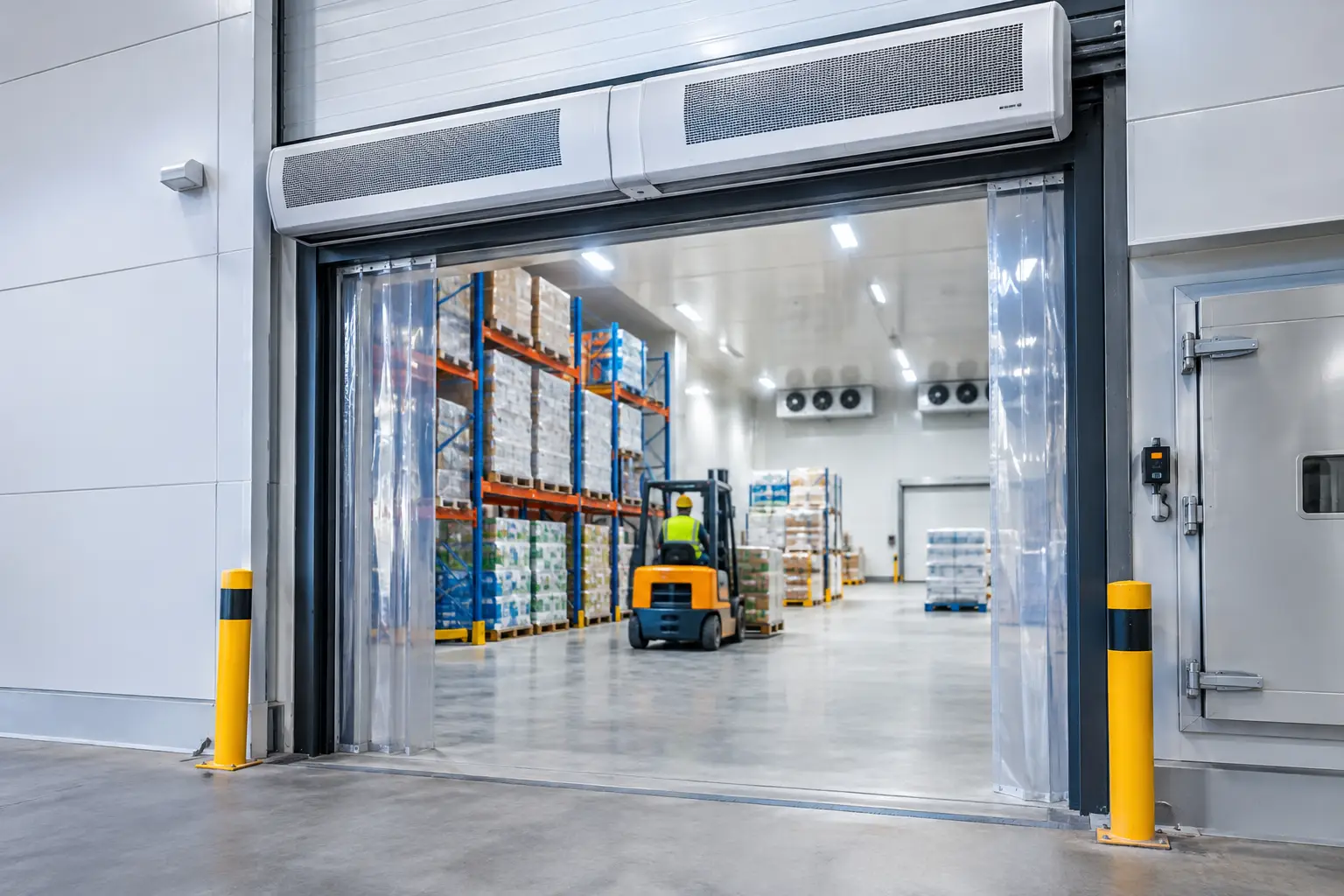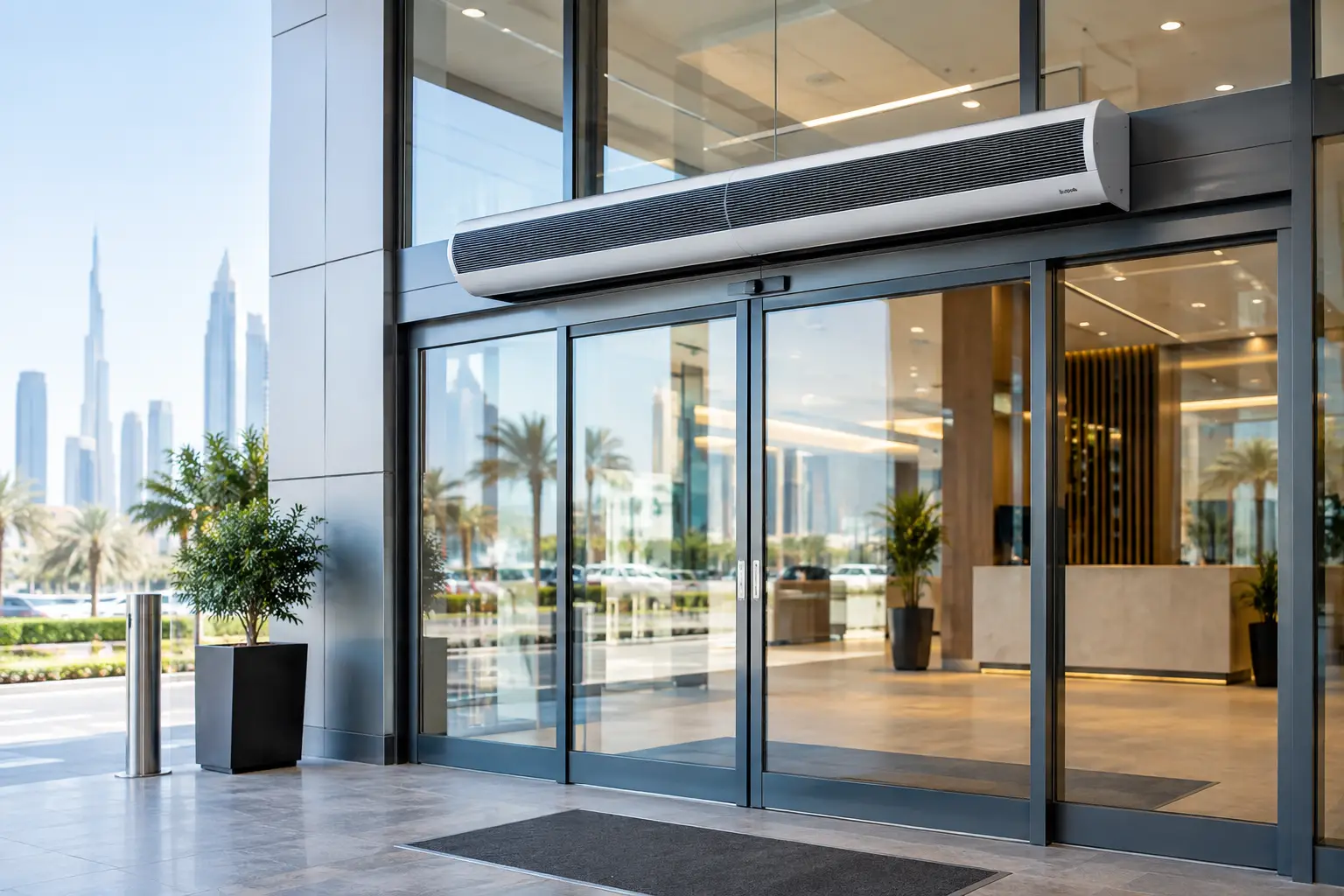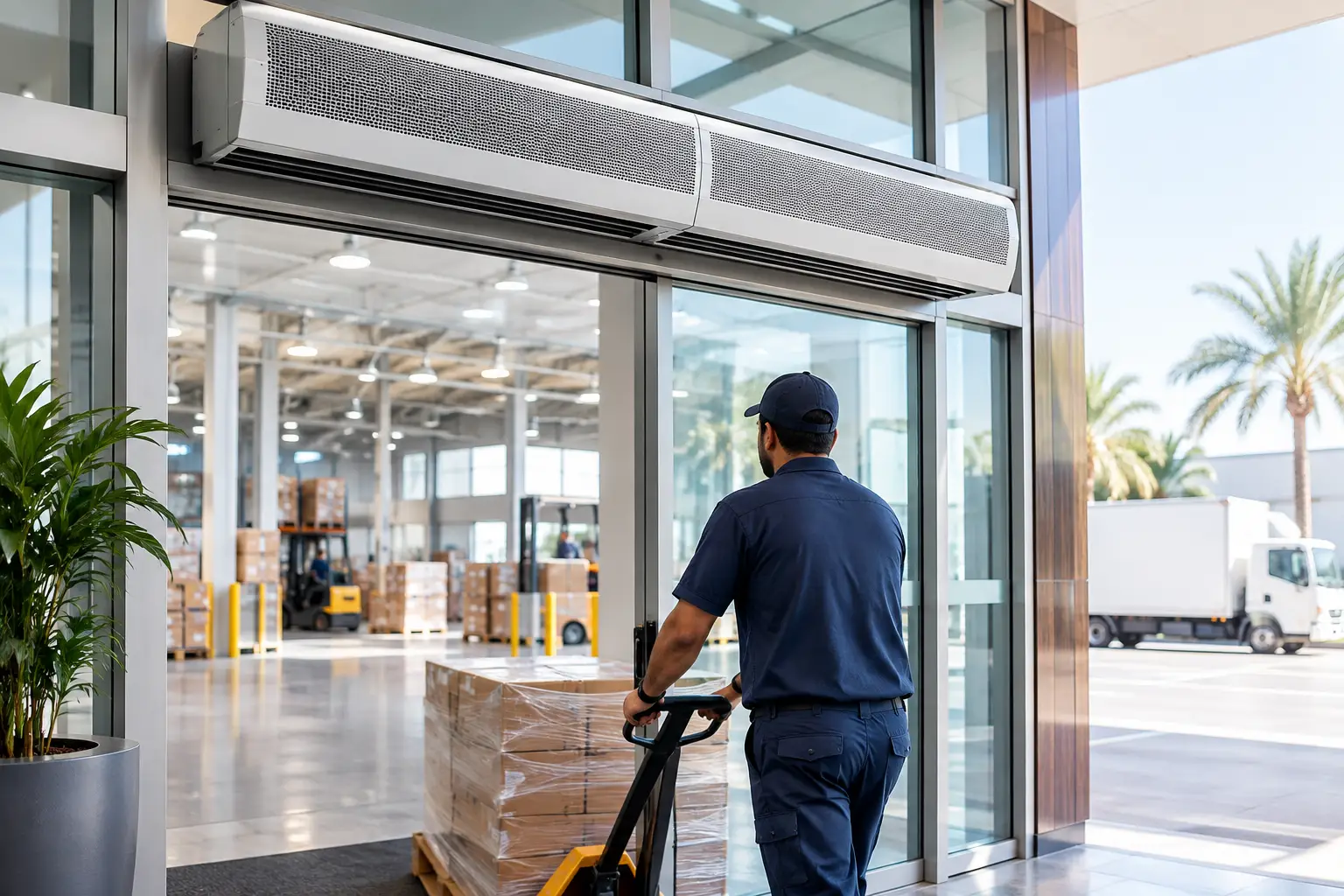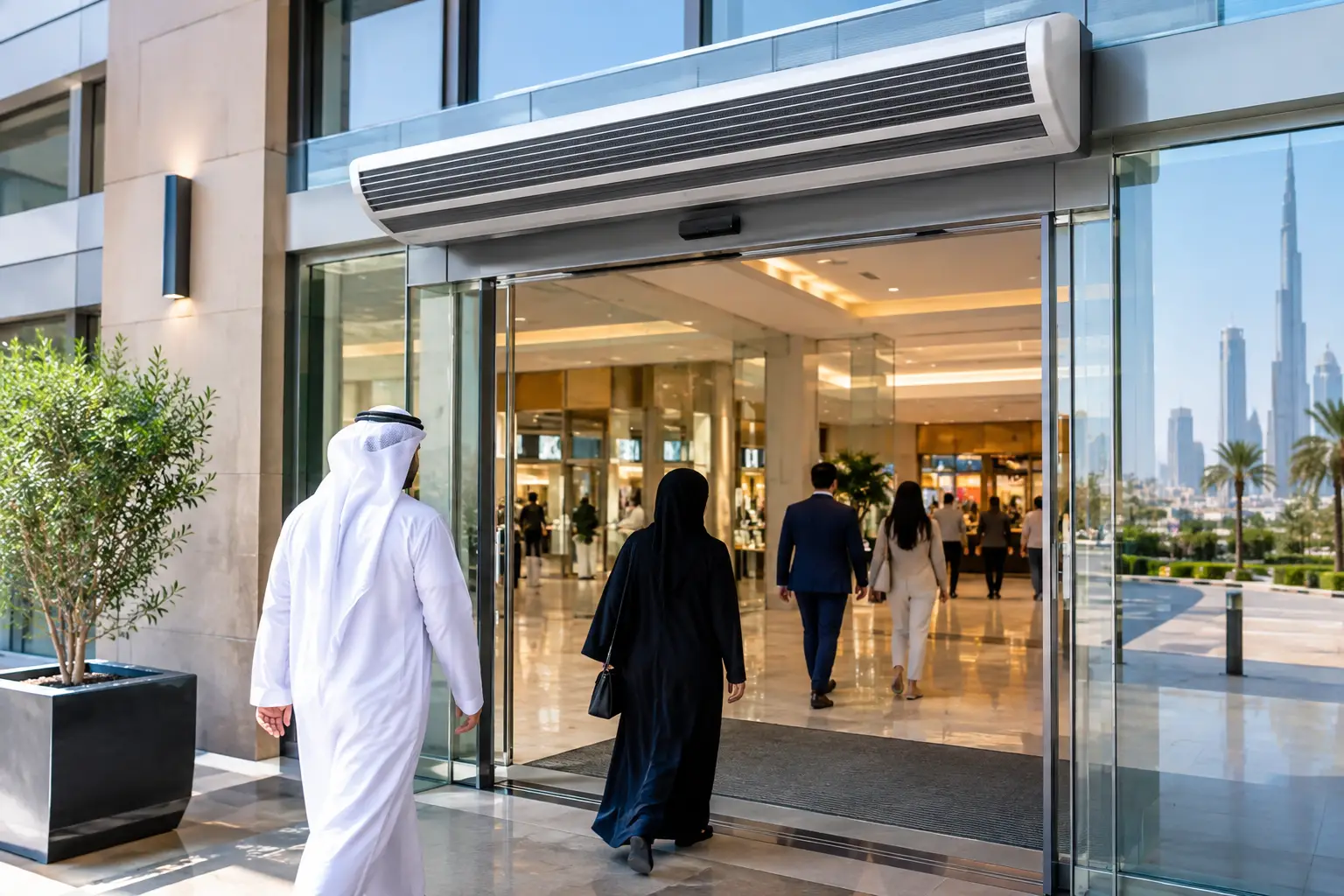
A failed air curtain at a busy loading bay or supermarket entrance does more than create an uncomfortable doorway. It allows hot, humid, dusty outside air to challenge the building’s cooling system, disrupts temperature control, and can increase cleaning and maintenance demands. This industrial air curtain durability review examines what determines service life in demanding commercial environments and what specifiers should assess before approving equipment.
For facilities in Dubai, Riyadh, Doha, Muscat, Cairo, Lagos, or Nairobi, durability is not a secondary feature. High ambient heat, airborne dust, humidity, long operating hours, and frequent door cycles place continuous strain on the air curtain assembly. The right unit should sustain its air barrier performance over time, not simply produce strong airflow on the day of commissioning.
What Durability Means in an Industrial Air Curtain
Durability is the ability of an air curtain to maintain reliable airflow, structural integrity, and controllable operation through its expected operating life. It is not defined by cabinet thickness alone. A well-built casing is valuable, but the motor, blower assembly, electrical controls, mounting method, inlet protection, and suitability for the doorway all influence lifecycle performance.
For industrial and commercial applications, the primary question is straightforward: can the system continue producing a stable, correctly directed air stream under actual site conditions? At a warehouse door that opens repeatedly, a unit may operate for extended periods while facing heat, dust, vehicle movement, and pressure differences across the opening. At a food processing entrance or hospital service door, hygiene and contamination-control requirements add another layer of performance risk.
A durable design therefore combines mechanical strength with application fit. Overspecifying a small retail doorway may add unnecessary cost and noise. Underspecifying a high-traffic logistics entrance can result in continuous strain, weak air separation, and premature component wear.
Industrial Air Curtain Durability Review: Key Components
Cabinet construction and corrosion resistance
The enclosure protects the internal equipment from impact, dust accumulation, and environmental exposure. In dry, dusty locations, cabinet seams and intake areas should be designed for straightforward inspection and cleaning. In humid coastal markets, such as Dubai, Doha, or parts of East Africa, corrosion resistance deserves closer attention because moisture and salt-laden air can accelerate surface deterioration.
A durable cabinet also needs adequate rigidity. Vibration from high-output blower systems can loosen fasteners or create objectionable noise if the housing and mounting arrangement are poorly matched. For exposed loading bays, factories, and distribution centers, industrial-grade construction is generally more appropriate than light commercial equipment intended for modest-height pedestrian entrances.
Motor and blower configuration
The blower and motor assembly is the working core of the system. Industrial centrifugal designs are commonly suited to higher mounting heights and more demanding entrances because they can generate the pressure needed to project airflow toward the floor. Their durability depends on motor duty rating, bearing quality, balance of rotating components, and protection from dust ingress.
Centrifugal airflow is not automatically the correct choice for every site. A lower, sheltered hotel or retail entrance may be better served by a commercial unit selected for quiet operation and refined appearance. However, a warehouse, factory, or frequently opened service entrance usually benefits from equipment designed for sustained operating loads. FreezeeX’s Industrial Centrifugal Series is intended for these heavier-use conditions, where air volume and mechanical endurance must work together.
Controls and electrical protection
Electrical components are often overlooked during initial selection, yet they affect uptime directly. Controls should be suitable for the site’s operating schedule and capable of integrating with door status, building management logic, or HVAC operation where required. This prevents the unit from running unnecessarily when doors are closed while ensuring protection begins when traffic starts.
In hot equipment rooms, dusty back-of-house areas, and humid service corridors, electrical protection and accessible control placement matter. A durable system is one that can be inspected by facility maintenance personnel without extended shutdowns or difficult access above the entrance.
Why Climate and Door Use Change the Expected Service Life
The same air curtain model can have very different lifecycle results depending on its environment. A unit installed above a controlled mall entrance faces a different duty cycle than one above a manufacturing door that opens for forklifts throughout the shift.
Heat affects motors, electronics, and surrounding installation conditions. Dust can build on inlet areas and moving components, restricting airflow and forcing the system to work harder. Humidity increases the likelihood of corrosion and condensation-related concerns, particularly around poorly protected electrical parts. These conditions are common across the GCC, MENA, and many African commercial markets, making climate-ready selection essential rather than optional.
Door geometry also matters. A wide or tall opening requires sufficient throw, air volume, and mounting position to maintain separation at floor level. If the airflow falls short, operators may extend run times in an attempt to compensate. That does not solve the performance gap and can raise energy use and equipment wear.
Before specifying capacity, evaluate door width, clear opening height, traffic frequency, mounting location, prevailing wind exposure, indoor cooling load, and whether the doorway is open to a dusty yard, humid exterior, or vehicle area. This approach helps determine whether an industrial centrifugal unit, a commercial centrifugal model, or a recessed solution is appropriate.
Maintenance Access Is Part of Durability
No commercial air curtain is maintenance-free. Long-term reliability depends on planned inspection and cleaning that reflects the operating environment. The goal is not a repair routine. It is to preserve airflow performance before restricted intake, accumulated dust, vibration, or loose mounting hardware becomes a service interruption.
Facility teams should establish an inspection schedule based on door traffic and airborne contaminants. A clean retail entrance may need less frequent attention than a logistics center near an unpaved yard or a food facility with demanding cleanliness standards. Maintenance access should be considered during design, particularly for recessed ceiling installations or units mounted above tall industrial doors.
A practical lifecycle review should confirm that intake areas can be reached safely, electrical isolation is straightforward, and the installation allows technicians to inspect mounting points and internal components. Equipment that is difficult to access often receives delayed maintenance, regardless of how capable the original design may be.
Signs a Specification May Reduce Service Life
Premature wear is frequently a selection or installation issue rather than a product defect. Several specification choices deserve careful review:
- Selecting a unit based on door width while ignoring mounting height and outside pressure conditions.
- Using a light commercial air curtain at a high-traffic warehouse, factory, or loading entrance.
- Mounting equipment where it cannot be inspected, cleaned, or securely supported.
- Assuming high airflow alone guarantees effective air separation without considering discharge direction and door geometry.
- Operating the system continuously when controls could align run time with door activity.
These are not minor details. An undersized air curtain may run at maximum demand without creating the intended barrier, while an incorrectly mounted unit can transmit vibration to the structure and reduce effective coverage at the opening.
Assessing Lifecycle Value Instead of Initial Cost
A durability review should compare expected operating value, not just equipment price. A lower-cost unit can become the more expensive option if it requires frequent intervention, fails to protect the conditioned space, or is unsuitable for the site’s climate and duty cycle.
For a supermarket entrance, lifecycle value may center on reducing warm-air infiltration while maintaining a welcoming, low-noise entrance. For a cold storage dispatch door, the focus may be limiting moisture and temperature transfer during loading. For industrial sites, it may be keeping dust, fumes, and outdoor heat away from production or storage areas while reducing avoidable HVAC load.
The appropriate system is therefore application-specific. FreezeeX evaluates entrance dimensions, mounting conditions, traffic patterns, ambient climate, and HVAC objectives before recommending a configuration. This helps project teams avoid the common mistake of treating all doorways as identical.
A Better Basis for Industrial Selection
The most durable industrial air curtain is the one correctly matched to the entrance, supported by sound installation planning, and maintained according to its exposure level. Strong airflow, a rigid enclosure, and a capable motor matter, but they only deliver their expected service life when the unit is selected for the real operating environment.
For projects in hot, tropical, humid, or desert climates, request a technical consultation or quotation based on the actual doorway and operating conditions. A properly specified FreezeeX air curtain can support dependable entrance separation, protect HVAC performance, and provide a more predictable long-term operating outcome.