A commercial entrance can lose conditioned air every time the door opens, but running an air curtain at full output all day is not always the most efficient answer. Smart air curtain controls allow the unit to respond to actual door activity, indoor and outdoor conditions, and operational schedules. For supermarkets, warehouses, hospitals, hotels, and food facilities in hot, humid, and dusty markets, that control can make the difference between a useful air barrier and unnecessary energy use.
The objective is straightforward: maintain a stable, correctly directed air stream whenever the entrance needs protection, without treating every operating hour as the same. The appropriate control strategy depends on door size, mounting height, traffic volume, HVAC capacity, and the contaminants the facility needs to manage.
What Smart Air Curtain Controls Do
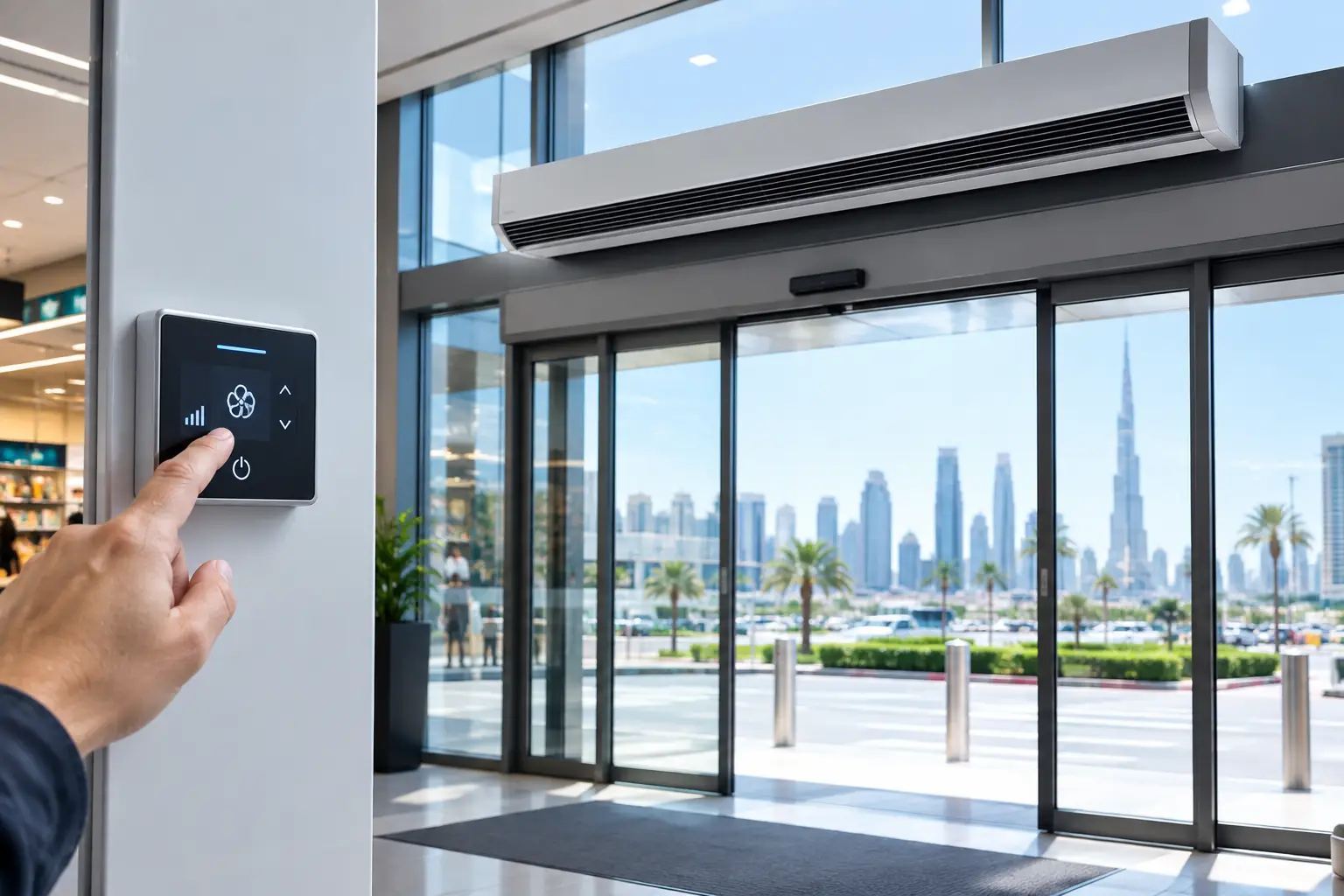
Smart controls are not a single feature. They are a set of control methods that adjust air curtain operation based on changing conditions at the entrance. Depending on the application, the system may start when a door opens, increase fan speed during heavy traffic, operate at reduced speed during quiet periods, or receive an operating signal from the building management system.
A properly selected controller improves consistency. Rather than relying on staff to switch equipment on and off, the air curtain is activated according to defined operating logic. This is particularly valuable at loading bays, retail entrances, and service doors where opening patterns vary throughout the day.
The control system should support the air curtain’s primary job: creating an air barrier that limits the infiltration of hot air, humidity, dust, insects, fumes, and airborne contaminants. Controls cannot correct a poorly sized unit or incorrect installation height. They help a correctly specified system operate more efficiently under real site conditions.
Why Control Strategy Matters in Hot and Humid Facilities
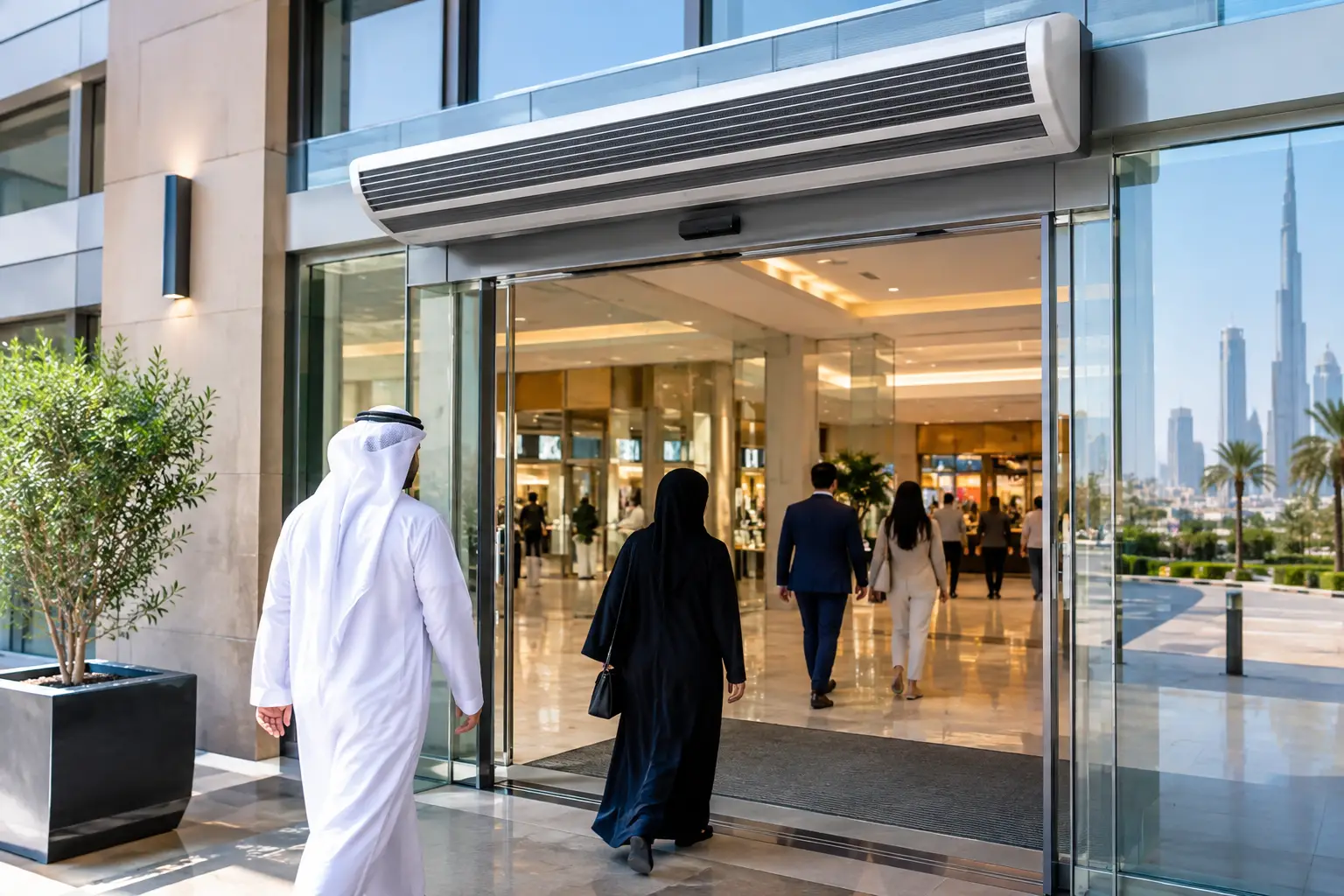
In Dubai, Abu Dhabi, Riyadh, Doha, Muscat, Cairo, Lagos, and similar operating environments, outdoor air is often hot, dusty, or humid. When a frequently used entrance opens, the HVAC system must offset the heat and moisture entering the building. In a supermarket or hotel lobby, this can affect customer comfort near the doorway. In a cold storage or food processing operation, it can create a more serious operational load.
An air curtain that operates only at a fixed speed may be adequate for a low-traffic internal door. A busy external entrance, however, experiences changing pressure conditions and different levels of exposure throughout the day. High pedestrian traffic, delivery activity, wind effects, and peak ambient temperatures all change the demand on the air barrier.
Smart control options help facilities align airflow with those conditions. The benefit is not simply lower electrical consumption by the air curtain motor. The larger opportunity is reducing avoidable cooling loss and limiting the burden placed on the building’s air-conditioning system.
Common Control Methods for Commercial Air Curtains
Door-Activated Controls
A door contact, magnetic switch, or door-position sensor signals the air curtain to operate when the entrance opens. This is one of the most practical approaches for hinged service doors, warehouse doors, and controlled-access openings.
Door activation avoids continuous operation when the entrance remains closed. It also provides immediate airflow when the opening creates the greatest risk of heat, dust, or insect entry. Response timing matters: the control should activate promptly enough to protect the opening without frequent short cycling that adds unnecessary wear.
For high-speed or sectional industrial doors, controls must be coordinated with the door’s opening and closing sequence. The air curtain should operate long enough to cover the full open period and a short post-close interval where needed.
Multi-Speed Fan Control
Many commercial and industrial applications benefit from more than one airflow setting. A lower speed may be sufficient for normal retail traffic, while a higher setting is needed during peak entry periods or when external conditions are severe.
Multi-speed operation is useful, but higher airflow is not automatically better. Excessive velocity can create noise, drafts, or air turbulence that weakens the barrier at floor level. The correct setting depends on mounting height, discharge angle, entrance width, and the air pressure relationship between spaces.
For larger openings and demanding conditions, industrial centrifugal systems are commonly selected because they can maintain the throw and air volume required across wider or taller doorways. The controls should be selected alongside the equipment, not added as an afterthought.
Time Schedules and Operating Modes
Scheduled control is effective where operating hours are predictable. A retail store may require full entrance protection before opening, during trading hours, and during delivery windows, while using a reduced setting during cleaning or security shifts.
Schedules should reflect actual site operations rather than standard building hours. A logistics center may have early-morning vehicle movements, while a restaurant may experience concentrated traffic during lunch and evening service. When schedules are combined with door sensors, the air curtain can remain available only when the facility requires it.
Building Management System Integration
For larger commercial projects, smart air curtain controls can be integrated with a building management system. This allows facility teams to monitor status, apply operating schedules, and coordinate entrance equipment with broader HVAC strategies.
Integration is especially relevant for airports, shopping malls, hospitals, pharmaceutical sites, and multi-tenant commercial facilities. It can provide centralized control, but it also requires clear responsibility between the MEP consultant, controls contractor, HVAC contractor, and air curtain supplier. A system that is technically compatible but poorly commissioned may not deliver the intended operating sequence.
The most useful integration points are typically enable signals, fan-speed selection, door status, alarms, and timed overrides. The specification should define these requirements early, including the control protocol and whether local manual control must remain available.
Temperature and Environmental Inputs
Some applications use temperature sensors or external-condition signals to influence fan speed. This can be helpful at entrances where solar gain and peak outdoor temperatures change the load substantially over the day.
However, temperature alone is not a complete control signal. An entrance may need strong air isolation because of dust, insects, humidity, smoke migration, or pressure imbalance even when the temperature difference is modest. Environmental sensing is most effective when it complements door status and operational schedules rather than replacing them.
Selecting Controls by Application
The operating environment should determine the control approach. A single strategy is rarely suitable across all commercial door types.
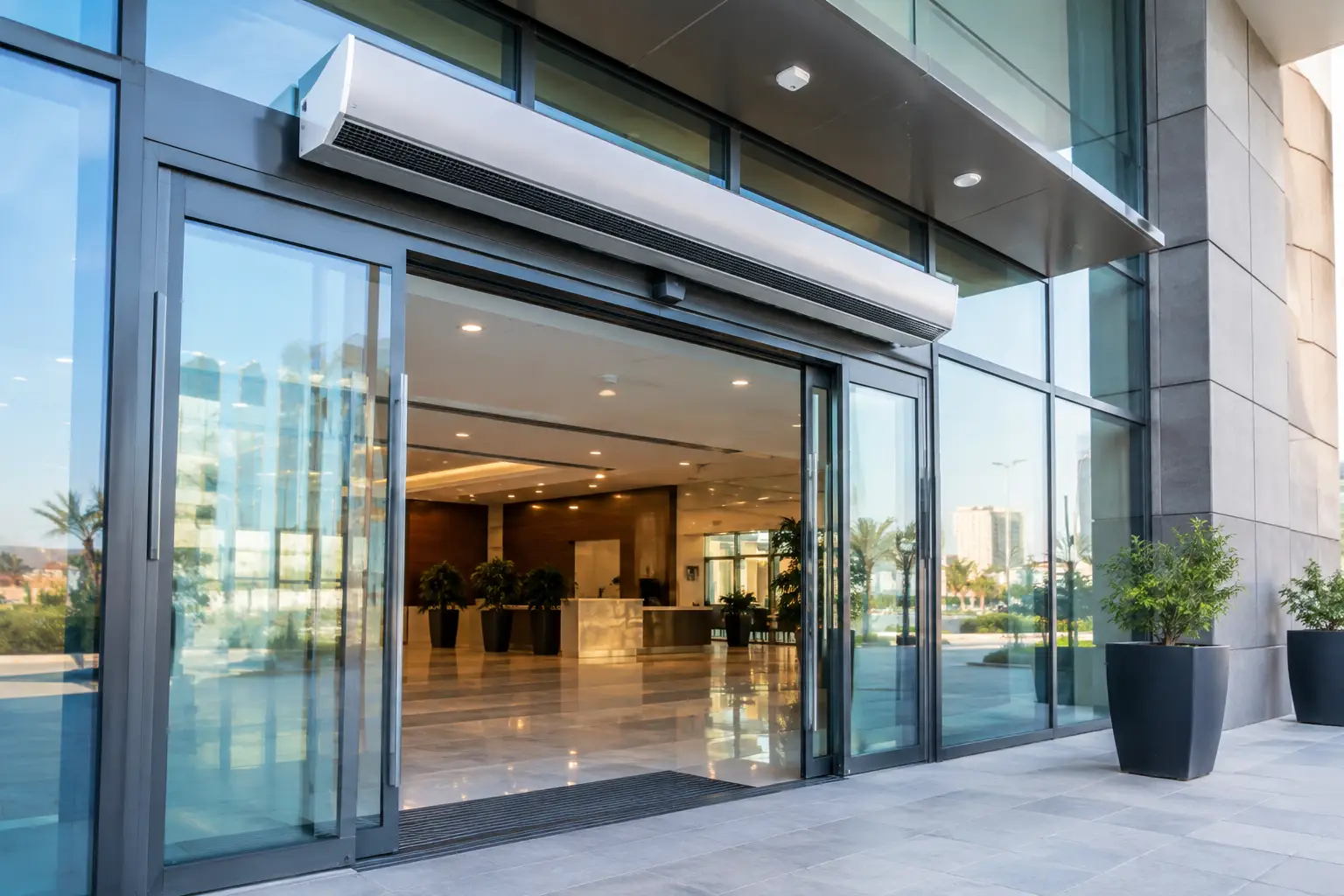
At a supermarket or shopping mall entrance, continuous low-speed operation with automatic high-speed response during peak traffic can maintain comfort while controlling noise. For hotels and office lobbies, the system should support a stable, discreet operating profile that protects the conditioned space without disrupting the arrival experience.
At warehouses, factories, and logistics centers, door-activated controls and industrial-grade interlocks are often more appropriate. The system must account for tall openings, prolonged door cycles, forklift traffic, and dusty external conditions. In these cases, the air curtain’s airflow performance and mounting position remain more critical than sophisticated automation alone.
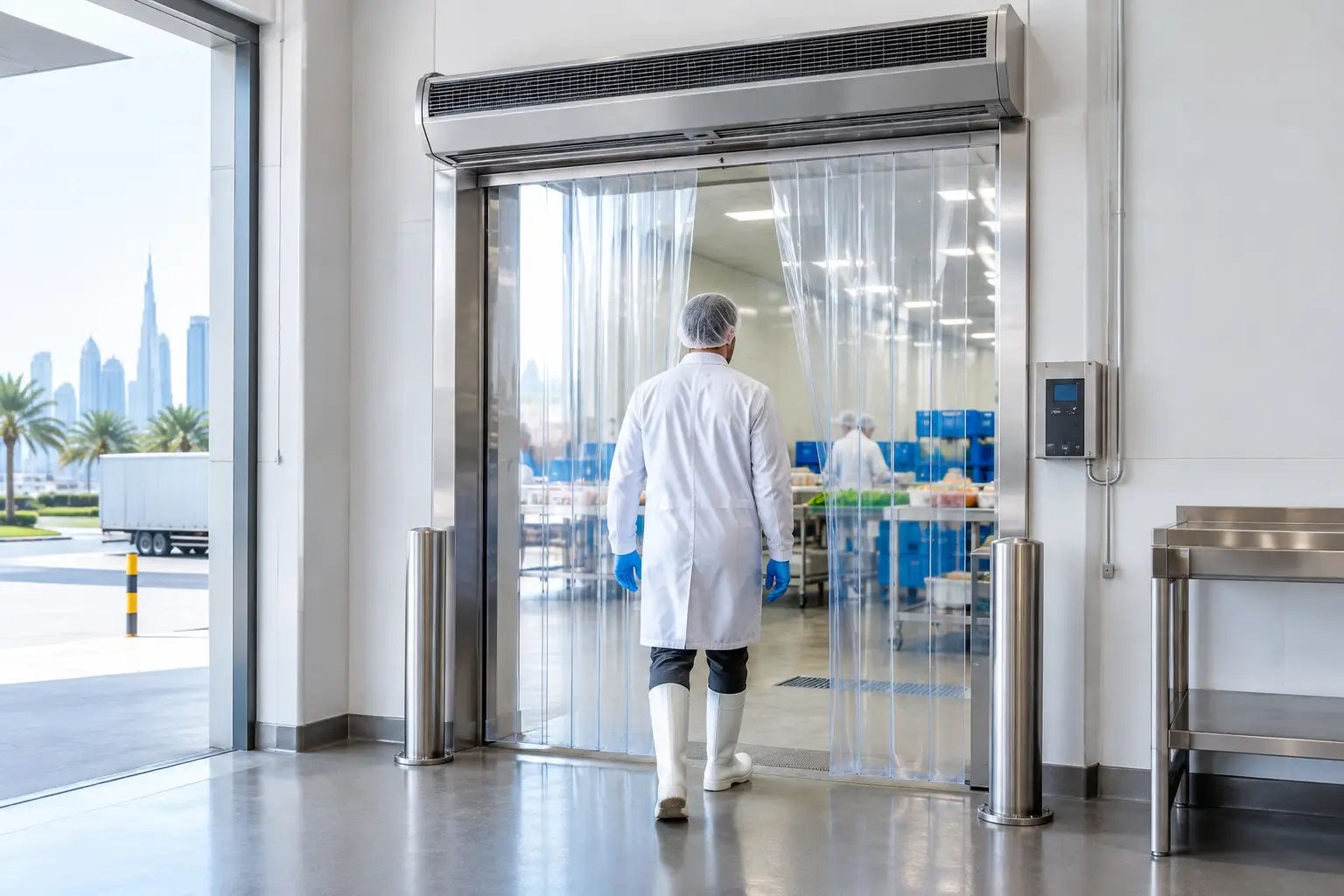
Cold storage, food processing, pharmaceutical, and healthcare facilities require more careful coordination. The control logic may need to support hygiene protocols, pressure zoning, temperature control, and frequent door operation. Facility teams should evaluate how the air curtain interacts with the overall environmental-control plan, rather than viewing it as an isolated entrance device.
Specification Questions to Resolve Early
Before selecting smart controls, project teams should establish how the entrance operates in practice. Four questions are particularly useful:
- Is the door normally open, intermittently used, or opened for long delivery cycles?
- What is the primary threat at the opening: heat, humidity, dust, insects, fumes, or loss of cooled air?
- Does the facility require local controls, central monitoring, or both?
- Can the selected air curtain maintain an effective air stream at the actual mounting height and doorway width?
These answers affect the fan type, unit capacity, control wiring, sensor selection, and commissioning requirements. They also help avoid a common mistake: specifying controls based only on convenience instead of the actual infiltration load.
Controls Need Commissioning, Not Just Installation
An air curtain can be mechanically installed and electrically connected yet still perform below expectations if controls are not commissioned correctly. Fan speeds, activation delays, discharge direction, and door interlocks should be checked while the building is operating under realistic conditions.
This is particularly relevant in desert and tropical climates, where strong outdoor heat, humidity, and airborne dust expose weaknesses quickly. The commissioning team should observe the air stream across the full doorway, not only at the discharge grille. If the stream does not reach the floor or becomes deflected, control changes alone will not solve the issue. The equipment selection, mounting arrangement, or airflow setting may need review.
Maintenance teams also need a clear operating sequence. They should know which settings are normal, when an override is appropriate, and which alarms or changes in performance require attention. Simplicity remains valuable. The most effective smart control system is one that operators can understand and maintain.
For projects across the GCC, MENA, and Africa, specify the air curtain and its controls as one entrance-performance solution. A consultation with FreezeeX can assess opening dimensions, traffic patterns, climate exposure, and HVAC requirements to define a practical quotation. The right control logic keeps the air barrier working when the entrance is most vulnerable, not merely when the switch is on.