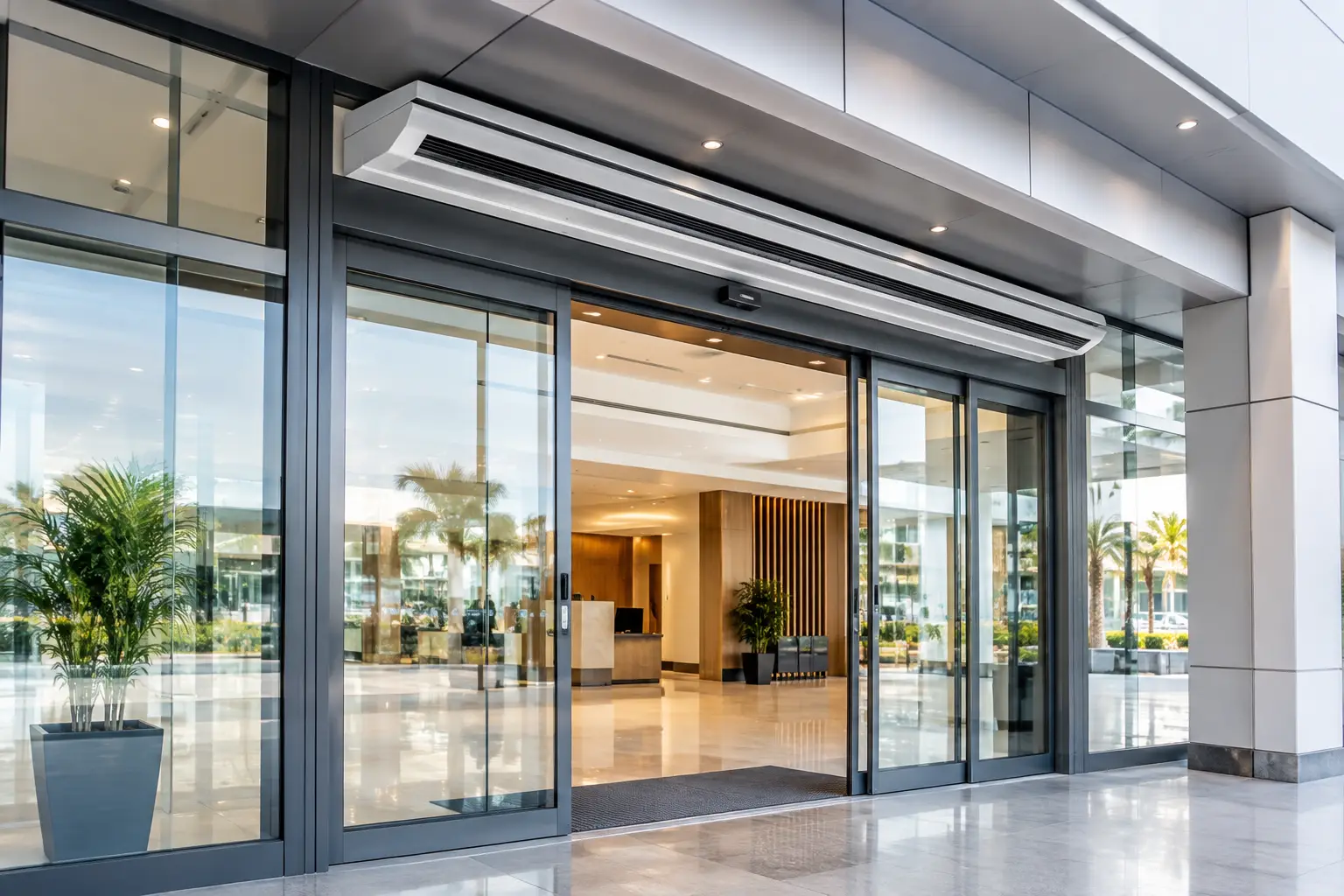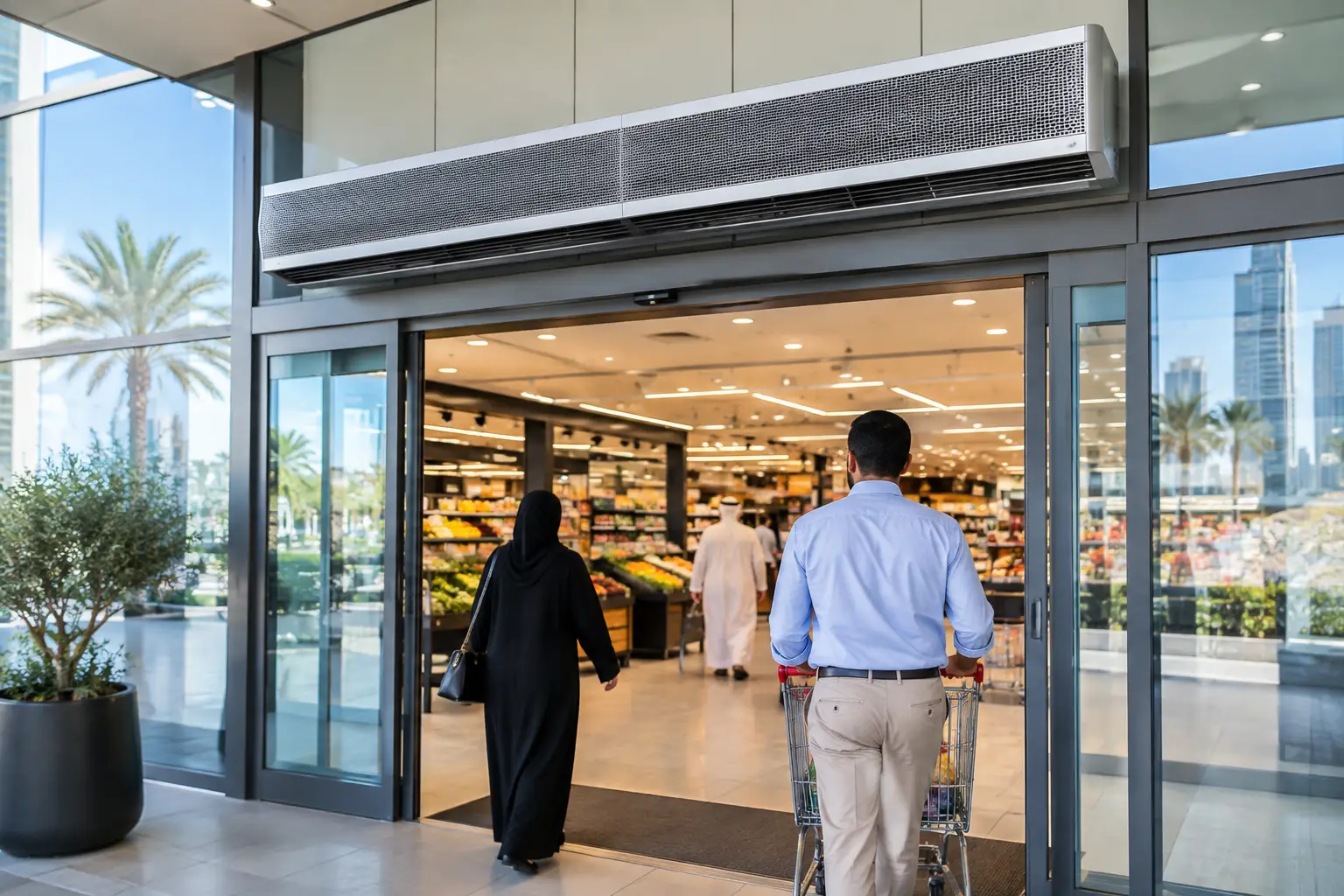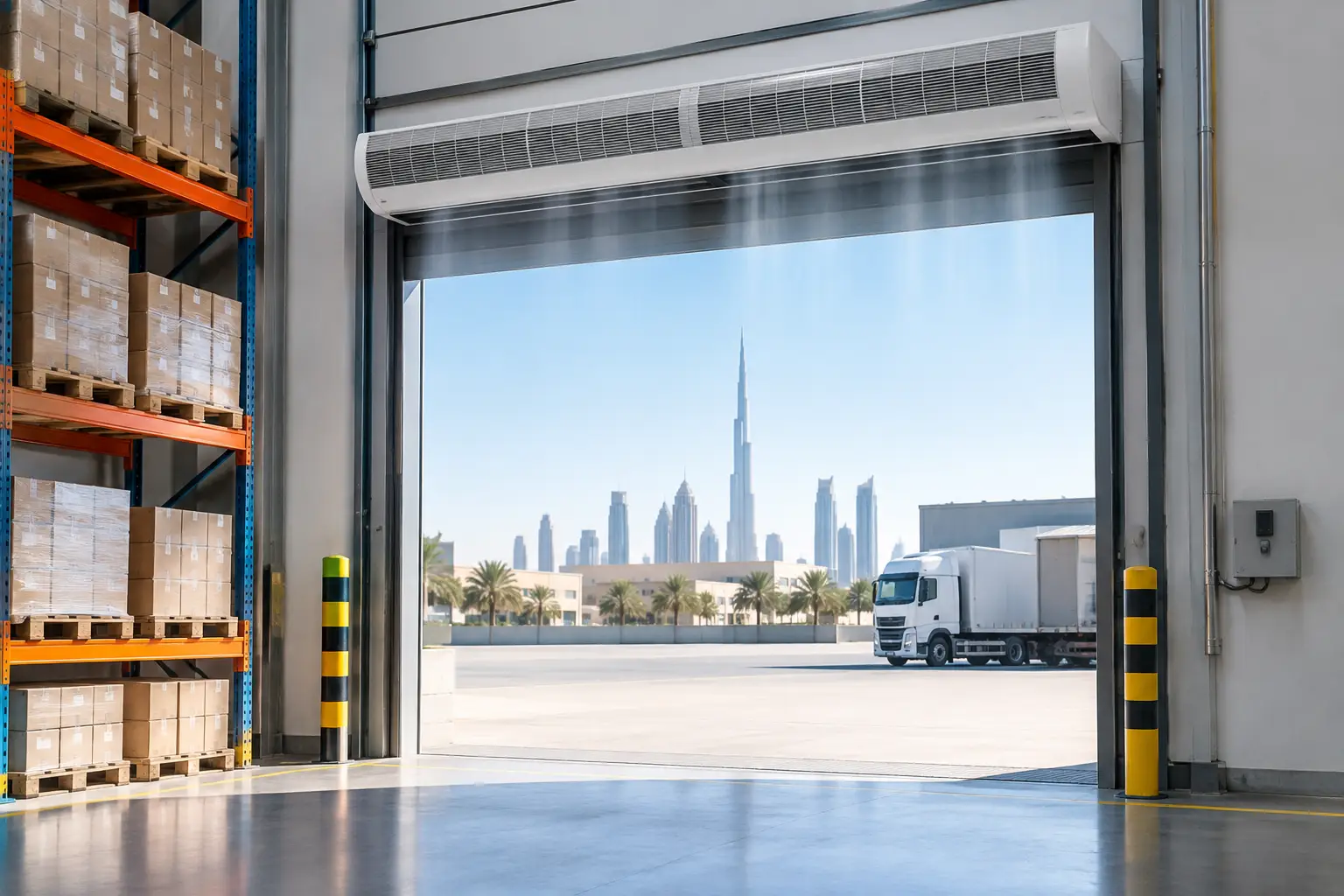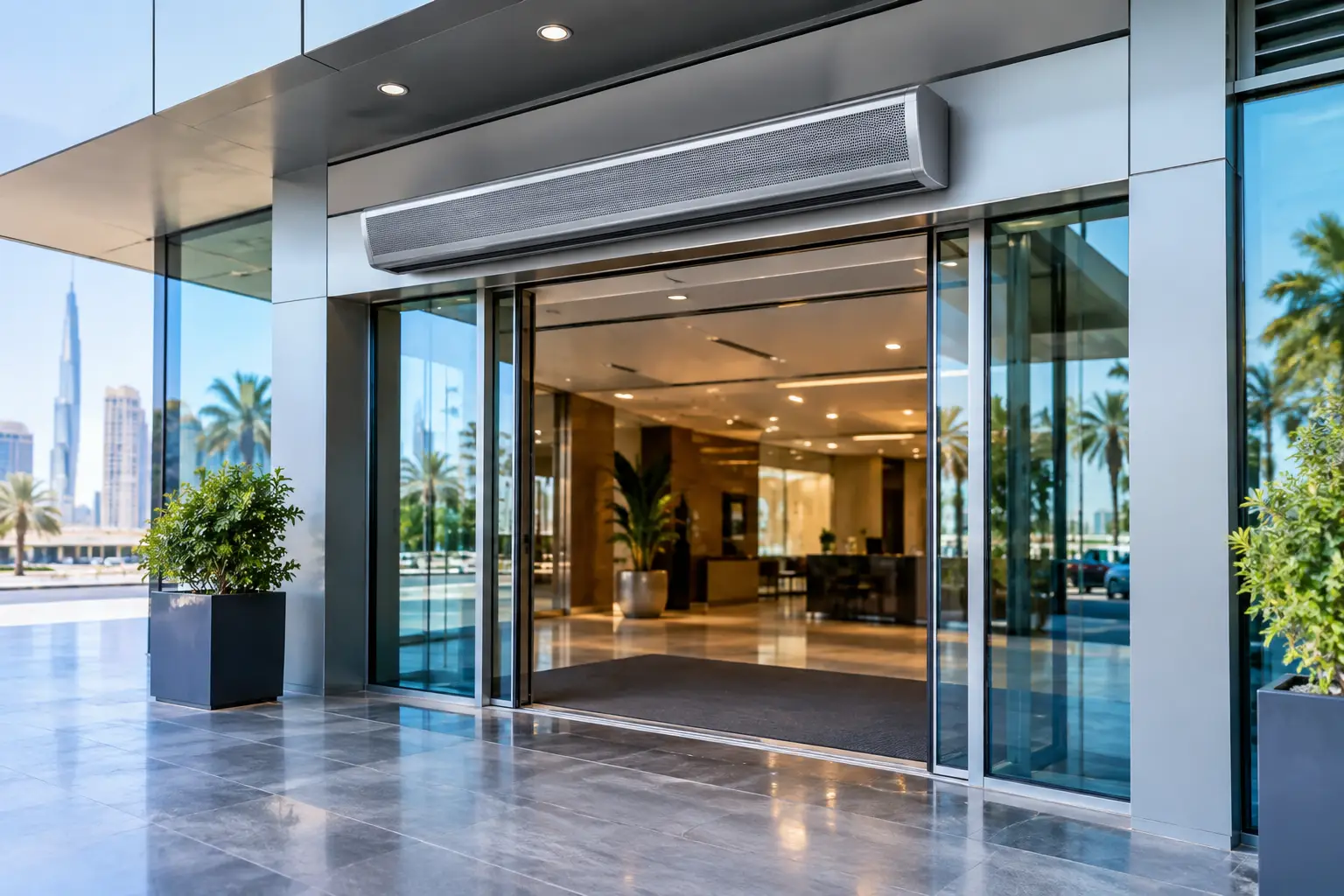
A busy entrance in Dubai or Lagos can drain cooling capacity faster than most facility teams expect. When buyers compare heated versus ambient air curtains, the real question is not which one sounds more advanced – it is which one protects the opening without adding unnecessary energy load, cost, or complexity.
For commercial and industrial sites in hot-weather markets, that distinction matters. An air curtain is there to create a controlled air barrier across the doorway, limiting hot air, dust, insects, and humidity from entering while reducing conditioned air loss. Whether that barrier should be heated depends heavily on climate, application, and operational goals.
Heated versus ambient air curtains: the basic difference
An ambient air curtain uses unheated air drawn from the surrounding indoor environment and discharges it at controlled velocity across the entrance. Its job is barrier performance first. It separates two environments without intentionally raising outlet air temperature.
A heated air curtain does the same basic job, but with a heating element or hot water coil that warms the discharge air. In some applications, that added heat improves occupant comfort near the doorway or supports temperature stabilization where cold drafts are a concern.
That sounds straightforward, but many projects specify the wrong type because the selection is based on assumptions instead of site conditions. In tropical and desert climates, heated units are often treated as a premium upgrade when, in reality, they may be unnecessary for the majority of openings.
Why climate changes the decision
In Riyadh, Muscat, Nairobi, or Cairo, the dominant problem at entrances is usually heat ingress, airborne dust, humidity, and insect movement – not cold discomfort. Buildings spend money trying to keep conditioned air inside. Adding heat to an entrance device in that context can work against the larger HVAC objective.
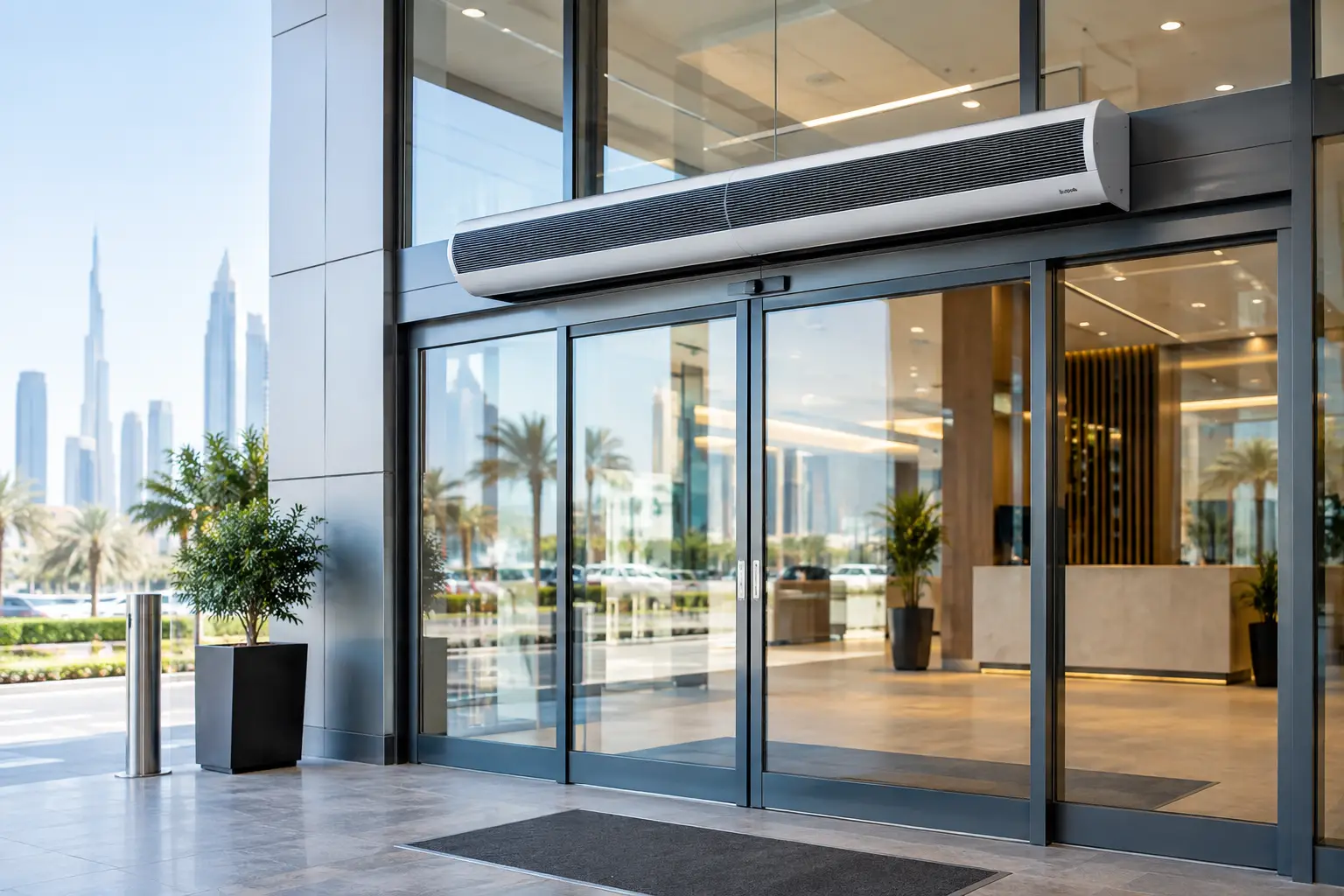
That is why ambient air curtains are often the stronger fit across retail entrances, hypermarkets, hospitality lobbies, warehouses, workshops, and commercial buildings in the GCC, MENA, and many African markets. They preserve cooled indoor air while forming a strong isolation barrier. They do not add a secondary heating load to a building already fighting extreme outdoor temperatures.
Heated models can still have a place, but in these regions they are a narrower solution. They are usually justified by a specific operational need, not by default specification.
Where ambient air curtains usually make more sense
For most hot-climate facilities, ambient units align better with the actual problem at the door. If the site is dealing with heavy foot traffic, frequent door opening, cooling loss, dust infiltration, or flying insects, the key performance factors are air velocity, coverage, mounting height, discharge angle, and blower design.
An ambient air curtain addresses those issues without increasing power consumption for heating. That matters in supermarkets, food service sites, commercial towers, and logistics spaces where entrances stay active all day. Lower operating cost is not a side benefit – it is often the reason the system delivers a strong return.
Ambient models are also generally simpler from a controls and infrastructure standpoint. There is less to integrate, less electrical demand to account for, and fewer components affecting lifecycle cost. For procurement teams and contractors, that can make the specification cleaner and more economical.
In high-temperature environments, comfort at the doorway is typically improved by stopping hot outside air from entering, not by warming the discharge stream. A properly selected ambient air curtain can make the entrance feel more controlled because it reduces mixing between outdoor heat and indoor cooling.
When heated air curtains can still be justified
There are situations where heated air curtains deserve consideration, even in warmer regions. The first is occupant comfort in spaces where people stand directly near the opening for extended periods, especially if aggressive cooling inside the building creates a cool-draft sensation around the entrance zone.
The second is process-related temperature control. Some specialized facilities need localized warming at an opening or need to offset a sharp temperature transition. This is more application-specific than climate-specific.
The third is environments that operate at very low internal temperatures compared with the surrounding building areas, such as certain controlled commercial zones. In those cases, the heated function may support a more stable transition at the entrance, though it must be engineered carefully.
Even then, a heated air curtain should not be selected because it appears more powerful on paper. If the heating function does not directly solve a measurable problem, it becomes an added energy expense with limited operational value.
Performance is not about heat alone
A common mistake is assuming a heated unit creates a better barrier than an ambient unit. Barrier quality depends much more on aerodynamic performance than discharge temperature.
The real decision points are fan type, air volume, outlet velocity, installation height, door width, and the pressure conditions around the opening. A well-engineered ambient centrifugal air curtain can outperform a poorly matched heated unit at keeping out dust, insects, and outside air.
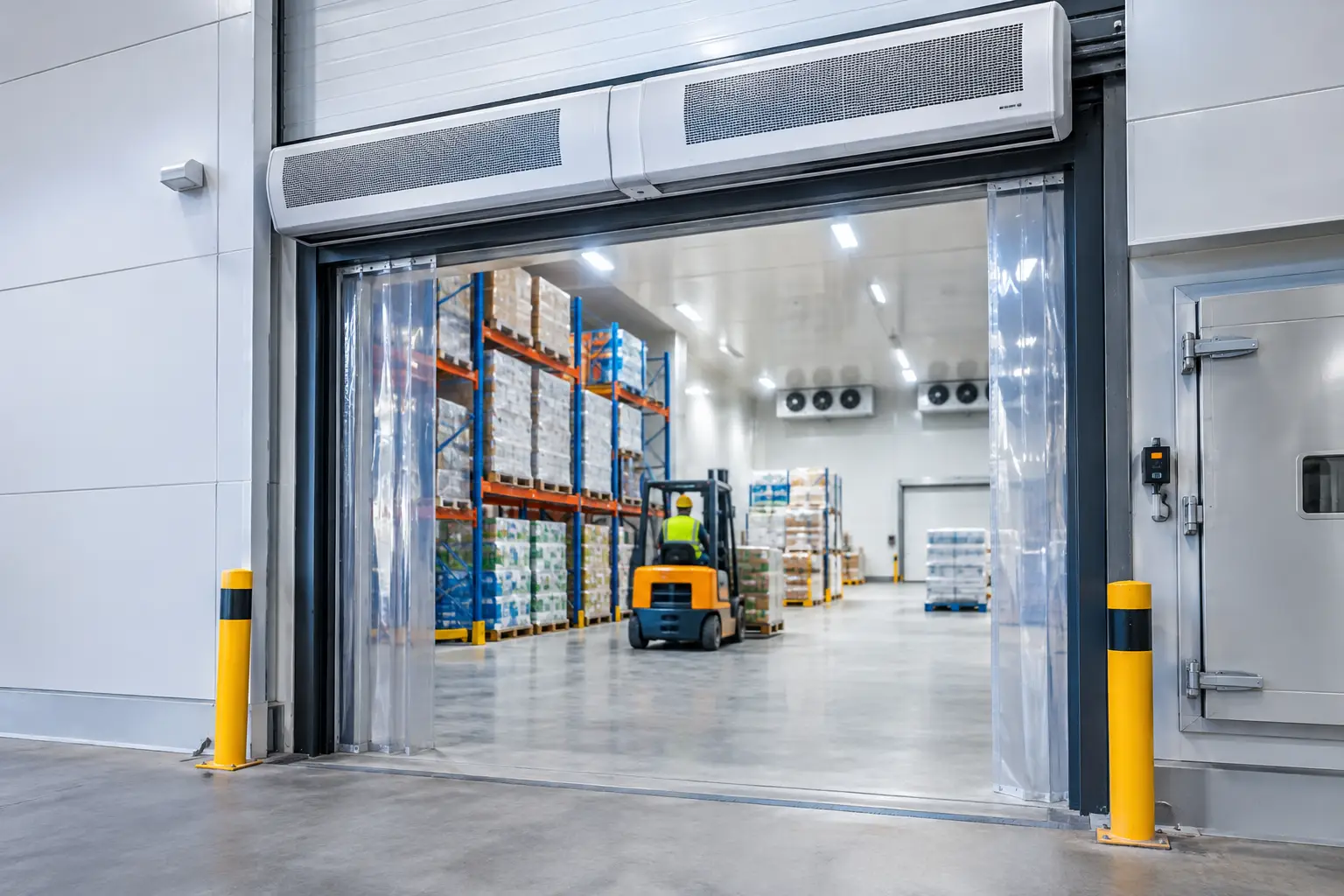
This is especially relevant for industrial doors, loading zones, and large commercial entrances in desert and tropical climates. If the opening is tall, exposed to crosswinds, or subject to heavy traffic, the buyer should focus on throw, stability, and motor performance first. Heating is secondary, and often irrelevant.
Energy cost and operating logic
For most decision-makers, the clearest argument in the heated versus ambient air curtains discussion is operating efficiency. Heated units consume more energy because they are doing two jobs at once – creating an air barrier and producing heat. In hot-weather regions, that extra energy use often has little strategic value.
An ambient unit supports the cooling strategy rather than complicating it. It helps reduce HVAC strain by limiting air exchange through open doors. In facilities with long operating hours, even modest improvements in entrance control can influence total cooling demand over time.
That makes ambient systems particularly attractive for hypermarkets, hotels, healthcare-adjacent commercial spaces, and industrial sites where utility costs and climate control are tightly monitored. The better question is not whether a heated model offers more features. It is whether those features produce measurable savings or performance gains for that entrance.
Application fit matters more than product category
A front entrance to a hospitality property has different needs than a cold-room access point, and a warehouse opening behaves differently than a pharmacy entrance in a shopping center. That is why blanket recommendations rarely work.
For customer-facing entrances in hot and humid cities such as Doha or Casablanca, ambient units are often the most commercially sound choice because they improve comfort, hygiene, and cooling retention without unnecessary heat output. For industrial openings, the choice depends on door size, air movement, and exposure. For temperature-sensitive operations, the answer may involve a more specialized setup.
Specifiers should also consider whether the unit is recessed or exposed, whether noise level matters in the occupied space, and whether the air curtain will operate continuously or on door activation. These details affect performance just as much as the heated-versus-ambient label.
What buyers should ask before specifying
The most useful starting point is operational intent. Is the goal to stop conditioned air loss, reduce dust, control insects, improve customer comfort, or support a temperature-managed process area? In many projects, one or two of those priorities dominate, and that immediately narrows the right equipment type.
After that, the entrance itself needs scrutiny. Opening height, width, traffic volume, door hold-open time, nearby wind pressure, and indoor setpoint all influence selection. A standard commercial doorway in a shopping environment may only need a well-sized ambient unit. A taller industrial opening may require a higher-performance centrifugal series with stronger throw and more precise specification.
This is where consultation matters. On paper, two air curtains may look similar. In operation, one may hold the barrier properly while the other leaves gaps at floor level or loses stability under pressure. Serious performance depends on matching the unit to the real site conditions.
The practical answer for hot-climate facilities
For most commercial and industrial buildings across the Middle East and Africa, ambient air curtains are the default choice because they solve the actual entrance-control problem without adding wasted heat. They are usually more energy-conscious, more aligned with cooling preservation, and more commercially efficient.
Heated air curtains remain a valid option where there is a clear comfort or process requirement, but they should be specified with discipline. If the site does not need heated discharge air, then it should not pay for it in capital cost, infrastructure, and ongoing energy use.
The strongest air curtain strategy is not about choosing the more complex system. It is about selecting the barrier that performs reliably in real operating conditions – high traffic, harsh heat, humidity, dust exposure, and demanding commercial schedules.
If you are evaluating heated versus ambient air curtains for a retail site, hotel, industrial plant, cold storage entrance, or large commercial facility, FreezeeX can help you specify the right system for your climate, opening size, and performance target. Request a consultation or quote to match the air curtain to your project conditions with confidence.