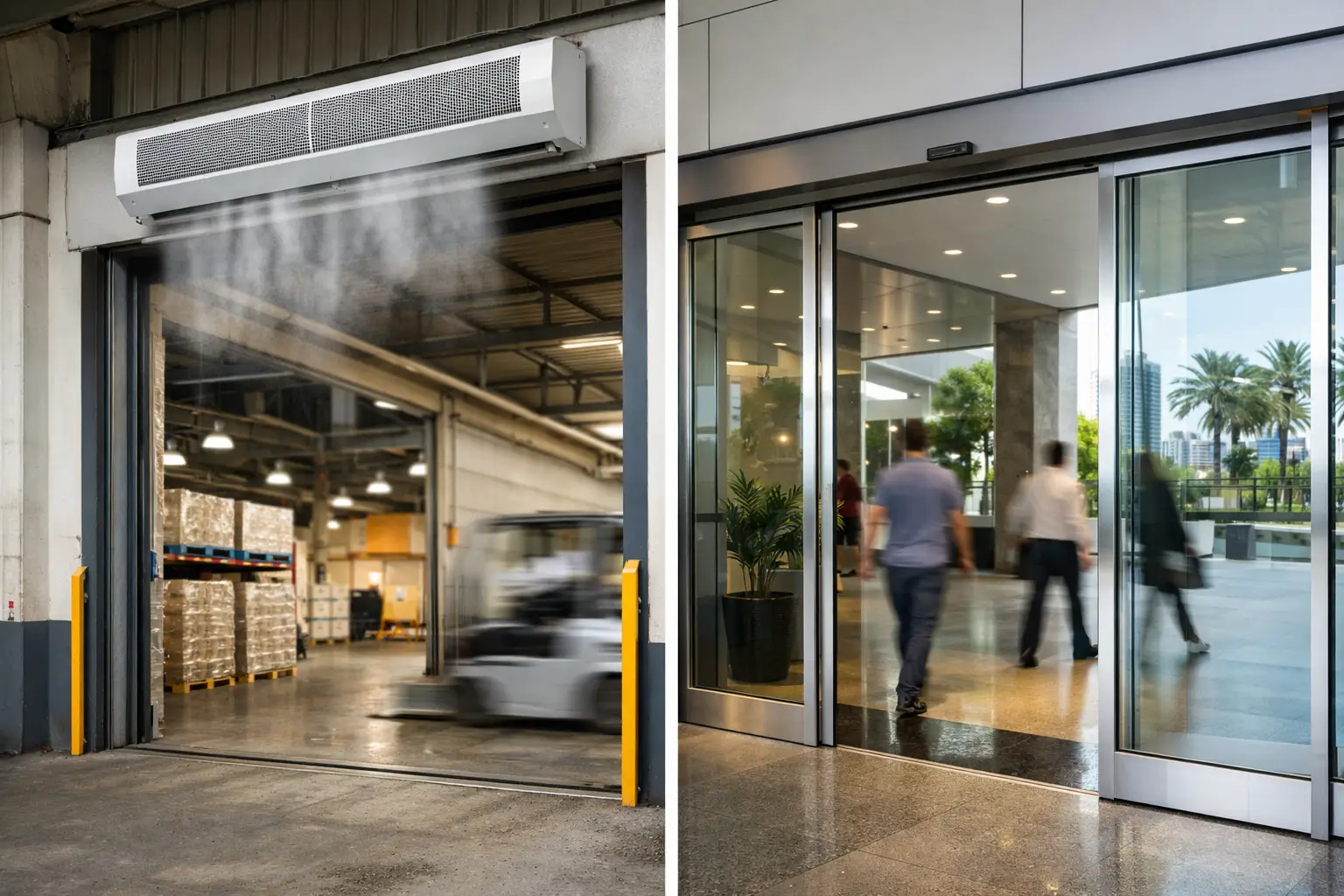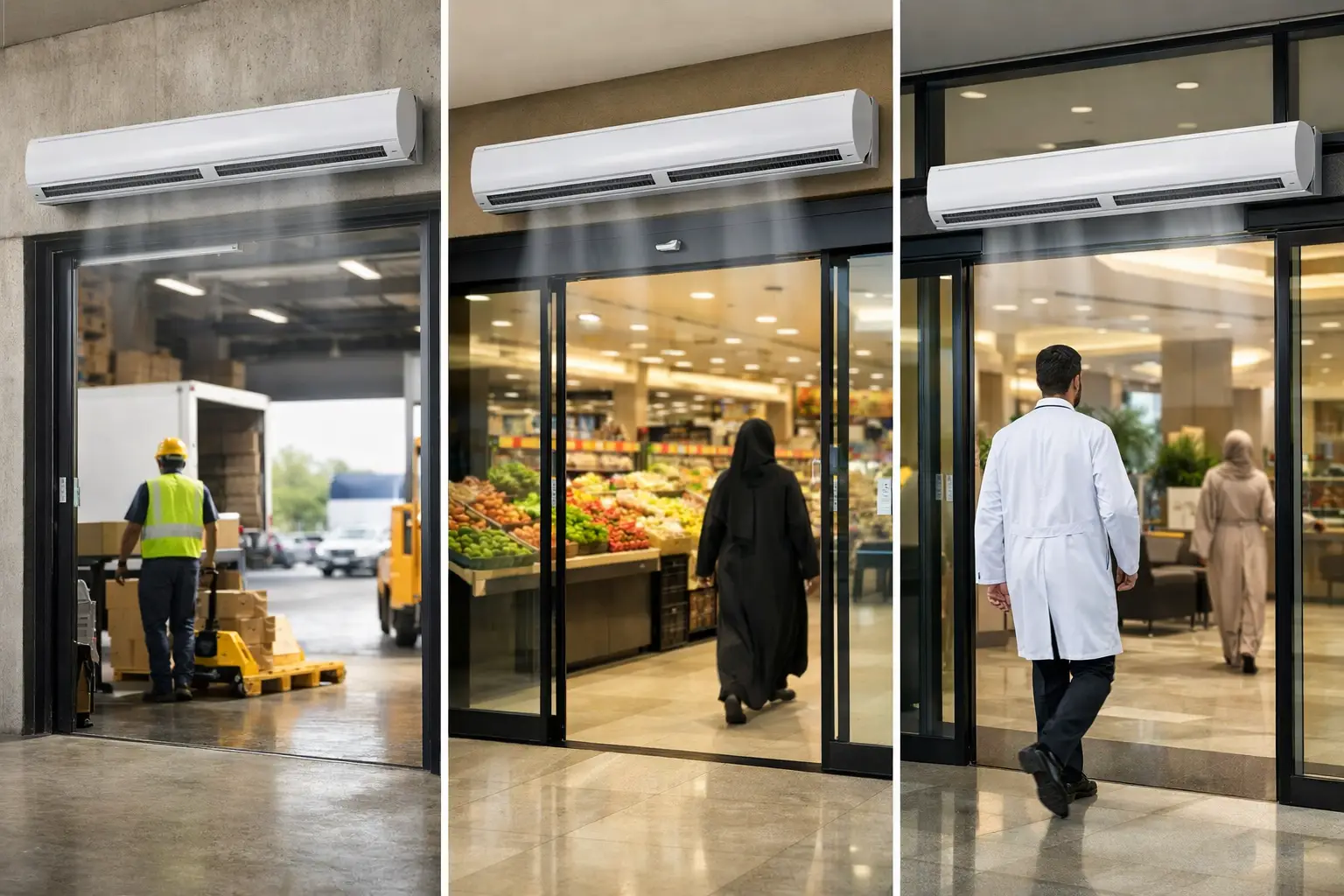
At a hypermarket entrance in Riyadh or a cold room loading zone in Lagos, the real cost is not the door itself. It is the conditioned air escaping every time traffic spikes, while dust, humidity, and insects move in. That is where the question of air curtains vs automatic doors becomes a facility performance decision, not just an entrance design choice.
For commercial and industrial operators in hot, humid, and dusty environments, the better option depends on what problem you are actually trying to solve. If the priority is access control and physical closure, automatic doors may be the right fit. If the priority is reducing cooling loss while keeping an entrance usable during constant traffic, an air curtain often does more practical work.
Air curtains vs automatic doors: the core difference
Automatic doors are physical barriers. They open when triggered, close after a delay, and create a clear point of entry. Their main value is controlled access, convenience, and a degree of separation between indoor and outdoor conditions.
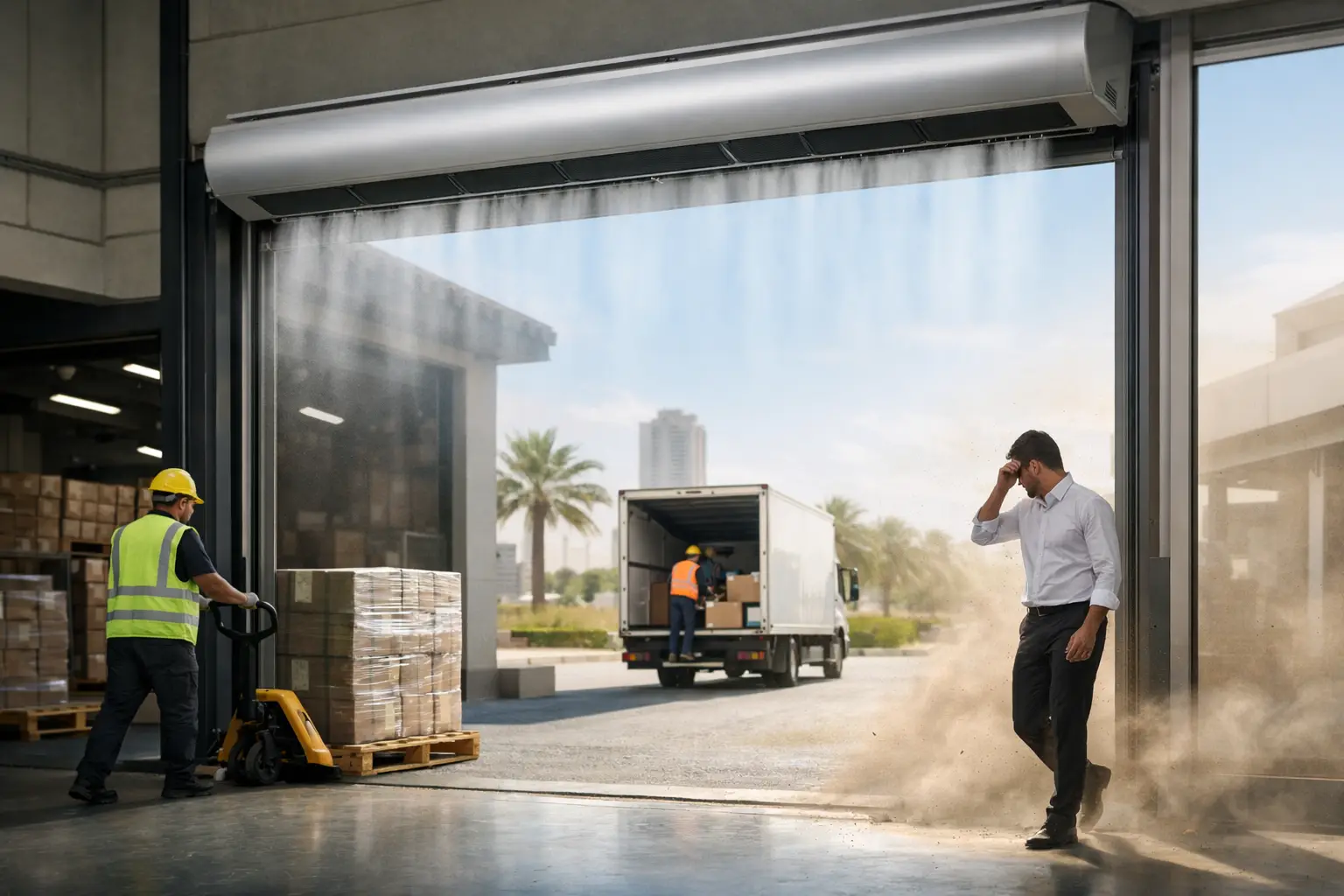
Air curtains are different. They do not shut the opening with glass or metal. They create a high-velocity air barrier across the doorway. That barrier is designed to reduce the transfer of hot air, dust, flying insects, and outdoor humidity into the building while the entrance remains functionally open.
That difference matters in desert and tropical climates. In Dubai, Doha, Muscat, Cairo, or Nairobi, the challenge is rarely just whether an entrance can close. The challenge is how to protect the indoor environment when the entrance opens constantly and outdoor conditions are aggressive for most of the year.
Where automatic doors perform well
Automatic doors are a logical choice where access control, appearance, and physical separation are the main goals. Offices, hospitality entrances, and premium retail sites often prefer them because they present a clean front-of-house experience and help reduce uncontrolled movement between inside and outside.
They also make sense when security or acoustic separation matters. A closed sliding or swinging automatic door provides a visible boundary. In some projects, that is non-negotiable.
But there is a practical limitation. Automatic doors only protect the space when they are closed. In high-traffic settings, they spend a surprising amount of time opening, waiting, and closing again. During those periods, hot air enters freely, conditioned air escapes, and the HVAC system has to recover the load.
In moderate climates, that loss may be manageable. In Gulf, MENA, and African markets with high ambient heat and humidity, the penalty becomes more expensive and more visible. Staff near the entrance feel temperature swings, humidity moves inward, and dust infiltration increases.
Where air curtains outperform automatic doors
An air curtain is built for a different operational reality. It is especially effective where entrances are used constantly and where opening time cannot be reduced without slowing people, carts, or goods movement.
Think about a supermarket entrance in Abu Dhabi, a hospitality service entry in Doha, a warehouse dispatch point in Nairobi, or a food processing facility in Egypt. In these environments, the issue is not whether the door can close eventually. The issue is whether climate separation can continue while traffic keeps moving.
That is the strength of an air curtain. A properly specified unit maintains an active air seal during operation. This helps reduce cooling loss, stabilize indoor temperature, and limit airborne contaminants entering from outside. Facilities evaluating entrance efficiency may also benefit from understanding How Do Air Curtains Save Energy?. In hot-weather markets, that translates directly into lower HVAC strain and better comfort near the opening.
Air curtains also solve problems automatic doors do not address well on their own. Flying insects are a common concern in food handling, retail, and hospitality. Dust is a major issue in desert-exposed sites and industrial zones. Humidity infiltration can affect product quality, employee comfort, and refrigeration performance. A strong air barrier is often more useful than a door cycle that opens and closes too slowly to keep up with activity.
The energy question is usually what decides it
For most facility managers and project consultants, energy performance becomes the deciding factor. Automatic doors can reduce infiltration compared with a permanently open entrance, but only when traffic is moderate and door closing cycles are tight.
In high-traffic conditions, that advantage drops quickly. If a door is reopening every few seconds, the entrance is effectively open for long periods. The building still loses conditioned air, and the HVAC system still works harder to compensate.
A commercial or industrial air curtain is designed specifically to address that pattern. By creating a continuous barrier while the entrance is in use, it helps protect cooled air where traditional doors become operationally porous.
This is especially valuable in tropical and desert climates, where the gap between indoor setpoint and outdoor temperature is large. Every minute of infiltration carries a bigger cooling penalty. The hotter and more humid the climate, the stronger the business case for entrance air control.
Hygiene, dust, and insects change the equation
In many B2B environments, the decision is not only about energy. It is also about hygiene and environmental control.
Automatic doors can limit exposure when closed, but they do little during active opening. If your site deals with food service, cold storage, retail produce, pharmaceutical operations, workshops, or manufacturing areas, that gap matters.Dust enters. Insects follow traffic flow. Humid outside air reaches interior zones that depend on stable conditions. Additional guidance can be found in our articles on Air Curtain for Dust Control, Air Curtain for Insect Control at Entrances, and Air Curtain for Humid Environments.
Air curtains are often specified because they address those exact risks at the moment the opening is in use. For operators in Casablanca, Lagos, or Kuwait City, where dust, heat, and insects can all be operational issues, this is not a cosmetic upgrade. It is part of maintaining cleaner indoor conditions and reducing avoidable disruption.
Traffic volume matters more than aesthetics
A common mistake in entrance planning is choosing the system that looks right on a drawing rather than the one that performs under real traffic conditions.
If your entrance handles occasional foot traffic, automatic doors may be sufficient. If your entrance handles shopping carts, pallet movement, shift changes, delivery cycles, or steady pedestrian flow for long operating hours, an air curtain deserves serious attention.
High-volume entrances expose the weakness of systems that rely on being closed most of the time. In practice, they are often not closed long enough to maintain stable indoor conditions. Air curtains are purpose-built for this kind of use case.
That does not mean automatic doors are obsolete. It means they solve a different problem.
The best answer is sometimes both
In many commercial projects, the real comparison is not air curtains or automatic doors. It is how both can work together.
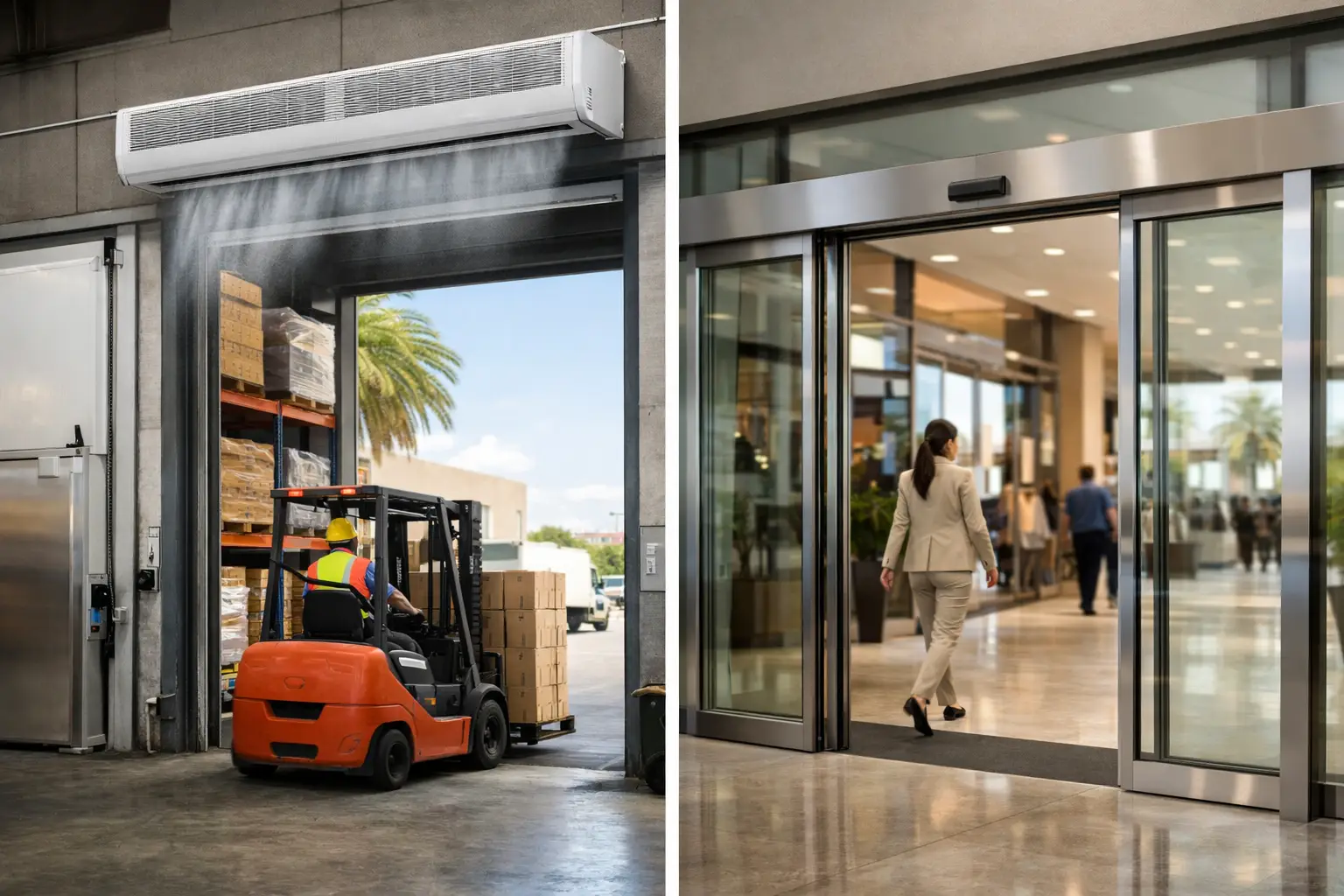
Automatic doors can provide access control, appearance, and physical closure during low traffic periods. An air curtain can protect the opening during active use, reducing the climate loss that occurs every time the doors cycle.
This combined approach is common in facilities that want both presentation and performance. Retail entrances, hotel service points, hospitals, logistics areas, and cold chain operations often benefit from layered protection.The door handles closure. The air curtain handles the environmental gap created by constant operation.
For specifiers, this is often the smartest answer because it reflects how buildings actually operate, especially in regions where outdoor conditions remain harsh for most of the year.
What specifiers should assess before choosing
The right system depends on entrance width, mounting height, traffic frequency, indoor-outdoor pressure difference, and the climate profile of the site. It also depends on whether the opening serves people, products, or both.
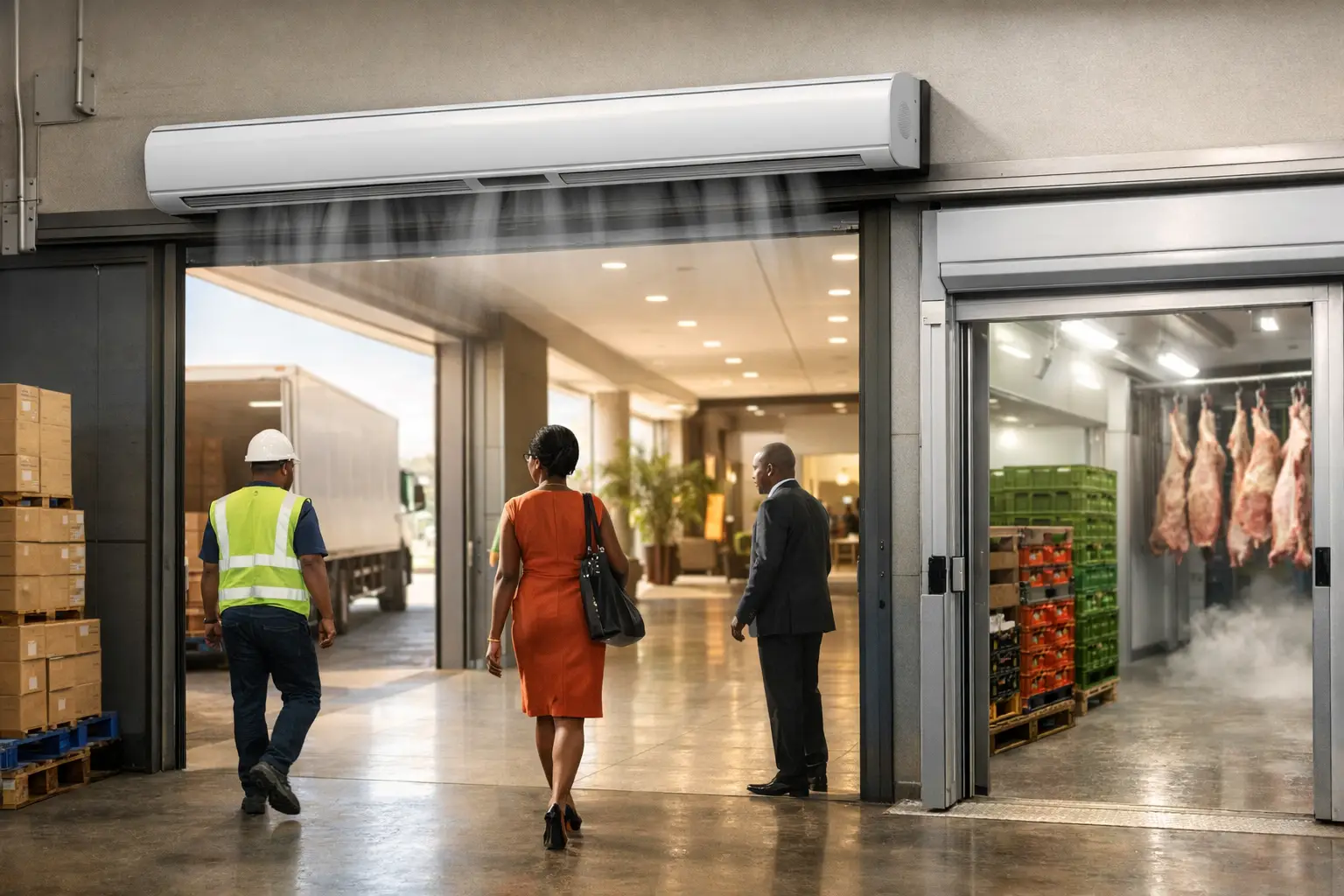
A light commercial entrance may require a quieter unit with a strong appearance standard. A warehouse or industrial opening may need a centrifugal air curtain built for higher mounting heights and heavier-duty use. Cold storage transitions need a different performance logic again, especially where temperature separation affects product integrity and energy spend.
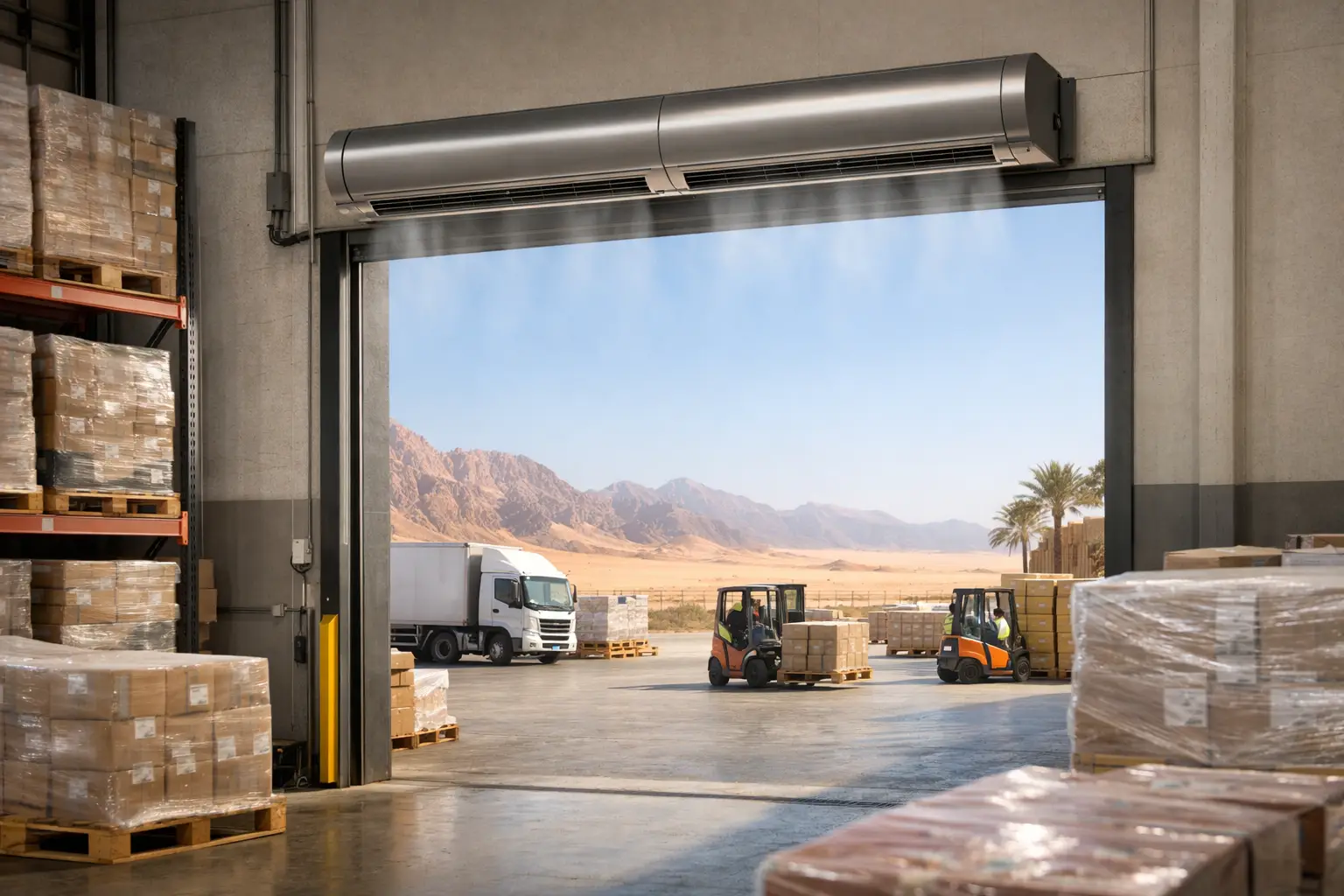
This is why generic comparisons miss the mark. A facility in a mild climate with limited traffic is not the same as a supermarket in Dubai, a plant in Algeria, or a loading bay in Ghana exposed to heat, dust, and continuous movement. Entrance control has to be matched to operating conditions, not copied from a standard specification.
Which is better?
If you need a physical entrance barrier with controlled opening and a polished front-end appearance, automatic doors are a valid choice.
If you need to reduce cooling loss, limit dust and insect infiltration, and maintain climate separation under heavy traffic, an air curtain is often the better operational tool.
If your site needs both controlled access and stronger entrance protection, the best answer may be a properly engineered combination of both systems.
For decision-makers in hot-weather commercial and industrial markets, that distinction has direct cost implications. It affects HVAC load, indoor comfort, hygiene control, and daily usability. The entrance is not a small detail. It is one of the most active pressure points in the building.
If you are evaluating an entrance for a retail site, cold storage facility, plant, hotel, or commercial building in a tropical or desert climate, FreezeeX can help you assess the opening, traffic pattern, and environmental load before you specify. Request a consultation or quote to match the right air curtain solution to your project conditions.