
A front entrance that stays open for hours in Dubai, Riyadh, Lagos, or Nairobi does not just let people in. It lets conditioned air out, pulls hot air and dust inside, and forces HVAC systems to work harder than they should. That is why a commercial air curtain buying guide matters at the specification stage, not after complaints start coming in.
For facility managers, MEP contractors, procurement teams, and consultants, the wrong air curtain usually fails in predictable ways. It is undersized for the door height, too weak for wind pressure, too noisy for the space, or simply not built for tropical and desert climate conditions. The result is poor air separation, rising cooling costs, and an entrance that never feels controlled.
What a commercial air curtain should actually solve
A commercial air curtain is not just an accessory above a doorway. In busy buildings, it is part of the entrance control strategy. Its job is to create a consistent air barrier that reduces heat transfer, limits dust and insect entry, and protects indoor comfort without blocking traffic. Businesses looking to improve entrance efficiency may also benefit from understanding How Do Air Curtains Save Energy?.
That sounds straightforward, but performance depends on application. A hotel entrance, a hypermarket loading point, a cold storage threshold, and a light industrial workshop all face different pressures. Traffic volume, door width, mounting height, ambient temperature, humidity, and crosswinds all affect what will work.
In hotter regions, this matters even more. External temperatures are higher, doors stay open longer, and cooling loss is more expensive. In coastal cities with humidity, moisture infiltration can become part of the problem. In dusty or sandy environments, filtration and motor durability move much higher on the buying checklist.
Start with the opening, not the product
The first decision is not brand or model. It is the opening itself. Buyers should begin with door width, door height, and how often the entrance remains open. A unit that performs well on a standard commercial door may be completely unsuitable for a taller lobby entrance or an industrial access point.
Mounting height is usually where specification errors begin. As door height increases, the air stream must remain strong and stable long enough to reach the floor level effectively. If the throw is too weak, the barrier breaks before it reaches the lower section of the doorway. On paper, the unit may look adequate. In operation, it will not stop heat, dust, or insects consistently.
Door width also changes the equipment choice. Some applications can use a single unit, while wider openings may need multiple units installed in sequence. In those cases, uniform coverage matters. Gaps between units reduce barrier performance and create weak points exactly where infiltration happens.
Commercial air curtain buying guide: Match airflow to the application
Airflow type and strength should match the site, not just the entrance size. This is where buyers need to separate basic commercial needs from more demanding operational environments.
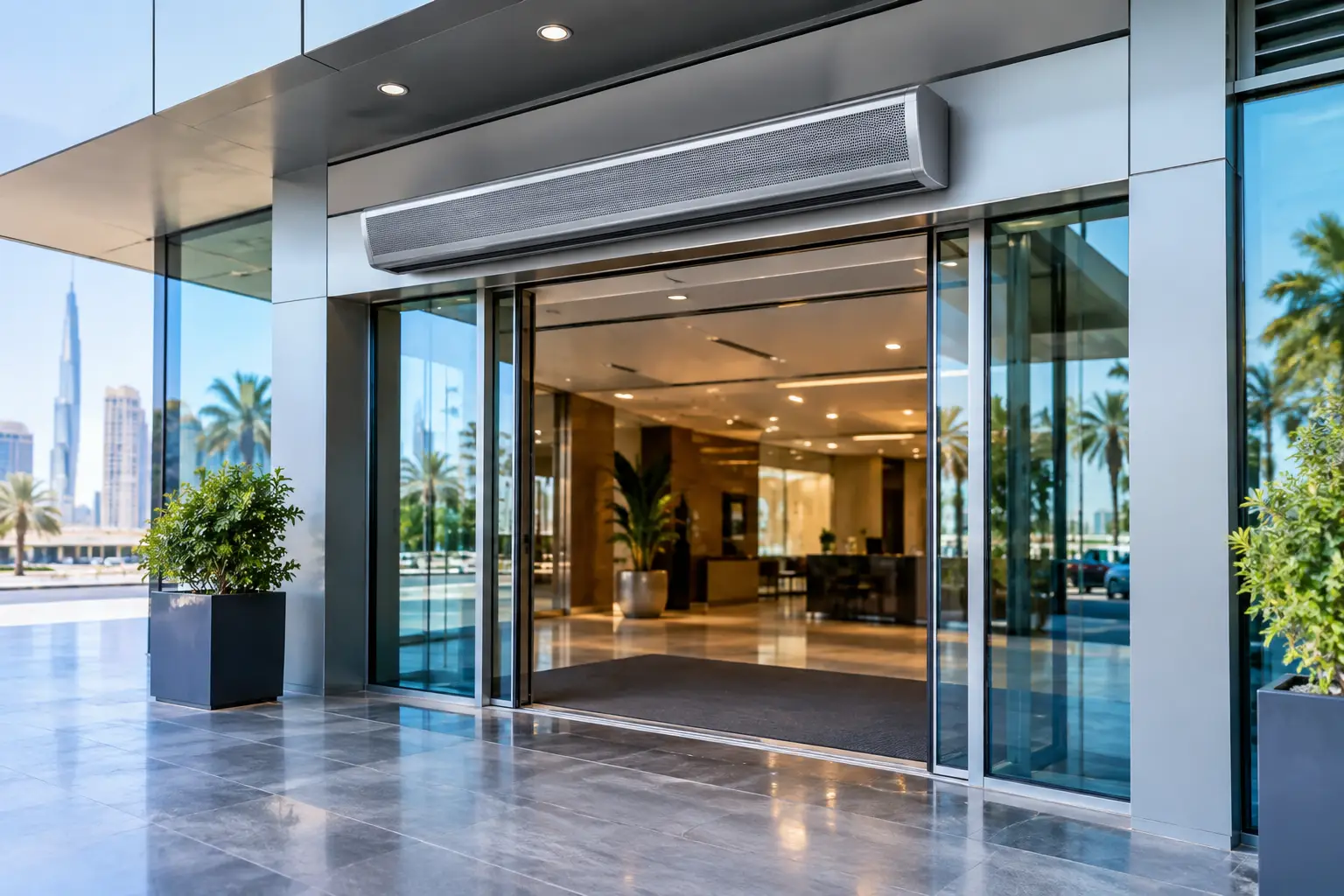
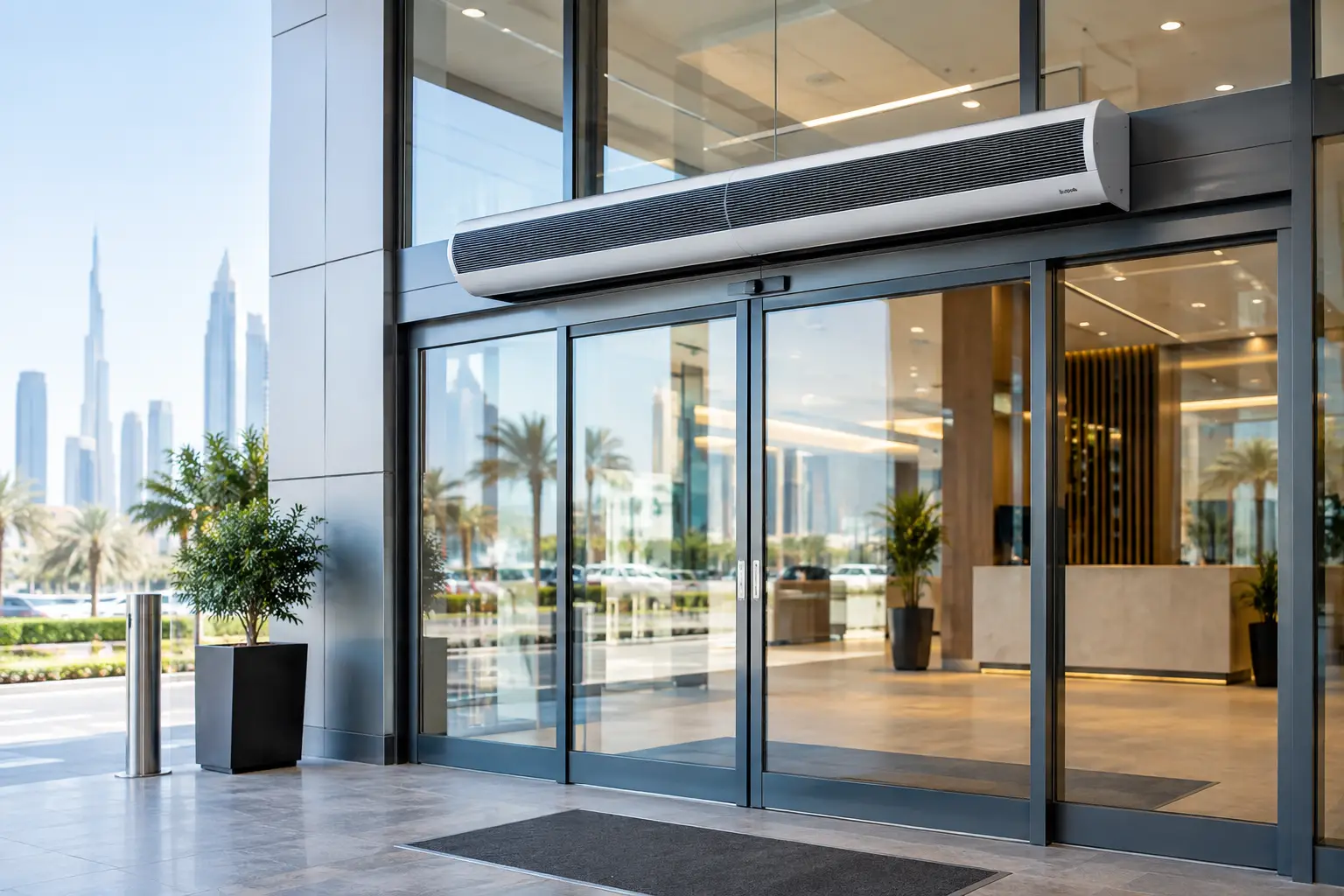
For offices, retail fronts, hospitality entrances, and similar commercial buildings, a well-selected commercial centrifugal flow unit may provide the right balance of air isolation, sound control, and appearance. Recessed ceiling models are often preferred where aesthetics matter and visible hardware needs to be minimized.
For heavier-duty sites, stronger airflow and more durable construction become more important. Industrial entrances, warehouses, workshops, and facilities exposed to hotter air, dust, or pressure differences often require a more aggressive air barrier. In those settings, the buying decision should focus less on appearance and more on throw performance, motor reliability, and operational endurance.
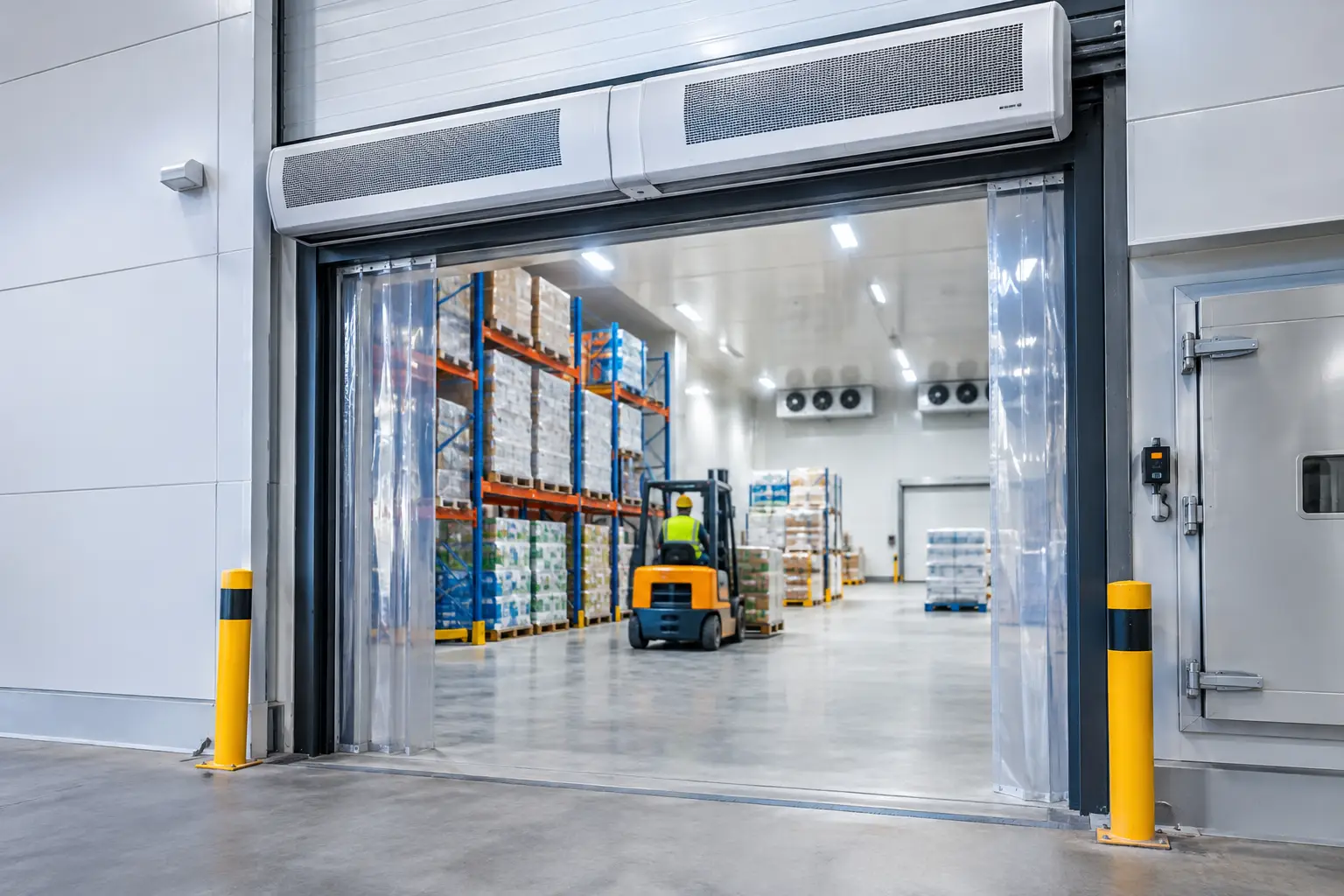
Cold storage is its own category. The objective is not only comfort at the doorway. It is temperature retention, moisture control, and reducing the burden on cooling systems in a high-traffic thermal boundary. A unit chosen for a retail entrance may not be suitable for this kind of application, even if the dimensions appear similar. Additional considerations are discussed in our guide to Air Curtain for Cold Storage. It is temperature retention, moisture control, and reducing the burden on cooling systems in a high-traffic thermal boundary. A unit chosen for a retail entrance may not be suitable for this kind of application, even if the dimensions appear similar.
Motor, blower, and build quality are not minor details
When buyers compare units, they often focus on visible features and overlook the internal components that determine long-term performance. That is a mistake, especially in hot-weather markets.
The motor and blower configuration directly affect airflow consistency, energy use, and service life. In high-temperature and high-use conditions, weak internal components become expensive quickly. Reduced air velocity, rising noise, and repeated maintenance calls usually trace back to poor component selection or mismatch with the site conditions.
Centrifugal designs are often preferred in commercial and industrial applications because they can support controlled, focused airflow across wider or taller openings. Build quality also matters. Cabinet construction, corrosion resistance, and component protection all influence how well the unit holds up in humid, dusty, or harsh operating environments.
Filter nets, access panels, and serviceability should also be reviewed early. A product that performs well in a brochure but is difficult to maintain in a live facility creates avoidable operational friction. Contractors and facility teams generally benefit from units that are straightforward to access, clean, and inspect.
Noise matters, but context matters more
Noise level should always be considered, but it should be judged against the environment. In a luxury hospitality entrance or premium office reception, lower operating noise may be a priority. In a workshop, plant entrance, or loading area, sound tolerance is usually different.
The trade-off is simple. Higher airflow performance can come with higher sound output, especially where the opening is large or the external conditions are aggressive. That does not mean buyers should accept excessive noise. It means the right specification balances acoustic expectations with the actual barrier strength required.
In practice, many performance issues come from over-prioritizing quiet operation in spaces that need stronger air separation. A quieter unit that does not control infiltration is rarely the better investment.
Climate conditions should shape the buying decision
A building entrance in Abu Dhabi or Doha may deal with intense solar gain and sustained cooling loss. A site in Lagos or Nairobi may face humidity, heavy traffic, and contamination concerns. In Cairo or Casablanca, dust and urban pollution can become part of the entrance-control challenge. Facilities operating in these environments often evaluate solutions such as Air Curtain for Dust Control and Air Curtain for Humid Environments when planning entrance protection strategies.This is where many generic specifications fall short. An air curtain selected for mild operating conditions is not automatically suitable for facilities in the GCC, North Africa, or major African commercial centers with extreme heat and airborne dust.
A building entrance in Abu Dhabi or Doha may deal with intense solar gain and sustained cooling loss. A site in Lagos or Nairobi may face humidity, heavy traffic, and contamination concerns. In Cairo or Casablanca, dust and urban pollution can become part of the entrance-control challenge. The equipment should be selected for these realities, not just for nominal door dimensions.
That is why climate-adapted performance matters. Buyers should ask whether the unit is engineered for demanding hot-weather duty, whether the motor and housing can tolerate harsh conditions, and whether the airflow remains effective under real entrance pressure, not just test conditions.
Control strategy affects operating value
An air curtain should not be treated as an isolated device. Its operating value improves when it works in step with the entrance and HVAC strategy.
Some facilities need simple on-off control linked to door activity. Others benefit from speed adjustment, seasonal operating modes, or coordination with cooling demands. High-traffic buildings may need a setup that supports continuous operation during peak hours. In facilities with variable occupancy or mixed-use entrances, more flexible control can reduce unnecessary energy use while maintaining barrier performance.
This part of the buying decision often gets less attention than airflow figures, but it affects day-to-day cost and consistency. A well-controlled unit is easier to live with, easier to manage, and more likely to deliver measurable operating benefit over time.
Specification questions buyers should settle before requesting a quote
Before moving to product selection, decision-makers should be clear on six practical points: opening size, mounting method, traffic frequency, environmental conditions, acoustic expectations, and the main operational goal. That goal may be cooling retention, dust reduction, insect control, humidity management, or a mix of all four. Buyers concerned about pest management may also find value in our guide to Air Curtain for Insect Control at Entrances.
It also helps to define whether the project is a new build, a retrofit, or part of an upgrade to an underperforming entrance. Retrofit conditions can change the recommendation because ceiling depth, power availability, and structural mounting limitations may narrow the best-fit options.
This is one reason consultation-based supply is valuable in commercial projects. A quote based only on door width can miss the real operating requirement. A quote based on application, climate, and usage pattern is far more likely to deliver performance that holds up after handover.
A better buying decision comes from application fit
The strongest commercial air curtain buying guide is not the one with the longest feature list. It is the one that helps buyers match the equipment to the opening, the climate, and the operational pressure at the site.
For visible commercial entrances, recessed or architecturally cleaner models may make sense. For mainstream commercial buildings, centrifugal systems often offer a practical performance balance. For harsher environments, industrial-grade series are usually the safer choice. And for projects where temperature control and entrance protection are business-critical, the specification needs to be built around performance first.
If you are planning a project or replacing an underperforming unit, the right next step is not a retail purchase. It is a technical review of the opening, usage profile, and climate conditions. FreezeeX Air Curtains Ltd. can support contractors, consultants, and facility teams with specification guidance and quote-based recommendations for demanding tropical and desert-climate applications.



3 Responses
That’s why application-based specification is so important. Different entrances place different demands on an air curtain, and matching the unit to the opening, operating environment, and climate conditions helps ensure reliable performance, better energy efficiency, and long-term operational value.