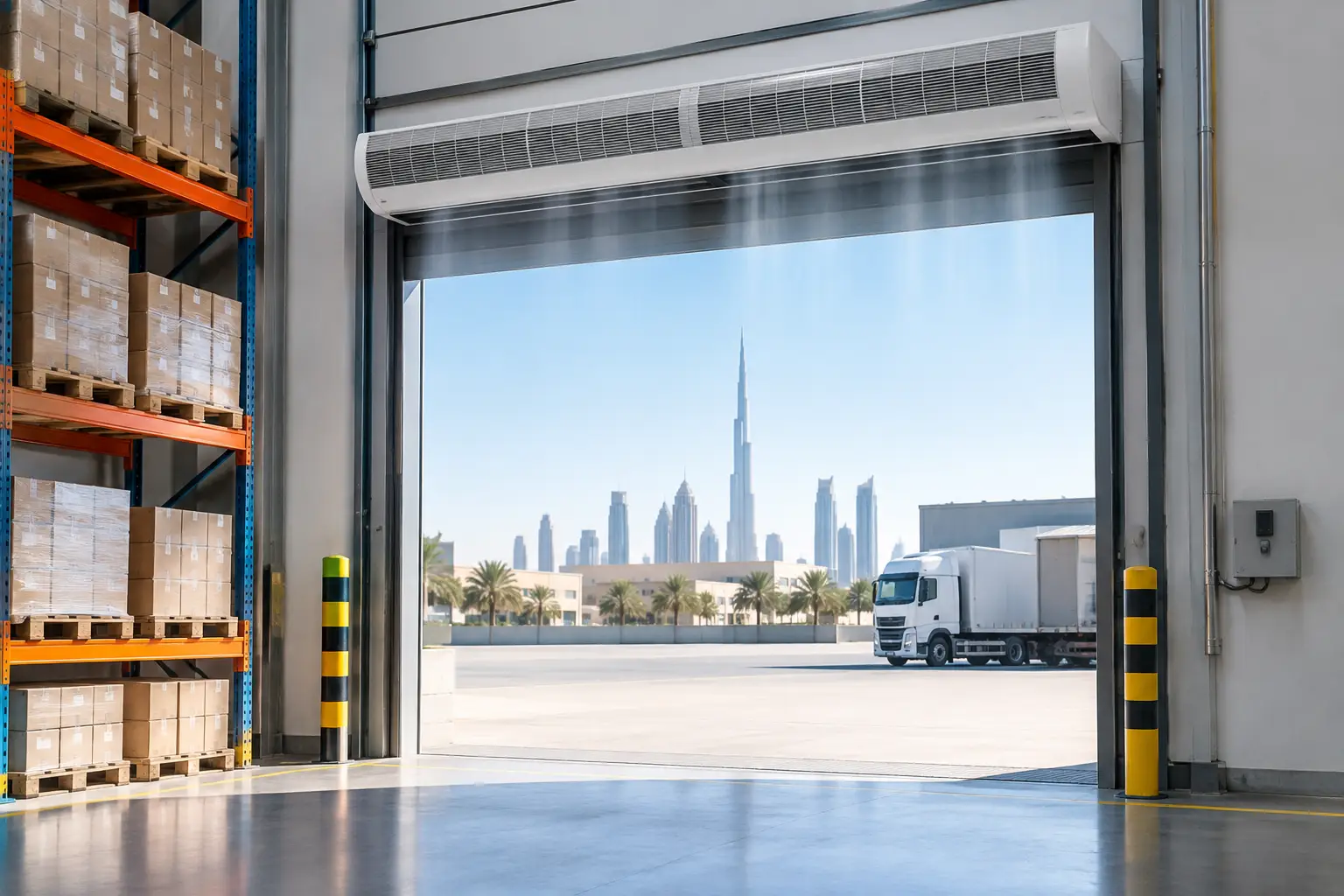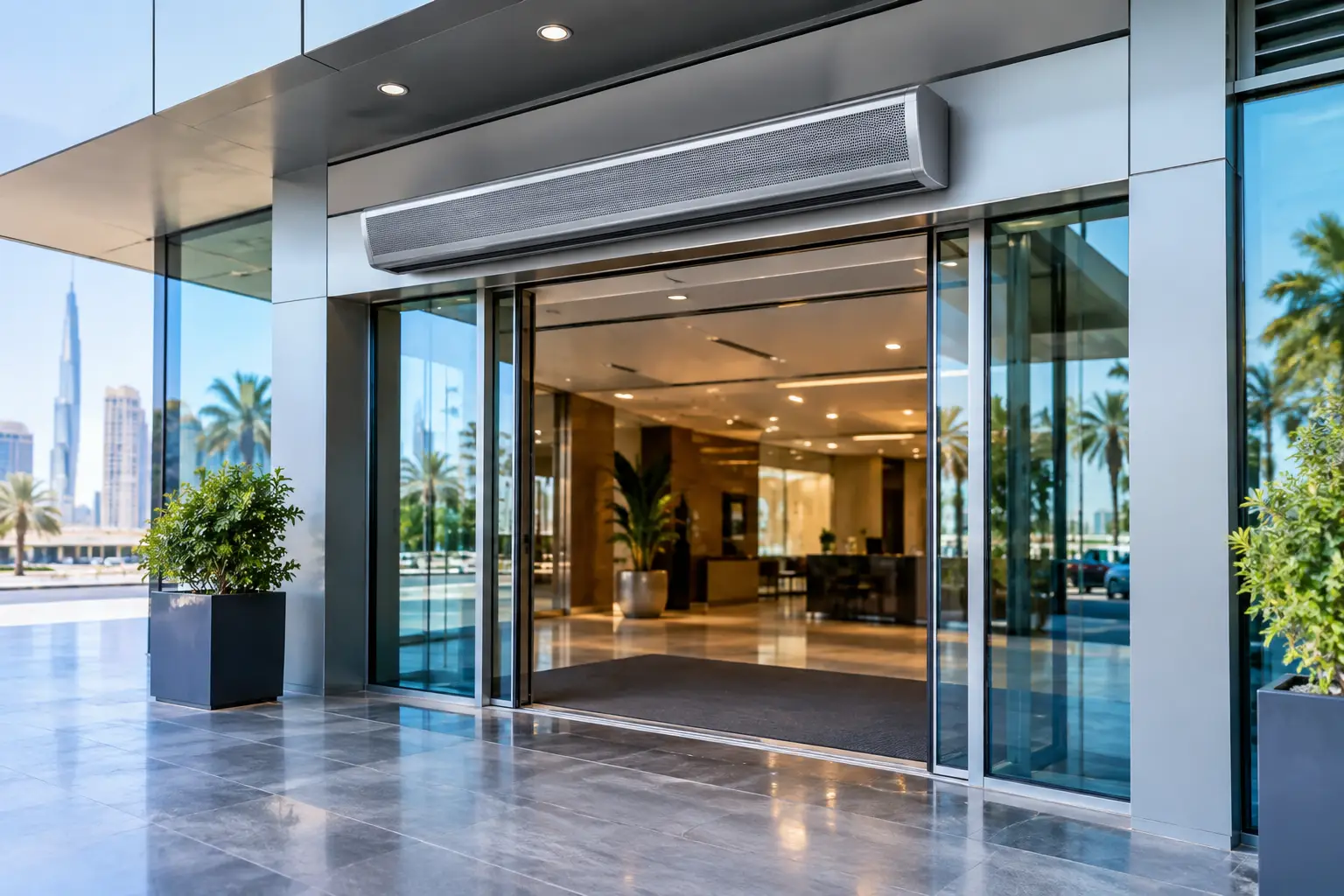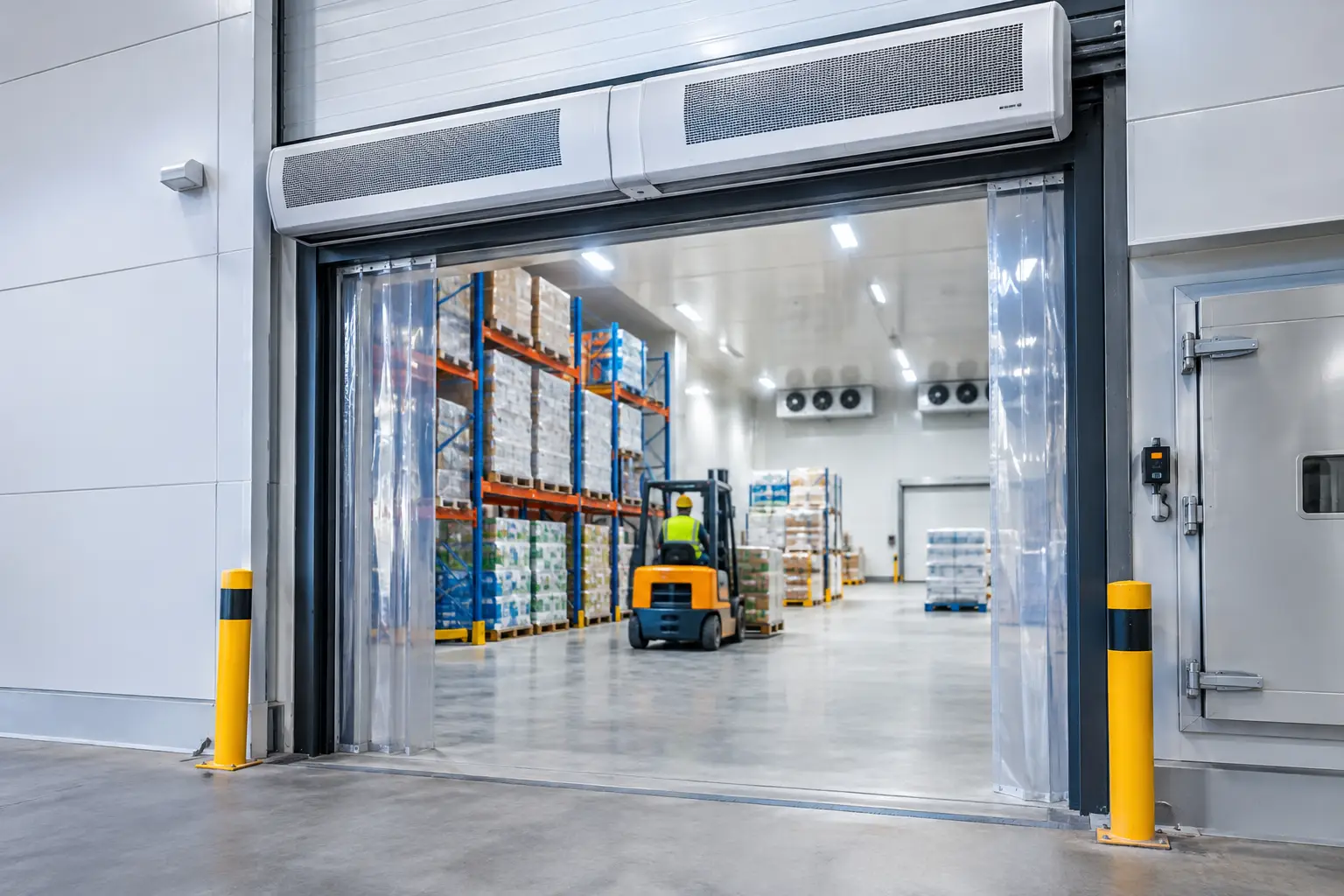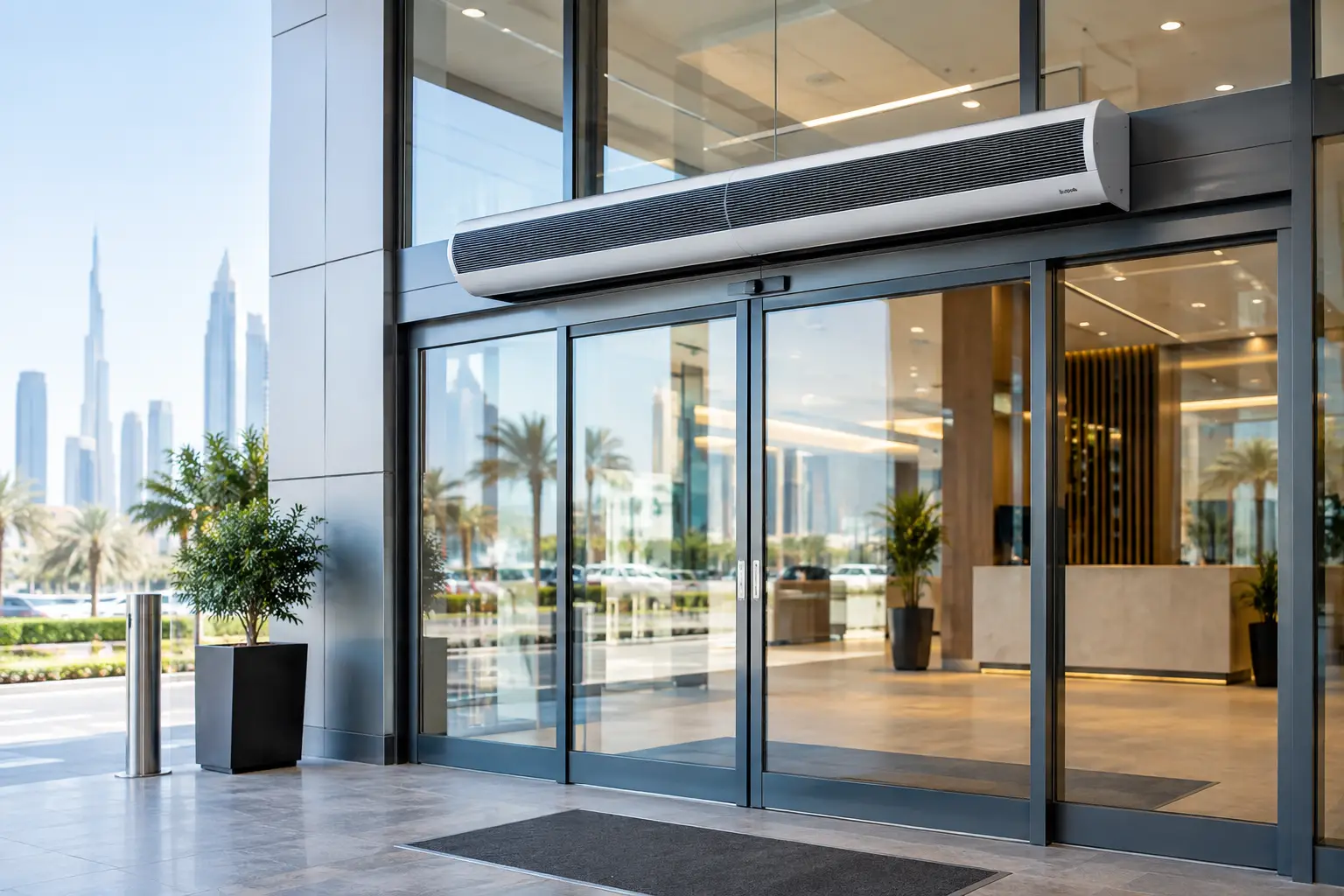
A practical logistics airflow example begins at a busy loading dock: an air-conditioned distribution center in Dubai receives trucks throughout the day, with each dock door open for long loading cycles. Hot outdoor air, dust, humidity, and vehicle fumes move toward the cooler interior every time a door opens. The result is not only discomfort near the dock. It is higher HVAC demand, unstable temperatures in staging areas, and more airborne contamination entering the facility.
An industrial air curtain can create a high-velocity barrier across the opening without obstructing the movement of people, pallets, forklifts, or goods. The objective is not to make an open doorway airtight. It is to reduce the exchange of conditioned indoor air and harsh outdoor air enough to protect operations, improve temperature stability, and reduce avoidable cooling load.
The Logistics Airflow Example: A High-Traffic Dock
Consider a 4-meter-wide, 4.5-meter-high loading-bay opening at a regional warehouse. The facility holds finished goods at a controlled indoor temperature, while outdoor conditions are 42°C, dusty, and dry. The dock door is opened repeatedly during the afternoon, when solar gain and ambient heat are at their highest.
Without air isolation, hot air naturally enters at the upper part of the opening while cooler, denser indoor air spills outward at floor level. Truck movement, forklift traffic, pressure changes from adjacent doors, and wind can intensify this exchange. Even where loading is efficient, the door may remain open long enough for the HVAC system to react to a substantial and repeated heat gain.
The facility installs an industrial centrifugal air curtain above the door. Its discharge nozzle is set to direct the air stream toward the threshold, creating a continuous downward sheet of air. Correctly selected airflow velocity helps the stream reach the floor instead of breaking apart midway down the opening.
This arrangement changes the behavior at the entrance. Outdoor heat and dust now meet a moving air barrier, while the loss of cooled air is reduced. The warehouse does not become fully isolated – no open-door solution can guarantee that under every pressure and wind condition – but the operational impact of each loading cycle is materially lower.
What Makes the Airflow Barrier Work
Air curtains work through momentum, coverage, and correct discharge direction. A unit may produce a large volume of air, but volume alone does not prove that it can protect a tall loading door. The air stream needs adequate throw and sufficient velocity at the floor line to resist crosswinds and pressure differences.
Key design inputs for a loading-dock air curtain:
- Door width and mounting height
- Door-open duration and traffic frequency
- Required airflow reach and discharge velocity
- Outdoor temperature, humidity, and wind exposure
- Building pressure differences
- Truck movement and dock activity
- Required coverage across the full opening
For a logistics opening, the most important design inputs are door width, mounting height, door-open duration, traffic pattern, indoor temperature target, and external conditions. A warehouse in Riyadh or Doha may face extreme dry heat and dust. A logistics center in Muscat, Lagos, or Nairobi may need to account for high humidity as well as heat. Those conditions affect the required performance level.
Mounting height and air throw
The taller the opening, the more difficult it is for the air stream to remain coherent from the mounting point to the floor. A light-duty commercial model may suit a customer entrance or a low back-of-house doorway, but it may not provide the floor-reaching throw required for a 4- to 6-meter logistics dock.
Industrial centrifugal systems are typically better suited to these applications because they are designed for stronger, more directional discharge. Where a project has tall doors, intense traffic, or exposed external loading areas, product selection should focus on demonstrated throw performance rather than nominal motor power alone.
Width coverage and overlapping units
The full opening must be covered. On wide doors, this can require multiple units installed side by side. Gaps between units create weak points where warm air, dust, or insects can pass through more easily.
The layout should also account for side clearance, structural beams, dock levelers, roller shutters, and any obstructions above the opening. In some facilities, recessed mounting is possible at finished goods dispatch doors. In others, a surface-mounted industrial arrangement is more practical and easier to coordinate with the building structure.
Pressure, wind, and truck movement
External wind is one of the main reasons a nominally suitable air curtain can underperform. A loading dock exposed to prevailing winds experiences a lateral force that can deflect the downward air stream. Truck arrivals and departures can also create short but significant pressure disturbances.
This is why a real logistics airflow example must include site exposure. A sheltered internal transfer door has very different requirements from an external cross-dock entrance. If the building has several dock doors open at the same time, the combined pressure effect matters too. The air curtain should be specified as part of the entrance condition, not as an isolated appliance selection.
How the Example Changes by Facility Type
The same airflow principle applies across logistics operations, but the performance target changes with the goods being handled.
For a general warehouse, the priority is usually reducing heat gain, dust ingress, and the burden on air conditioning. At a busy dispatch bay, this can help maintain more stable working conditions around packing, scanning, and staging zones.
For food distribution or pharmaceutical logistics, contamination control becomes more prominent. An air curtain can help limit the entry of dust, flying insects, humid air, and airborne particulates when doors are open. It should complement established hygiene, door management, and temperature-control procedures rather than replace them.
For a cold storage loading interface, the challenge is more demanding. The temperature differential between the conditioned zone and the dock area can create strong air movement through the opening. A correctly designed air curtain helps reduce infiltration, but door cycle times, docking seals, staging temperatures, and product handling procedures remain critical. The solution depends on the opening dimensions and the actual temperature differential, not simply the fact that the facility is cold storage.
Measuring Whether the Design Is Appropriate
A useful logistics airflow example includes measurable outcomes. Facility teams should assess more than whether employees can feel air blowing at the doorway. The better questions are whether the air stream reaches the threshold, whether indoor temperature near the dock remains more stable, and whether dust accumulation decreases in adjacent work zones.
Operational observations can also reveal whether the selected unit matches the application. If the air stream is visibly pushed aside during normal truck movement, if the floor line has weak coverage, or if dock personnel report persistent hot-air entry, the specification may need review. Increasing fan speed is not always the answer. The issue may be mounting height, nozzle angle, door exposure, unit placement, or insufficient coverage width.
Energy results should be interpreted carefully. Cooling savings depend on the number of door openings, local climate, air-conditioning capacity, building pressure, and operating schedules. A warehouse with doors open for only a few minutes per hour will behave differently from a cross-dock facility with continuous traffic. The purpose of the air curtain is to reduce a recurring load, especially during the hottest and most demanding operating periods.
Specification Questions to Resolve Before Quotation
For contractors, MEP consultants, and facility managers, a reliable selection begins with complete site information. A consultation should establish the clear opening width and height, whether the door faces outdoors, the mounting position available, and the door’s daily operating profile. Photos or drawings are valuable because they show beams, shutters, dock equipment, and potential airflow obstructions.
It is also useful to identify the indoor setpoint, exterior climate exposure, product sensitivity, and whether the facility is trying to control dust, humidity, insects, fumes, or cooling loss. These factors determine whether a commercial unit is sufficient or whether an industrial centrifugal series is necessary.
Noise expectations matter as well. A high-traffic dock can normally tolerate more operating sound than a hospital receiving bay or pharmaceutical dispatch area, but unit performance should still be balanced with the work environment. The selected system must deliver the required air barrier without creating an impractical operating condition for staff.
A Better Approach to Entrance Climate Control
The central lesson from this logistics airflow example is that an air curtain should be engineered around the doorway and its operating reality. A unit that works well over a moderate retail entrance may not protect a tall, wind-exposed warehouse dock. Conversely, overspecifying a low-traffic internal opening can add unnecessary cost and noise.
For logistics facilities operating in hot, humid, dusty, and desert climates, entrance air isolation deserves the same planning attention as other operational controls. FreezeeX can assess door dimensions, traffic volume, mounting constraints, and climate exposure to recommend an appropriate commercial or industrial air curtain configuration. Request a project consultation and quotation before finalizing the loading-dock specification.