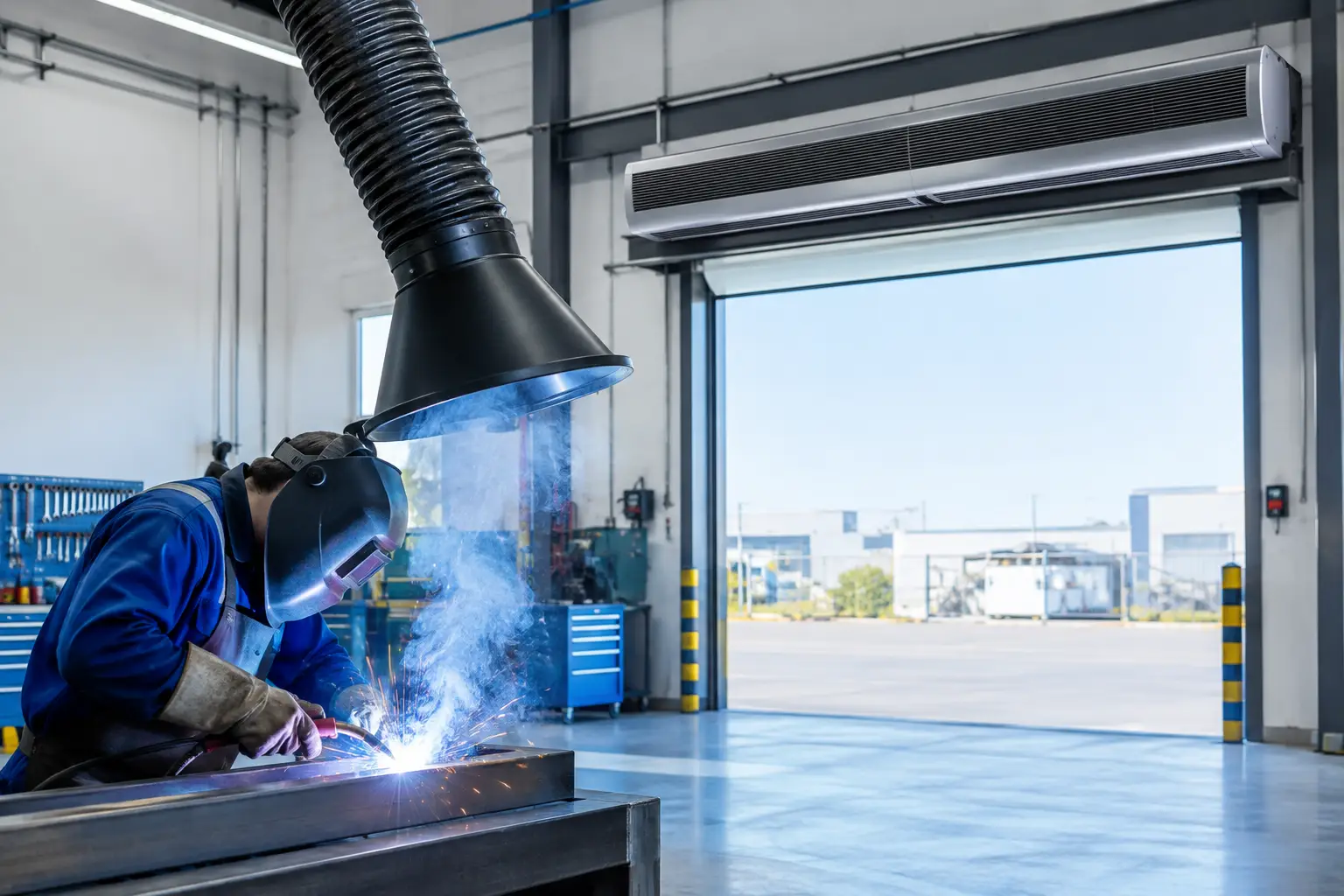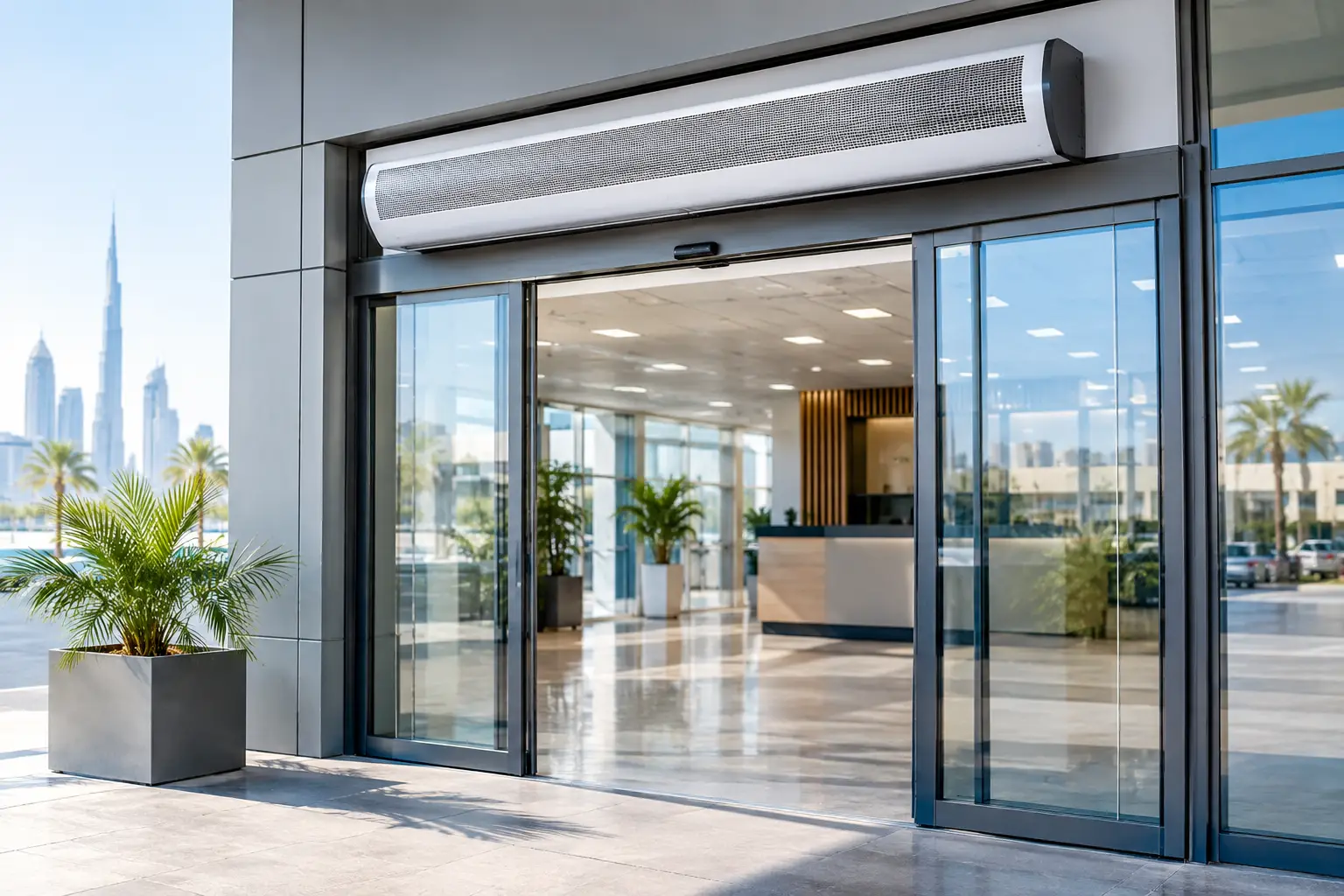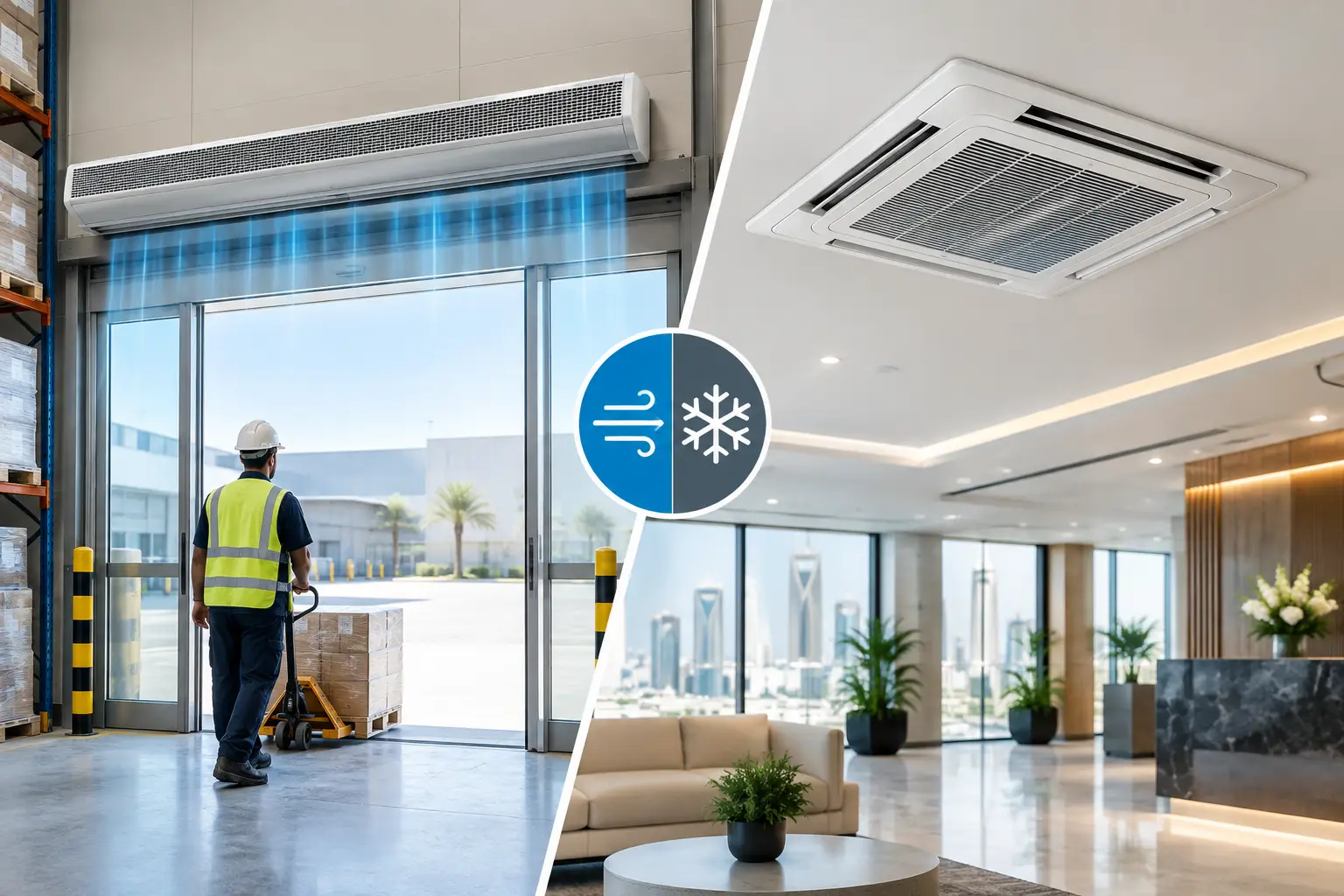
A loading dock door can stay open for hours during receiving and dispatch. In Dubai, Riyadh, Doha, or Lagos, that opening becomes a direct path for hot air, dust, humidity, insects, and vehicle fumes to enter the facility. Loading dock curtains can reduce that exposure, but they are not the right answer for every traffic pattern. The correct choice depends on how people, forklifts, and goods move through the opening – and whether the facility needs a physical barrier, an uninterrupted airflow barrier, or both.
For warehouse managers, MEP consultants, and logistics operators, the key question is not simply whether a curtain will fit the doorway. It is whether it will protect the conditioned space without slowing dock operations or creating a maintenance burden.
What Are Loading Dock Curtains?
Loading dock curtains are typically flexible PVC strip barriers or heavy-duty industrial curtain panels installed across a loading-bay opening. They create a physical separation between the dock and the warehouse while still allowing staff, pallet trucks, and forklifts to pass through.
They are commonly specified for internal openings, chilled work areas, warehouse partitions, and lower-traffic loading points. Their main advantage is simple: when the doorway is not actively in use, the material occupies the opening and limits direct air exchange. When traffic passes through, the strips or panels move aside and then return.
That physical barrier can also help reduce dust movement and discourage insects. However, it does not create a controlled, high-velocity air stream. During frequent forklift movements or sustained open-door periods, large gaps are repeatedly created. In hot, humid, or dusty climates, the resulting infiltration can be substantial.
Where Loading Dock Curtains Work Well
Physical dock curtains have a clear place in industrial facilities. They are most effective where traffic is predictable, relatively low speed, and not constant throughout the shift.
A PVC strip curtain may be suitable at an internal transfer opening between a warehouse and a packing area. It can also be practical at a cold-room access point with intermittent pedestrian or trolley traffic, provided the curtain material and overlap are selected for the temperature range and hygiene requirements.
At an exterior loading dock, they may be useful as a secondary barrier behind a sectional door, dock shelter, or rolling shutter. In this arrangement, the curtain reduces exposure when the main door is opened briefly and the bay is inactive between vehicle movements.
Their value tends to decline when an opening is continuously active. Forklift routes, high-volume distribution centers, and food-processing dispatch areas often experience repeated passages every few minutes. Each movement parts the curtain, and the opening may remain disrupted for longer than expected. That is why a physical curtain alone can struggle to protect a conditioned space during peak operations.
The Limitation: A Curtain Cannot Maintain Air Isolation
The operational weakness of loading dock curtains is friction. Workers and forklift drivers must push through them. The material can obstruct sightlines, contact loads, and wear over time in busy applications. It may be acceptable at a secondary opening, but it can become a bottleneck at a primary goods entrance.
More importantly, the barrier is only effective when it is hanging in place. Once it is displaced, outside heat and airborne contaminants can move through the open space. This matters most in facilities operating under strong cooling loads, such as cold storage, food distribution, pharmaceutical handling, and supermarkets with rear receiving bays.
In desert and tropical markets, the temperature and humidity difference between indoors and outdoors can be severe. Air infiltration does not only affect comfort near the door. It increases the cooling demand on the wider HVAC system, contributes to condensation risk in sensitive areas, and can carry fine dust deeper into the operation.
When an Industrial Air Curtain Is the Better Choice
An industrial air curtain creates a directed stream of air across the doorway. Properly selected and mounted, that stream forms an air barrier while the opening remains physically clear for traffic. Forklifts, staff, carts, and pallets can move through without pushing aside strips or panels.
For active exterior docks, this is usually the more practical approach. The objective is not to seal the dock as a closed door would. It is to reduce the transfer of hot outdoor air, dust, humidity, insects, and airborne contaminants while loading activity continues.
A high-performance industrial unit is particularly relevant where door heights are substantial, traffic is frequent, or the dock faces prevailing wind and dust exposure. Centrifugal air curtain designs are often specified for these conditions because they can produce the airflow pressure needed to project an effective air stream over larger openings.
The selection must be based on the real installation conditions. A small unit above a wide or tall loading door may run continuously without delivering meaningful separation at floor level. Door width, mounting height, wind exposure, indoor and outdoor temperature difference, and the required operating hours all affect the specification.
Typical applications for air curtains at docks
Industrial air curtains are commonly considered for high-traffic warehouse doors, logistics hubs, manufacturing dispatch bays, food-processing receiving areas, and cold-chain transfer points. They can also support cleaner operations where dust, insects, and fumes are concerns.
For a dock that is exposed to intense heat and frequent vehicle movements, the air curtain should be treated as part of the building’s entrance climate-control strategy, not as a standalone accessory. Door discipline, dock seals, loading schedules, and HVAC capacity still matter. The air curtain reduces infiltration; it does not compensate for an incorrectly sized cooling system or a door left open unnecessarily.
Air Curtain vs. PVC Dock Curtain: The Practical Decision
There is no universal winner. A physical curtain and an air curtain solve different aspects of the same problem.
A PVC dock curtain is often appropriate when a physical partition is required, traffic is moderate, and the opening can tolerate contact with flexible material. It may be the lower-complexity option for internal segregation or for bays that remain closed much of the day.
An air curtain is usually more appropriate when clear, continuous access is operationally important. It is especially useful where a loading door opens directly to hot, humid, dusty, or insect-prone outdoor conditions. The clear opening improves material flow while the air stream helps limit unwanted infiltration.
Some facilities benefit from both. A physical curtain can provide separation during inactive periods or within a controlled internal zone, while an air curtain protects the high-traffic exterior entrance during active loading. Whether this combined approach is justified depends on the temperature control target, hygiene risk, traffic volume, and available mounting space.
Specification Factors That Change Performance
Selecting an air curtain for a dock is an engineering decision. The most useful starting point is a site assessment that records the clear opening dimensions, mounting location, door type, operating pattern, and environmental conditions.
Mounting height is critical. As the installation height increases, the air stream must retain enough velocity to reach the floor zone and resist crosswinds. A unit designed for a retail doorway is not automatically suitable for a warehouse shutter or loading-bay opening.
Airflow direction also requires attention. The discharge should be set to counter the prevailing infiltration path without blowing dust into sensitive processes or creating discomfort for staff at workstations. At loading docks, vehicle movement and nearby doors can create turbulent air conditions that change the effectiveness of the barrier.
Noise matters as well, particularly where office, packing, or quality-control activities sit close to the dock. The correct specification balances air performance, motor configuration, service access, and acceptable sound levels rather than focusing on airflow volume alone.
For food, pharmaceutical, and cold-chain facilities, hygiene requirements add another layer. Equipment should be selected with suitable materials, accessible intake protection, and a maintenance plan that keeps the air path clean. If insects are a concern, the system should support the overall pest-control strategy rather than be expected to replace door management and sanitation controls.
Plan for Dock Operations, Not Just Door Dimensions
A loading bay may look like a simple rectangular opening on a drawing, but its real conditions are operational. Ask how long doors remain open, how many vehicle cycles occur per shift, whether forklifts pass continuously, and whether the dock connects directly to conditioned storage.
Also consider the hottest and dustiest operating periods, not only average weather. In GCC, MENA, and African industrial environments, climate extremes are often what determine energy loss and comfort complaints. A solution that appears adequate during a quiet morning can underperform during afternoon heat, high humidity, or a busy dispatch window.
A properly specified industrial air curtain can reduce the burden placed on cooling equipment while keeping the passage clear for logistics activity. Physical curtains still have value, but they should be selected for applications where their limitations align with the operational reality.
For a loading dock project, provide the door size, mounting height, traffic type, indoor setpoint, and site climate conditions to FreezeeX for a consultation and quotation. This allows the recommended system to be matched to demanding tropical and desert-climate performance rather than selected by doorway width alone.