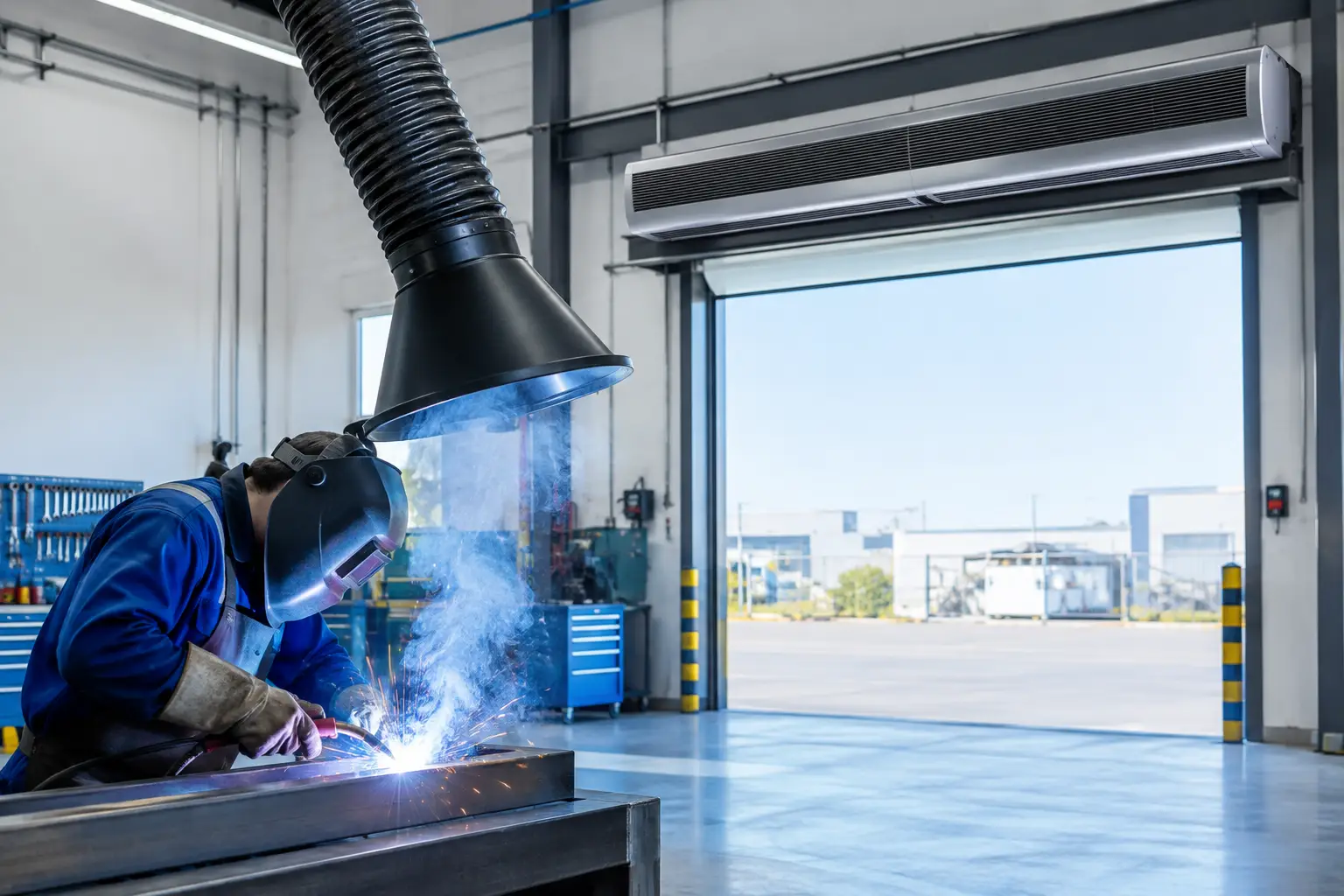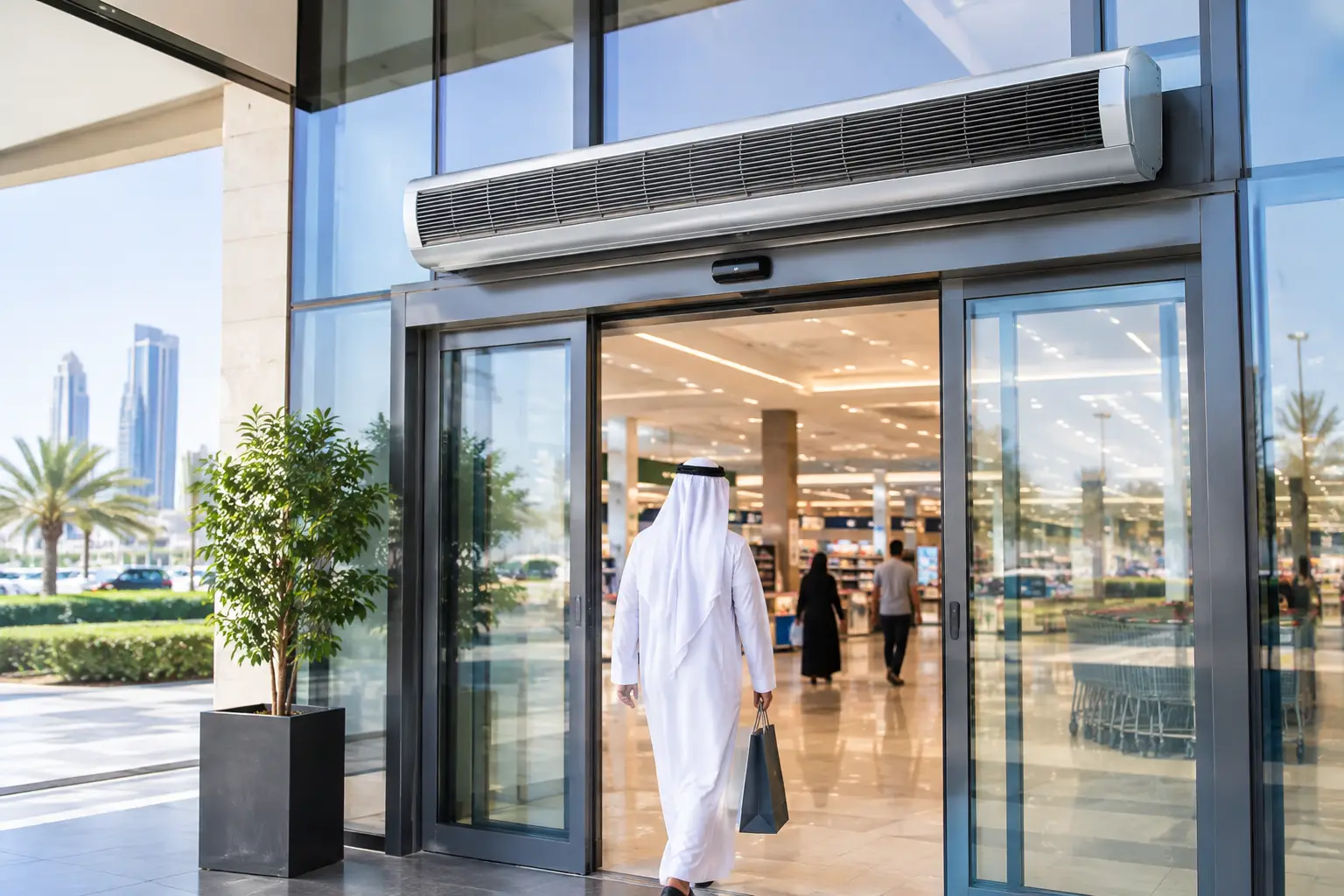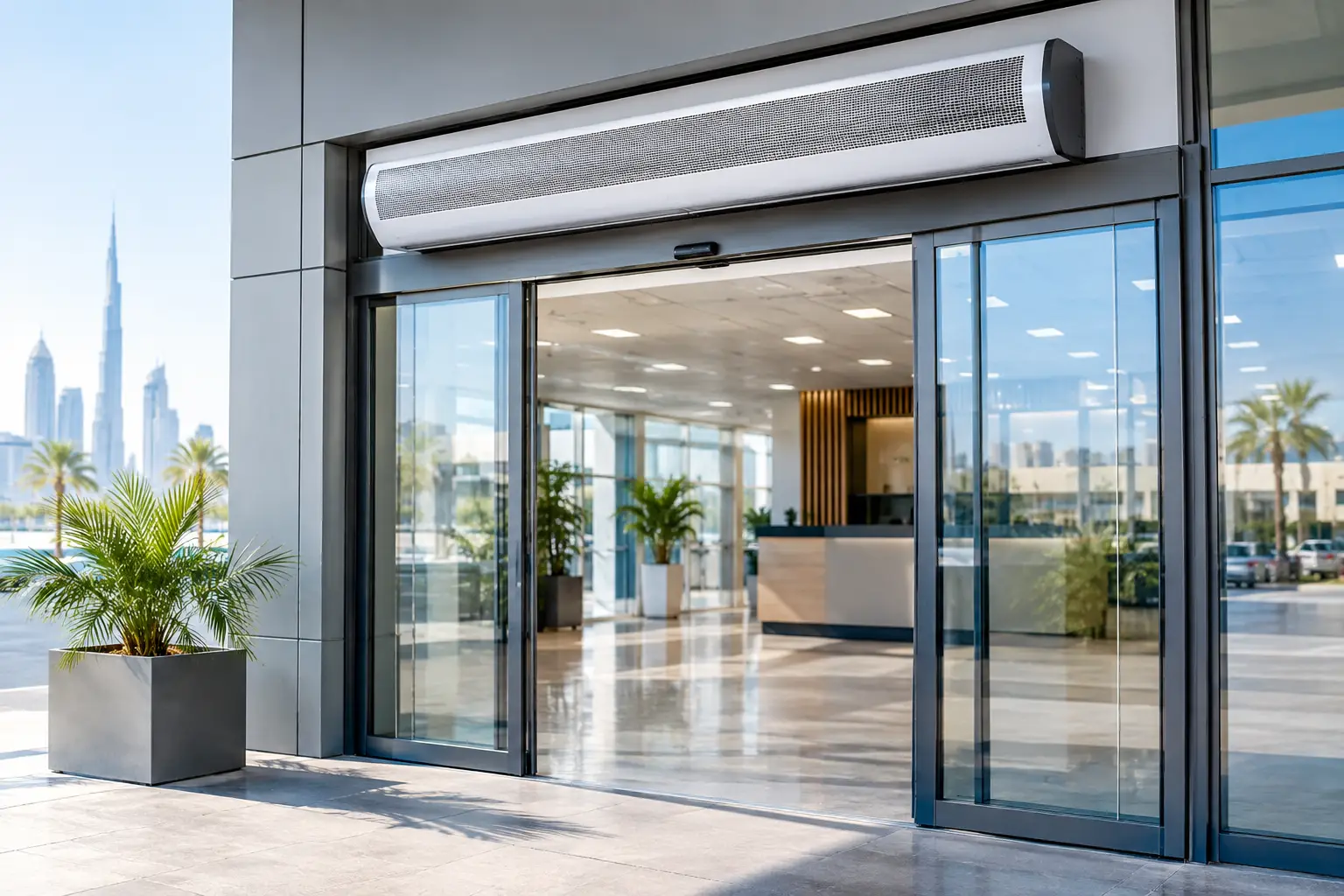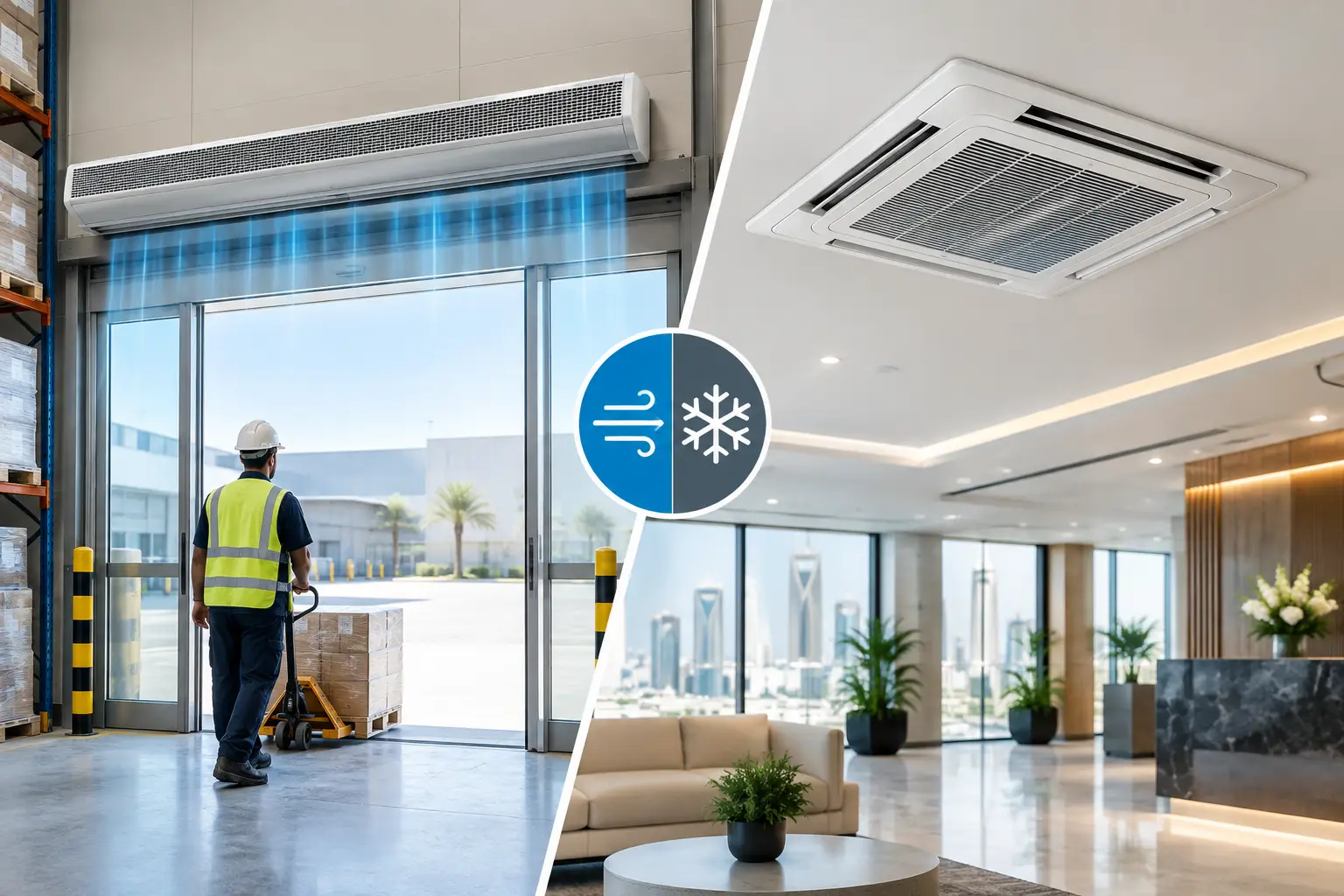
A commercial kitchen can lose conditioned air in seconds when a delivery, service, or waste-handling door stays open. In Dubai, Riyadh, Doha, and other hot, humid, or dusty markets, that opening also becomes a direct path for heat, moisture, dust, insects, and outdoor odors. Kitchen air curtains create a controlled high-velocity airstream across the doorway, helping separate the indoor working environment from demanding outdoor conditions without slowing essential traffic.
For restaurants, hotels, catering facilities, food courts, and food-processing operations, the value is not simply cooler air. It is better control of a frequently opened entrance, lower strain on mechanical cooling, and a more hygienic perimeter around areas where food is received, prepared, or dispatched.
Why Kitchen Entrances Need a Different Approach
Kitchen doors rarely behave like standard office entrances. A back-of-house delivery door may open repeatedly during peak receiving hours. A restaurant service entrance can see constant staff movement. Waste-room and loading-bay doors may be exposed to dust, traffic fumes, humidity, and insect activity.
The resulting pressure difference pulls outdoor air inward, especially when the kitchen is cooled and the exterior is extremely hot. If the opening connects to a loading area, alley, service corridor, or external dock, the challenge can be more severe. The HVAC system must then remove the added sensible heat and moisture while trying to maintain a workable indoor temperature for staff.
An air curtain addresses this exposure at the opening itself. Properly selected equipment projects an air barrier from the mounting position to the floor, reducing uncontrolled air exchange while allowing people, trolleys, and deliveries to pass. It does not turn an open door into a sealed wall, and it should not be treated as a substitute for good door management or proper kitchen ventilation design. It does, however, reduce the operational penalty of doors that cannot realistically remain closed.
What Kitchen Air Curtains Help Control
The primary benefit in a commercial kitchen is air isolation. A stable discharge stream helps resist the infiltration of hot outdoor air and limits the escape of cooled indoor air. In tropical and desert climates, this can support more consistent temperatures around receiving areas, prep-adjacent doors, and staff circulation routes.
The same barrier can also help reduce exposure to airborne dust, insects, humidity, smoke from nearby external activity, and traffic-related odors. This is particularly relevant for food businesses operating near busy roads, shared mall service zones, open loading yards, or industrial estates.
The outcome depends on site conditions. An air curtain cannot eliminate contaminants generated inside the kitchen, and it should not be specified as a hygiene-control system without considering the complete food safety and ventilation strategy. Its role is to reduce what enters through an open doorway. That distinction matters when consultants are defining responsibilities across HVAC, kitchen ventilation, and food-safety requirements.
Airflow Matters More Than a Generic Size Match
Choosing equipment solely by door width is one of the most common specification errors. Width is essential because the air stream must cover the full opening, often with a small overlap beyond each side. But the required performance also depends on mounting height, exposure, pressure differences, traffic frequency, and the type of doorway.
A sheltered internal service door may need a different solution than an external receiving entrance exposed to crosswinds. Likewise, a standard restaurant back door is not comparable to a tall loading opening where pallet jacks and delivery trolleys move throughout the day.
Door Height and Mounting Position
The air stream needs enough velocity and stability to reach the floor or the effective lower boundary of the opening. As mounting height rises, the airflow must overcome dispersion before it reaches that point. Recessed ceiling units may suit finished customer-facing entrances where appearance is a priority, but the ceiling void, service access, and mounting height must support the required performance.
Surface-mounted commercial units can be a practical fit above kitchen service doors, while industrial centrifugal models are often more appropriate where the opening is taller, wider, or subject to more severe external conditions. The right choice is based on measured site conditions, not aesthetics alone.
Traffic Volume and Door Behavior
A doorway used occasionally by staff has a different demand profile from a receiving door held open during deliveries. High traffic does not automatically require the largest unit available, but it does increase the need for reliable air throw, durable components, and controls that match operating hours.
For example, a hotel kitchen may benefit from an air curtain linked to door operation or scheduled around service periods. A supermarket food-preparation access point may require steady operation through long shifts. Facilities should consider how doors are actually used, including propping behavior, peak delivery windows, and whether vehicles or equipment create cross-drafts.
External Exposure and Climate Load
Extreme heat is only one part of the equation. Coastal humidity in locations such as Dubai, Abu Dhabi, Muscat, and Doha can increase moisture infiltration. Dry, dusty conditions common across many Gulf and African industrial areas can contaminate workspaces and place additional demand on filters and coils. A wind-exposed doorway may require higher-performance airflow than a similar opening inside a covered service court.
This is why kitchen air curtains designed for tropical and desert climates should be assessed for their air velocity, blower configuration, construction quality, and suitability for continuous commercial duty. A low-noise model may be appropriate near guest areas, while a more powerful centrifugal-flow configuration may be justified at a hard-working back-of-house entrance.
Where Air Curtains Deliver the Strongest Value
The most suitable applications are usually openings that combine frequent traffic with a meaningful difference between indoor and outdoor conditions. Restaurant receiving doors, hotel loading entrances, supermarket prep-area access doors, bakery dispatch points, catering kitchens, and food-processing service doors are common examples.
In a quick-service restaurant, the concern may be insects and hot air entering through the rear delivery door. In a large hotel, the objective may be to protect an air-conditioned kitchen corridor connected to a loading dock. In a food production facility, the priority may be reducing dust and humidity transfer between external logistics areas and controlled processing zones.
There are also cases where an air curtain is not the first answer. If a door is rarely used and can remain tightly closed, improving the door seal and operating discipline may offer sufficient benefit. If a doorway is exceptionally exposed to high winds, the project may need a more detailed airflow assessment, added vestibule measures, or a revised loading layout. Effective specification starts with the problem rather than a predetermined product category.
Coordination With HVAC and Kitchen Operations
Air curtains work best when they are treated as part of the entrance climate-control strategy. The mechanical cooling system, door location, air balance, kitchen ventilation arrangement, and operating schedule all affect results. Installing a unit after commissioning without reviewing these factors can lead to an underperforming application, even if the equipment itself is correctly manufactured.
MEP consultants and contractors should verify the clear opening width and height, available mounting space, electrical requirements, nearby obstructions, and maintenance access. Facility managers should also identify whether the doorway is exposed to dust, insects, fumes, humidity, or unusual traffic patterns. These details help determine whether a recessed model, a commercial centrifugal unit, a HiFi Plus configuration, or an industrial-duty system is the appropriate direction.
Noise should be evaluated in context. Back-of-house receiving zones can generally accept a higher sound level than a customer-facing restaurant entrance or an open kitchen adjacent to dining areas. Selecting for quiet operation alone can compromise the air barrier at a challenging external door. Conversely, overspecifying industrial airflow at a lightly used internal opening can create unnecessary noise and energy use.
Specification Questions to Resolve Before Quotation
A consultation should begin with the opening dimensions and mounting height, then move to the operating environment. The project team should document whether the door opens to outdoors, a covered loading area, or another conditioned space; whether crosswinds occur; and how many hours per day the entrance is active.
It is also useful to confirm the main operational priority. Is the goal to reduce cooling loss, discourage insect entry, limit dust, protect against humidity, or manage several of these issues at once? The answer influences the recommended airflow class and control approach.
For demanding restaurant, hotel, supermarket, and food-production entrances, FreezeeX can assess these variables and recommend a quotation-ready air curtain configuration suited to the opening and local climate. Share the door dimensions, photographs, mounting details, traffic pattern, and the environmental conditions around the entrance. A properly matched air curtain gives the kitchen team a more controlled threshold, even when business operations require the door to keep moving.