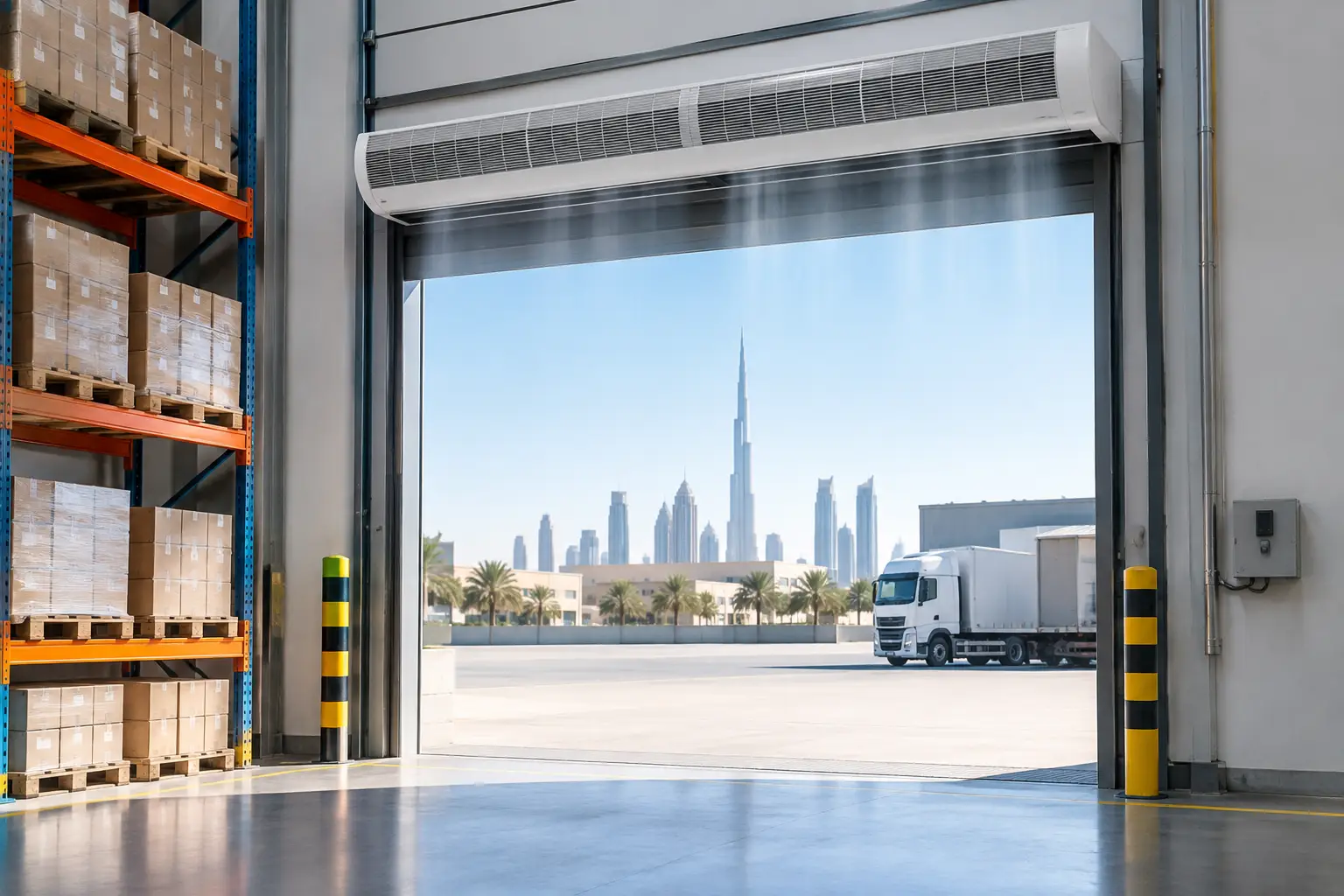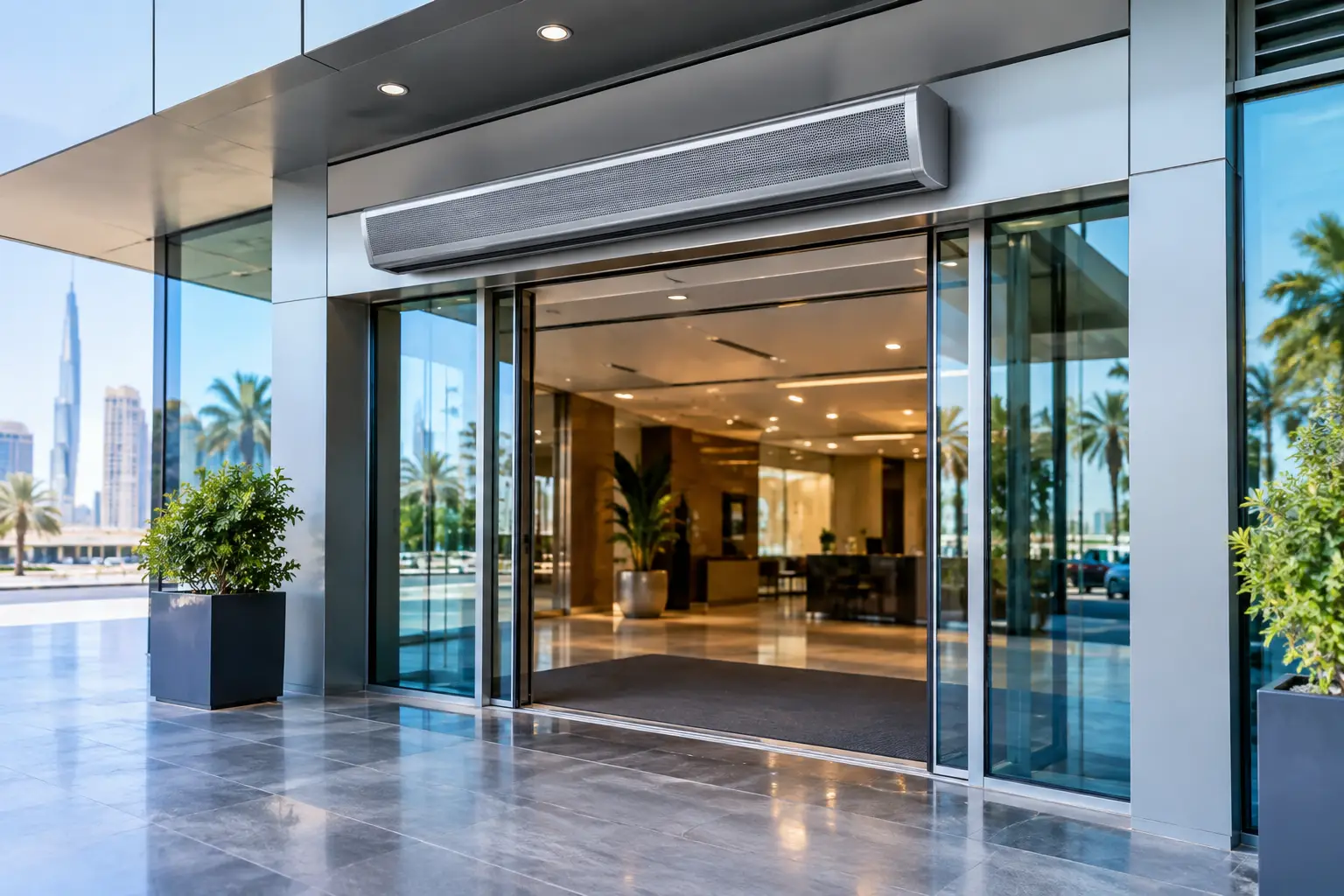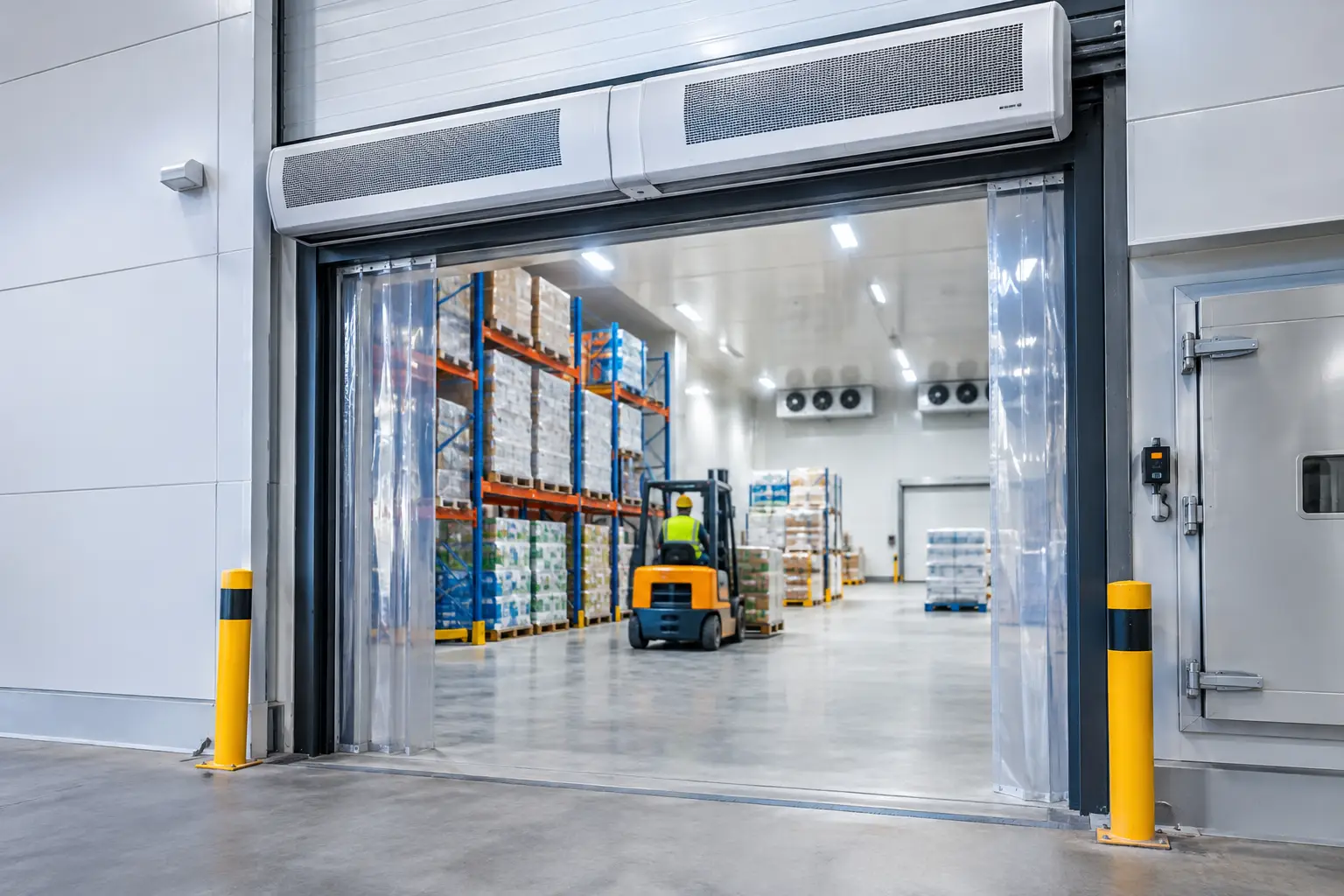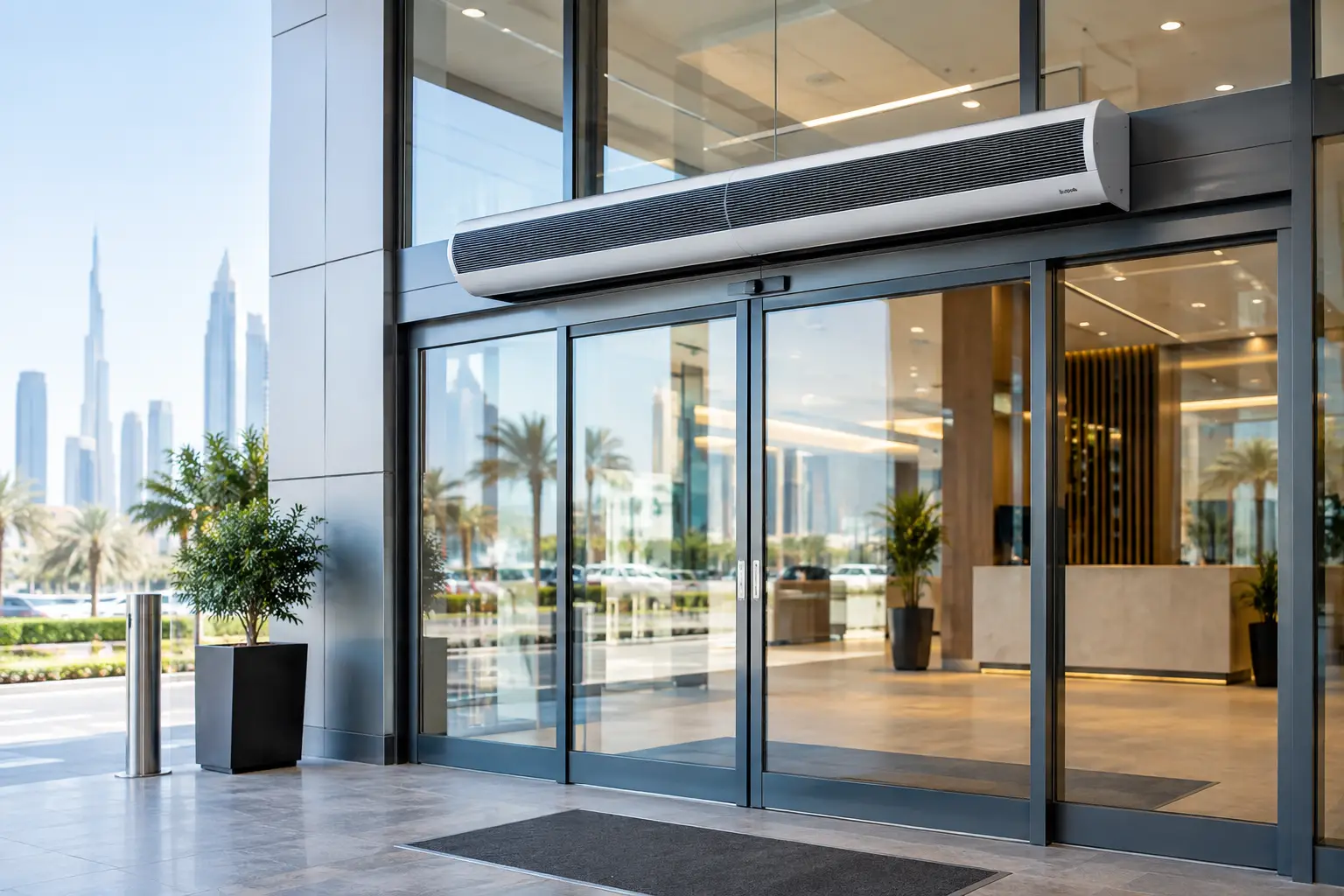
A loading-bay door that opens every few minutes can undermine HVAC efficiency faster than many facility teams expect. In Dubai, Riyadh, Doha, Lagos, and other hot or humid markets, each open entrance creates a direct path for outdoor heat, moisture, dust, and airborne contaminants to enter conditioned space. The cooling system must then remove that added heat and humidity while trying to maintain stable indoor conditions for staff, customers, products, and processes.
For commercial and industrial buildings, entrance climate control is not a minor comfort feature. It is part of the building’s operating strategy. A properly selected air curtain creates a high-velocity air barrier across an opening, helping separate indoor and outdoor air without preventing normal pedestrian, trolley, or forklift movement. The result is lower cooling loss at active doorways and less unnecessary demand on the HVAC system. For specialized cleanroom isolation standards, review our pharmaceutical cleanroom door barrier guide. For technical sizing and velocity criteria, review our industrial air curtain selection guide.
Why Commercial Entrances Reduce HVAC Efficiency
Conditioned air naturally escapes through open doors, but the larger problem is often infiltration. Hot outdoor air enters at the same time, carrying sensible heat, humidity, dust, insects, exhaust fumes, and other contaminants. In a supermarket, this can affect shopper comfort near the entrance and increase refrigeration-area moisture loads. In a warehouse or factory, it can introduce dust into work areas and force air-conditioning equipment to run longer.
The impact depends on more than door size. Opening frequency, local wind pressure, indoor-to-outdoor temperature difference, building pressure, and the height of the opening all matter. A small retail entrance with constant customer traffic may create a significant cumulative load over a full trading day. A high industrial shutter door may experience fewer openings, yet each opening can allow a substantial volume of hot air into the building.
This is why simply increasing HVAC capacity is not always the most efficient response. Oversizing cooling equipment can increase capital cost and may still leave entrance zones uncomfortable. Reducing the load at its source is generally the more disciplined approach.
How Air Curtains Support HVAC Efficiency
An air curtain uses a controlled stream of air to create separation at the doorway. It does not seal an opening in the same way as a physical door. Instead, it forms an air barrier designed to resist the mixing of hot outdoor air and cooler indoor air while keeping the entrance usable.
When specified correctly, the system helps preserve the conditioned environment, reducing the amount of replacement air the HVAC system must cool and dehumidify. This can improve temperature consistency near the entrance, particularly in high-traffic retail stores, hotels, restaurants, hospitals, and shopping malls.
In desert and tropical climates, the benefit extends beyond temperature control. Dust intrusion is a practical concern in exposed facilities, while humidity can create discomfort, condensation risk, and additional latent cooling demand. For food processing areas, pharmaceutical facilities, and cold storage operations, limiting uncontrolled air exchange also supports hygiene and process stability.
An air curtain should therefore be treated as an entrance-control component within the wider HVAC design, not as a stand-alone accessory. Its performance depends on the relationship between the air barrier, door geometry, external conditions, and how the building is operated.
Selecting an Air Curtain for Commercial HVAC Efficiency
The right unit is determined by the application. A compact decorative air curtain suitable for a hotel lobby may not have the throw, airflow pattern, or construction needed for a dusty warehouse door. Likewise, an industrial model can be unnecessary for a narrow, recessed retail entrance where appearance and noise levels are major specification factors.
Start With Door Geometry and Mounting Height
The air stream must reach the floor or the intended barrier zone with enough velocity to resist infiltration. As mounting height increases, the equipment needs sufficient throw and airflow performance. A unit selected only by doorway width can look adequate on paper but perform poorly at floor level if the door is tall or exposed to crosswinds.
For standard commercial entrances, a recessed ceiling air curtain can provide a clean architectural finish while maintaining effective coverage. For wider openings or locations with greater exposure, centrifugal-flow commercial units may provide the pressure and air distribution required for more demanding conditions.
Consider Traffic and Door Operation
A low-traffic office entrance and a supermarket entrance operate very differently. Door opening duration, automatic-door cycling, and the movement of people or equipment all influence infiltration. At logistics centers and factories, forklifts can keep doors open for long periods, requiring an industrial air curtain designed for high mounting heights and continuous-duty operation.
The objective is not to maximize airflow without reason. Excessive airflow can create objectionable noise, drafts, or disturbance to lightweight materials. The objective is to achieve the required air barrier for the actual opening and operating conditions.
Account for Pressure, Wind, and Exposure
External wind can deflect an air curtain and weaken its barrier effect. Entrances facing open parking areas, loading yards, coastal exposure, or prevailing desert winds need particular attention. Building pressure also matters. If extraction systems or poorly balanced supply air create negative pressure indoors, outdoor air will be drawn through every available opening, including doorways.
In these cases, air curtain selection should be coordinated with the HVAC and ventilation design. The equipment can substantially reduce infiltration, but it cannot fully compensate for major pressure imbalance or an improperly designed entrance vestibule.
Match the Unit to the Environment
Commercial environments have different priorities. A retail store may prioritize appearance, low noise, and customer comfort. A restaurant may need help controlling insects, odors, and humid air at a service entrance. A warehouse may prioritize wide coverage, durable components, and strong air throw. Cold storage facilities require careful specification to limit temperature exchange and moisture entry at frequently used access points.
FreezeeX air curtain ranges include recessed, commercial centrifugal, commercial HiFi Plus, industrial centrifugal, and Dynamic Series options to suit these different operating demands. A consultation-based selection process is valuable because the correct solution is based on site conditions, not a one-size-fits-all model number.
Where Entrance Air Barriers Deliver the Most Value
The strongest case for air curtains is usually at openings that combine high traffic with a large difference between indoor and outdoor conditions. These areas deserve attention during energy audits and MEP design reviews:
- Main entrances in supermarkets, malls, hotels, hospitals, and retail stores.
- Service doors at restaurants, food production facilities, and pharmaceutical sites.
- Loading bays and dispatch doors at warehouses, factories, and logistics centers.
- Cold room and cold storage access points with frequent staff or goods movement.
- Airport, transport, and public-building entrances with continuous pedestrian traffic.
The savings profile will vary. A customer-facing entrance may primarily improve comfort and reduce cooling run time. A loading bay may deliver additional operational value by limiting dust, insects, and hot air entering storage or production areas. For a facility manager, these combined effects often matter more than a single energy figure.
Avoid Common Specification Mistakes
The most frequent error is selecting an air curtain by width alone. Width is necessary for full opening coverage, but mounting height, air velocity, external exposure, and traffic pattern determine whether the air stream can form an effective barrier.
Another mistake is locating the unit where obstructions disrupt the discharge pattern. Signage, bulkheads, door tracks, structural beams, and incorrect recess details can all affect airflow. The equipment should be coordinated early with architectural, electrical, and HVAC layouts, especially when specifying recessed units.
Maintenance access also deserves consideration. In dusty environments, intake areas and filter nets require planned inspection to preserve airflow. A unit that is difficult to access is less likely to receive consistent maintenance, which can reduce performance over time.
Finally, avoid treating the air curtain as a replacement for sound HVAC fundamentals. Door management, reasonable building pressure, suitable automatic-door settings, and correctly maintained cooling equipment remain essential. Air curtains strengthen this overall strategy by reducing the entrance load that would otherwise reach the HVAC system.
A Practical Approach for Hot and Humid Facilities
For projects in the UAE, Saudi Arabia, Qatar, Oman, Kuwait, Bahrain, and across MENA and Africa, begin with an entrance survey. Record clear opening width and height, mounting location, door type, operating hours, traffic volume, nearby exhaust or supply systems, and exposure to wind, dust, or humidity. These details allow engineers to select airflow performance that fits the site rather than relying on general assumptions.
For high-use entrances, assess the air curtain alongside HVAC operating data. If cooling equipment runs heavily during peak door activity, the entrance may be contributing more load than expected. This is especially relevant in facilities that expanded operations without updating their entrance-control strategy.
A properly specified air curtain will not eliminate all heat transfer, and projected energy savings should always reflect actual site conditions. It can, however, materially reduce uncontrolled infiltration at one of the building envelope’s most active weak points. That makes it a practical investment in comfort, cleanliness, and HVAC efficiency.
For a project-specific recommendation, request a consultation and quotation based on your entrance dimensions, mounting height, traffic pattern, and climate exposure. The right air curtain for a desert loading bay, humid retail entrance, or high-traffic cold storage door is the one engineered around the conditions your facility faces every day.