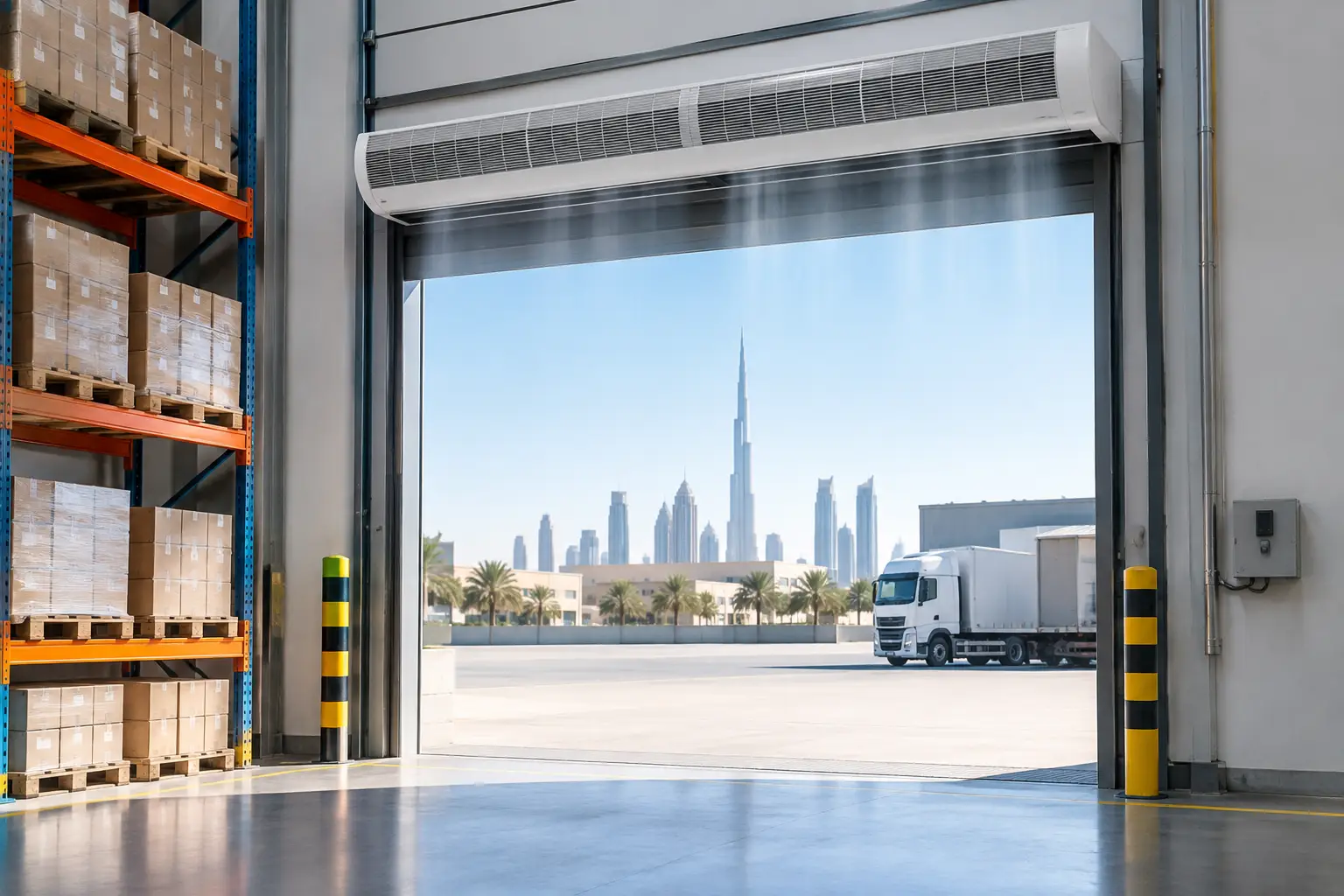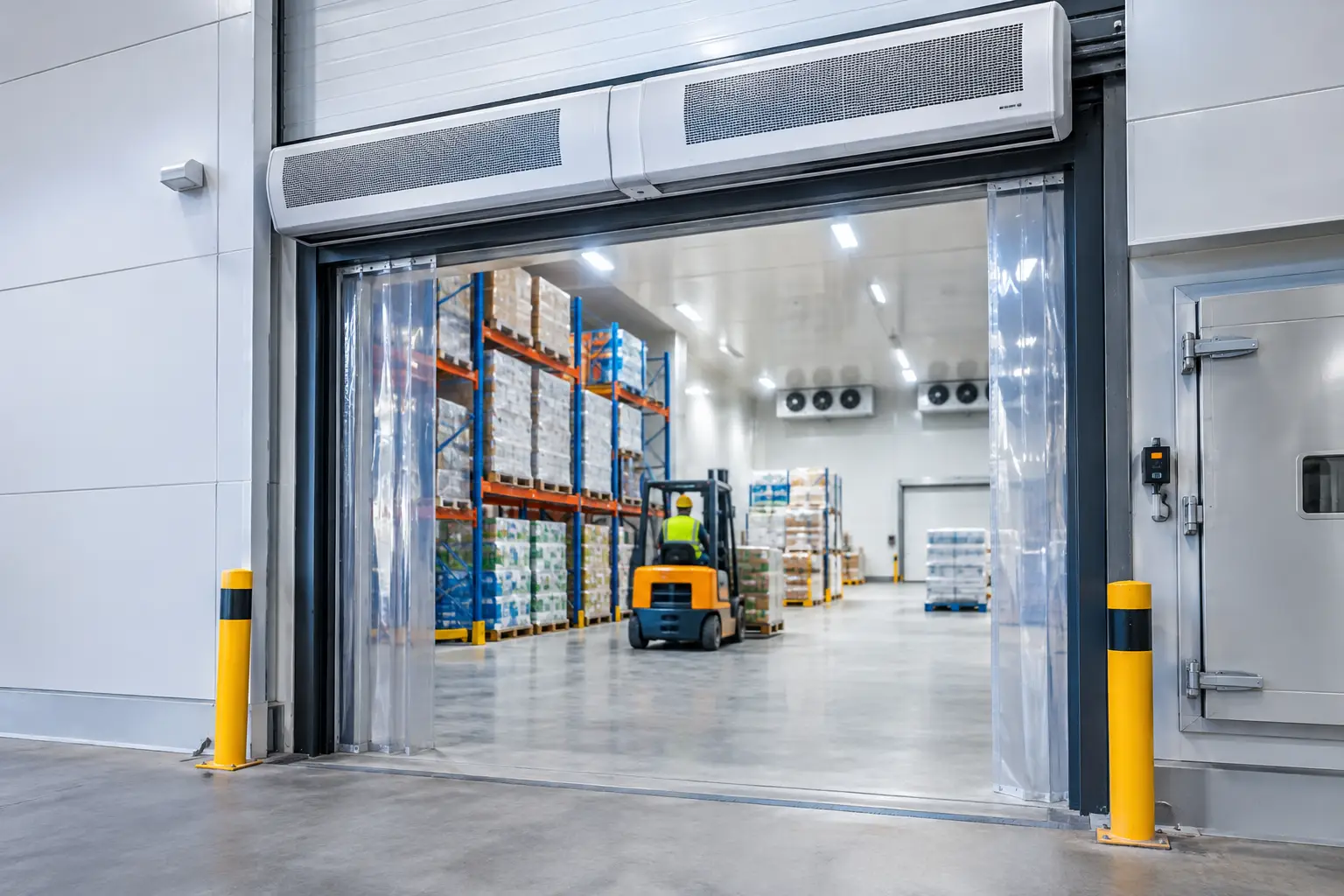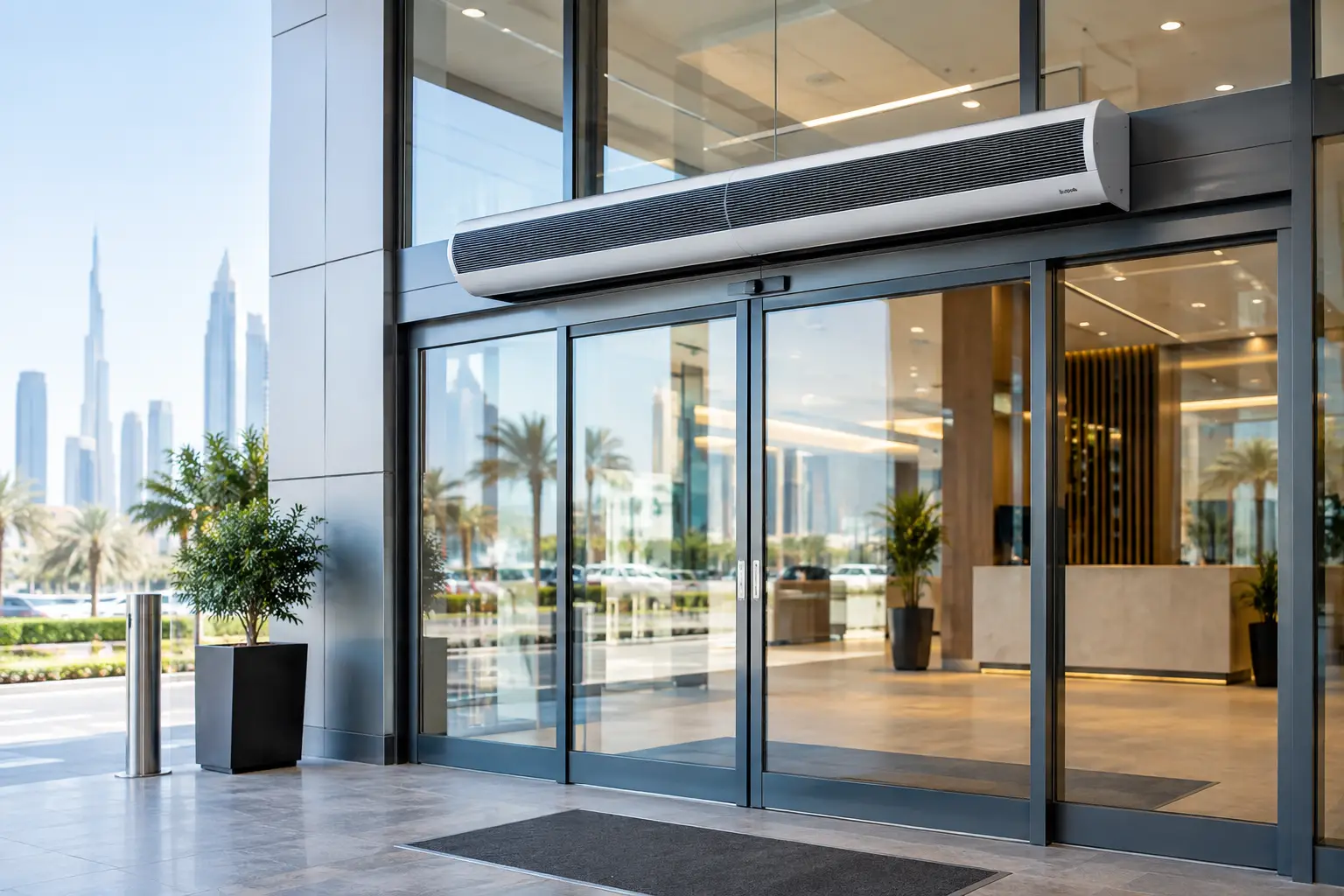
A loading-bay door that stays open during deliveries can become a direct path for vehicle exhaust, process odors, dust, and hot outside air. Understanding how air curtains block fumes helps facility managers and MEP teams specify a practical barrier at that weak point – without slowing pedestrian, trolley, or forklift traffic.
An air curtain does not trap fumes or clean contaminated air. It creates a controlled, high-velocity sheet of air across an opening. When that air stream is correctly selected, aimed, and balanced with the building’s pressure conditions, it reduces the amount of contaminated outdoor air that crosses into the conditioned space.
How Air Curtains Block Fumes at an Open Door
A commercial air curtain discharges air from the top or sides of an entrance, forming a continuous jet that travels toward the floor. This jet creates air separation between indoor and outdoor environments. Airborne contaminants approaching from outside must pass through that moving barrier, and many are deflected, diluted, or carried away from the opening rather than entering the building.
The principle is momentum. The discharged air must retain enough velocity to reach the floor or operating threshold and resist crosswinds, pressure differences, and traffic movement. If the airstream breaks apart halfway down a tall opening, fumes can pass below or around it. If it is too aggressive for a public entrance, it may create discomfort without delivering better isolation.
For a restaurant receiving door near a vehicle lane, the concern may be diesel odor and heat. At a factory entrance, it may be welding-related odors or dust from an external yard. At a hospital service entrance, it may be odors and airborne contaminants from loading operations. The application changes, but the requirement remains the same: establish a stable air barrier at the opening.
What an Air Curtain Can and Cannot Do
Air curtains are effective at reducing the infiltration of outdoor fumes, smoke, dust, humidity, insects, and heat through frequently open doors. They are particularly valuable where physical doors cannot remain closed because of continuous movement.
However, an air curtain is not a substitute for source capture, filtration, or mechanical exhaust where fumes originate inside the facility. Vehicle exhaust generated in an enclosed loading area, chemical vapors from production, or smoke from a cooking process requires the appropriate ventilation and safety strategy. The air curtain’s role is entrance isolation – limiting transfer through an open doorway.
This distinction matters during specification. A facility with hazardous or high-concentration contaminants needs an engineered ventilation assessment. An air curtain can support the overall control strategy, but it should not be presented as the sole safeguard for occupational exposure or fire-smoke control.
The Conditions That Determine Fume-Blocking Performance
The same unit will not perform equally at every entrance. Air isolation depends on the full doorway condition, not simply the unit’s listed airflow volume.
Key conditions that affect fume-blocking performance:
- Door height and width
- Pressure difference across the opening
- Wind and vehicle movement
- Mounting position and discharge angle
- Airflow type and required throw
- Outdoor temperature, humidity, and exposure
- Type and concentration of fumes or contaminants
Door Height and Width
Door height is the first sizing variable because the air jet loses velocity as it travels. A unit suited to a standard retail entrance may not maintain an effective barrier over a high warehouse roller shutter. Wide openings may require multiple units installed edge to edge so there are no gaps in the discharge pattern.
For tall, exposed, or high-traffic industrial openings, centrifugal designs are commonly preferred because they can deliver stronger throw and pressure capability. This is especially relevant for warehouses, logistics centers, factories, and distribution facilities with frequent forklift movement.
Pressure Difference Across the Opening
Air moves from higher pressure to lower pressure. If a building is strongly negatively pressurized, outdoor air – including fumes – will be drawn inward through any available gap. The air curtain must work against that pressure-driven infiltration.
Positive or neutral building pressure can improve air-curtain effectiveness, while severe negative pressure can overwhelm it. HVAC engineers should review supply, exhaust, and relief-air balance before relying on an entrance air barrier to control fumes. In kitchens, workshops, and industrial zones, that review is often as important as the air curtain selection itself.
Wind, Vehicle Movement, and Door Exposure
A door facing a busy service road or an open desert yard experiences conditions far different from an interior mall entrance. Wind gusts can bend the air stream away from the threshold. Passing trucks and forklifts can create short pressure pulses that pull fumes through the opening.
In Dubai, Riyadh, Doha, Muscat, and other hot-climate commercial locations, high outdoor temperatures compound the problem. The entering air carries heat as well as odors, pollutants, and sometimes humidity. A properly selected air curtain helps reduce that combined load on the building’s cooling system, but exposed entrances may require higher-performance equipment and careful on-site adjustment.
Mounting Position and Discharge Angle
The discharge nozzle must be positioned to create a complete barrier at the actual opening. Recessed ceiling installations can provide a clean architectural finish in hotels, retail stores, and office lobbies, provided the ceiling recess is aligned correctly with the door line.
At service entrances, wall-mounted units need adequate clearance and a direct discharge path. The air stream is generally aimed slightly outward, not vertically down, to counter incoming air. The correct angle depends on pressure conditions and exposure. A small adjustment can materially affect where the air jet lands and whether fumes are pushed back outside or drawn indoors.
Why Airflow Type Matters
Commercial air curtains generally use axial or centrifugal blower arrangements. The suitable option depends on the required throw, opening geometry, operating hours, noise expectations, and environmental exposure.
For lower-height commercial entrances, a quieter commercial unit can provide effective separation while preserving customer comfort. Retail stores, hotels, pharmacies, and supermarket entrances often need a balance between visible performance and a welcoming environment.
For demanding applications, centrifugal air curtains provide stronger, more focused airflow and are better suited to higher mounting heights and challenging pressure conditions. At a warehouse dock, industrial workshop, food processing entrance, or loading door, the priority is stable barrier performance across a large opening. The required unit should be selected for the clear opening height, not the building ceiling height.
Noise also deserves attention. Increasing fan speed may improve resistance to infiltration, but it can create an unsuitable acoustic environment at front-of-house doors. The right approach is not simply choosing the highest-output model. It is matching air velocity, throw, sound level, and installation configuration to the actual duty.
Fumes, Smoke, and Humidity Need Different Strategies
Buyers often group smoke, fumes, odors, humidity, and dust into one problem. They are related, but their behavior differs.
Light vehicle fumes and outdoor odors are often carried by pressure-driven airflow and can be reduced effectively by a consistent entrance barrier. Fine dust is also controlled by limiting the air volume that enters through the opening, although an air curtain will not replace filtration for sensitive production spaces. Humid outside air can increase the latent load on a cooling system, making air separation valuable at supermarket, hotel, healthcare, and food-service entrances.
Visible smoke requires more caution. Smoke movement depends heavily on buoyancy, temperature, pressure, and air currents. Standard commercial air curtains should not be specified as a life-safety smoke-control system unless the full system has been designed and approved for that purpose. For normal operational odors or nuisance fumes at external doors, however, air curtains can be a highly effective part of the building’s environmental control plan.
Specification Questions for Consultants and Facility Teams
Before selecting an air curtain to reduce fume ingress, establish the clear opening dimensions, mounting height, number of daily door cycles, and whether the entrance faces an exposed road, yard, or loading area. Confirm the primary contaminants and whether they originate outside or inside the building. Review nearby exhaust outlets, vehicle routes, and the building’s pressure balance.
It is also useful to identify the operational consequence of infiltration. In a cold storage or food-processing facility, the concern may be energy loss and hygiene. In a hospital, it may be comfort and separation between service areas. In a warehouse, it may be diesel odor, dust, and heat affecting staff and stored goods. These details determine whether a commercial or industrial air curtain configuration is appropriate.
For demanding tropical, humid, and desert-climate projects, equipment selection should account for sustained operating temperatures, dust exposure, long operating hours, and service access. A unit that performs adequately in a protected lobby may not be suitable for a large, wind-exposed industrial door.
A Practical Role in Better Entrance Control
The most effective installations treat the air curtain as one part of a coordinated entrance strategy. Door discipline, suitable door speed, building pressure management, vehicle routing, and properly located exhaust all affect results. The air curtain then provides the active barrier needed when the opening must stay accessible.
For projects in the UAE, Saudi Arabia, Qatar, Oman, Kuwait, Bahrain, and wider MENA and African markets, FreezeeX can review the entrance size, environment, traffic pattern, and HVAC conditions to recommend a quotation-ready commercial or industrial configuration. A well-specified air curtain will not eliminate the need for ventilation where fumes are generated, but it can keep an open doorway from becoming the weakest point in your indoor environment.
Key conditions that affect fume-blocking performance:
- Door height and width
- Pressure difference across the opening
- Wind and vehicle movement
- Mounting position and discharge angle
- Airflow type and required throw
- Outdoor temperature, humidity, and exposure
- Type and concentration of fumes or contaminants