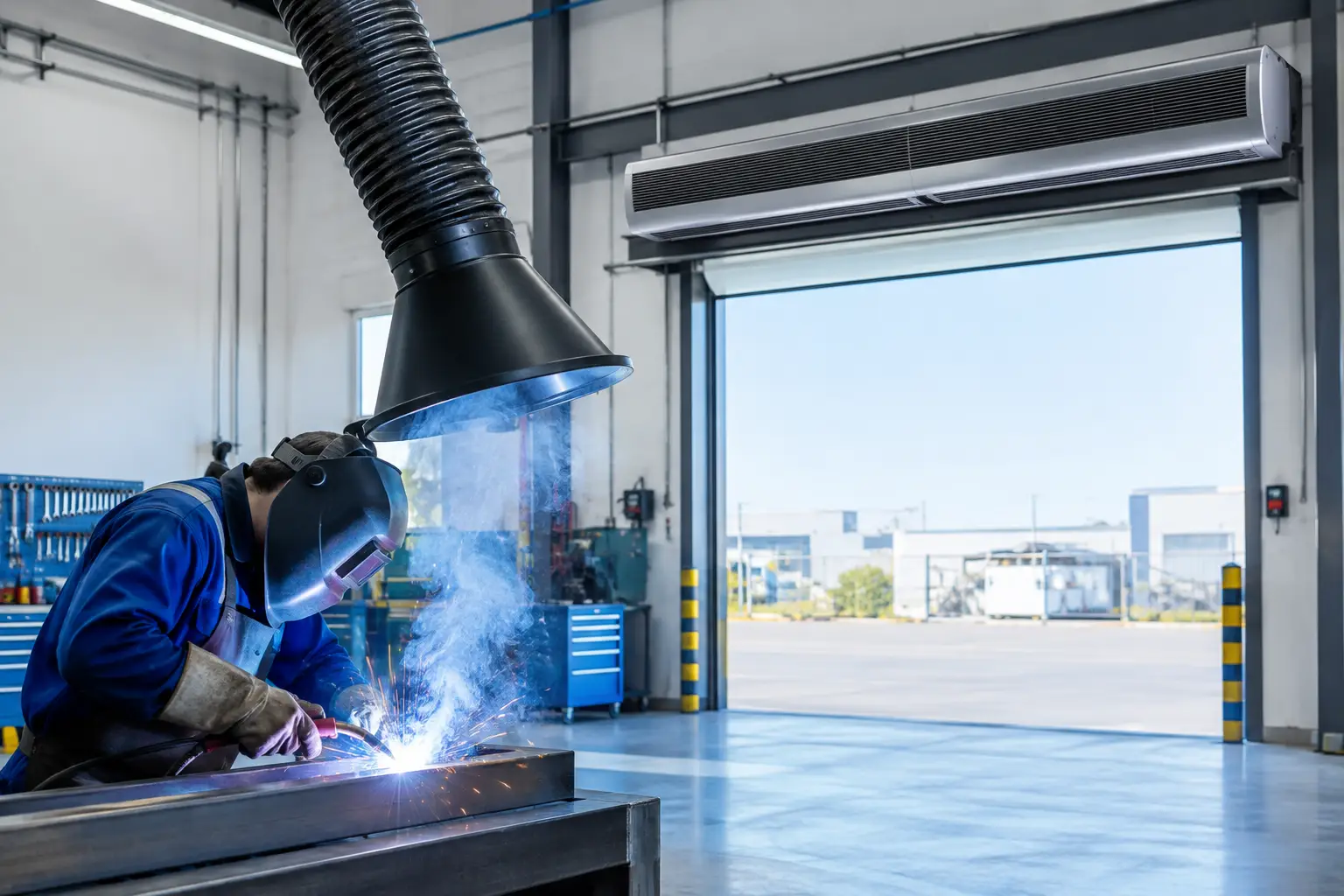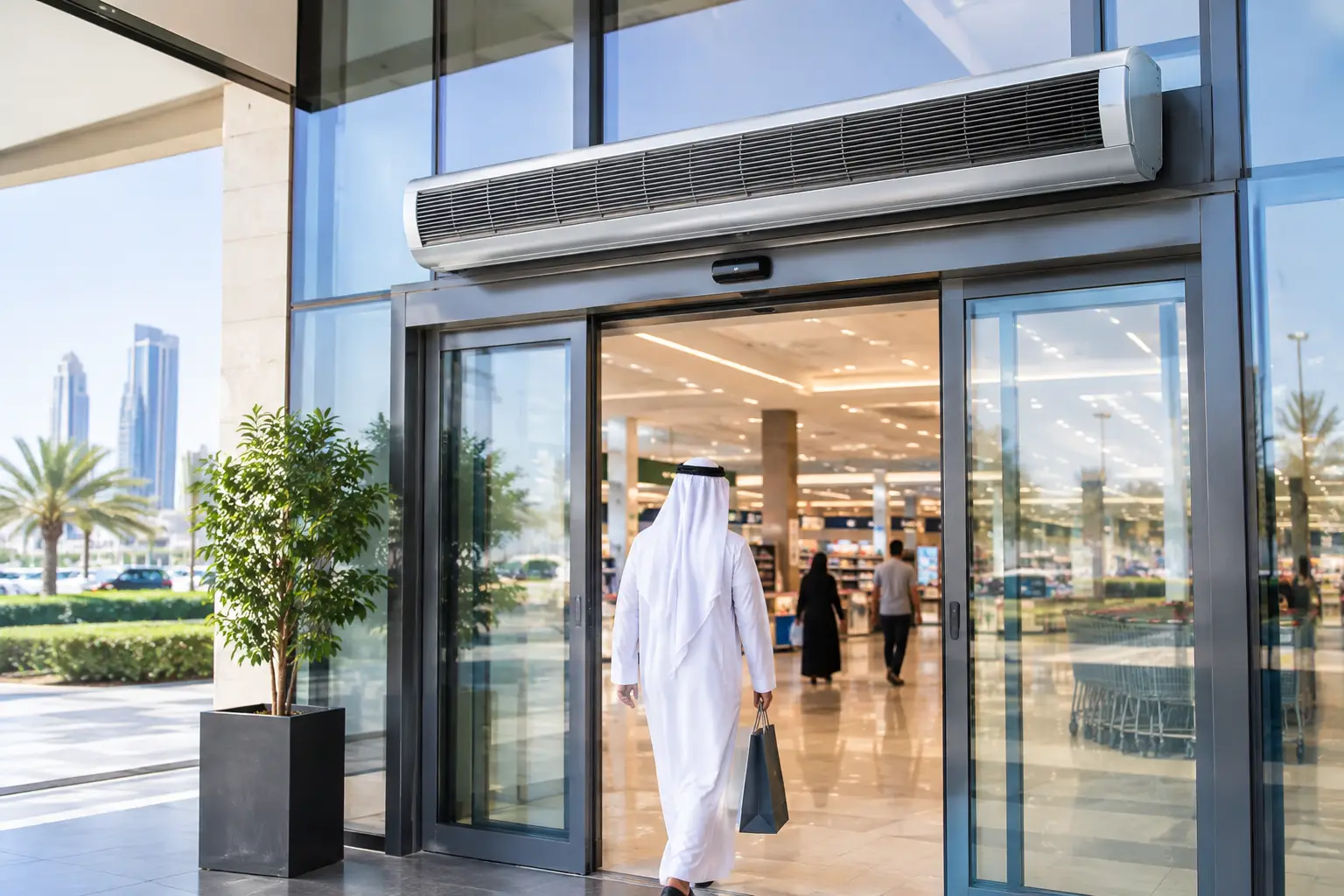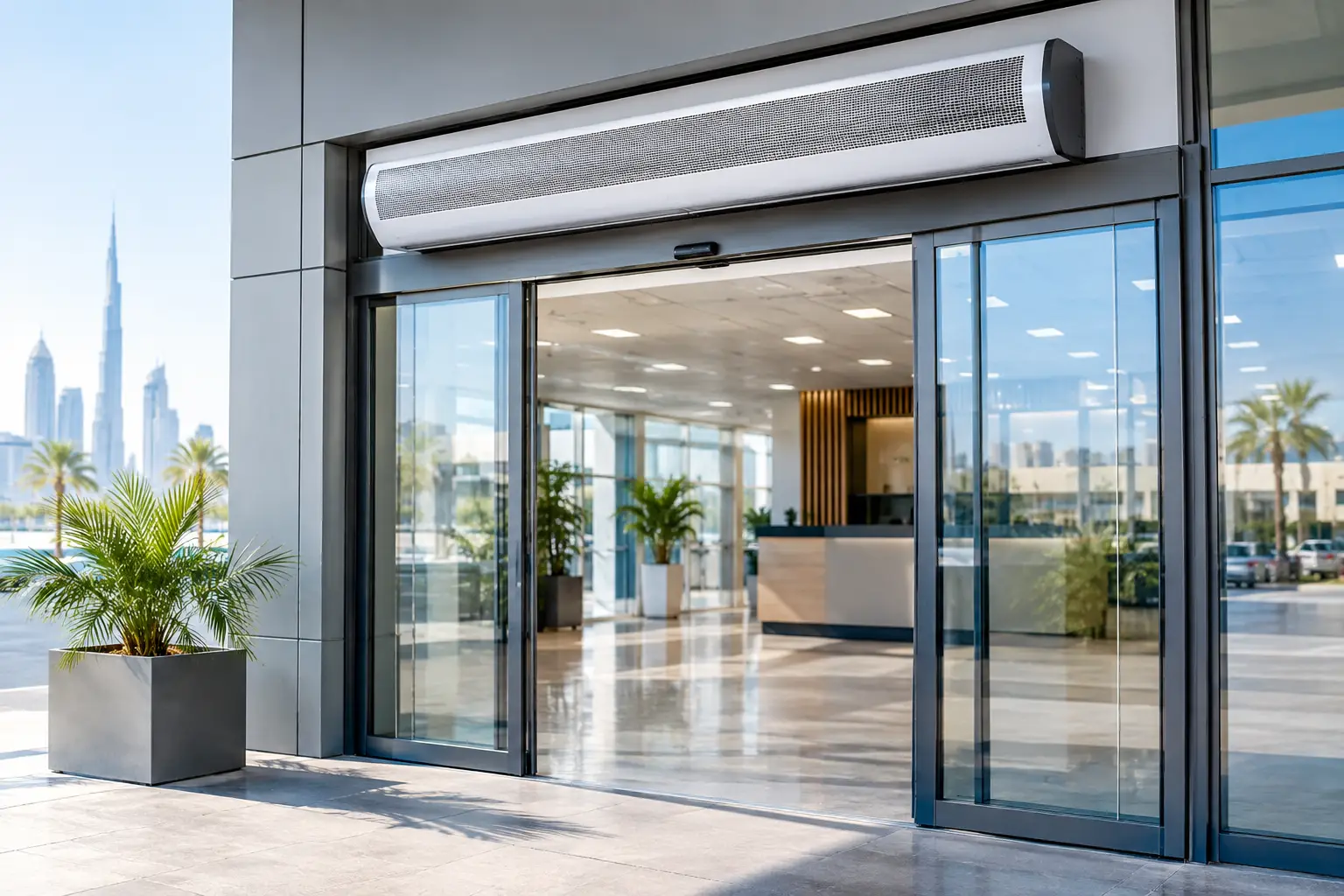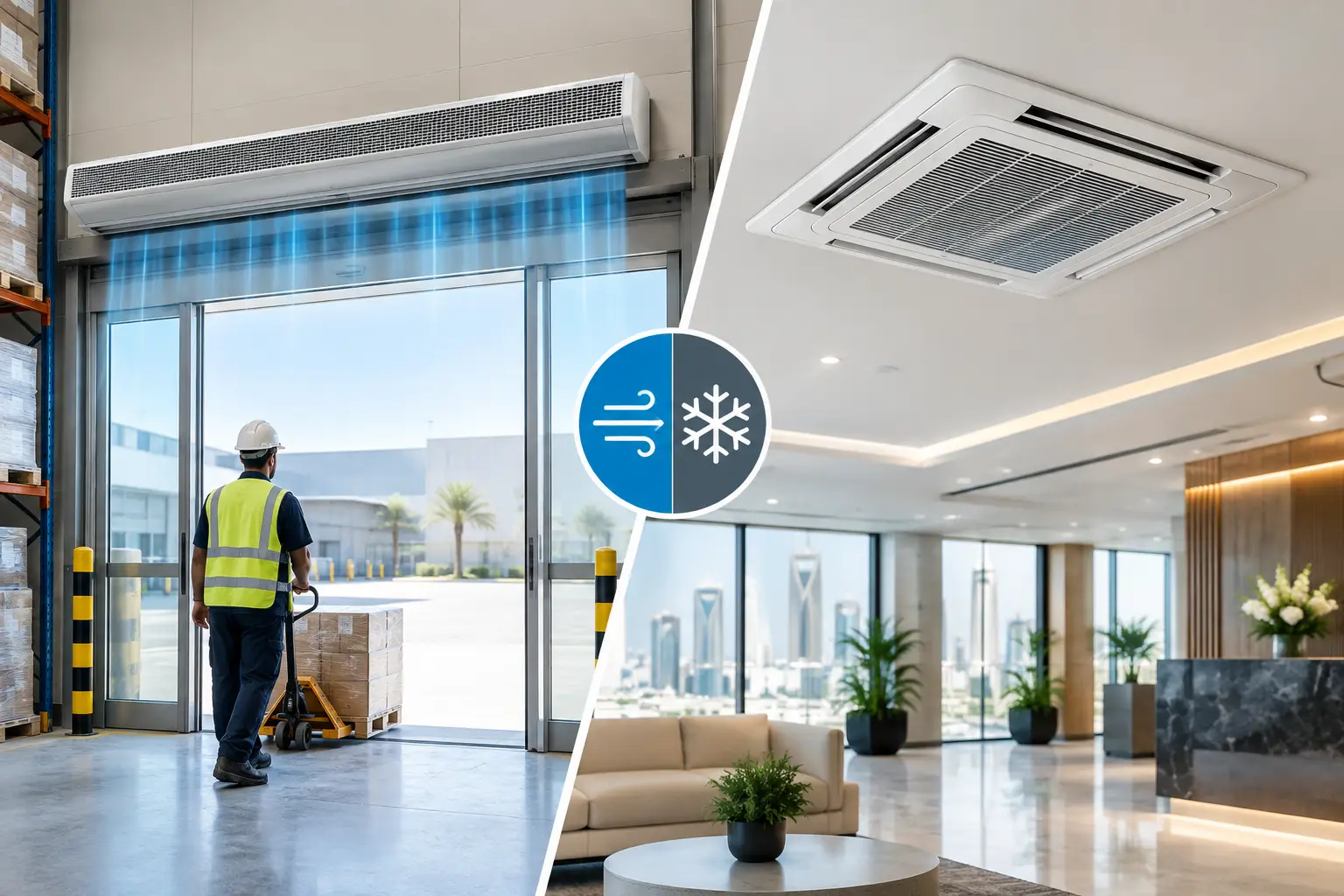
A loading door left open during peak dispatch can become one of the largest sources of cooling loss in a warehouse. The best warehouse air curtains are not simply the units with the highest listed airflow. They are correctly sized systems that create a continuous, stable air barrier across the full doorway height and width, even when forklifts, pallet jacks, and delivery traffic are moving through.
For warehouses in Dubai, Riyadh, Doha, Muscat, Cairo, Lagos, and similar hot, humid, or dusty locations, selection has to account for more than door dimensions. Outdoor heat, wind exposure, airborne dust, humidity, internal pressure, and operating hours all affect whether the air stream reaches the floor and maintains separation between indoor and outdoor conditions.
What Makes the Best Warehouse Air Curtains Effective?
A warehouse air curtain works by projecting a controlled column of air downward across an opening. This air barrier limits the exchange of conditioned indoor air and outdoor air while keeping the doorway physically open for traffic. It can also reduce the entry of dust, insects, fumes, and humidity where the application allows.
Performance depends on air velocity at the floor, not just the volume of air leaving the unit. A curtain may appear powerful at the discharge grille but lose momentum before reaching the threshold if it is installed too high, undersized for the opening, or exposed to crosswinds. That is why warehouse specification should begin with application data rather than selecting by motor power alone.
The right system must balance several conditions: opening height and width, mounting position, traffic frequency, external wind, indoor cooling demand, and the required level of separation. A busy logistics bay with frequent vehicle movement needs a different solution from a personnel entrance within the same facility.
Start With Door Geometry and Mounting Height
Door height is the first major selection factor. As the mounting height increases, the unit requires greater throw and sufficient discharge velocity to maintain a usable barrier at floor level. A low-profile commercial air curtain designed for a retail entrance is rarely appropriate for a high warehouse shutter or loading bay.
Width matters equally. The discharge must cover the entire opening without gaps at either edge. For wide roller shutters, multiple industrial units can be arranged side by side to provide continuous coverage. The design should consider overlap between units and the practical clearance needed for shutters, structural beams, fire systems, and loading equipment.
Horizontal or Vertical Installation
Over-door horizontal mounting is the most common arrangement when clear structural space is available above the entrance. It directs air downward and suits many loading doors, warehouse access points, and factory openings.
Vertical mounting can be useful where headroom is limited or where the doorway layout creates a difficult overhead installation. Units may be positioned at one or both sides of the opening to form a lateral air barrier. This approach needs careful engineering because airflow direction, passing vehicle movement, and side wind can influence coverage.
For large industrial openings, the best arrangement is often determined during site review rather than from drawings alone. Door photographs, mounting elevations, and operating details help identify obstacles that affect air delivery.
Match Airflow to Traffic and Door Exposure
A warehouse entrance that opens a few times per day has a very different duty profile from a dispatch bay operating continuously. High-traffic doors need equipment designed for long operating hours, stable output, and dependable controls. They also benefit from automatic activation so the system operates when the door is open rather than relying on manual intervention.
External conditions matter. A sheltered internal loading area may require moderate air separation, while a door facing prevailing desert winds or intense afternoon heat needs greater air velocity and more careful positioning. In coastal and tropical environments, humidity can add a significant cooling burden whenever moist outside air enters the building.
Air curtains do not replace correctly sized HVAC equipment or an insulated loading door. Their role is to reduce infiltration during normal door-open periods. When specified as part of the entrance strategy, they help the cooling system hold setpoint more consistently and reduce the sharp temperature swings commonly felt near active doors.
Choose an Industrial Construction for Industrial Duty
Warehouse applications place greater demands on air curtain construction than standard commercial entrances. The unit should be suitable for repeated operation, vibration, dust exposure, and the physical conditions around logistics and manufacturing areas.
Industrial centrifugal air curtains are often a practical choice for large or high openings because centrifugal blowers can deliver concentrated airflow with the pressure needed for demanding entrances. Their suitability depends on the actual installation height and exposure, but they are generally aligned with loading bays, factories, distribution centers, and heavy-traffic warehouse doors.
FreezeeX Industrial Centrifugal Series systems are intended for these higher-duty applications, while other configurations may suit lower warehouse personnel doors, internal transitions, or entrances with tighter architectural constraints. The product category should follow the duty requirement, not the other way around.
A well-specified unit should also allow reasonable access for professional inspection and planned maintenance. Filters, intake areas, and discharge grilles can accumulate dust in industrial environments. Maintaining clear airflow paths protects performance and supports longer equipment life.
Controls Are Part of Air Curtain Performance
An air curtain that runs at the wrong time wastes energy. One that does not start when a door opens leaves the conditioned space exposed. For warehouse projects, controls should be selected alongside the equipment.
Door contacts are commonly used to activate the curtain when a roller shutter, sectional door, or high-speed door opens. This makes operation consistent across shifts and removes dependence on staff behavior. Timed run-on can be useful where doors cycle frequently, helping prevent repeated starts during short loading movements.
Variable speed or multi-speed control can also be valuable. A facility may need higher airflow during intense daytime heat or when a door is exposed to wind, then lower output during quieter periods. The correct setting depends on the air barrier reaching the threshold without creating unnecessary noise or turbulence.
Where the facility has building controls, coordinate the air curtain sequence with door status and HVAC operation. This is particularly relevant for temperature-sensitive storage areas, food processing zones, pharmaceutical logistics spaces, and warehouses with closely controlled indoor conditions.
Do Not Specify Only by Airflow Volume
Airflow volume is useful, but it is not a complete measure of warehouse suitability. Two units may list similar air volume while delivering very different barrier performance due to blower design, discharge geometry, mounting height, and external pressure conditions.
Ask for operating information that relates to the application: recommended mounting height, air velocity at distance, discharge angle adjustment, motor duty, sound level, electrical supply, and the intended opening type. This creates a more reliable basis for comparison than choosing the largest figure on a datasheet.
Noise should be assessed realistically. At a loading bay, some operating sound may be acceptable because of the wider industrial environment. At an office-connected warehouse entrance, staff access point, or customer collection area, lower noise can be a more important requirement. The right answer depends on who uses the entrance and how close the unit is to occupied work areas.
Common Specification Mistakes at Warehouse Doors
The most costly mistake is undersizing the air curtain for the mounting height. The unit may operate continuously but fail to form a barrier at floor level, resulting in persistent heat, dust, and humidity entry.
Another common issue is ignoring crosswind. A strong lateral draft can deflect the airstream and create gaps. In exposed bays, it may be necessary to consider installation orientation, discharge angle, door layout, or a more capable industrial configuration.
It is also unwise to treat every opening as identical. A warehouse may have a high loading shutter, a staff entrance, an internal door between cooled and ambient zones, and a receiving area with different environmental demands. Each opening should be assessed independently, even when the project uses the same product family.
Finally, avoid assuming that an air curtain is automatically appropriate for every temperature-controlled room. Cold storage and sensitive process areas require application-specific review of temperature differential, door operation, condensation risk, hygiene requirements, and the facility’s wider environmental controls.
A Better Way to Specify Warehouse Air Curtains
For a quotation-ready recommendation, provide the clear opening width and height, available mounting location, door type, opening frequency, indoor and outdoor conditions, and whether the door is sheltered or exposed. Include photos or drawings where possible, along with the electrical supply and any preferred control interface.
It also helps to describe the operational problem. Is the priority reducing heat gain at a dispatch door, limiting dust at a manufacturing entrance, improving comfort for warehouse staff, or reducing humidity entering a cooled space? A clear performance objective allows the selection to focus on the actual risk rather than generic product categories.
For warehouses operating in desert and tropical climates, the most effective air curtain solution is one engineered around the entrance, its traffic, and its exposure. Request a FreezeeX consultation or project quotation with your door schedule and site conditions to select an industrial air curtain system that supports cooling efficiency without slowing warehouse movement.