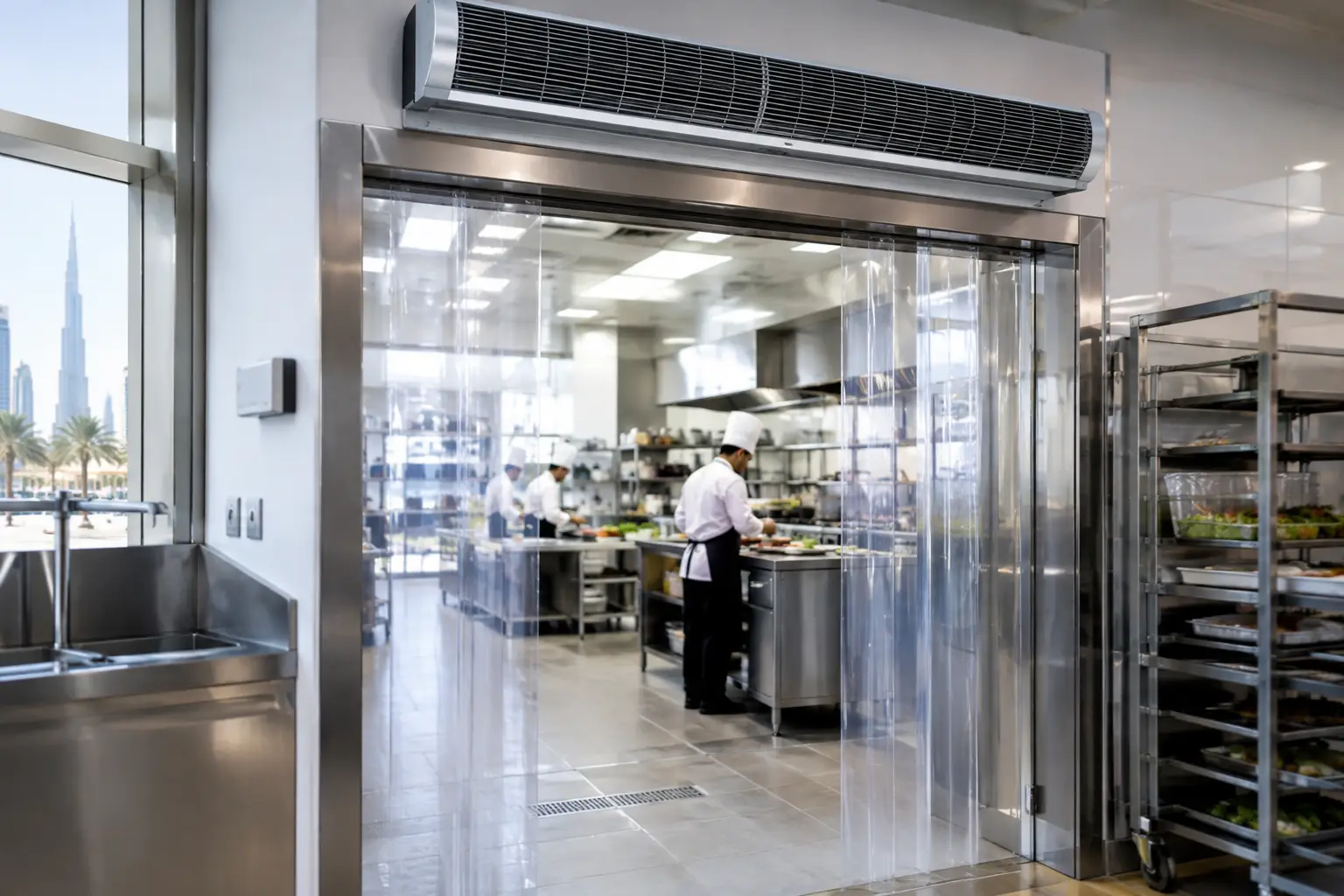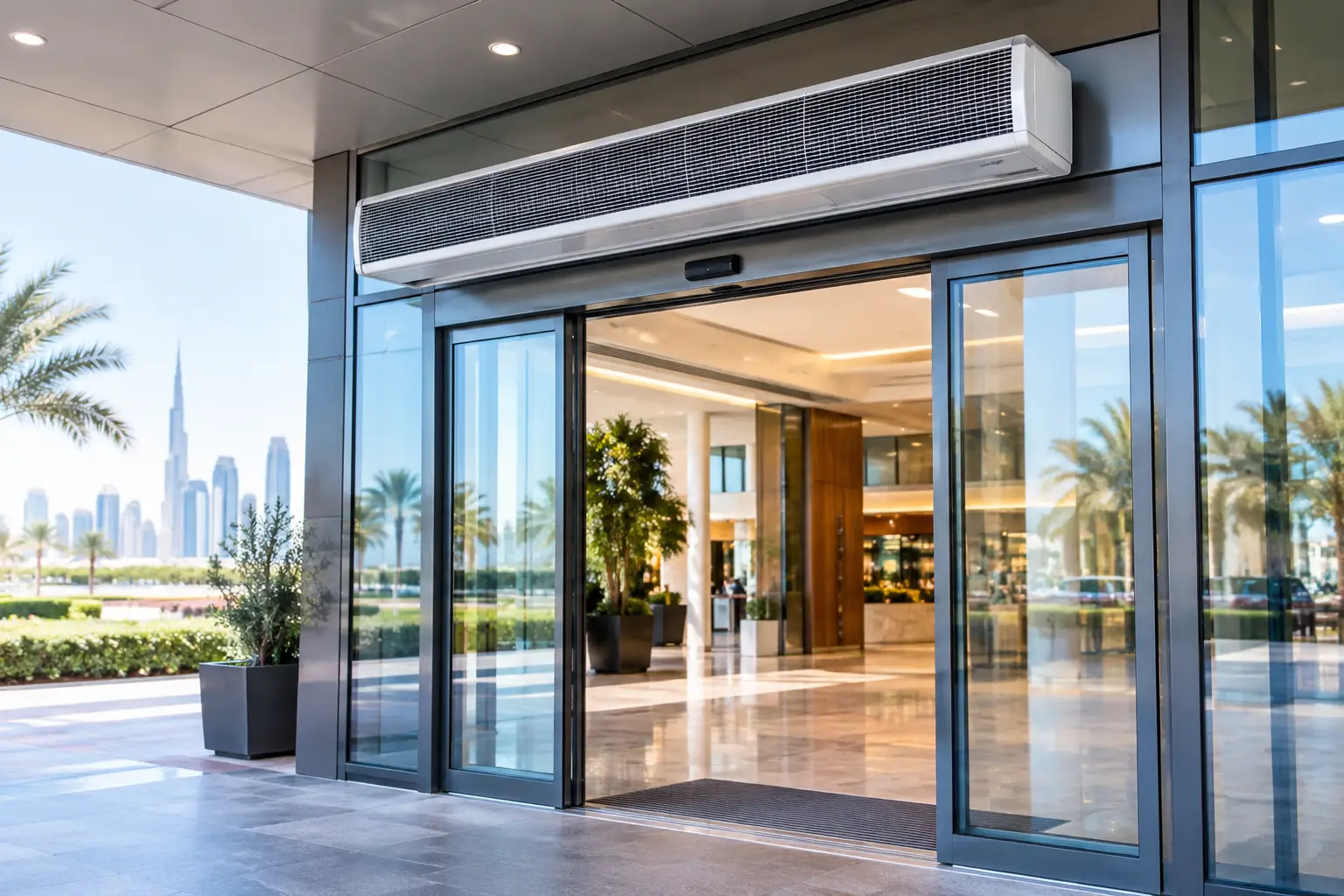
A warehouse roller shutter opens repeatedly through a Dubai afternoon. A loading bay door stays open during dispatch. A supermarket entrance receives a continuous stream of customers. In each case, industrial air curtains create a controlled, high-velocity air barrier across the opening, helping separate conditioned indoor space from punishing outdoor conditions without slowing essential traffic.
For facilities across the GCC, MENA, and Africa, this is not a cosmetic entrance accessory. It is an operational control at one of the building’s most vulnerable points: the doorway. The right system can support cooling retention, improve occupant comfort, and reduce the ingress of dust, humidity, insects, fumes, and airborne contaminants. The wrong system, however, may leave gaps in coverage, create unacceptable noise, or fail to perform in the actual mounting and traffic conditions.
Why are industrial air curtains necessary in hot-climate facilities?
Every open industrial door creates an exchange between indoor and outdoor air. In Riyadh, Doha, Muscat, Cairo, Lagos, or Nairobi, that incoming air can carry extreme heat, moisture, fine dust, odors, or insects. The building’s air-conditioning system then has to remove that added load while maintaining acceptable conditions for people, products, and processes.
An industrial air curtain directs an engineered stream of air downward or across the opening. Its purpose is to disrupt uncontrolled air exchange while allowing people, carts, forklifts, and goods to pass through. It does not physically seal the door, and it should not be specified as a substitute for a closed door where a fully enclosed condition is required. Its value is greatest where access must remain frequent or open for extended periods.
For heavy-use entrances, the operational benefits typically include:
- Reduced loss of conditioned indoor air through open doorways.
- Lower exposure to outdoor heat, humidity, dust, and insects.
- Better comfort near entrances, checkout areas, loading zones, and reception points.
- Added support for hygiene and contamination-control practices in suitable facilities.
- Less strain on HVAC operation caused by repeated door opening.
The result depends on the opening geometry, air-pressure difference, prevailing wind, traffic pattern, and the system selected. A high door in a dusty logistics yard requires a very different approach from a customer entrance at a mall or a controlled access point at a pharmaceutical facility.
Where do industrial air curtains deliver the most value?
The strongest applications are not simply the largest doors. They are the entrances where outdoor air repeatedly compromises indoor conditions and closing the door is impractical.
Warehouses, factories, and logistics centers
Loading bays, dispatch doors, production access points, and forklift routes are common sources of cooling loss. Industrial centrifugal solutions are often considered where openings are larger, mounting heights are more demanding, and operating conditions are tougher. Facility teams should assess whether traffic is intermittent, continuous, or concentrated around shift changes, since this affects controls and operating schedules.
A well-selected air curtain can help protect internal work areas from dust and heat while keeping material movement efficient. It must still be coordinated with door operation, dock layout, and any pressure conditions created by nearby equipment or extraction systems.
Food processing, cold storage, and pharmaceutical environments
In food, storage, and pharmaceutical operations, entrance conditions can influence more than comfort. Humidity, insects, dust, and airborne contaminants may affect hygiene practices, product handling, or environmental control. Air curtains can support separation at frequently used openings, particularly between areas with different operating conditions.
Specification needs to be application-specific. Teams should define the required cleanliness protocol, washdown considerations where applicable, door-use frequency, and the relationship between the entrance and adjacent controlled spaces. An air curtain is one layer of protection within a broader facility design, not a replacement for validated process controls.
Retail, supermarkets, hotels, and public buildings
Customer-facing entrances create a different challenge: frequent pedestrian traffic, visual expectations, comfort requirements, and sometimes limited mounting space. Recessed ceiling units may suit projects where architectural integration matters, while commercial series can address standard storefronts, supermarket entrances, and hotel access points.
For these environments, selection often balances air performance with appearance and acoustic expectations. The goal is to maintain a welcoming entrance while reducing the blast of hot, humid, or dusty outdoor air that visitors notice immediately.
How should a project team select industrial air curtains?
Choosing by door width alone is a common specification mistake. Width matters, but it does not establish whether the airflow will reach the threshold with enough continuity to form an effective barrier. A professional assessment should start with the building and the opening, not a catalog model.
Use this selection process when preparing a project brief:
- Measure the opening and mounting condition. Record clear width, clear height, available headroom, mounting surface, and whether the unit will be exposed to wind or external weather.
- Map traffic and door behavior. Identify pedestrian, trolley, forklift, pallet, or vehicle movement, along with how often and how long the door remains open.
- Define the outdoor challenge. Consider heat, humidity, dust, insects, odors, smoke, or fumes relevant to the specific site and season.
- Review the indoor objective. The priority may be customer comfort, cooling retention, dust control, hygiene support, or separation between operational zones.
- Coordinate with HVAC and controls. Confirm how the unit will operate with door contacts, building schedules, air-conditioning strategy, and other systems affecting pressure at the opening.
- Match the product family to the application. Consider recessed, commercial, or industrial configurations based on duty level, mounting position, visual requirements, and entrance conditions.
FreezeeX evaluates these project inputs before recommending a system. That consultation-led approach matters because a product suited to a retail doorway may not be appropriate for a high-traffic industrial shutter, even when the nominal opening width appears similar.
What affects air curtain performance at an open door?
An air curtain works through airflow direction, velocity, coverage, and stability. If the discharge stream is disrupted before reaching the floor or threshold, outside air can pass underneath or around it. Crosswinds, pressure imbalance, and obstructions are especially relevant at loading doors and entrances close to external vehicle routes.
Mounting height and discharge coverage
Higher mounting positions require the air stream to remain effective across a greater distance. Wide openings may require multiple units arranged for continuous coverage. Gaps between units, inadequate overlap, or a unit that does not cover the active opening can undermine the intended result.
The installation position also matters. A unit should be located and aligned so its airflow is not blocked by structural elements, door tracks, signs, or equipment. For recessed installations, coordination with ceiling construction and service access should happen early in the design stage.
Building pressure and local airflow
Doorway performance cannot be separated from the rest of the building. A facility that is strongly negative in pressure may draw outdoor air inward more aggressively. Nearby exhaust, high-speed vehicle movement, prevailing winds, and adjacent open doors can all influence the air barrier.
This is why MEP coordination is essential. The air curtain should complement the HVAC design rather than be treated as an isolated device. Where the pressure conditions are unusual, an on-site review can prevent costly assumptions before procurement.
Climate and contamination exposure
Desert dust and extreme heat demand a different project conversation from coastal humidity or tropical rainfall. In the UAE and Saudi Arabia, fine airborne dust and heat are frequent concerns. In humid locations such as parts of the Gulf and East or West Africa, moisture ingress can place additional demand on indoor cooling and comfort control.
Facilities should also distinguish between ordinary outdoor dust and process-specific contaminants. Where smoke, fumes, odors, or sensitive production requirements are involved, air curtain specification needs to be considered alongside the facility’s wider air-management plan.
Which product approach fits the entrance?
FreezeeX offers Recessed Ceiling Air Curtains, Commercial Centrifugal Flow Series, Commercial HiFi Plus Series, Industrial Centrifugal Series, and New Dynamic Series options for different commercial and industrial requirements. Selection should follow application conditions rather than visual preference alone.
| Entrance condition | Typical specification priority | Product approach to assess | |—|—|—| | Customer-facing retail or hotel entrance | Comfort, appearance, frequent pedestrian flow | Recessed ceiling or commercial series | | Supermarket or mall access | Continuous coverage, HVAC support, customer comfort | Commercial centrifugal flow or commercial series | | Warehouse or factory opening | Heavy-duty operation, larger openings, demanding traffic | Industrial centrifugal series | | Specialized high-traffic commercial entrance | Application fit, controls, airflow coverage | New Dynamic Series or suitable commercial option | | Food, pharmaceutical, or controlled operations | Entrance separation aligned with process requirements | Application-led evaluation with the relevant series |
The table is a starting point, not a final specification. Exact suitability depends on the opening dimensions, mounting height, operating environment, and required outcome. Procurement teams should request a recommendation based on actual site data instead of treating one series as a universal solution.
Specify for the doorway, not the brochure
The most effective industrial air curtain is the one sized and positioned for the way the entrance truly operates. That requires clear information from the project team and a supplier willing to ask practical questions about traffic, climate exposure, HVAC conditions, and the building’s operational priorities.
For projects in hot, humid, tropical, and desert climates, request a consultation and quotation from FreezeeX with your entrance dimensions, mounting details, traffic pattern, and site conditions. A correctly matched air curtain can turn an open doorway from a persistent source of cooling loss into a more controlled part of the facility.