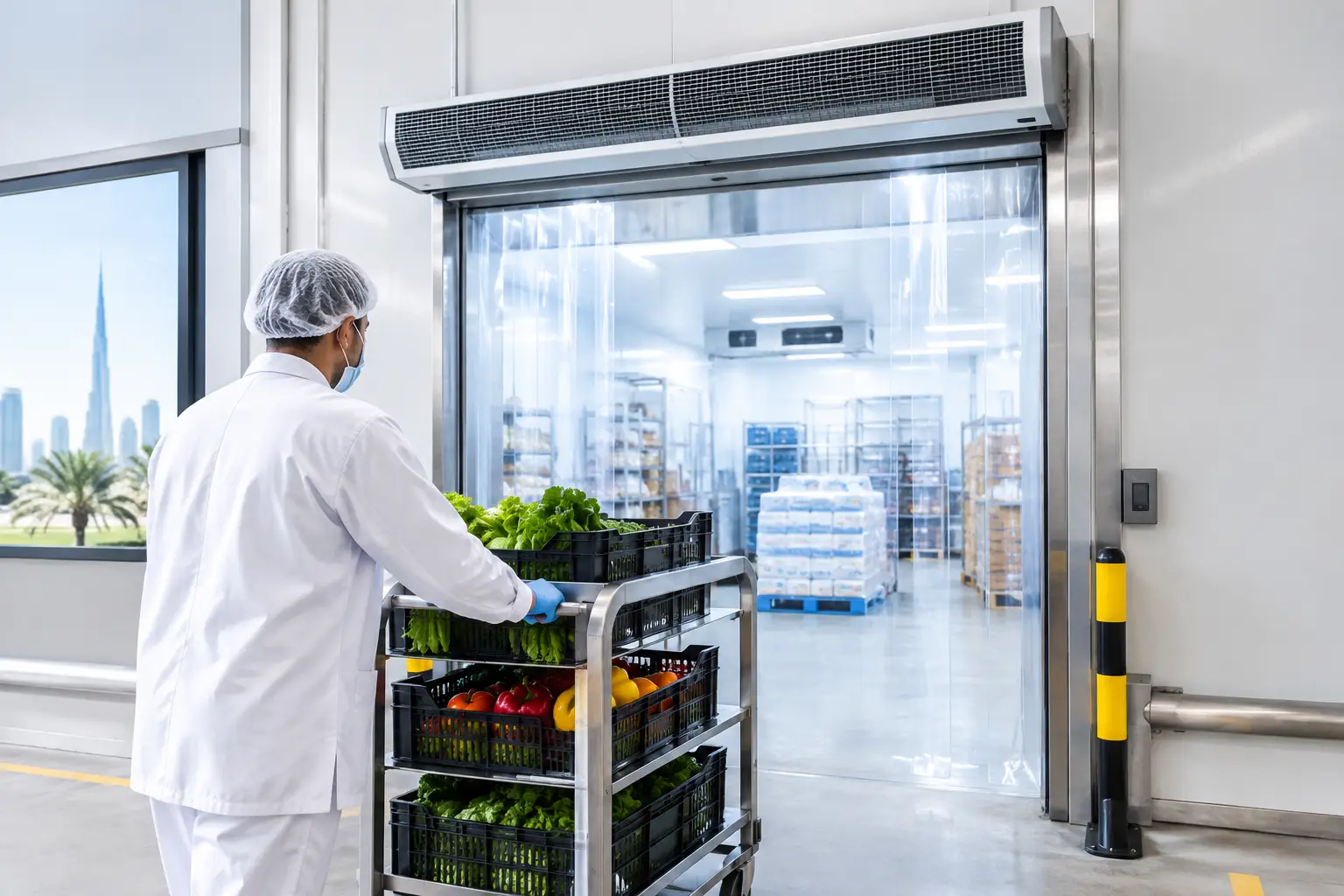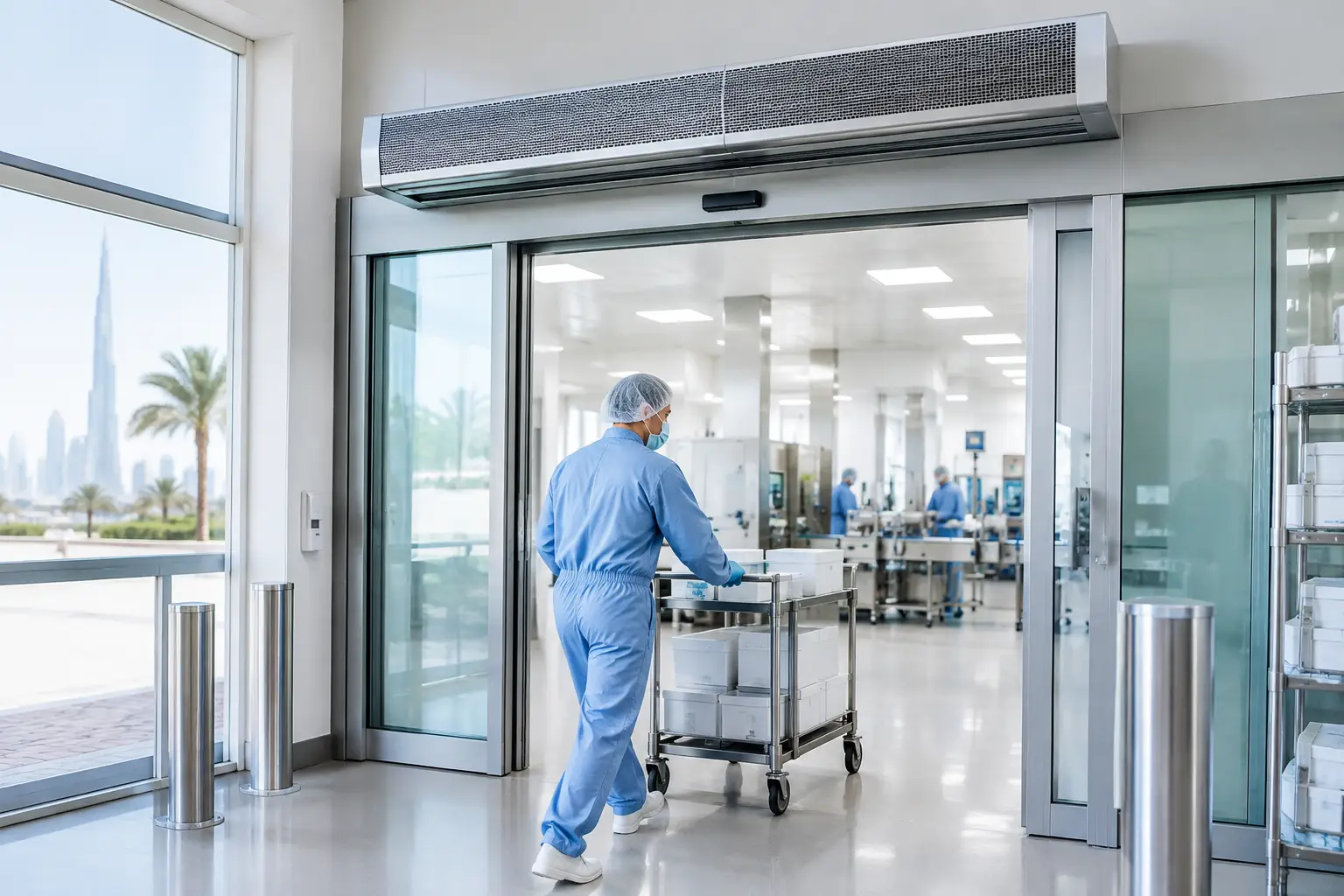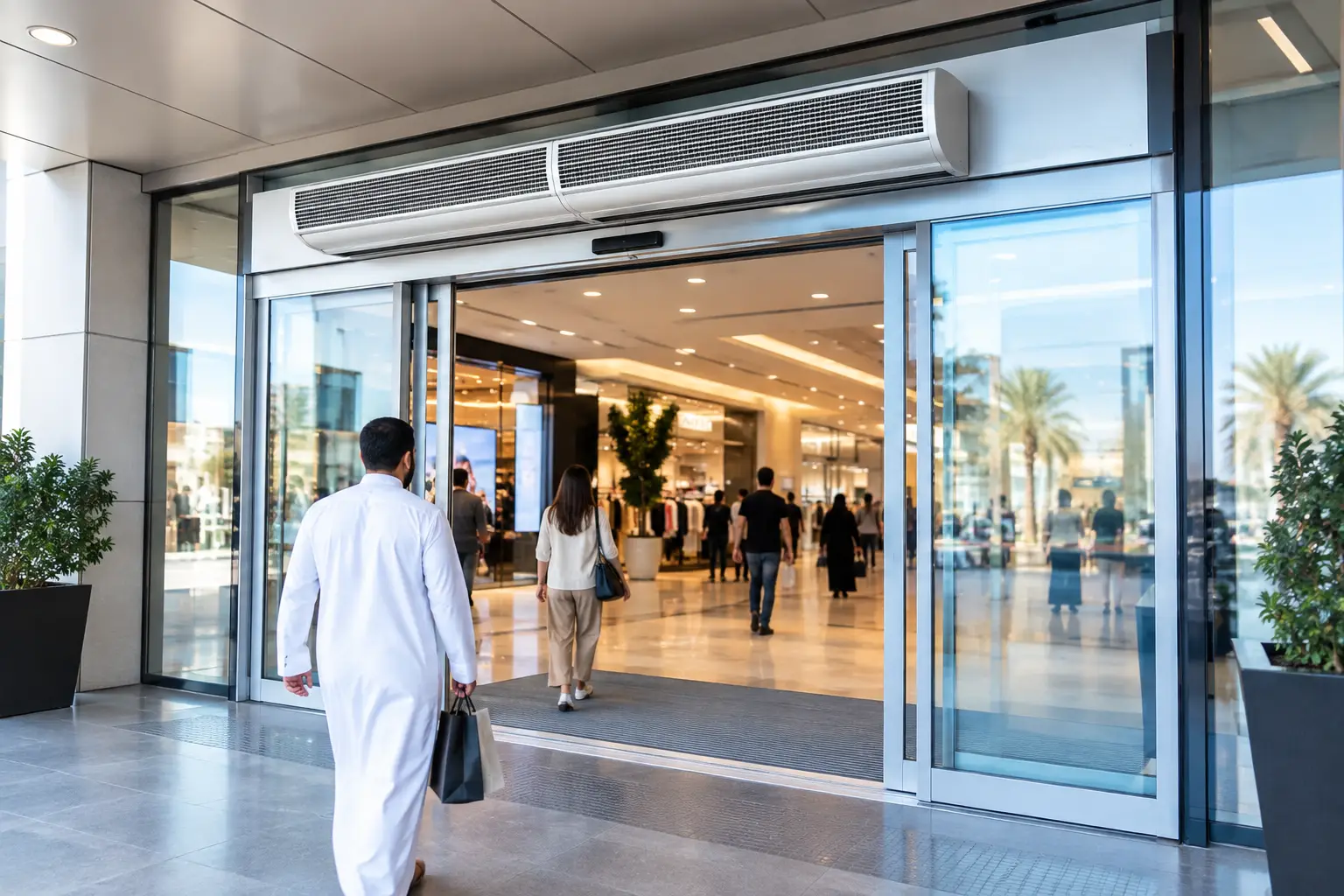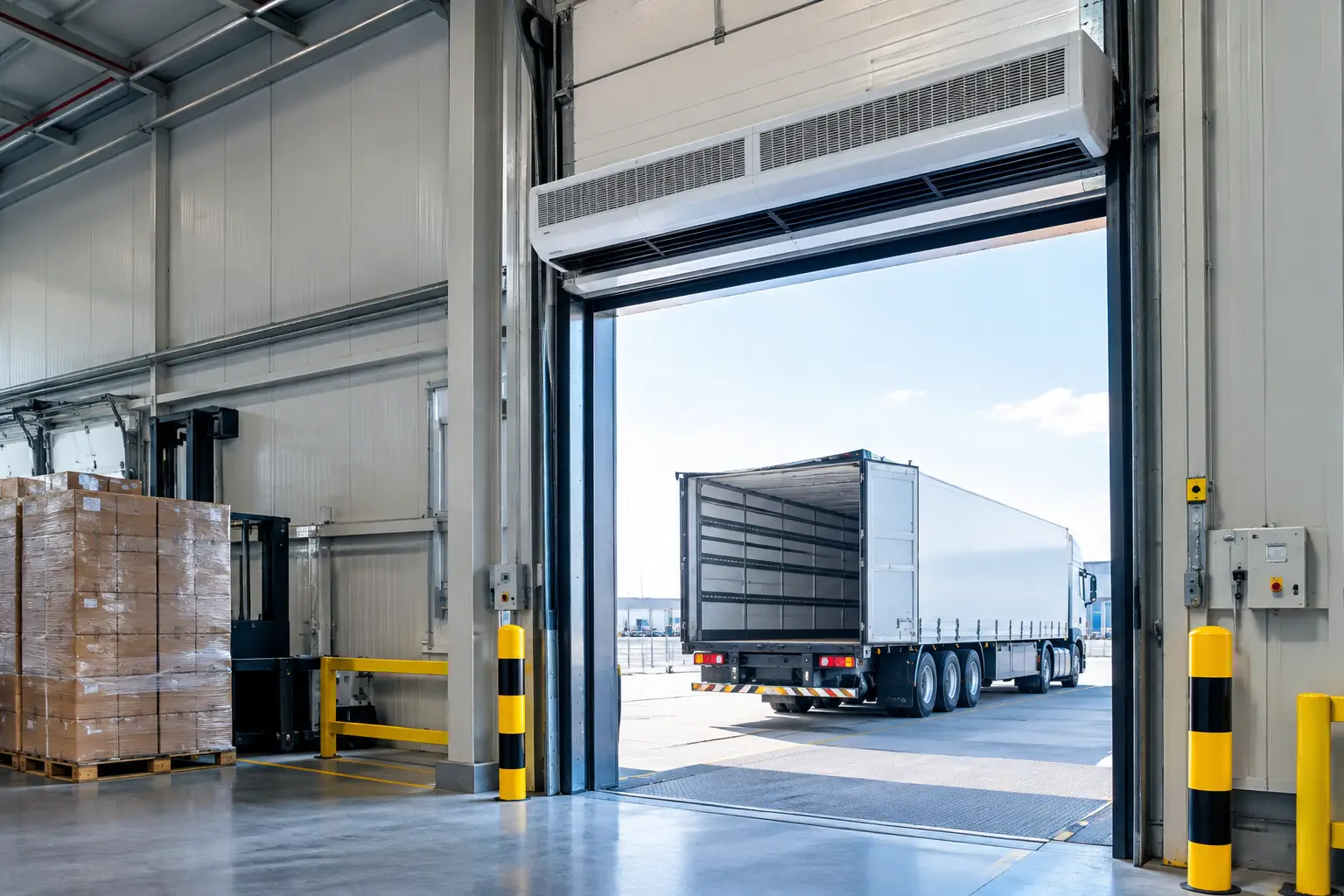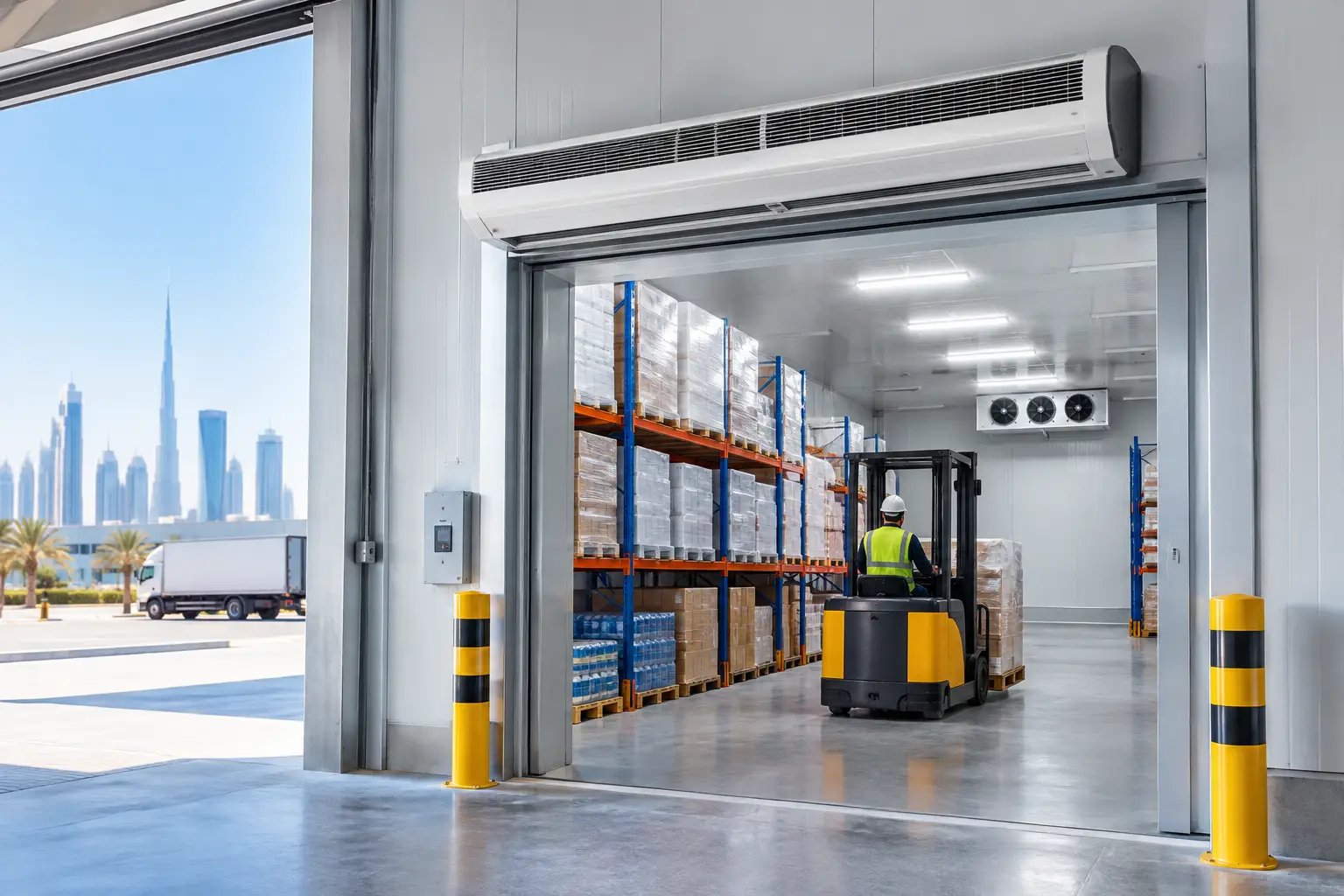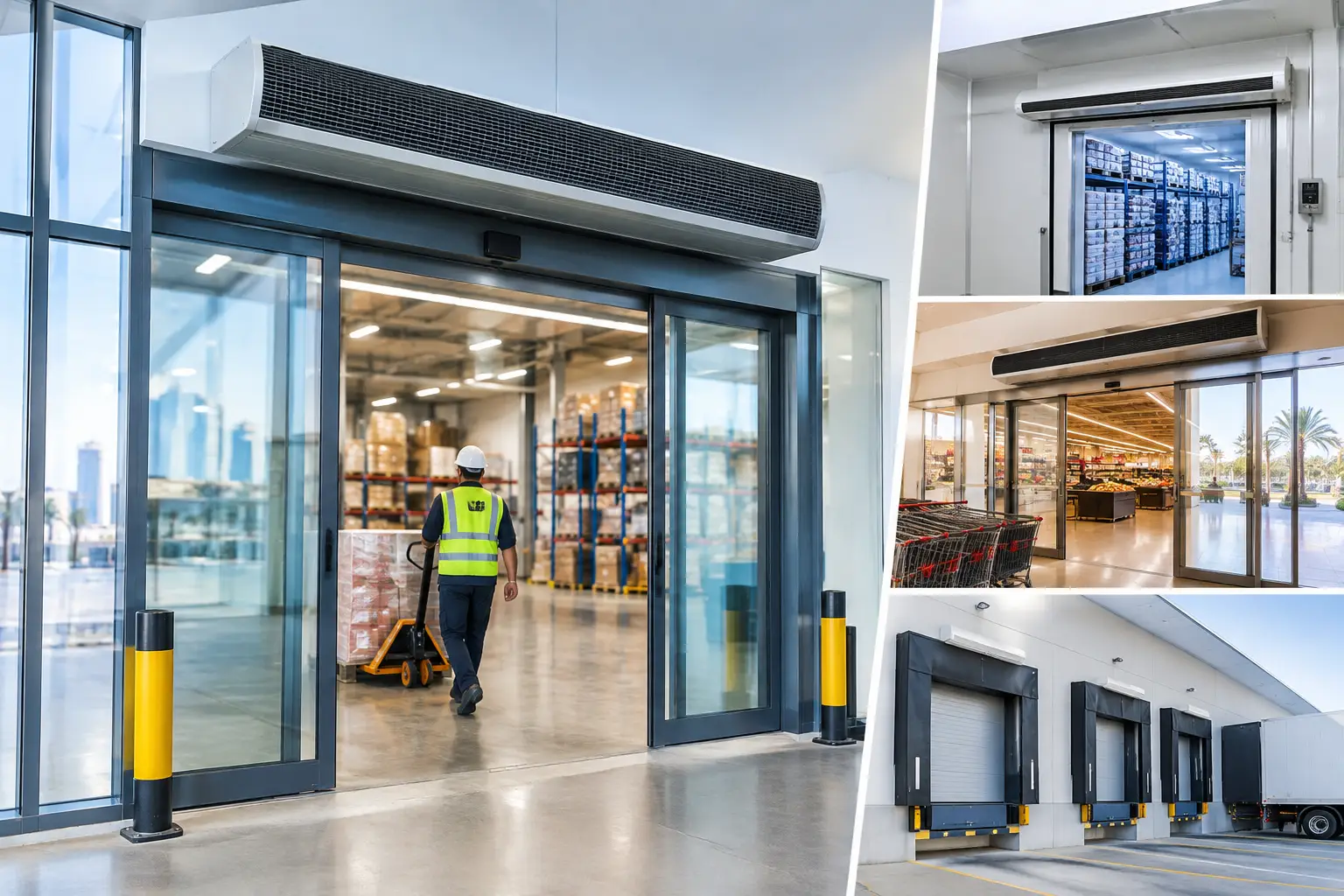
A loading-bay door that stays open through a delivery cycle can become a direct path for warm, dusty, humid outside air and flying insects to enter a controlled food environment. This food safety entrance protection guide explains how commercial air curtains support a stronger entrance-control strategy at food processing sites, cold storage facilities, commercial kitchens, supermarkets, and distribution centers.
Why is entrance protection part of food safety?
Food safety controls do not begin at the production line. They begin where people, ingredients, packaging, and deliveries enter the building. A frequently opened exterior door can compromise indoor conditions long before a product reaches a processing or storage area.
In hot, humid, and desert markets, the pressure on entrances is especially high. Outdoor heat can increase cooling demand, humidity can affect internal conditions, and dust or insects may enter whenever a door is open. Facilities in Dubai, Riyadh, Doha, Muscat, Cairo, Lagos, and Nairobi often need a practical way to keep traffic moving without leaving the entrance unprotected.
An air curtain creates a directed stream of air across an opening. When it is correctly selected and installed, that stream forms an air barrier intended to reduce the movement of outside air and airborne intrusions through an open doorway. It does not replace sanitation programs, door discipline, pest-control measures, physical barriers, or HACCP procedures. It strengthens the entrance as one controlled point within that wider system.
What risks should a food facility address at open doors?
Every doorway has its own exposure profile. A staff entrance, a retail delivery door, and a cold-store dispatch opening should not be treated as the same application. Before specifying equipment, identify what the opening exposes the facility to and how the door is used.
Key risks commonly include:
- Flying insects entering receiving areas, kitchens, packing zones, or retail back-of-house spaces.
- Dust, sand, and airborne particles entering through doors exposed to desert or high-traffic external areas.
- Warm air and humidity affecting conditioned rooms, refrigerated staging areas, and temperature-sensitive workflows.
- Cooling loss that increases the load on the building’s HVAC system during frequent door operation.
- Smoke, fumes, or odors moving inward from loading yards, vehicle areas, or adjacent operational spaces.
- Cross-traffic disruption when doors are held open for carts, pallet movement, deliveries, or peak customer flow.
The significance of each risk depends on zoning. An entrance leading into a public supermarket sales floor may require a different approach from one serving ingredient receiving or a high-care processing zone. The goal is not simply to install an air curtain at every door. The goal is to control the openings that can affect operational conditions, product handling, and facility hygiene.
How do air curtains support food safety entrance protection?
Air curtains are most effective when they are specified as operational infrastructure rather than as an afterthought. They allow a doorway to remain functional for people and goods while helping reduce the uncontrolled exchange of air across the opening.
For food-related facilities, the practical outcomes are clear. A properly matched unit can help limit insect ingress, reduce the entry of dust and humidity, and preserve conditioned indoor air during high-frequency use. This can support cleaner entrance areas and reduce the operational impact of open-door traffic.
Air curtains also help address a common trade-off: physical doors provide a strong barrier when closed, but busy operations cannot always wait for doors to close between every movement. At a receiving dock or supermarket service entrance, an air barrier can provide active protection while traffic passes through. It should be coordinated with door operation, not used as a reason to tolerate damaged seals, poor sanitation, or uncontrolled traffic patterns.
Match the system to the opening, not just the industry
A food factory and a restaurant may both need insect and dust control, yet their entrances can differ substantially in width, height, mounting arrangement, and traffic volume. Selecting by label alone can lead to weak air coverage or an oversized solution that does not suit the space.
| Entrance condition | Main specification concern | Typical system direction | | — | — | — | | Customer-facing supermarket or restaurant entrance | Comfort, appearance, frequent pedestrian traffic | Commercial air curtain selected for the entrance geometry and indoor environment | | Food processing personnel door | Dust and insect control with repeated staff movement | Commercial-duty unit coordinated with hygiene zoning and traffic patterns | | Warehouse or distribution loading door | Large opening, higher air movement, forklift or pallet traffic | Industrial air curtain designed for demanding operational entrances | | Cold storage access point | Limiting warm-air infiltration and protecting the temperature-controlled workflow | Application-specific assessment of door use, temperature difference, and mounting position | | Recessed architectural entrance | Concealed appearance with controlled pedestrian traffic | Recessed ceiling air curtain where the ceiling design and service access allow it |
FreezeeX offers commercial, industrial, recessed, and dynamic air curtain ranges for projects where application fit matters. For example, a high-traffic receiving entrance may call for an industrial approach, while a public-facing food retail entrance may be better suited to a commercial configuration. The correct recommendation depends on the opening itself, not a generic food-sector checklist.
What should be reviewed before specifying an air curtain?
A proper review starts with the real operating conditions. The following sequence gives MEP consultants, contractors, and facility teams a practical basis for an informed recommendation.
- Measure the clear opening and mounting position. Record the usable width, door height, headroom, and whether the unit can be mounted above the opening or requires a recessed arrangement. Airflow must cover the actual passage, not only the nominal door size.
- Observe traffic and door behavior. Establish whether the entrance is used by pedestrians, carts, trolleys, forklifts, or deliveries. Note peak periods and whether doors are automatic, manually held open, or regularly blocked during receiving.
- Assess the external environment. Consider outdoor heat, humidity, dust, insects, wind exposure, nearby vehicle activity, and any smoke or fumes. A sheltered mall entrance has different requirements from an exposed warehouse dock in a dusty industrial area.
- Define the protected zone. Identify whether the opening leads to a public sales space, preparation area, packaging room, refrigerated staging zone, or controlled production environment. This determines the consequences of air exchange and the level of control required.
- Coordinate with the HVAC and facility design. An air curtain should complement the building’s cooling strategy, pressure relationships, door controls, and maintenance access. It is not a substitute for correcting an unsuitable HVAC design.
- Confirm the operating objective. Projects may prioritize limiting insect entry, reducing cooling loss, improving comfort near the entrance, reducing dust, or a combination of these outcomes. A clear priority helps the supplier recommend the right configuration.
Where do food projects commonly get entrance protection wrong?
The most common error is treating all open doors as identical. A unit selected for a standard commercial entrance may not provide suitable coverage at a tall loading opening or an exposed industrial doorway. Mounting height and width, ambient conditions, and traffic intensity directly influence performance.
Another issue is separating entrance protection from the food-safety plan. When operations, facilities, pest control, and HVAC teams work independently, gaps can remain. For example, a facility may increase cleaning frequency without addressing the continual entry of dust through a busy receiving door. Or it may install physical pest controls while leaving a high-traffic opening exposed for long periods.
Maintenance access also deserves early attention. Any equipment installed at an entrance should be positioned so authorized personnel can inspect it and maintain the surrounding area without disrupting operations. In food environments, accessibility supports reliable long-term performance and cleaner facility management.
Choosing commercial, industrial, or recessed protection
The choice between product categories is largely about operating demand. Commercial air curtains are often appropriate for pedestrian-facing entrances in restaurants, hotels, supermarkets, and retail food locations. Industrial air curtains are better suited to larger, harder-working openings in warehouses, factories, logistics facilities, and loading areas where exposure and traffic are greater.
Recessed ceiling air curtains can suit projects where the entrance design calls for a less visible installation, provided the ceiling space, service access, and airflow path are appropriate. In every case, the system must be selected around the doorway’s geometry and use pattern. A visually discreet installation is not useful if it cannot deliver effective coverage at the opening.
For facilities across the GCC, MENA, and Africa, climate suitability should remain central to the brief. Hot outdoor air, humidity, desert dust, and operational intensity are not secondary details. They are the conditions the entrance solution must be designed around.
Specify the entrance as a controlled operational zone
The strongest food safety entrance protection plan combines sound workflow, well-maintained doors, hygiene procedures, pest-control measures, and an air curtain sized for the real opening. That approach protects product-handling areas without slowing the movement that keeps a food operation productive.
For a project-specific recommendation or quotation, consult FreezeeX with the entrance dimensions, mounting details, traffic profile, indoor use, and local climate exposure. A correctly assessed air curtain can help turn a vulnerable open door into a more controlled part of your facility’s daily operation.