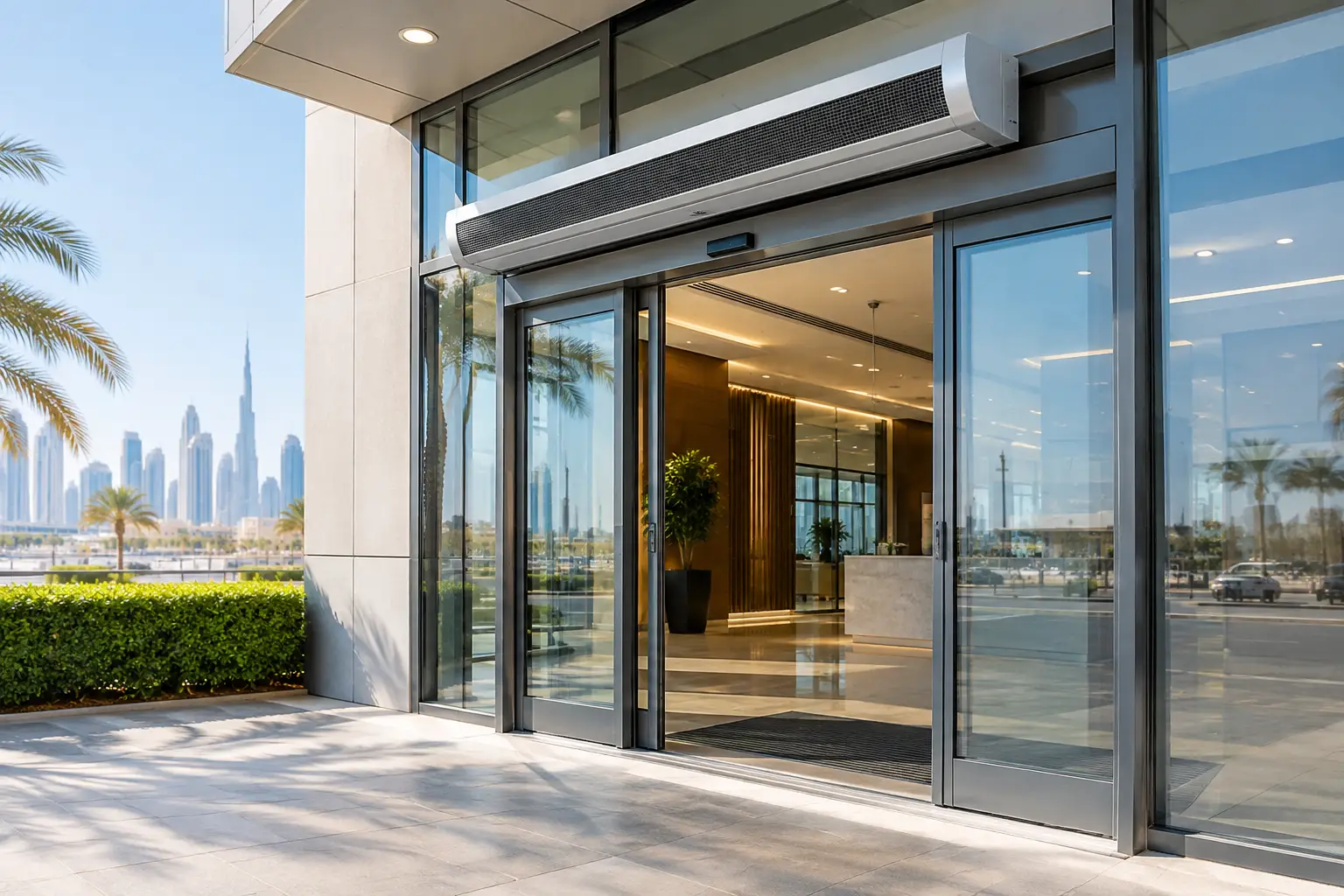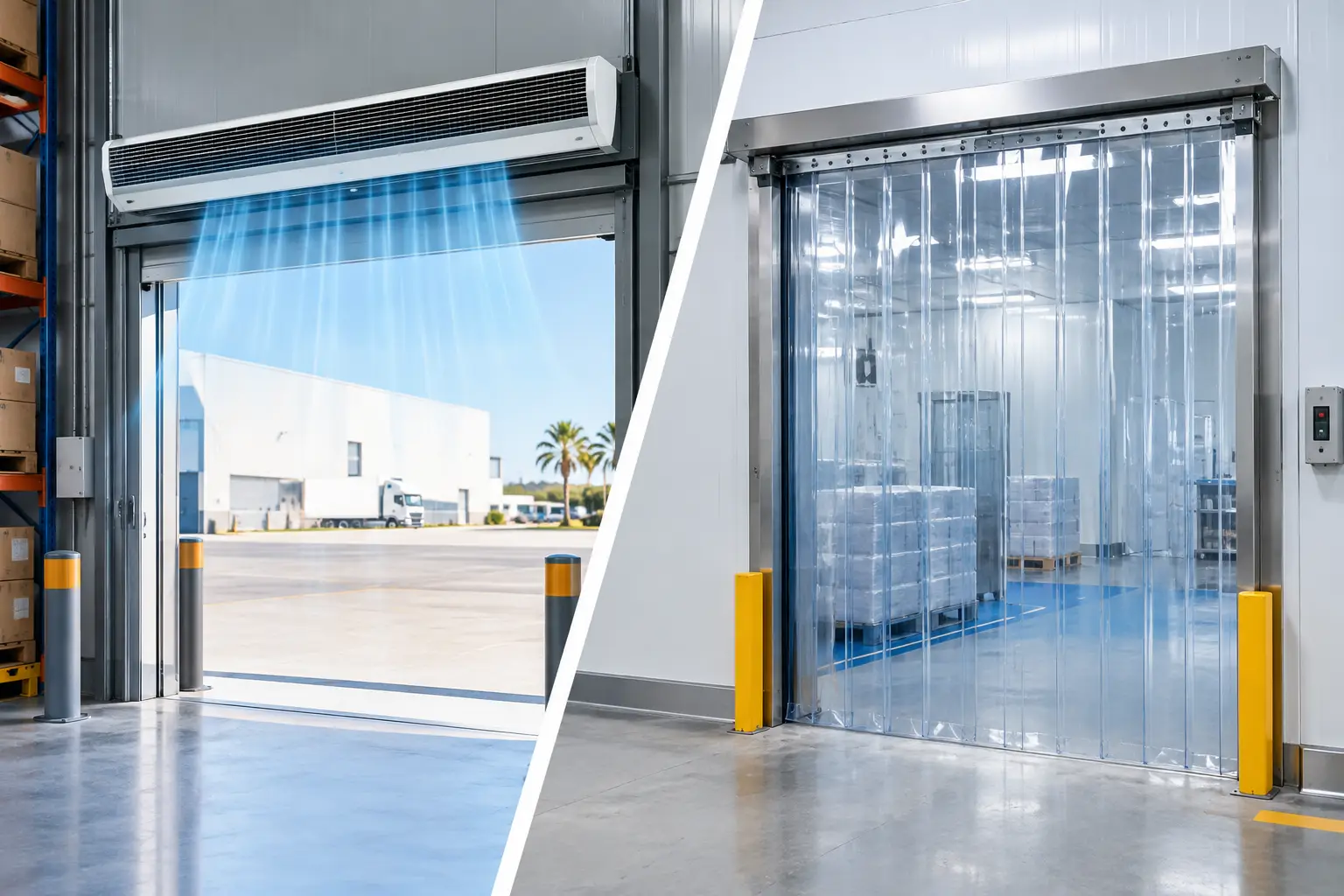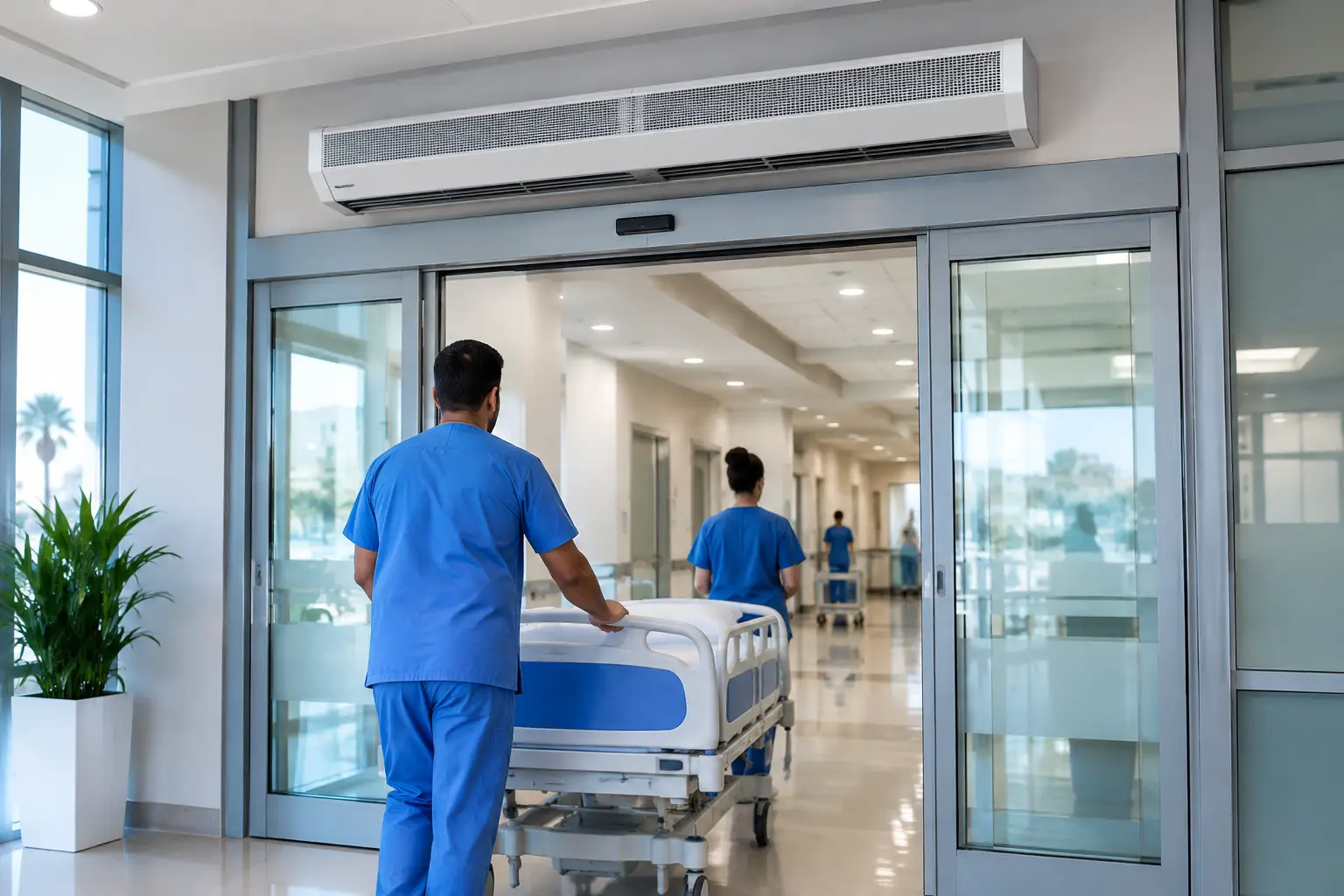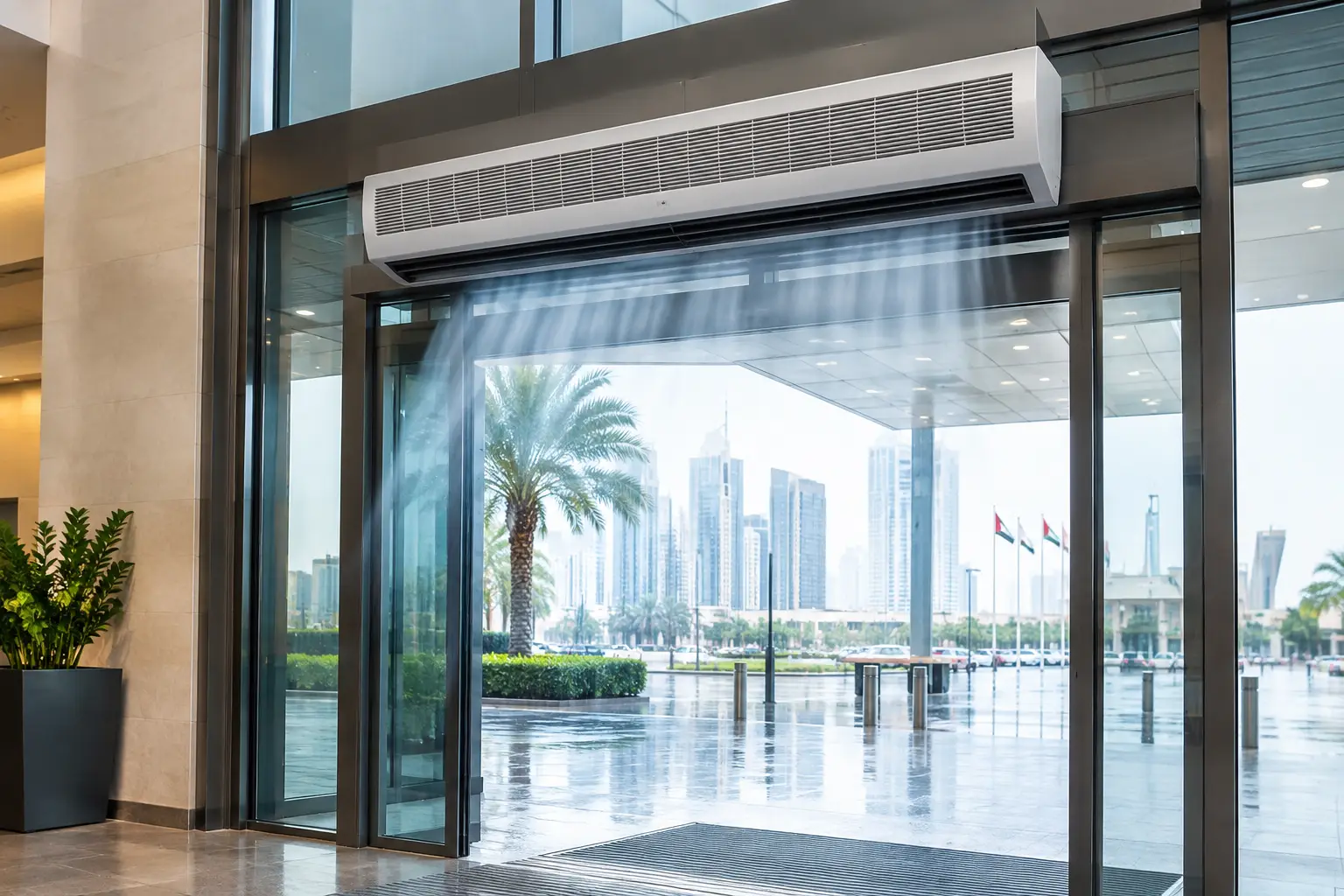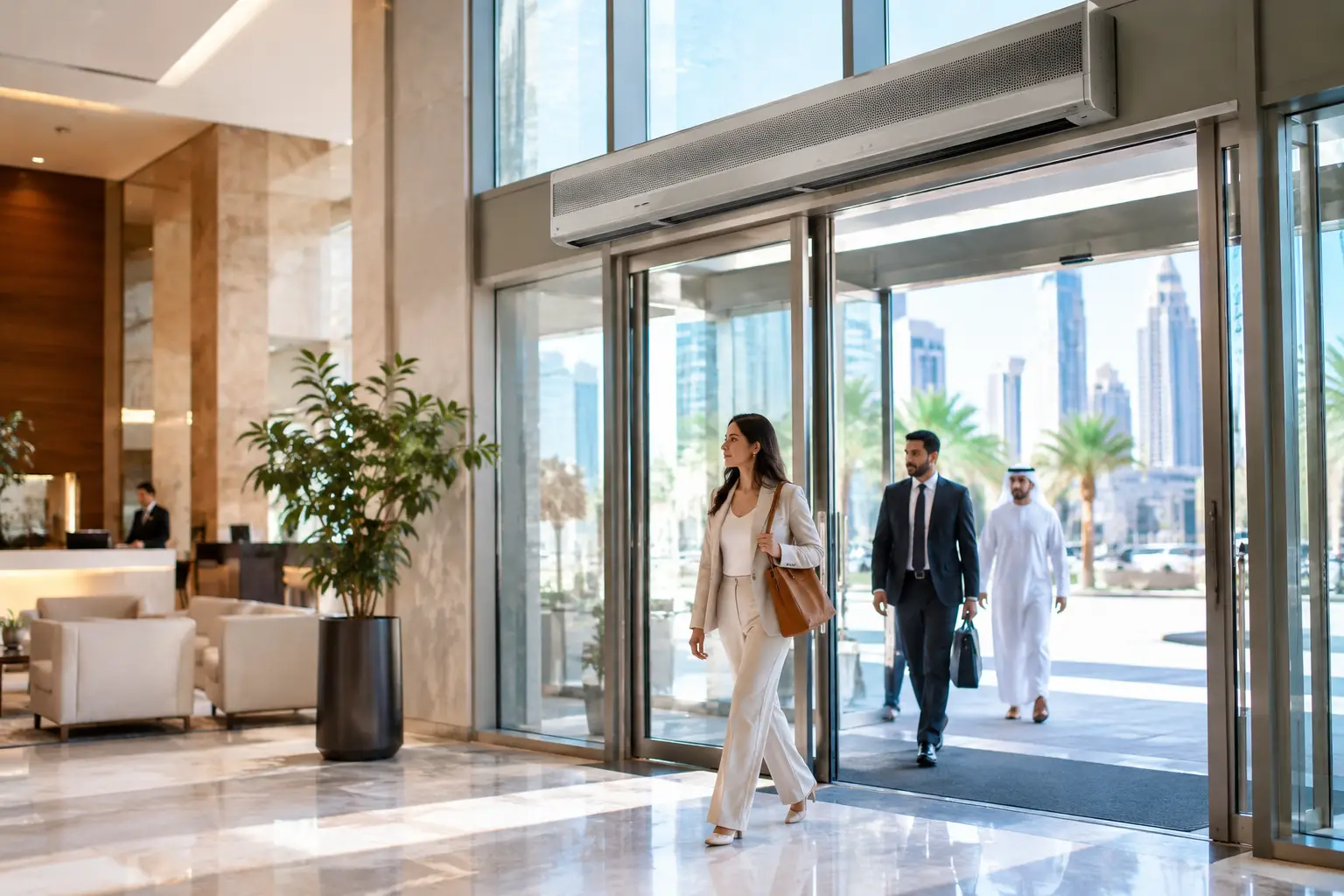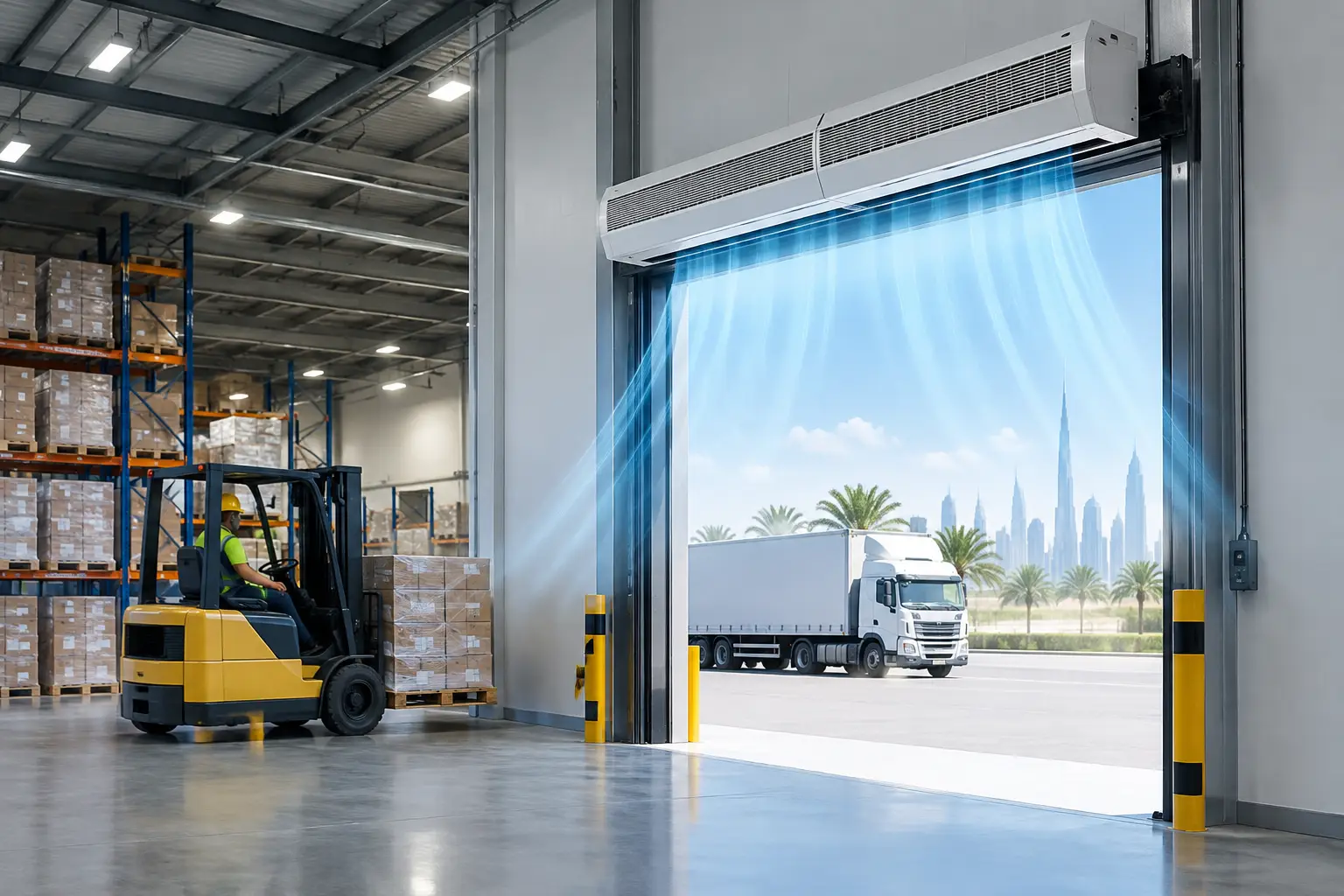
A loading bay door opening repeatedly in Dubai at midday does more than admit hot air. It disrupts the pressure and temperature conditions that the building’s HVAC system is working to maintain. Effective desert cooling addresses this weak point at the entrance, where conditioned air, dust, humidity, insects, and outdoor heat can enter in seconds.
For facilities across the GCC, MENA, and Africa, entrance climate control is not a cosmetic upgrade. It is an operational consideration that affects customer comfort, product handling, indoor cleanliness, and the demand placed on mechanical cooling equipment. Commercial air curtains are often a practical part of that strategy because they create an air barrier while allowing people, carts, and goods to move freely.
Why desert cooling starts at the door
A building may have well-designed air conditioning, insulated walls, and efficient equipment, yet still lose a meaningful amount of cooling at its busiest entrances. This is especially relevant in retail, logistics, food processing, hospitality, healthcare, and industrial facilities where doors cannot remain closed throughout the day.
Outdoor conditions in Riyadh, Doha, Abu Dhabi, Muscat, Cairo, Lagos, and Nairobi differ in detail, but the operating challenge is familiar: high ambient temperatures, airborne dust, humidity in coastal locations, or a combination of all three. When a doorway opens, the pressure difference between the conditioned interior and exterior encourages air exchange. The result can be warm drafts, uneven comfort near entrances, and extra HVAC runtime.
An air curtain directs a controlled stream of air across an opening. Properly selected and installed, it helps separate indoor and outdoor environments without creating a physical obstruction to traffic. It should support the existing HVAC design, not be treated as a replacement for it.
What an air curtain contributes to desert cooling
The main purpose of an air curtain in a hot-climate commercial setting is air isolation. The unit creates a barrier that makes it harder for outdoor air and contaminants to cross an open doorway. Its performance depends on matching the air stream to the actual opening and operating conditions.
For commercial and industrial decision-makers, the practical outcomes can include:
- Reduced loss of conditioned indoor air through frequently used doors
- Less ingress of heat, dust, humidity, insects, smoke, fumes, and airborne contaminants
- More consistent comfort for staff, visitors, and customers close to entrances
- Lower strain on HVAC equipment during high-traffic periods
- Improved separation between clean, temperature-controlled, and operational zones
The value is particularly clear where the door must stay open for service, delivery, customer circulation, or production flow. A supermarket entrance, hotel lobby, warehouse dispatch door, and pharmaceutical facility all require different levels of air isolation, but each can benefit from controlling what crosses the opening.
Air curtains are not one-size-fits-all equipment
A compact retail entrance and a high-clearance industrial bay have very different airflow requirements. Selecting a unit only by doorway width, or choosing the largest available option, can lead to poor results. The air stream must reach the floor or threshold area with enough stability to resist crosswinds, stack effect, pressure differences, and traffic disturbance.
Key factors that determine the right system
A professional assessment should account for the complete operating environment, including:
- Entrance dimensions: Width and mounting height influence the reach and coverage required.
- Door use: Pedestrian traffic, shopping carts, forklifts, and frequent delivery movement each affect barrier stability.
- Interior conditions: Cooling setpoints, pressure control, clean-zone requirements, and HVAC supply locations matter.
- Outdoor exposure: Desert heat, wind, dust, coastal humidity, and direct sun can increase the challenge.
- Mounting position: Surface, recessed, vertical, and industrial configurations affect performance and appearance.
- Application sensitivity: Food handling, healthcare, cold storage, and pharmaceutical areas may require tighter environmental separation.
This is why consultation-led selection is preferable to a generic product choice. The air curtain is part of the entrance system, and its success depends on how it works with the door, building pressure, and actual traffic pattern.
Which air curtain configuration fits the application?
FreezeeX supplies commercial and industrial air curtain ranges designed for demanding tropical and desert-climate environments. The appropriate series depends on the entrance type, required duty level, and architectural constraints.
| Application environment | Typical entrance challenge | Suitable air curtain approach | |—|—|—| | Retail stores, supermarkets, and malls | High pedestrian traffic and visible customer-facing entrances | Commercial units selected for reliable coverage, controlled noise, and an appropriate finish | | Hotels, restaurants, and office lobbies | Comfort expectations, frequent door cycles, and reception-area appearance | Recessed or commercial configurations that integrate with the entrance design | | Warehouses and logistics centers | Wide openings, forklifts, loading activity, and dust exposure | Industrial centrifugal systems matched to opening height, traffic, and operational intensity | | Factories and workshops | Heat, dust, fumes, and changing internal pressure conditions | Heavy-duty industrial solutions with application-specific airflow planning | | Food processing, cold storage, and pharmaceutical facilities | Separation between controlled areas and operational movement | Air isolation selected alongside hygiene, temperature, and process-flow requirements |
For architecturally sensitive projects, recessed ceiling air curtains can preserve a cleaner visual line at the entrance. For busy commercial openings, centrifugal flow and HiFi Plus configurations can support day-to-day climate separation. Industrial facilities may require the greater duty capability associated with industrial centrifugal or Dynamic Series solutions.
The series name alone should not determine the specification. A model that performs well over a standard commercial doorway may be unsuitable for a tall, exposed loading entrance. Conversely, an oversized industrial solution may create unnecessary noise or operating cost at a small lobby door.
How should project teams specify desert cooling at entrances?
The most reliable approach is to assess the entrance before finalizing equipment. This helps prevent a common problem: selecting an air curtain after the door layout, ceiling services, and HVAC arrangement are already fixed.
A practical specification workflow follows five steps:
- Map the opening and traffic pattern. Record clear width, mounting height, door type, expected opening duration, and whether people, trolleys, or vehicles pass through.
- Define the environmental objective. Establish whether the priority is reducing heat gain, controlling dust, limiting humidity, protecting a clean area, or supporting a cold-chain process.
- Review the surrounding HVAC conditions. Consider supply and return locations, indoor pressure, nearby doors, and any conditions that could deflect the air stream.
- Select the mounting and duty level. Choose a configuration that suits both the building design and the intensity of use, rather than treating appearance as the only criterion.
- Coordinate installation and controls. Door status, operating schedules, and facility procedures should support the intended air-curtain operation.
Early coordination is particularly valuable for new developments in Dubai, Riyadh, and Doha, where entrance design often combines high foot traffic with strong cooling demand. In retrofit projects, the same process identifies whether an existing doorway has enough mounting space and whether adjacent HVAC conditions need adjustment.
Common mistakes that weaken entrance performance
The most frequent issue is underestimating the opening. A unit may look properly sized from the front but fail to maintain a stable barrier because the mounting height is too great, the doorway is exposed to wind, or pressure differences are stronger than expected.
Another mistake is treating every entrance as a pedestrian doorway. Industrial doors, dispatch zones, and forklift access points require a different assessment from a retail storefront. Heavy traffic creates turbulence, and large openings create a longer air path that must be planned for accordingly.
Projects also lose performance when air curtains are isolated from the HVAC conversation. If a facility has excessive negative pressure, poorly placed supply air, or major air movement near the opening, the air curtain may need a revised configuration to work effectively. The objective is coordinated building performance, not simply adding equipment above a door.
Where air curtains make the strongest commercial case
Air curtains are most compelling where the cost of an open doorway is repeated throughout the operating day. Supermarkets with continuous customer flow, warehouses with active dispatch schedules, and hospitality venues with busy entrances are obvious examples. They are also useful in facilities where dust or insects can affect cleanliness, product quality, or visitor experience.
In humid coastal markets, the air barrier can help reduce the amount of moist outdoor air entering a cooled space. In dry desert conditions, it can limit dust and extreme heat at exposed doors. In mixed-use industrial environments, it can assist with separating operational zones from offices, production spaces, or controlled storage areas.
The right expectation is improvement, not a magic seal. An air curtain cannot overcome a severely unsuitable doorway design, uncontrolled crosswinds, or a building-pressure problem on its own. It is most effective when it is specified as part of a broader approach to entrance management and HVAC efficiency.
Get a project-specific desert cooling recommendation
For a commercial entrance in a desert or tropical climate, the best air curtain is the one matched to the opening, traffic volume, mounting condition, and environmental risk. Before requesting a quote, prepare the doorway dimensions, photographs or drawings, operating schedule, and a clear description of the indoor and outdoor conditions.
FreezeeX can assess these requirements and recommend a commercial or industrial air curtain configuration for your project. A properly planned entrance barrier gives your cooling system a better chance to protect the environment it was designed to maintain.