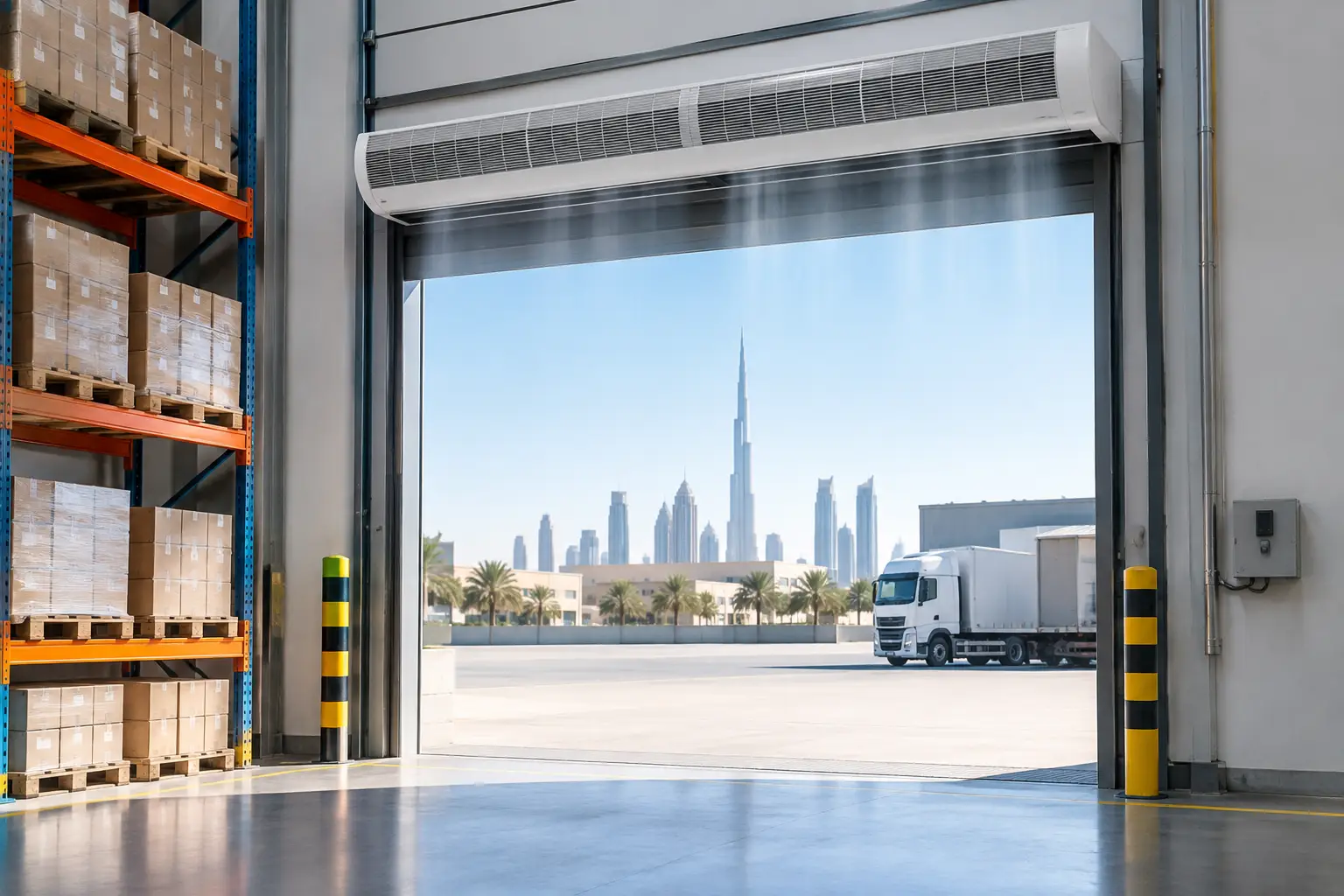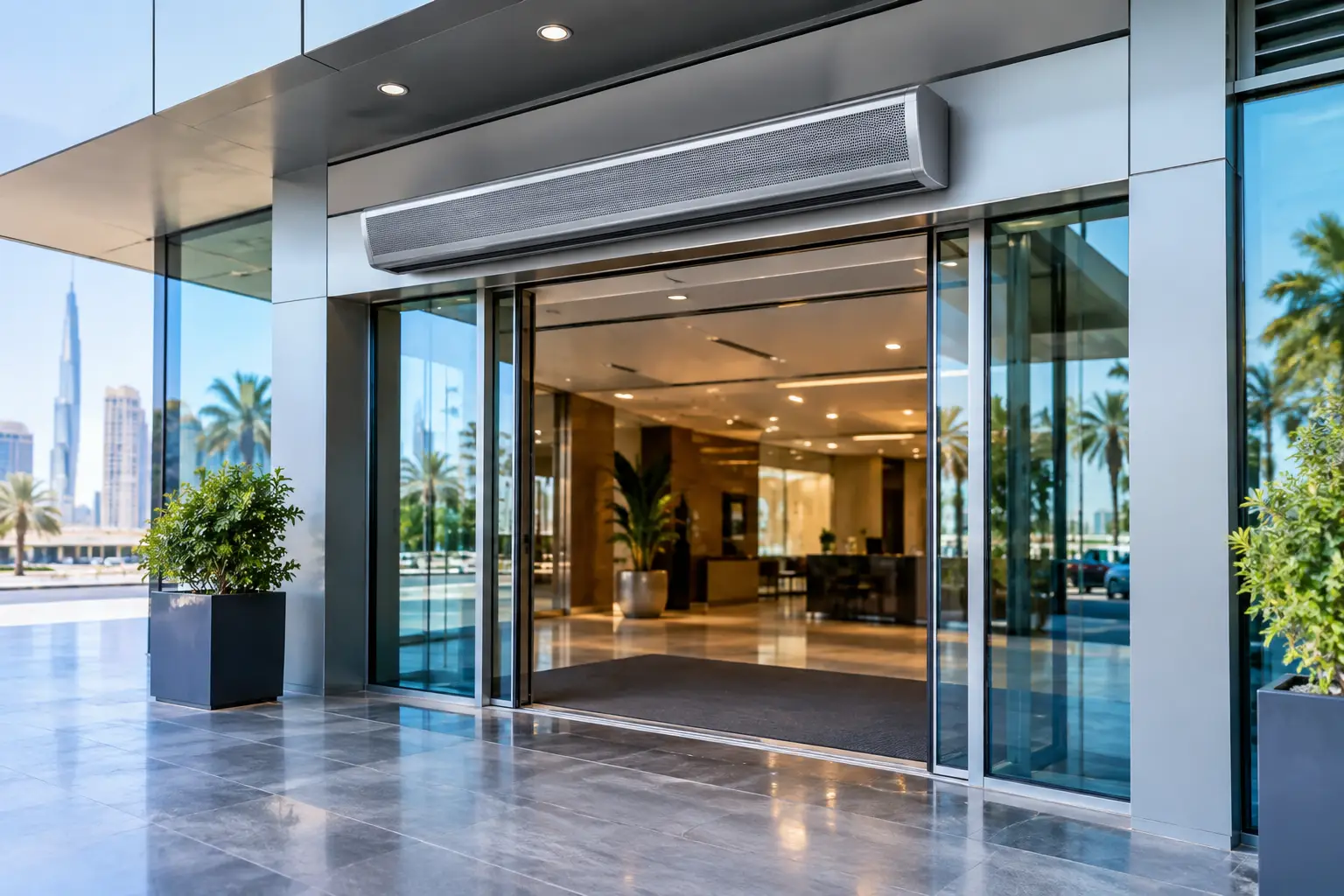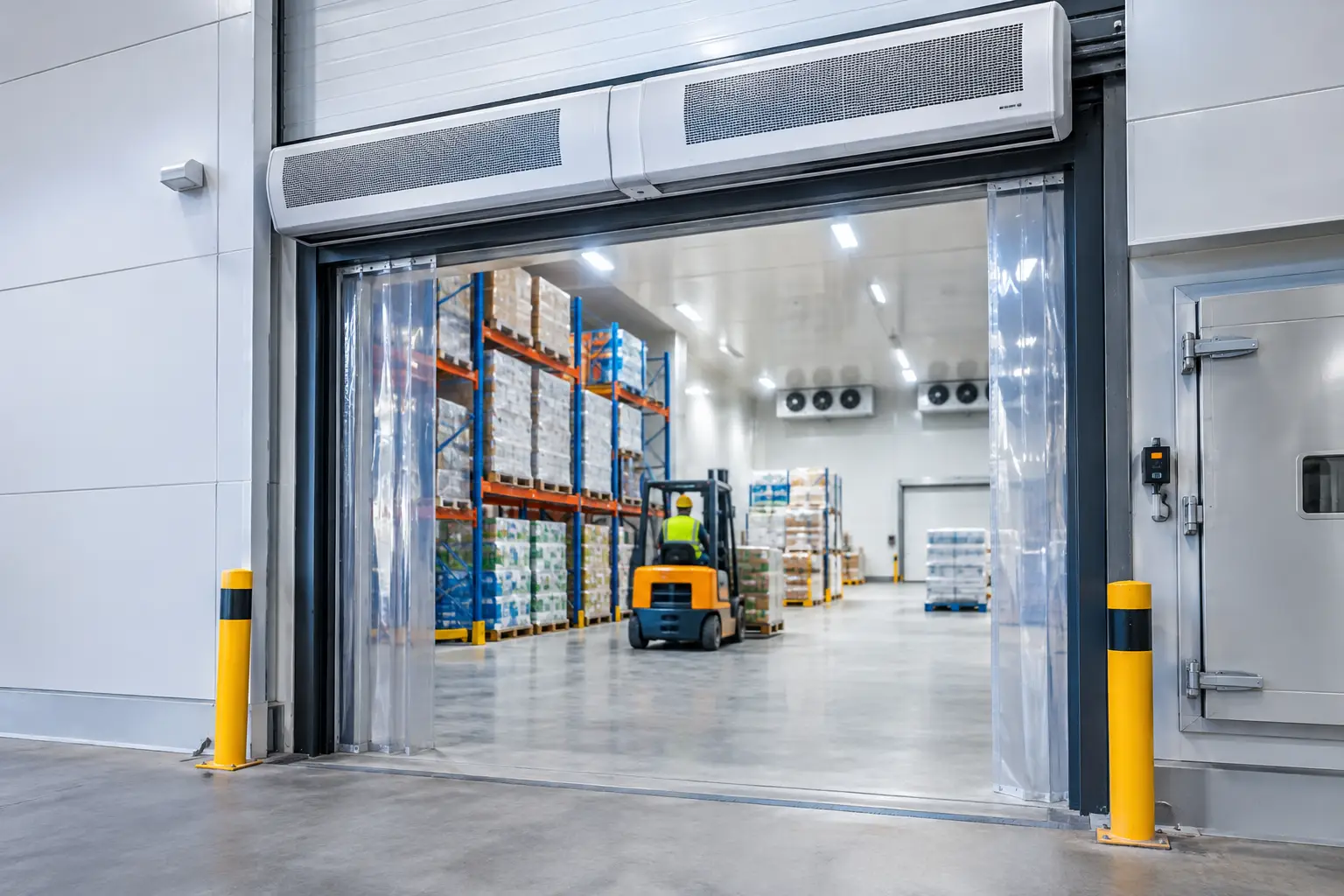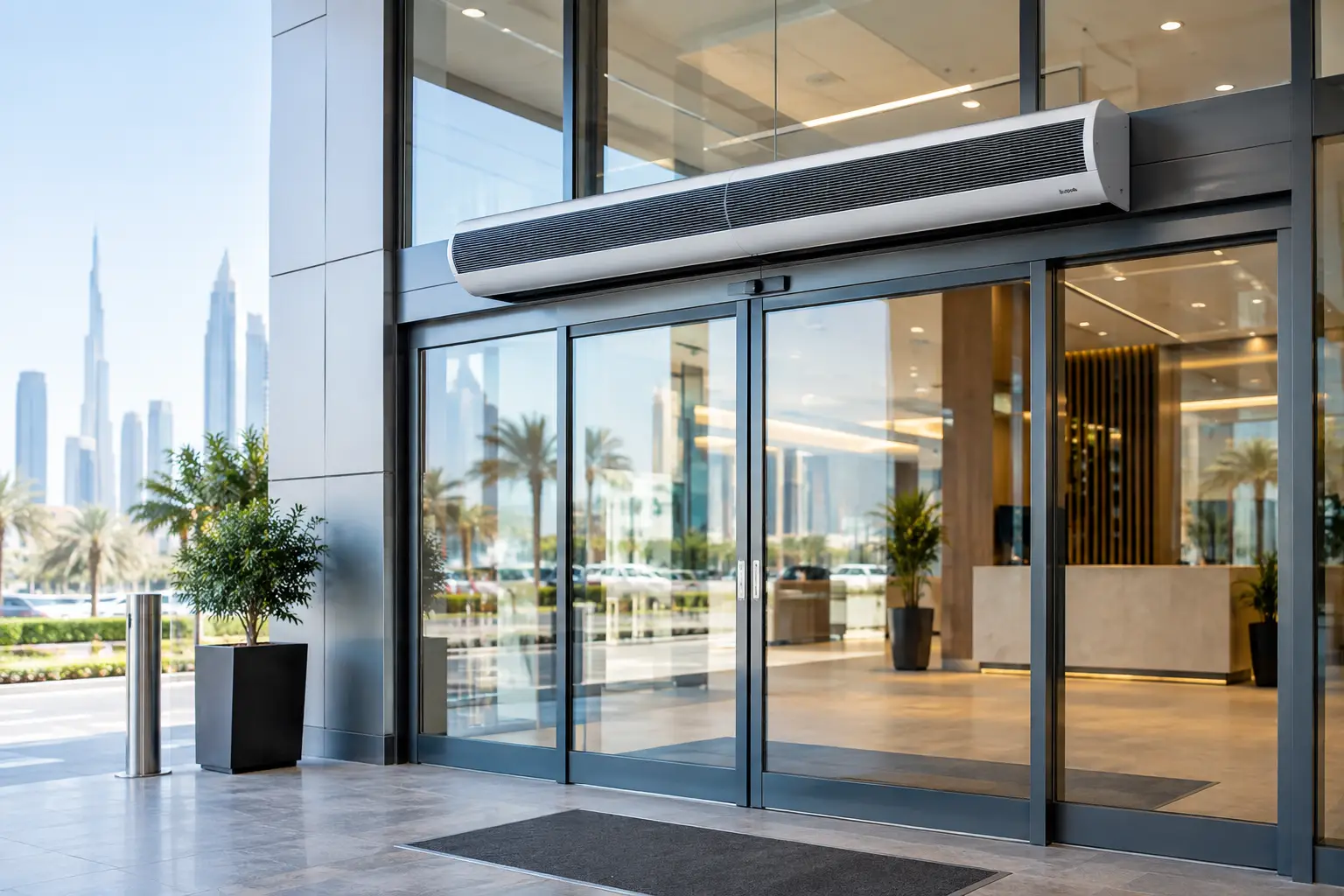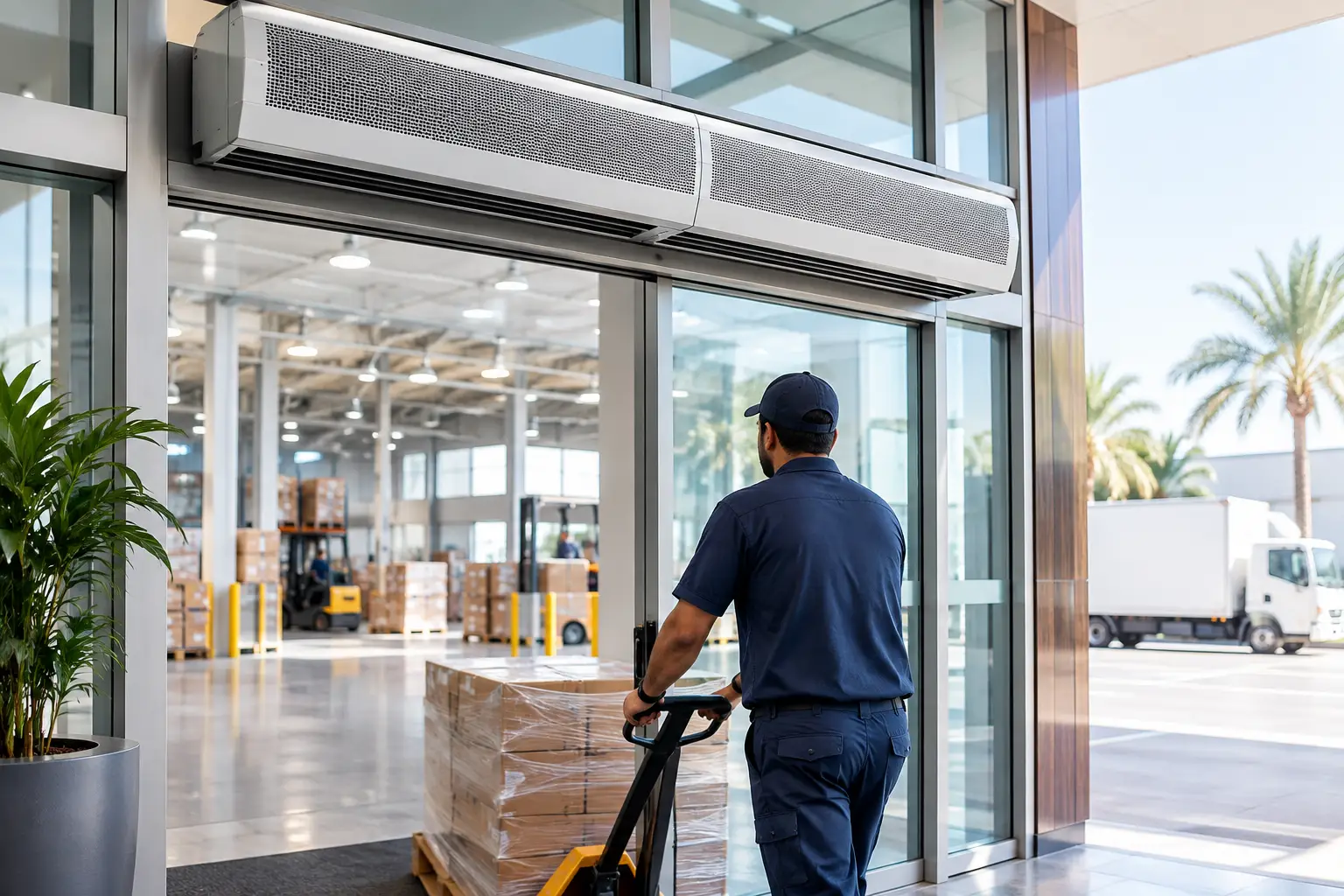
A loading-bay door in Dubai, a supermarket entrance in Riyadh, or a factory access point in Lagos can admit far more than foot traffic. Each opening can bring in desert dust, humid outdoor air, heat, insects, and airborne debris that place additional pressure on conditioned spaces. This dust barrier air curtain guide explains how commercial and industrial facilities can use a correctly specified air curtain to create a more controlled entrance environment.
An air curtain does not physically close a doorway or replace a building’s filtration strategy. It creates a directed, high-velocity stream of air across the opening. When the airflow is properly matched to the doorway and conditions, it helps separate indoor and outdoor air masses while allowing people, carts, and goods to move without interruption.
What Is a Dust Barrier Air Curtain?
A dust barrier air curtain is an entrance-mounted system designed to project an air stream from the top or side of an opening toward the floor or opposing side. Its job is to resist the inward movement of outside air and contaminants when a door remains open or opens frequently.
For commercial sites in hot, tropical, humid, and desert climates, this air barrier has a practical operational role. It can reduce the amount of dust and hot air that reaches the interior, helping the HVAC system maintain stable conditions with less disruption at the entrance.
The word “barrier” requires some context. The air stream is not an absolute seal. Performance depends on the quality of installation, external wind pressure, the height and width of the opening, and how long the door stays open. A properly selected unit provides powerful air isolation at the point where buildings are most exposed.
Why Dust Control at Open Doors Matters
Dust entering through a commercial doorway is not merely a housekeeping issue. In retail spaces, it affects presentation and customer comfort. In warehouses and logistics centers, dust can settle on stored goods, racking, and handling areas. In food processing, pharmaceutical, healthcare, and other controlled environments, airborne contamination may affect operational procedures and cleaning demands.
Open doors can also introduce conditions that undermine cooling performance. In Gulf and African markets, the facility may face intense solar heat, fine sand, humidity, or a combination of all three. When warm outdoor air enters repeatedly, the HVAC system must remove that added heat and moisture while trying to maintain indoor comfort.
A dust barrier air curtain is most valuable where the entrance has one or more of these conditions:
- Frequent pedestrian, trolley, forklift, or pallet movement
- Doors held open during receiving and dispatch activity
- Exposure to dust, sand, traffic pollutants, smoke, or industrial airborne debris
- Air-conditioned interiors with a large temperature difference from outdoors
- Operations where cleaner indoor conditions support hygiene, stock protection, or customer experience
How Does an Air Curtain Stop Dust From Entering?
An air curtain creates a controlled downward or cross-opening air stream. That stream builds resistance at the doorway, making it harder for outdoor air and particles to move inward with normal air exchange. It is particularly effective when the discharge air reaches the floor zone with enough stability to maintain separation.
Air Velocity Must Match the Doorway
A short retail entrance and a high warehouse shutter are not equivalent applications. As mounting height increases, the air stream must travel farther and is more exposed to deflection and loss of momentum. A system that works adequately over a standard customer doorway may be unsuitable for a tall industrial opening.
This is why selection should begin with the actual clear opening dimensions, not a generic product category. The required performance also changes when outdoor wind crosses the entrance, when vehicles pass nearby, or when the building has pressure differences between zones.
The Barrier Works Best With Good Building Practices
An air curtain improves entrance control, but it should support rather than replace sensible operational measures. Door management, correctly positioned supply and return air, loading-dock procedures, and reasonable opening durations all affect the result.
For example, a warehouse with a constantly open door may need a more industrial approach than a retail unit whose doors open for a few seconds at a time. The correct question is not simply, “Will an air curtain block dust?” It is, “What barrier performance is required at this specific opening?”
Which Air Curtain Type Fits Your Application?
FreezeeX air curtain selection is based on application requirements rather than a one-size-fits-all approach. The comparison below helps project teams determine the type of solution to evaluate during consultation.
| Application condition | Typical air curtain direction | Key selection concern | |—|—|—| | Retail stores, supermarkets, and mall entrances | Commercial unit | Customer comfort, doorway appearance, frequent pedestrian traffic | | Hotels, restaurants, and office entrances | Commercial or recessed installation | Noise expectations, architectural integration, conditioned lobby protection | | Warehouses, factories, workshops, and logistics doors | Industrial unit | Mounting height, large openings, wind exposure, vehicle movement | | Food processing, pharmaceutical, and healthcare environments | Application-specific commercial or industrial unit | Contamination control objectives, cleaning protocols, operating conditions | | Cold storage and temperature-sensitive areas | Purpose-selected air barrier | Temperature differential, door cycles, moisture management, operational workflow |
Commercial entrances may be suited to the Commercial Centrifugal Flow Series, Commercial HiFi Plus Series, or recessed ceiling options where the project calls for a more integrated visual finish. Large and demanding openings often require the stronger application focus of an Industrial Centrifugal Series or another configuration selected for the site.
The product name alone should never determine the specification. A compact entrance may require a discreet solution, while a high-traffic loading door needs air delivery that can withstand a much more difficult operating environment.
How to Specify a Dust Barrier Air Curtain
For consultants, MEP contractors, and facility teams, a clear site brief leads to a better recommendation. Use the following process before requesting a quotation.
- Measure the clear opening. Record door width and height, including the real usable opening rather than only the structural opening.
- Define the traffic pattern. State whether the entrance serves pedestrians, shopping carts, forklifts, pallet jacks, or mixed traffic. Also identify the typical duration and frequency of door opening.
- Assess the external environment. Consider prevailing wind, nearby roads, loading activity, sand exposure, humidity, smoke, fumes, and whether the door faces direct sun.
- Identify the indoor control objective. The priority may be dust reduction, cooling retention, insect deterrence, humidity control, cleaner air at an entrance, or several of these together.
- Confirm mounting constraints. Ceiling height, lintel space, door tracks, structural supports, electrical coordination, and desired mounting position all influence the practical solution.
- Coordinate with the HVAC design. Air curtains work alongside HVAC systems. The design team should understand occupancy patterns, indoor temperature targets, nearby supply air, and building pressure conditions.
This information helps avoid a common specification error: selecting a unit primarily by door width while overlooking height, outdoor exposure, or duty cycle.
Common Selection Mistakes to Avoid
The first mistake is undersizing the system for a tall or exposed opening. If the air stream cannot maintain effective coverage across the doorway, dust and heat can still enter at lower levels or around the edges.
The second is treating all dust as the same challenge. Fine desert dust, warehouse debris, roadside pollutants, and process-related particles behave differently in real operating conditions. An air curtain can reduce ingress at the opening, but facilities with strict air-quality requirements may also need wider filtration and housekeeping measures.
The third is ignoring maintenance access. Commercial and industrial equipment should be specified with practical inspection and cleaning needs in mind. Dusty environments can increase the need for routine checks to keep airflow paths clear and preserve expected performance.
Finally, do not assume a stronger air stream is always better. Excessive velocity can affect user comfort, create unnecessary noise concerns, or disrupt nearby spaces. The goal is a stable, fit-for-purpose air barrier, not maximum airflow without regard to application.
Where Dust Barrier Air Curtains Deliver the Most Value
The strongest business case is usually found at high-use entrances where conditioned indoor air meets harsh outdoor conditions. A supermarket entrance may benefit from better customer comfort and reduced dust migration. A logistics center may reduce the burden placed on its conditioned staging area. A food or pharmaceutical facility may use entrance air separation as one part of a broader contamination-control strategy.
For facilities across the UAE, Saudi Arabia, Qatar, Oman, Kuwait, Bahrain, Egypt, and African markets, climate matters. High heat, humidity, and airborne dust make entrance climate control a performance decision, not simply an accessory selection. A correctly designed air curtain helps protect the working environment while supporting smarter energy savings.
For a recommendation based on your opening size, traffic level, mounting position, and local climate exposure, request a FreezeeX consultation and quotation. The right dust barrier air curtain should be engineered around the doorway your operation actually uses, especially where desert heat and airborne dust are part of daily conditions.