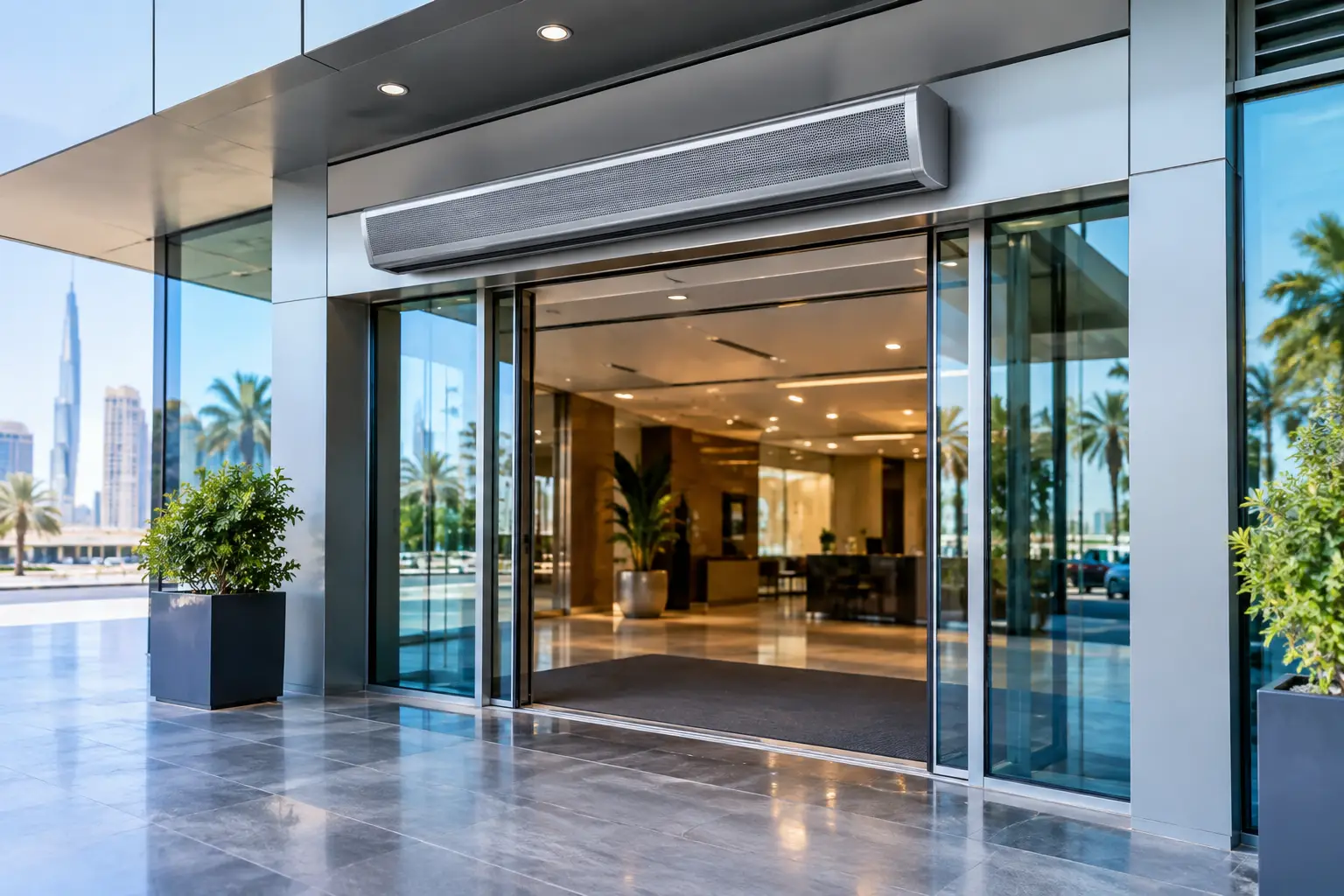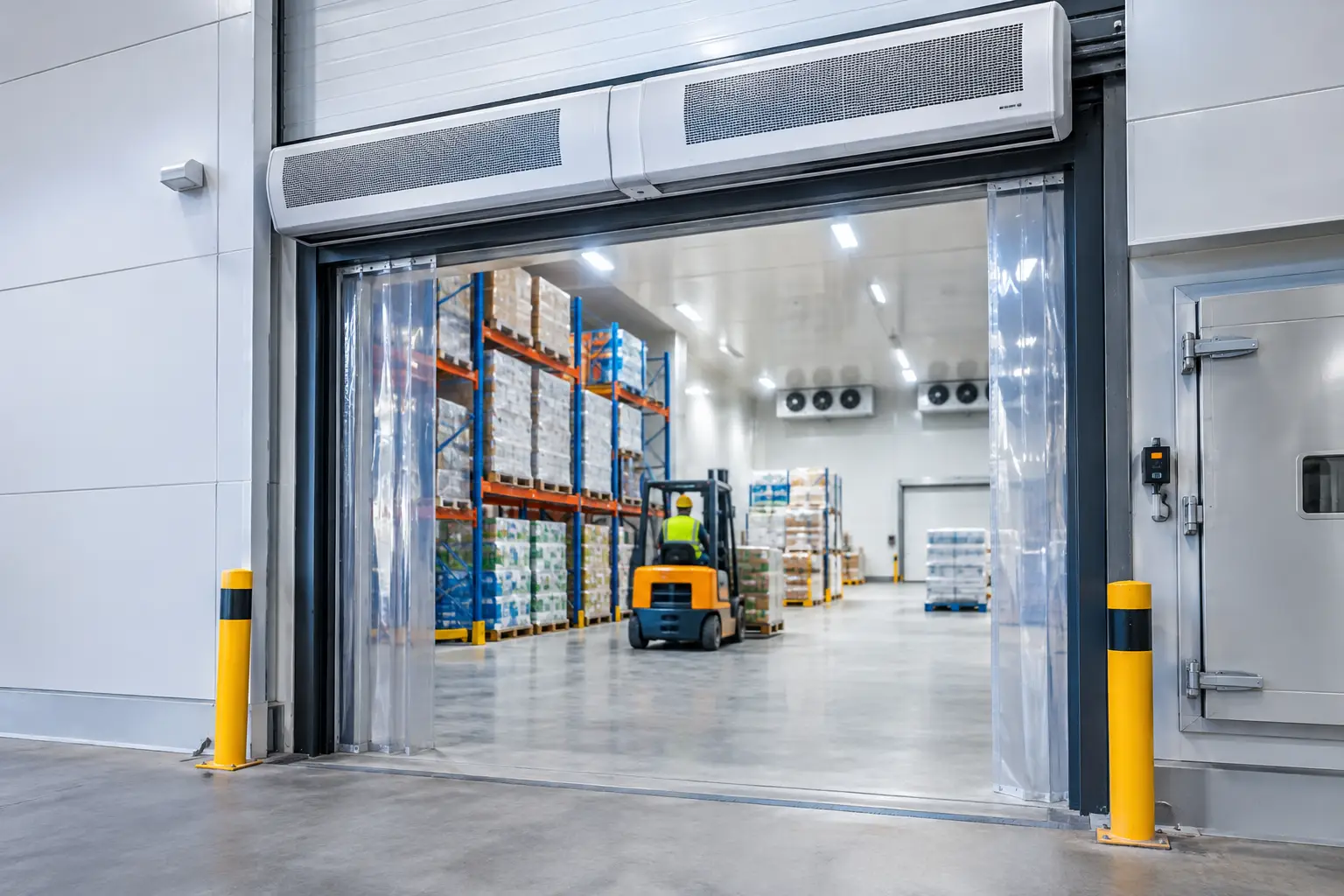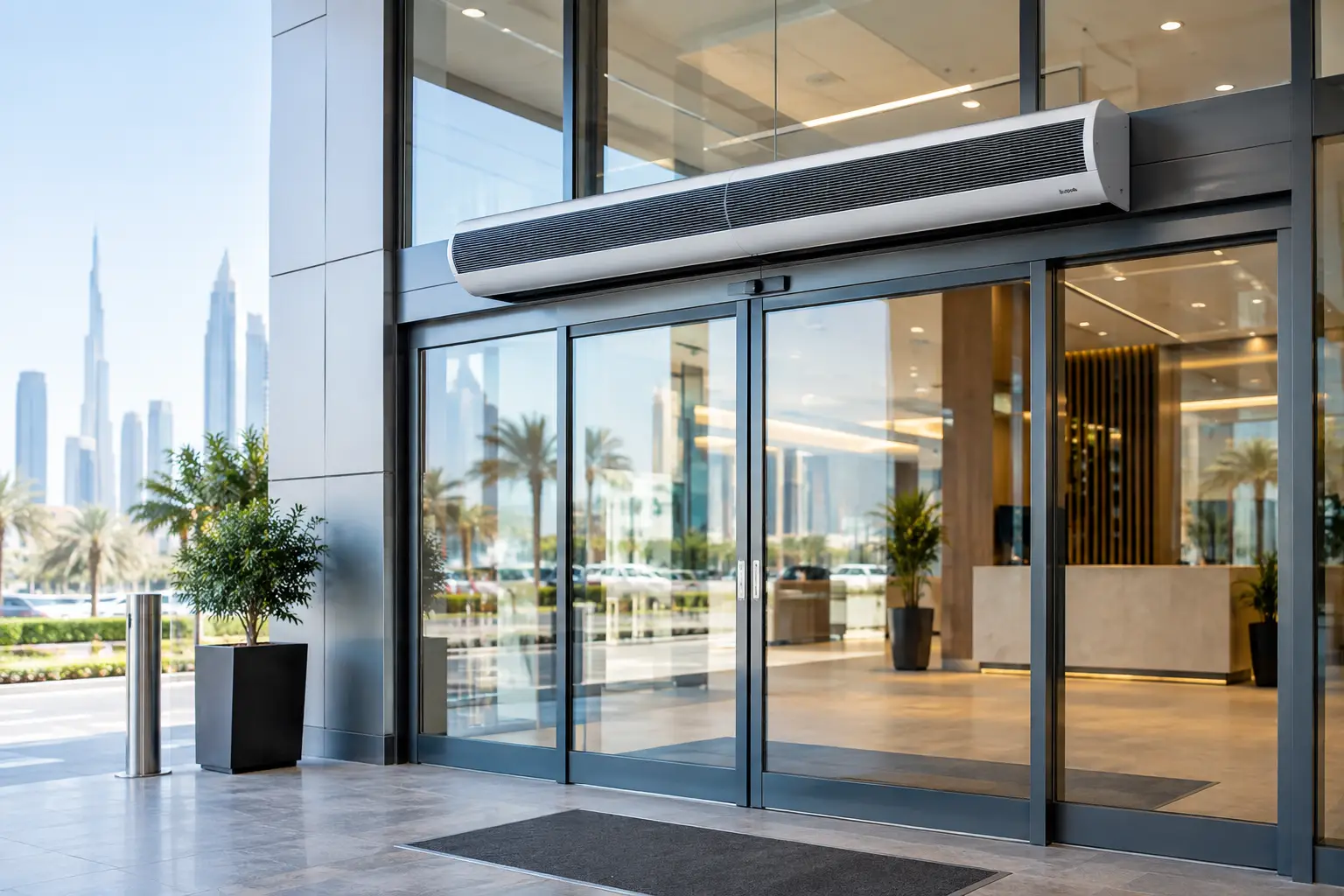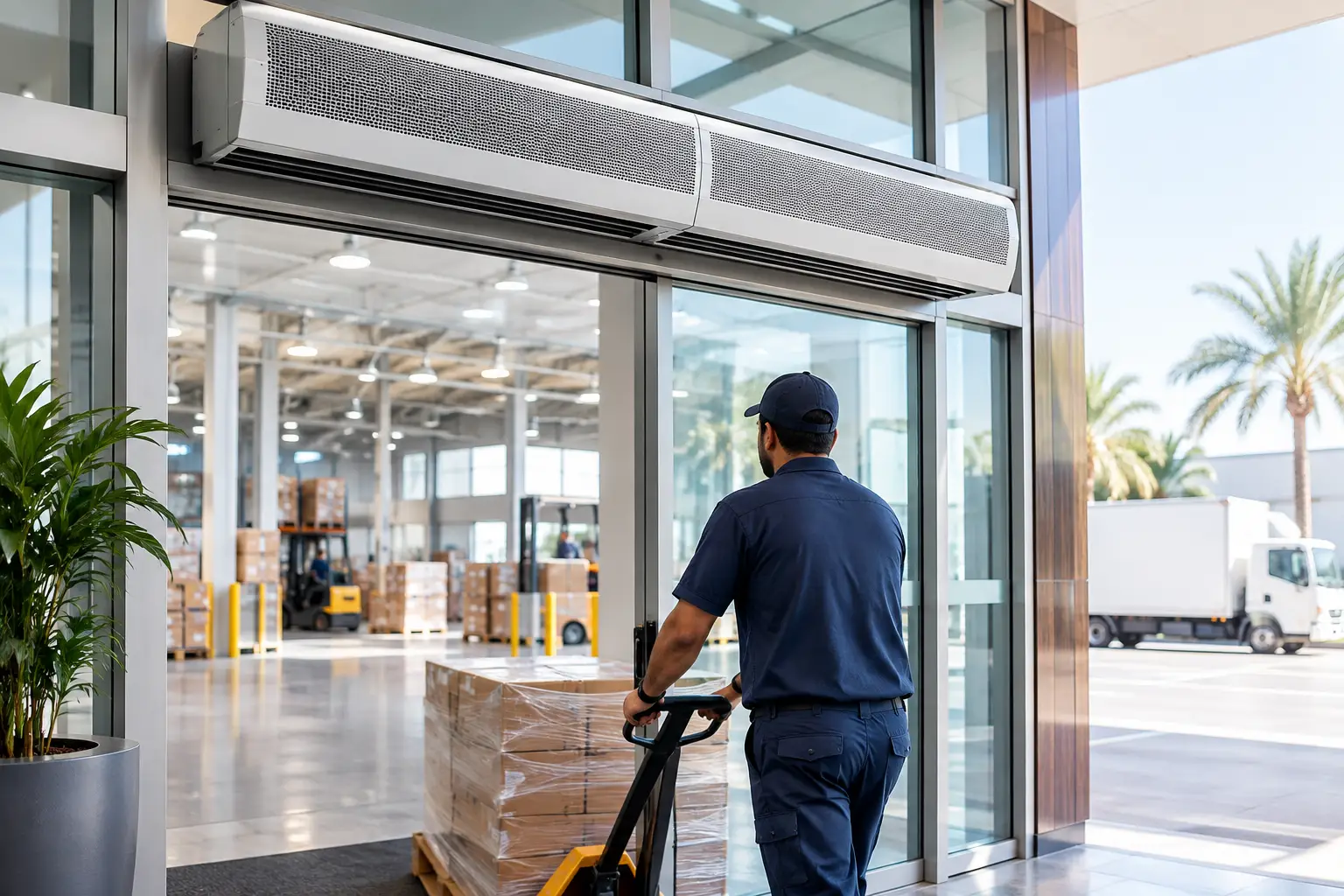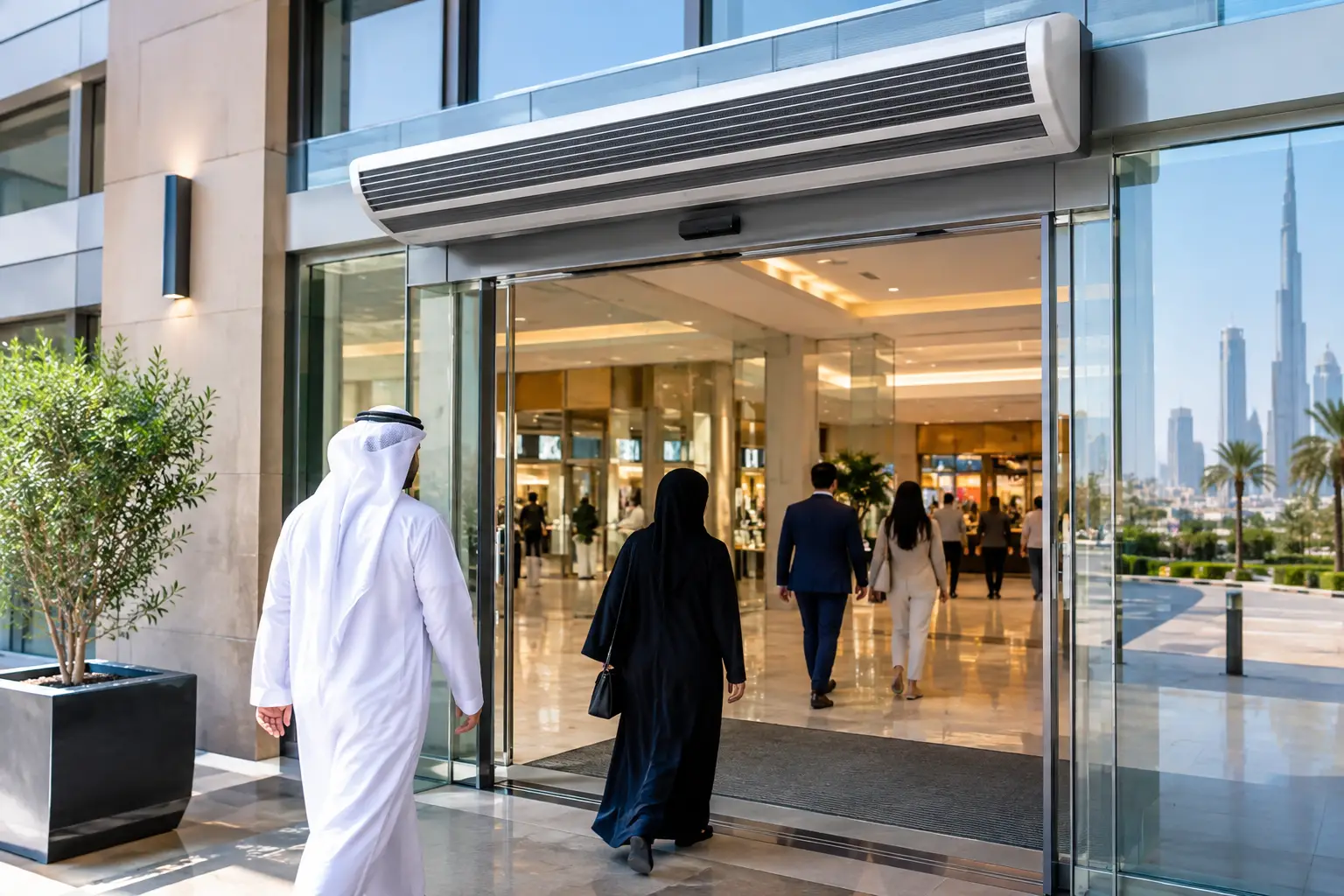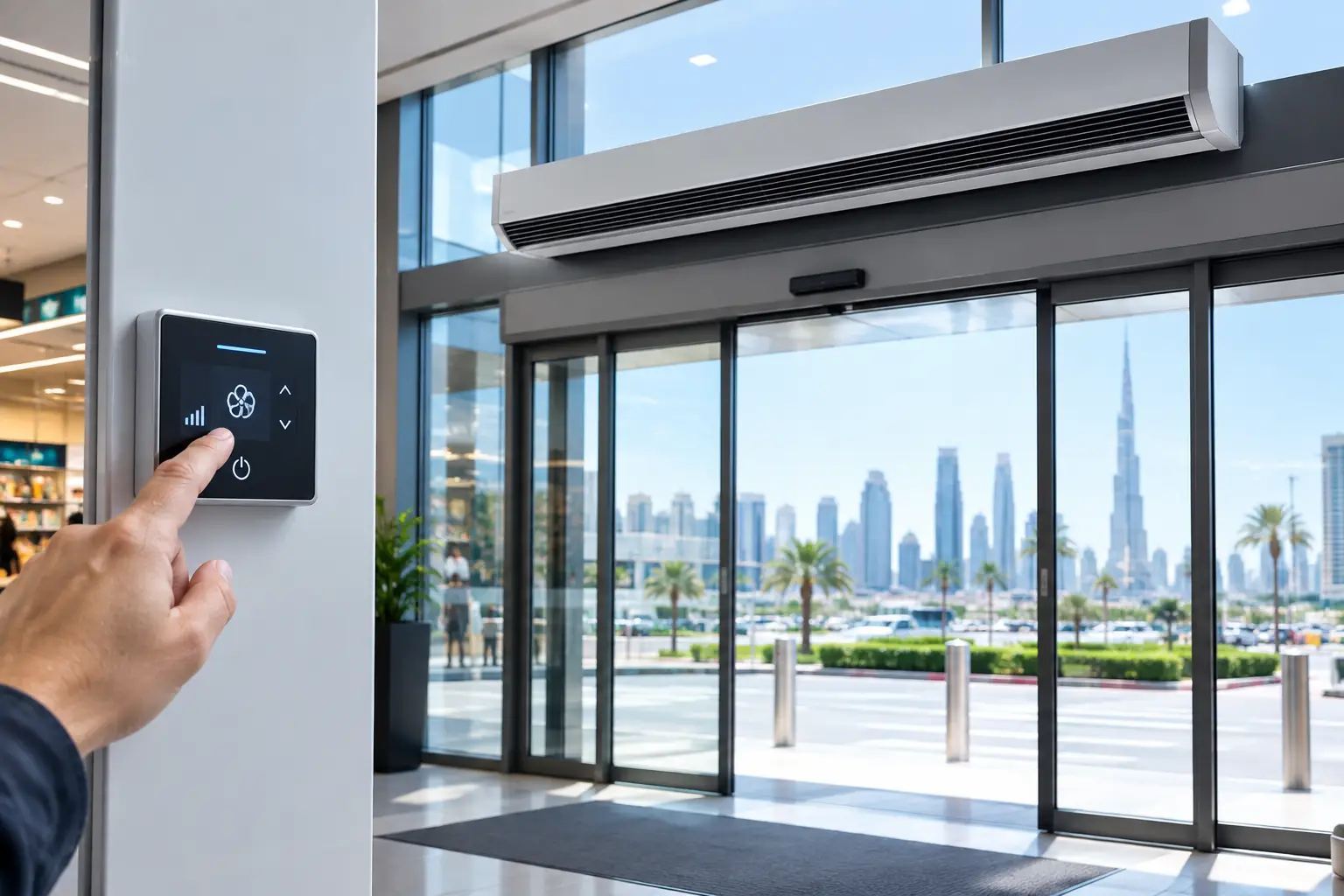
A loading bay door opening repeatedly in a Dubai warehouse can pull in far more than hot air. It can introduce dust, humid outdoor air, insects, and pressure-driven drafts that burden the cooling system and disrupt indoor conditions. Effective doorway pressure balance is the practical discipline of controlling that exchange at the building opening, not simply increasing air conditioning capacity.
For facility managers, MEP consultants, and HVAC contractors, the objective is clear: maintain usable indoor comfort and process conditions while keeping entrances operational. Air curtains are often a central part of that strategy because they form a high-velocity air barrier across an open doorway, reducing the movement of untreated outdoor air into the conditioned space.
What Does Doorway Pressure Balance Mean?
Doorway pressure balance describes the relationship between air pressure inside a facility and the air pressure outside it at an open entrance. Air naturally moves from higher pressure toward lower pressure. When that movement is uncontrolled, an open door becomes a direct path for heat, humidity, dust, odors, smoke, and airborne contaminants.
A building does not need to be perfectly pressurized at every doorway. In fact, the right approach depends on the use of the space. A retail entrance, a pharmaceutical production area, and a distribution center may each require a different balance between access, comfort, contamination control, and energy use.
An air curtain does not replace the wider HVAC design or a properly considered pressurization strategy. It supports that strategy at the point where it is most vulnerable: the open door. The discharge stream creates separation between indoor and outdoor air masses, helping preserve conditioned air while people, carts, or goods pass through.
Why Open Doors Create a Pressure Problem
In hot, humid, and dusty markets across the GCC, MENA, and Africa, the temperature difference between an air-conditioned facility and the exterior can be substantial. Wind, stack effect, exhaust systems, loading activity, and nearby air handling equipment can all change how air behaves at an entrance.
The result may be felt immediately near the door, but the operational impact extends further into the facility. Common signs include:
- Warm or humid drafts reaching customer areas, production zones, or refrigerated workspaces
- Dust accumulation near entrances and on adjacent merchandise or equipment
- Increased cooling demand during peak traffic periods
- Insect entry at restaurants, food processing sites, and supermarkets
- Uncomfortable conditions for staff stationed at reception desks, security points, or loading areas
- Odors, smoke, or vehicle-related fumes migrating into occupied spaces
These issues are not always caused by one factor. A door may be too wide for the installed unit, the discharge may not reach the floor effectively, or the air curtain may be working against a strong crosswind or an unbalanced exhaust system. That is why entrance assessment matters more than selecting equipment by door width alone.
How Air Curtains Support Doorway Pressure Balance
An air curtain projects a controlled stream of air downward or across an opening, depending on the installation arrangement. This air stream acts as a barrier that reduces mixing between indoor and outdoor environments while the physical door remains open.
For commercial facilities, this can support three practical outcomes: lower cooling loss, better protection against outdoor contaminants, and a more stable indoor environment close to the entrance. In a supermarket or shopping mall, that means reducing the hot-air surge when foot traffic is continuous. At a warehouse or logistics center, it can mean limiting dust and heat intrusion during frequent pallet movement.
The barrier must be appropriately matched to the application. An undersized unit may provide some local airflow but fail to maintain separation across the full door height or width. An oversized selection may introduce unnecessary noise or energy use. The most effective specification considers the opening and the operating conditions together.
Air Barrier Performance Depends on More Than Airflow
High airflow alone does not guarantee effective entrance separation. The air stream must have sufficient throw, coverage, and stability to resist external conditions at the opening. Mounting height, discharge angle, door geometry, and surrounding air movement all influence the result.
For example, a recessed entrance in a mall may be relatively protected from wind but experience constant pedestrian traffic. A factory door may face wind, vehicle movement, and long opening cycles. A cold storage access point may need to reduce the migration of warm, moisture-laden air into a temperature-controlled area. Each condition changes the selection criteria.
Which Factors Should Be Assessed Before Specification?
A professional doorway pressure balance review should begin with the entrance itself, then consider the building systems that influence it. The following factors shape air curtain selection and positioning.
| Assessment factor | Why it affects the solution | | — | — | | Door width and height | Determines the coverage area and the required air stream reach. | | Mounting position | Influences whether the unit can be installed above, recessed, or positioned to suit the entrance layout. | | Traffic volume | Frequent opening cycles require a solution designed for continuous commercial use. | | Outdoor exposure | Wind, desert dust, humidity, and direct heat can weaken an air barrier. | | Indoor conditions | Retail comfort, food hygiene, industrial processes, and controlled environments have different priorities. | | Nearby HVAC and exhaust | Supply air, return paths, and exhaust systems can create pressure effects at the doorway. | | Door operation | Sliding, rolling, swinging, and high-speed doors create different airflow patterns and access requirements. |
For high-traffic commercial doors, a unit from a commercial-focused range may be appropriate where appearance, low-disruption operation, and consistent comfort matter. For loading areas, workshops, factories, and larger access openings, industrial air curtain selection should prioritize the harsher operating environment and the need for dependable barrier performance.
Where Does Pressure Balance Matter Most?
Every frequently opened external door can affect HVAC efficiency, but the consequences are particularly significant in facilities that depend on controlled conditions or have high daily traffic.
Retail, Supermarkets, and Shopping Centers
Customer entrances remain open for long periods, especially during busy trading hours. Hot and humid air entering through automatic doors can create discomfort near the threshold and increase the load on interior cooling. A properly selected commercial air curtain supports a more consistent customer environment without obstructing access.
Warehouses, Logistics Centers, and Factories
Large doors introduce a greater challenge because of their size, traffic, and exposure. Forklifts, delivery vehicles, and goods movement may keep access points open longer than expected. In these settings, air isolation must be assessed alongside door behavior, external wind, and the facility’s overall air movement.
Food, Healthcare, and Pharmaceutical Environments
For food processing facilities, hospitals, and pharmaceutical operations, doorway control can contribute to better separation between areas and help reduce the entry of insects, dust, and airborne contaminants. Requirements differ by facility, so the air curtain should be evaluated as one component within the site’s hygiene and environmental-control plan.
Restaurants, Hotels, and Hospitality Entrances
Guest comfort and back-of-house operations can both suffer when outdoor heat, insects, or odors enter through service and public entrances. The right air curtain can support an inviting front entrance while also helping protect kitchens, receiving doors, and high-use staff access points.
A Practical Selection Process for Commercial Projects
Selecting for doorway pressure balance should be treated as an engineering and application decision, not a catalog exercise. A useful process follows five steps:
- Document the opening. Record clear width, clear height, mounting space, door type, and whether the entrance is recessed or exposed.
- Review the operating pattern. Identify traffic type, peak opening frequency, vehicle movement, and periods when doors stay open.
- Assess external conditions. Consider heat, humidity, dust, wind direction, smoke, fumes, and the level of weather exposure.
- Check internal air influences. Review nearby supply diffusers, return-air locations, exhaust points, and spaces that require a positive or controlled pressure relationship.
- Match the air curtain to the application. Select the installation format and commercial or industrial series based on the full operating condition, then confirm the recommendation before procurement.
This process avoids a common mistake: specifying the same model for every entrance in a multi-use building. A polished main lobby, a restaurant service door, and a warehouse loading bay rarely have the same requirements.
What Can Undermine an Air Curtain Installation?
An air curtain is most effective when it is integrated into the entrance design rather than added after performance issues become severe. Poor placement, inadequate coverage, and ignoring cross-drafts are frequent causes of disappointing results.
Other building systems deserve attention as well. A powerful exhaust system close to an entrance can pull outdoor air inward. Excessive positive pressure may push conditioned air out. Door vestibules, canopies, and the physical layout of the opening can either help stabilize the barrier or expose it to disruptive air movement.
The answer is not always a larger unit. In some cases, revising the mounting arrangement, using multiple units across a wider opening, or addressing an adjacent pressure influence will produce a better result. This is particularly relevant in desert and tropical climates, where heat, humidity, and airborne dust place greater demands on entrance climate control.
Specify for the Doorway, Not Just the Building
Doorway pressure balance is where HVAC performance meets daily operations. A well-considered air curtain installation can help protect cooling investment, support cleaner indoor conditions, and keep busy entrances functional without slowing people or goods.
For projects in Dubai, Riyadh, Doha, Nairobi, Lagos, or other demanding hot-climate locations, request a consultation and quotation from FreezeeX with the entrance dimensions, mounting details, traffic pattern, and environmental conditions. The right recommendation starts with how the doorway actually performs during the busiest part of the day.