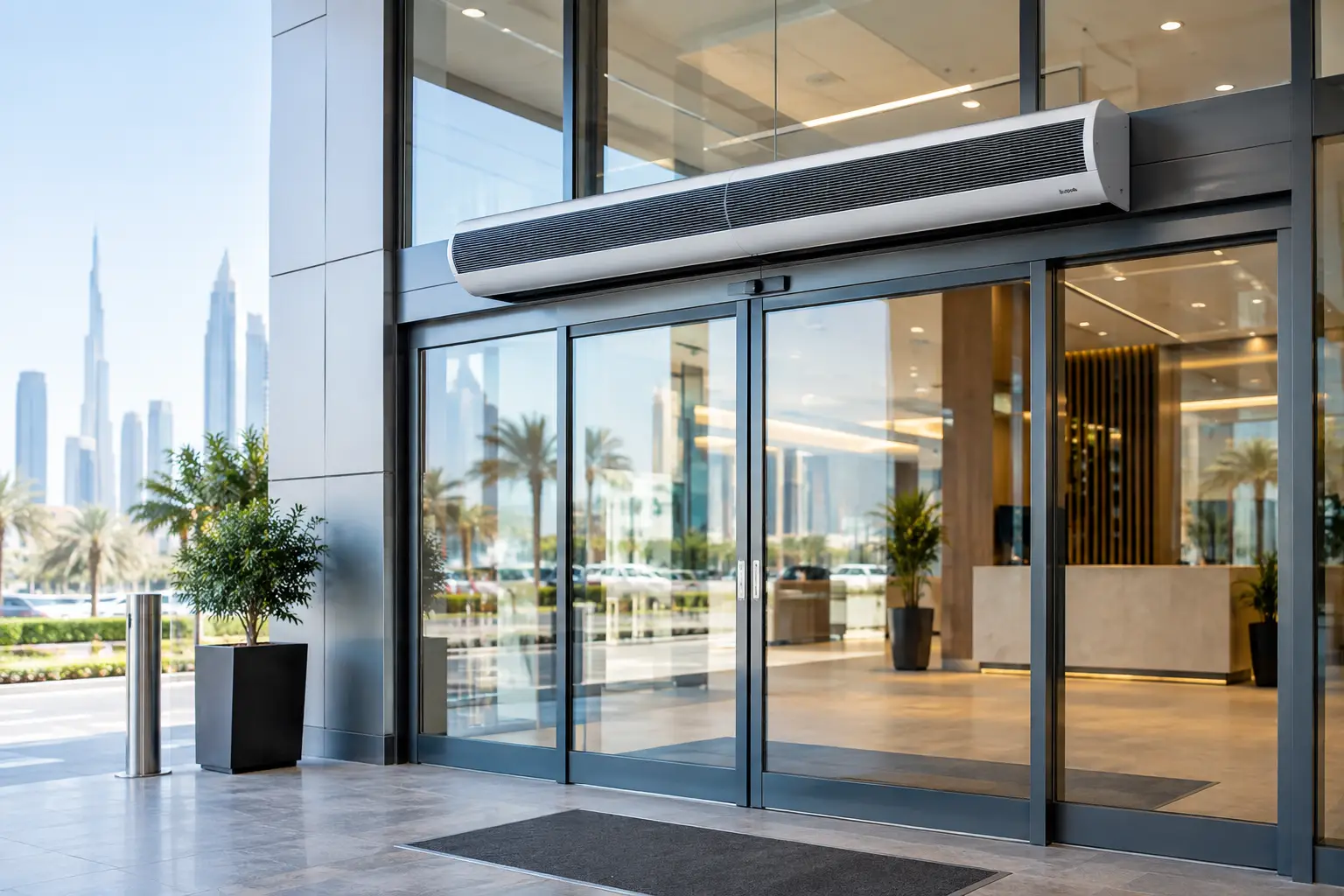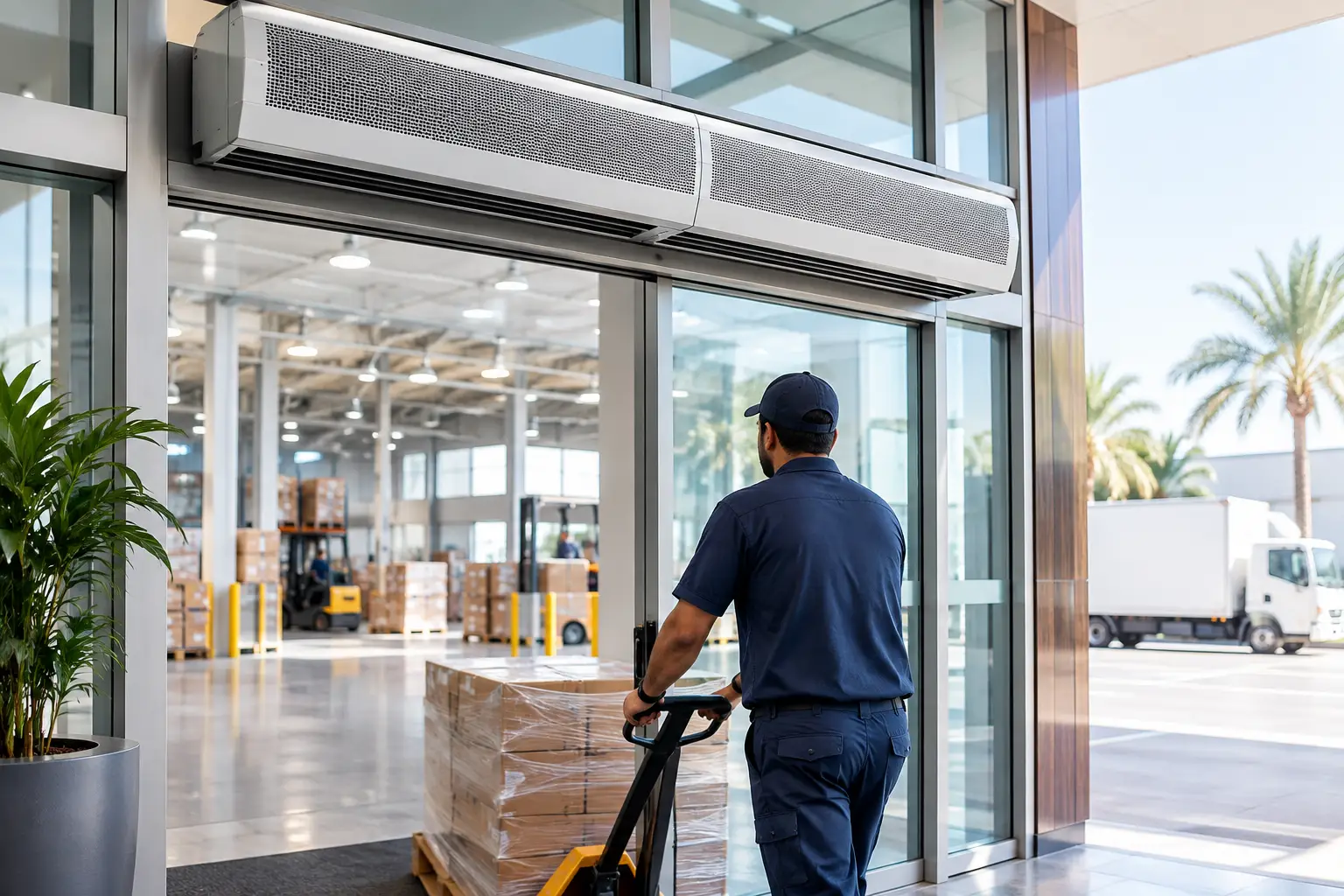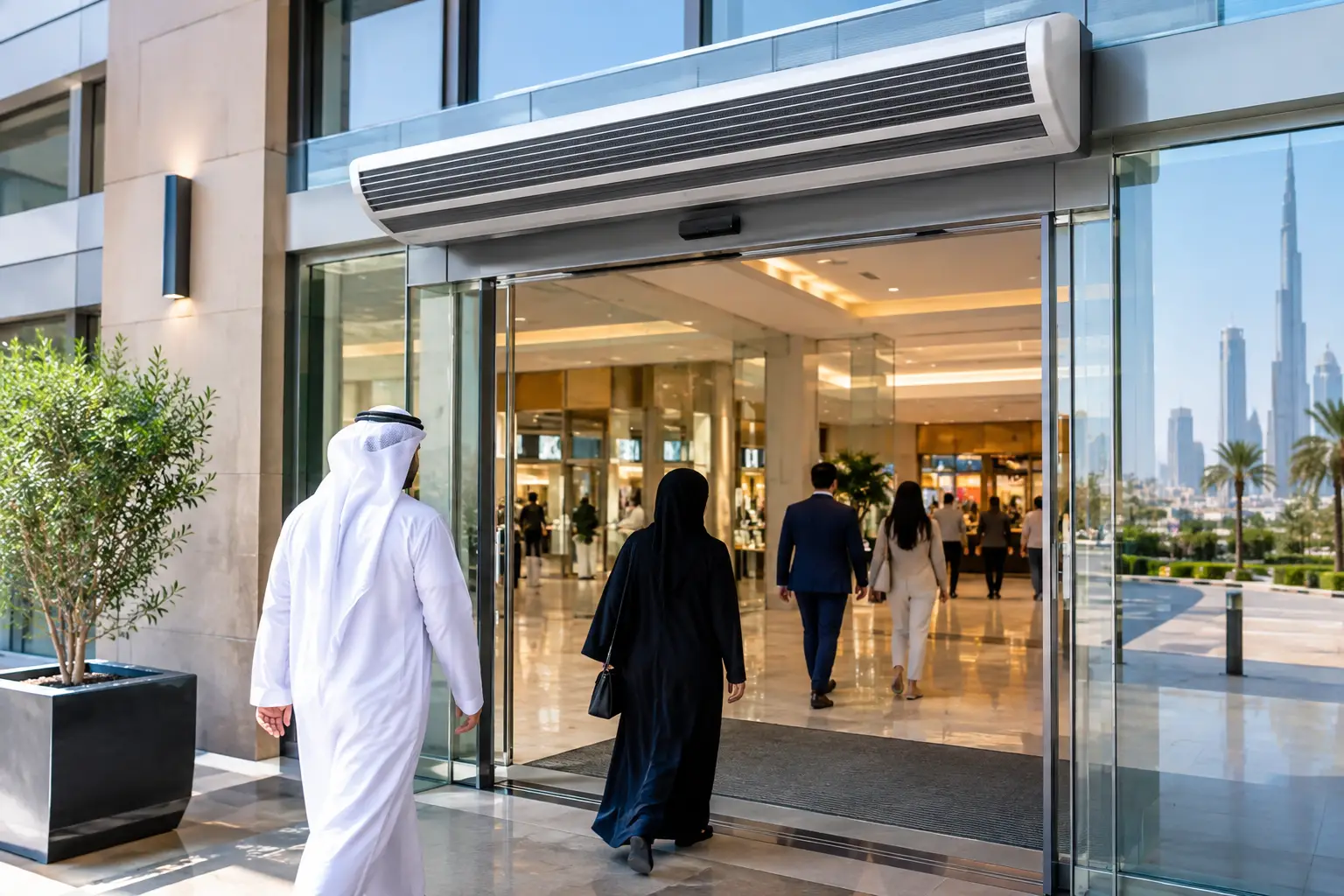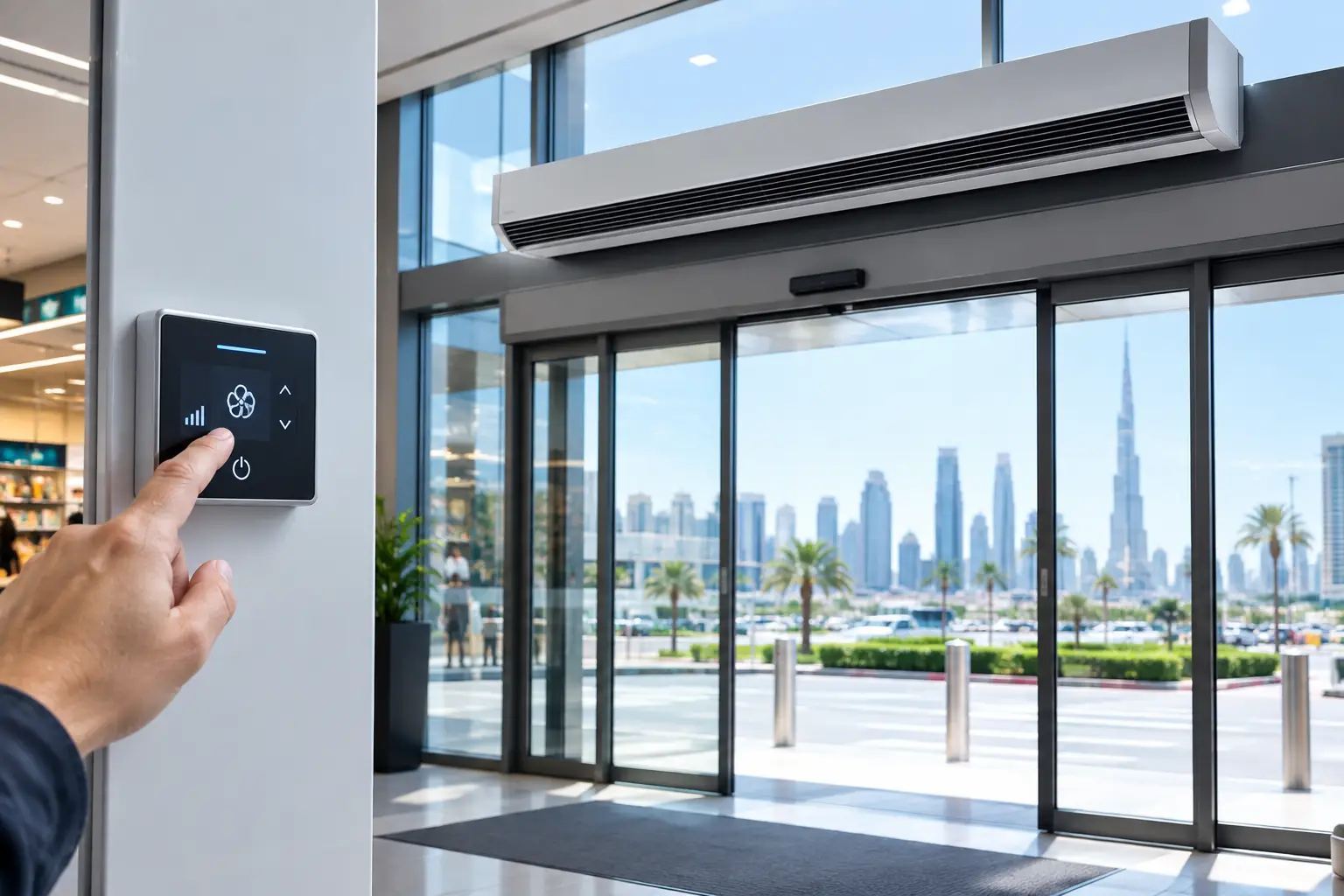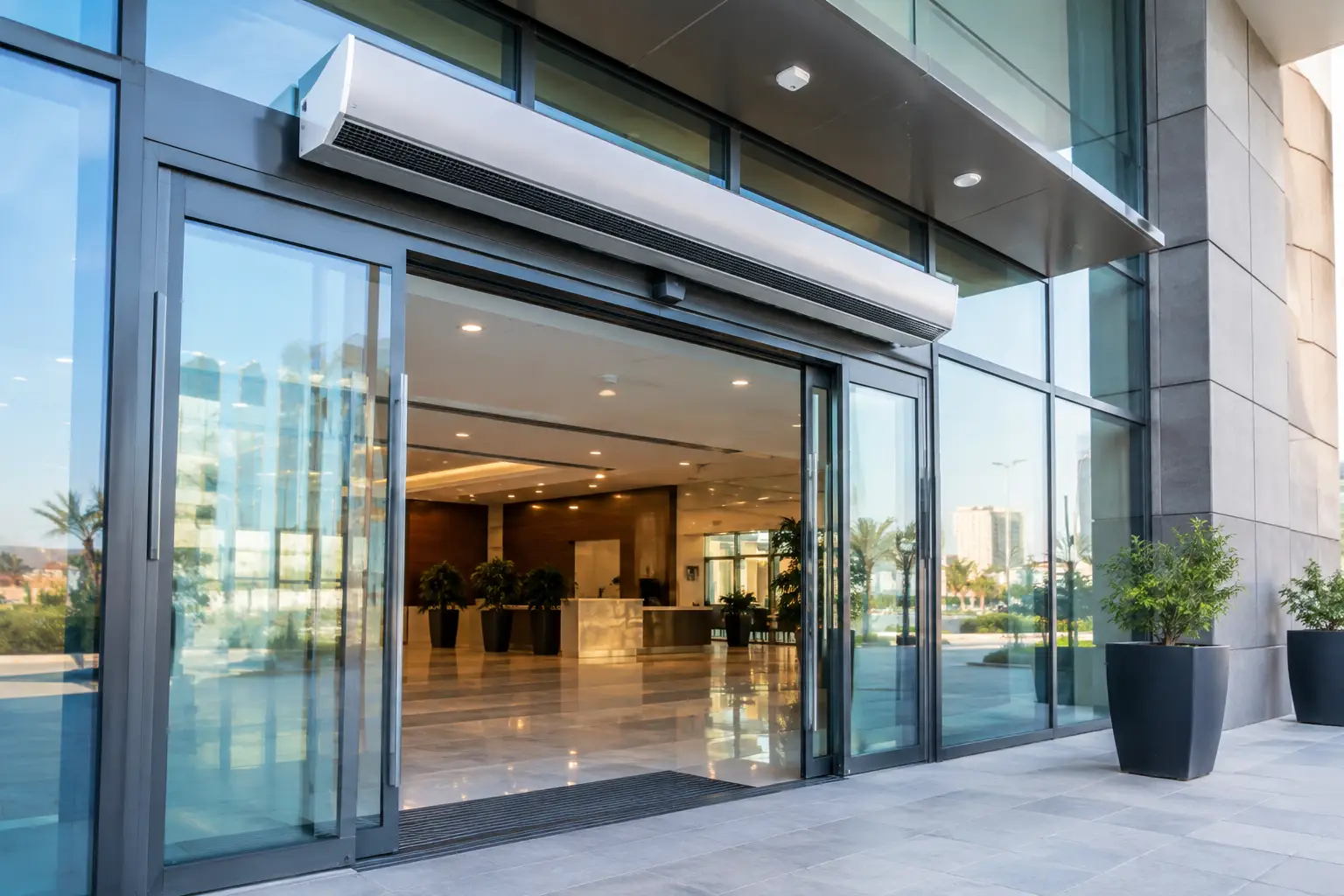
A loading-bay door left open during a busy shift can quickly become an uncontrolled opening in a building’s thermal envelope. In Dubai, Riyadh, Doha, Muscat, Cairo, Lagos, and other hot or humid markets, effective doorway protection is not simply about occupant comfort. It is a practical way to control heat gain, reduce airborne contamination, protect conditioned spaces, and support HVAC performance where doors must remain open for people, deliveries, or operations.
For commercial and industrial facilities, the entrance is often where energy loss and environmental control problems begin. A conventional door works when it stays closed. It becomes less effective in a supermarket receiving area, warehouse dispatch zone, restaurant entrance, hospital corridor, or cold storage loading point where traffic is frequent. An air curtain provides a controlled air barrier across that opening, helping separate indoor and outdoor conditions without interrupting access.
Why Doorway Protection Matters in High-Traffic Facilities
Every open doorway creates pressure and temperature exchange. Hot outdoor air moves toward cooler conditioned spaces, while cooled indoor air escapes. In coastal locations, humidity adds another operational challenge. In desert environments, windborne dust and fine particles can enter through entrances and loading bays. Where food, pharmaceuticals, healthcare, or manufacturing processes are involved, that exposure can affect cleanliness as well as comfort.
The effect is rarely limited to the doorway itself. HVAC systems must work harder to recover the setpoint after repeated air exchange. Areas near entrances may feel warm or humid, leading to complaints from staff and visitors. In a retail environment, this can affect customer comfort. In a warehouse or factory, it can create inconsistent working conditions and add unnecessary load to the building’s cooling system.
Doorway protection using a correctly selected air curtain helps reduce this exchange. The system creates a high-velocity air stream aimed across the full height and width of the opening. When engineered for the application, that stream forms an air seal that resists external heat, dust, insects, humidity, smoke, and fumes while allowing uninterrupted movement of people and goods.
An Air Curtain Is Not a One-Size-Fits-All Barrier
The performance of an air curtain depends on more than the unit itself. Specifiers should evaluate the opening dimensions, mounting height, building pressure, local climate, nearby exhaust or supply air, and the pattern of door use. A system that performs well above a standard retail entrance may be unsuitable for a tall warehouse shutter or a cold room loading door.
Mounting height is especially significant. As the air stream travels downward, it loses velocity through entrainment with surrounding air. A tall opening therefore needs greater throw and carefully controlled airflow. Industrial entrances may require high-capacity centrifugal units designed to project air effectively from elevated mounting positions. A lower commercial doorway may benefit from a quieter, more compact unit that prioritizes appearance as well as performance.
The type of air movement also matters. Centrifugal blower designs are commonly specified where stronger pressure resistance and longer air throw are needed, such as logistics centers, factories, loading areas, and large retail entrances. For customer-facing applications, commercial air curtains can balance dependable air separation with lower operating noise and a finish suited to visible entrances. Recessed ceiling models are appropriate where architects need entrance climate control without a prominent surface-mounted unit.
What an Air Curtain Can Help Control
A professionally specified air curtain is not a replacement for doors, HVAC design, or building hygiene procedures. It is an operational layer of protection for openings that cannot remain closed. Its contribution depends on correct sizing, installation, and use conditions.
In commercial and industrial applications, doorway protection can help facilities address several recurring problems:
- Cooling loss at frequently used entrances, service doors, and loading bays
- Outdoor heat infiltration in high-temperature desert and tropical climates
- Humidity migration that makes entrance zones uncomfortable or affects sensitive operations
- Dust, insects, debris, and airborne particles entering from exterior areas
- Smoke, odors, and fumes moving between adjacent zones where pressure conditions allow
- Reduced comfort near entrances for customers, staff, patients, and visitors
The operational value differs by site. A hotel may prioritize guest comfort and discreet installation. A supermarket may need to protect an entrance that opens continuously during peak trading hours. A food processing facility may focus on reducing insect entry and maintaining a more controlled internal environment. A warehouse may require powerful air isolation at dock doors while forklifts and personnel move through the opening.
Selecting Doorway Protection by Application
Retail, supermarkets, and shopping malls
Retail entrances are typically wide, highly visible, and subject to repeated traffic. The objective is to preserve cooled air while keeping the entrance welcoming and unobstructed. Noise level, appearance, and mounting arrangement are important alongside airflow performance. For a mall-facing store or supermarket, the air curtain should cover the full clear opening rather than leaving gaps at either side.
Where automatic doors cycle continuously, selection should account for the cumulative open time, not only the physical door dimensions. A unit that is undersized may operate continuously without producing an effective air seal at floor level.
Warehouses, logistics centers, and factories
Industrial doorways need a different approach. Door heights are greater, traffic may include forklifts, and external conditions can be severe. Dust, hot air, vehicle exhaust, and pressure differences caused by extraction systems can all undermine an underspecified air curtain.
For these sites, centrifugal industrial units are commonly appropriate because they can deliver the pressure and throw needed at larger openings. The design team should also review whether the unit will operate continuously, activate with the door, or use a combination of controls. The correct control strategy can reduce unnecessary runtime while ensuring protection is available when traffic begins.
Cold storage, food handling, and pharmaceutical facilities
Cold storage and temperature-sensitive operations require closer attention to thermal transfer and moisture. Warm, humid air entering a chilled zone can increase refrigeration load and contribute to condensation. At food and pharmaceutical entrances, airborne contaminants and insects may also be a concern.
The right air curtain supports an access-friendly barrier, but the specification must reflect the temperature difference, doorway height, traffic type, and hygiene requirements. It may need to work alongside rapid doors, strip curtains, or controlled vestibules. The right combination depends on the operational process, not just the entrance size.
Hospitals, hotels, and public buildings
In public-facing facilities, comfort and presentation often lead the specification. Entrances may operate for long periods, and occupants are more likely to notice drafts, noise, or inconsistent temperatures. A well-selected commercial or recessed air curtain can help maintain more stable conditions in reception areas, corridors, and public access points without creating a physical obstruction.
For hospitals, airflow planning should be coordinated with the wider HVAC and infection-control design. An air curtain should not be treated as a standalone solution for critical clinical isolation. Its role is to reduce unwanted exchange at open access points where appropriate within the building’s environmental strategy.
Specification Factors That Determine Performance
The most effective air curtain projects begin with accurate site information. At minimum, the consultant or contractor should establish clear opening width and height, mounting location, door type, traffic frequency, indoor temperature target, external climate, and the presence of nearby supply or extract air.
Air velocity must be strong enough to reach the floor or threshold zone with useful momentum. Yet excessive velocity can create discomfort or noise in customer-facing applications. This is why airflow volume alone is not a reliable selection method. Throw, discharge angle, fan type, pressure resistance, and the conditions around the doorway all influence real performance.
Installation geometry also deserves attention. Units should normally be positioned as close as practical to the opening, with a continuous air stream across its width. For wide entrances, multiple units may be required. The discharge angle should be adjusted to suit pressure differences and prevailing external conditions. A door exposed to wind, for example, may require different commissioning than a protected internal entrance.
Maintenance planning is straightforward but essential. Dust accumulation on intake screens, fans, and internal components can reduce airflow over time. Facility teams should include air curtains in planned maintenance schedules, particularly at dusty industrial sites and entrances exposed to desert conditions.
Make the Entrance Part of the HVAC Strategy
Doorway protection delivers its strongest operational benefit when it is considered early in the project, rather than added after complaints about hot entrance zones or rising cooling costs. Architects can coordinate mounting space and visual integration. MEP consultants can assess airflow and controls alongside HVAC design. Facility managers can define real traffic conditions that may not appear on drawings.
For projects across the GCC, MENA, and Africa, climate cannot be treated as a secondary detail. High ambient heat, humidity, dust, and intensive door use place greater demands on entrance air barriers. A commercial unit selected for a low-traffic internal opening is not automatically suitable for an exposed loading bay or a busy hypermarket entrance.
Before requesting a quotation, document the doorway dimensions, mounting height, operating hours, door activity, and environmental challenge at the entrance. Share those details with FreezeeX so the recommended air curtain can be matched to the application, from discreet public entrances to heavy-duty industrial openings. The right consultation turns doorway protection from an afterthought into a measurable part of building performance.