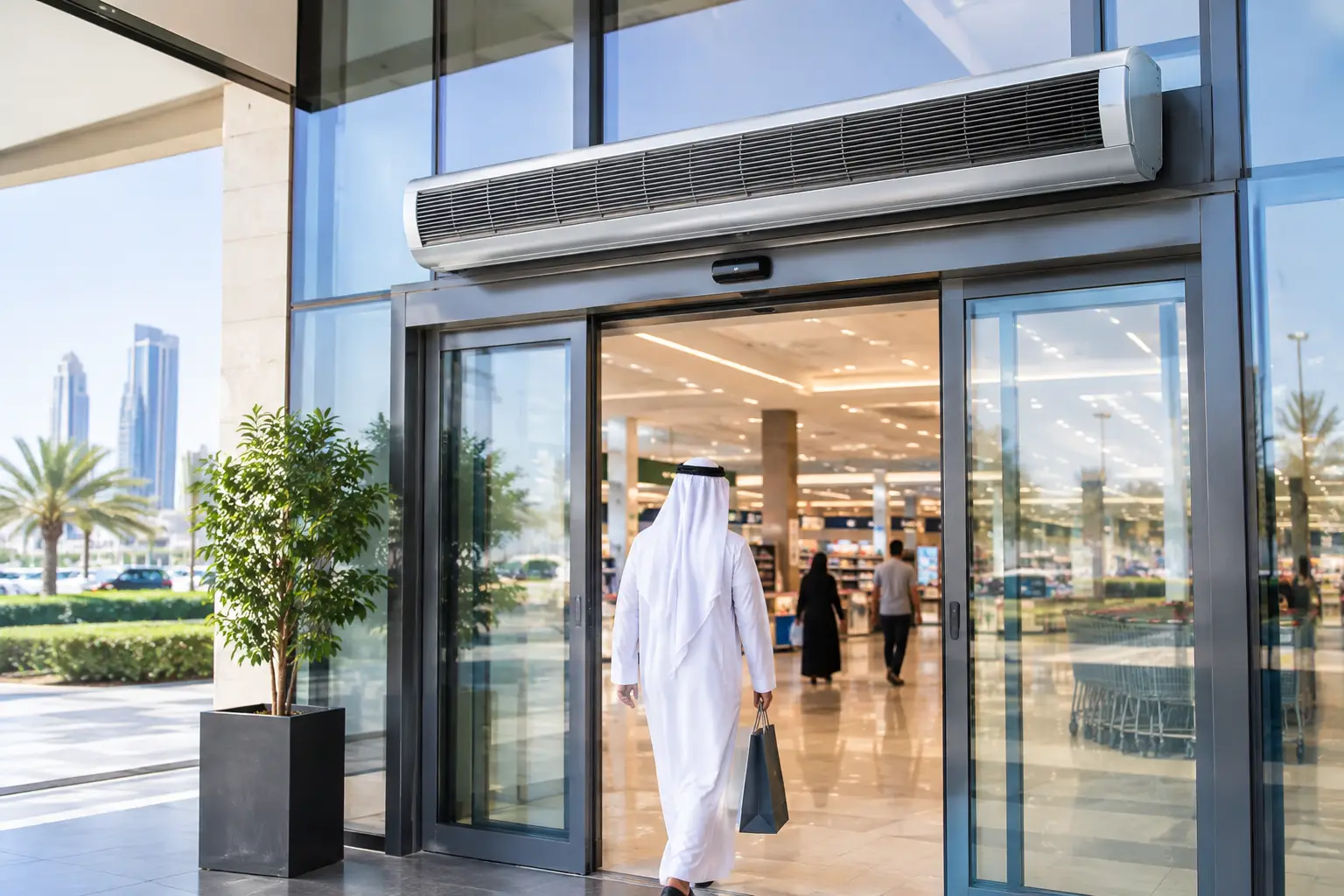
A supermarket entrance in Dubai can open hundreds of times a day. A warehouse loading door in Riyadh may remain open for extended periods. In both cases, smart air curtain controls trends are moving the equipment beyond a simple on-off switch and toward responsive entrance climate control. The objective is practical: operate the air barrier when it delivers value, match output to the opening and conditions, and avoid wasting energy during low-demand periods.
For facility managers, MEP consultants, and HVAC contractors, the control strategy now deserves the same attention as the air curtain’s airflow capacity, discharge velocity, mounting height, and blower design. A well-selected unit with poorly planned controls can run unnecessarily or fail to respond when doors open. Conversely, the right control logic can support cooling retention, improve operational visibility, and reduce the burden on air-conditioning systems in hot, humid, and dusty environments.
Why Smart Air Curtain Controls Matter in Hot Climates
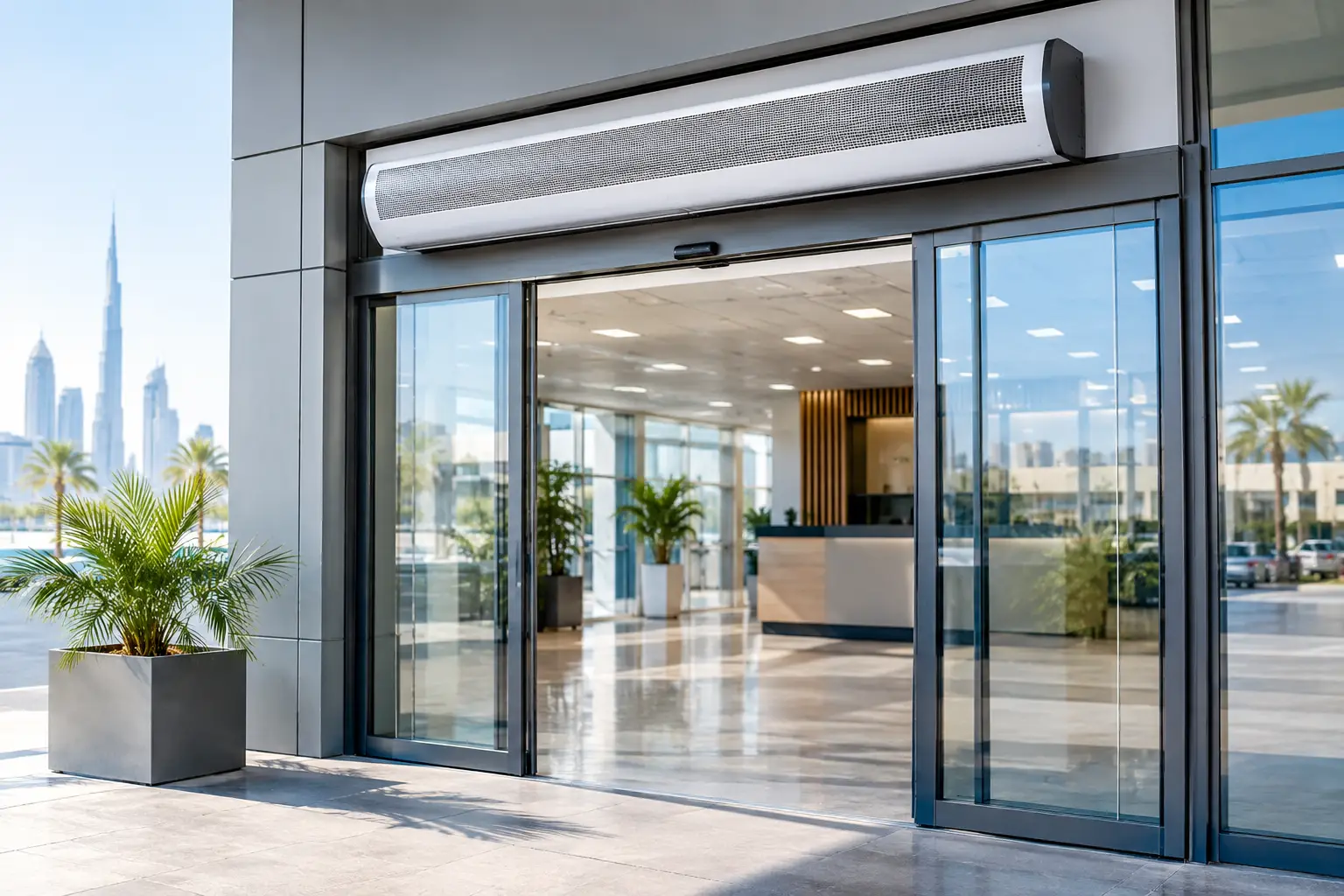
An air curtain is not intended to cool a building by itself. It creates a high-velocity air stream across an opening that helps separate indoor and outdoor air. In the GCC, MENA, and African markets, that separation can limit the entry of extreme heat, humidity, dust, insects, smoke, and airborne contaminants while helping conditioned air remain inside.
Traditional manual controls are still appropriate for some low-traffic doors, particularly where operating hours are fixed and doors remain consistently open. But busy retail entrances, logistics doors, hospital access points, and food-service facilities experience changing traffic patterns. A fixed operating setting may be too little at peak demand and more than needed during quiet periods.
Smart controls address that mismatch. They use door status, schedules, occupancy conditions, or building-management signals to determine when an air curtain should operate and at what level. The result depends on correct commissioning. Controls cannot compensate for an undersized unit, an incorrectly positioned discharge, or an opening exposed to strong crosswinds. Selection should begin with the entrance dimensions, mounting arrangement, pressure conditions, and traffic profile.
Smart Air Curtain Controls Trends Shaping Specifications
Door-activated operation is becoming a baseline requirement
The most practical control trend is direct integration with automatic sliding, swing, roller shutter, or sectional doors. A door contact starts the air curtain when the opening is in use and stops it after a defined delay. This avoids continuous operation at entrances that are closed most of the day.
The delay setting matters. If it is too short, the air curtain may shut down before the door cycle is complete. If it is too long, energy savings decline. For high-frequency supermarket doors, a short delay may keep protection consistent between customers. At an industrial loading dock, the delay and airflow response should reflect the longer door-open duration and the higher infiltration risk.
Variable-speed control is replacing one-speed thinking
Many commercial entrances do not need maximum airflow at all times. Variable-speed control allows the air curtain to operate at a lower setting during normal traffic and increase output when a large door opens, external conditions worsen, or the site enters a high-activity period.
This approach can reduce unnecessary electrical consumption and sound levels, but it must be specified carefully. At tall entrances or exposed loading areas, low speed may not provide sufficient throw to maintain an effective air barrier at floor level. The control sequence should preserve the required performance, rather than prioritizing energy reduction at the expense of separation.
For applications with demanding mounting heights and frequent access, the Industrial Centrifugal Series is typically evaluated around duty cycle, door dimensions, and pressure exposure. Centrifugal airflow designs are particularly relevant where the entrance conditions require sustained, directed performance.
Building management integration is becoming more useful
Air curtains are increasingly included in building management system strategies, especially in malls, airports, hospitals, large hotels, and multi-tenant commercial facilities. Through dry contacts, relays, or compatible control interfaces, an air curtain can coordinate with scheduled building operation, door controls, and HVAC modes.
The value is not simply remote switching. Integration can give facility teams clearer oversight of run hours, operating status, and exceptions. It also helps ensure that entrance protection aligns with the way the building is actually used. For example, a retail entrance can follow opening hours while retaining door-activated control during trading periods.
Projects should avoid overcomplicating this arrangement. A sophisticated BMS sequence may add cost and commissioning time without meaningful benefit at a small single-door site. For a large facility with centralized controls, however, it can support consistent operation across multiple entrances and simplify maintenance planning.
Time schedules remain valuable, especially for predictable sites
Smart control does not always mean sensor-heavy control. Time scheduling is often one of the most reliable options for restaurants, offices, pharmacies, and retail locations with known operating hours. It prevents an air curtain from running overnight or before a site opens, while maintaining automatic performance during expected traffic periods.
Schedules should account for cleaning, deliveries, and peak footfall rather than following public opening hours alone. A restaurant may receive deliveries well before guests arrive. A hypermarket’s receiving doors may be active overnight. Reviewing actual door-use patterns is more useful than copying a generic schedule.
Sensor-led control is growing, but needs a clear purpose
Motion, occupancy, temperature, and humidity signals can be used to refine air curtain operation. The potential is strongest when these inputs solve a known operational issue. A sensor may trigger operation before a pedestrian reaches a door, for instance, or help a facility identify periods when entrance infiltration is unusually high.
However, more sensors do not automatically create better performance. Sensors need suitable placement, calibration, access for service, and a control logic that the facilities team can understand. In dusty industrial environments or high-humidity coastal locations, equipment protection and reliability are as important as functionality.
Remote monitoring supports proactive facility management
For portfolios with multiple branches, warehouses, or retail sites, remote status monitoring can help maintenance teams identify units with unusual operating hours or control faults. This is useful where air curtains are part of a broader energy-management program and where site visits are costly.
Remote capability should be considered an operational tool, not a substitute for inspection. Physical conditions still matter: blocked intake areas, changes to door geometry, altered air pressure, and damage from loading operations can all affect air barrier performance. A maintenance plan should include periodic review of airflow, mounting integrity, control response, and cleanliness.
Control Strategy by Application
The right control approach varies by door type and operating environment. At a customer-facing retail or hotel entrance, automatic door activation with a short run-on delay is usually the logical starting point. Where appearance and acoustics are priorities, a recessed option such as a Recessed Ceiling Air Curtain can be paired with controls that keep operation unobtrusive outside active door cycles.
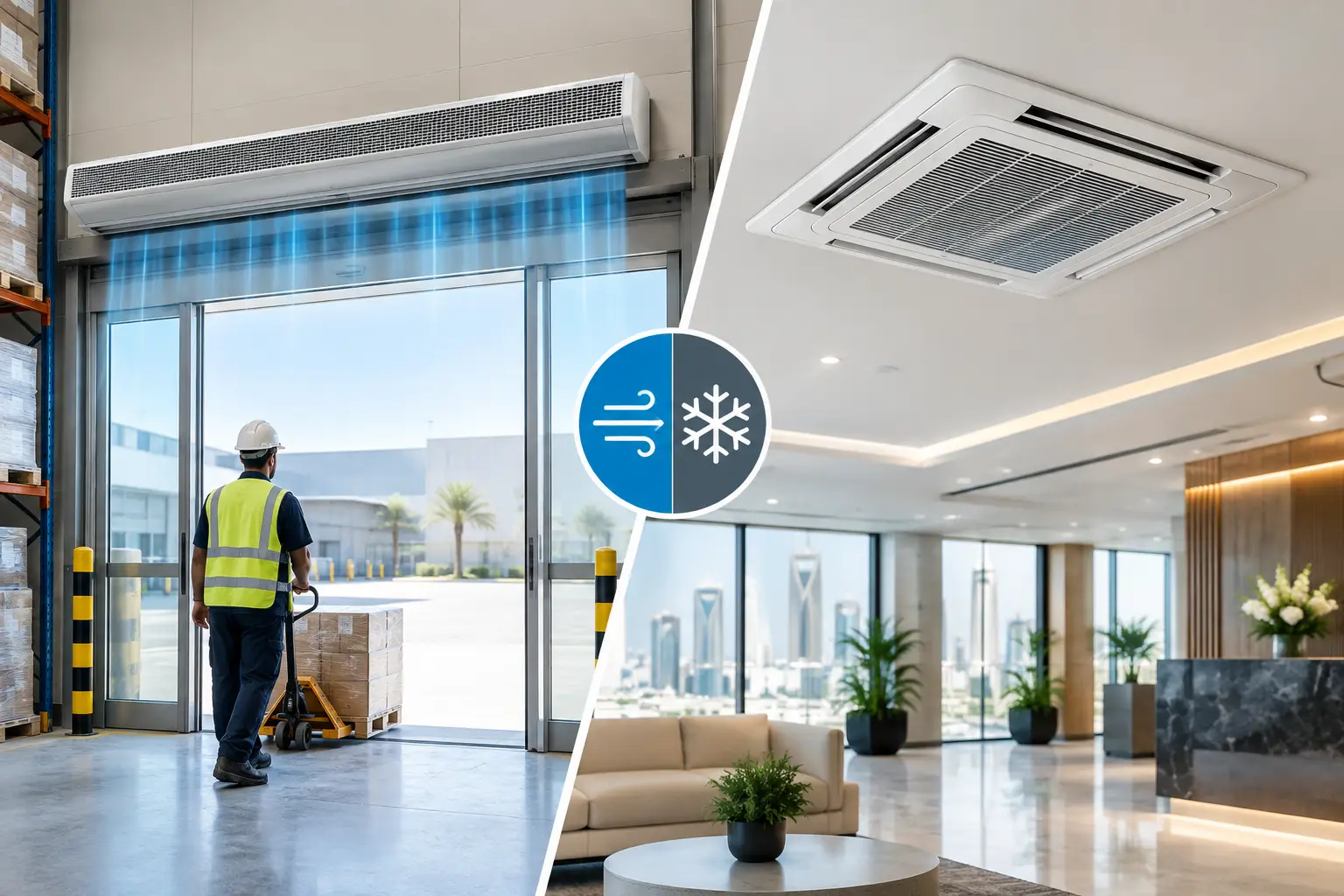
Warehouses, factories, and distribution centers often need more direct control tied to industrial door status. These sites should prioritize air velocity, coverage, and durability before advanced automation. If loading doors remain open for long periods, continuous operation at an engineered setting may be more effective than repeated starts and stops.
Cold storage, food processing, and pharmaceutical facilities require additional discipline. Door events, hygiene procedures, humidity exposure, and pressure relationships can affect the control sequence. The air curtain must support the facility’s environmental objectives without interfering with door interlocks or established operational controls. These projects benefit from early coordination among the facility team, HVAC consultant, and door supplier.
Hospitals and healthcare entrances may prioritize predictable activation, low sound levels, and reduced ingress of dust and outdoor pollutants. Airports and malls may need zoned strategies because entrance traffic differs widely by location and time of day. There is no universal smart-control package that fits every site.
Questions to Ask Before Specifying Controls
Before including smart controls in a tender or project schedule, establish the door type, clear opening width and height, mounting location, daily opening frequency, and expected open duration. Also assess whether the doorway is exposed to wind, whether the facility has a BMS, and whether the priority is cooling retention, dust control, insect reduction, humidity management, or a combination of these outcomes.
It is also worth identifying who will own the controls after handover. A simple door contact and local controller may be easier for an on-site maintenance team to manage than a highly customized sequence. On the other hand, a major development with centralized facilities management may require BMS visibility and standardized operating schedules from the outset.
For high-traffic commercial sites, the Commercial Centrifugal Flow Series and Commercial HiFi Plus Series can be assessed against both entrance performance and the preferred control method. The selection should be based on the application, not solely on a feature checklist.
Specify the Air Barrier and the Logic Together
Smart controls work best when they are planned as part of the air curtain specification, not added after equipment selection. The consultant or contractor should define the activation source, speed settings, time delays, BMS requirements, override method, and commissioning checks alongside the physical equipment schedule.
This is particularly relevant in desert and tropical climates, where outdoor heat, humidity, and airborne dust create a greater penalty each time a busy entrance is left unprotected. A control strategy that reflects real door use can help preserve indoor conditions without keeping the unit at full output unnecessarily.
For a project-specific assessment of door conditions, traffic patterns, mounting constraints, and suitable controls, contact FreezeeX for a consultation and quotation. The most effective system is the one that delivers reliable air isolation at the actual entrance, through the actual operating day.