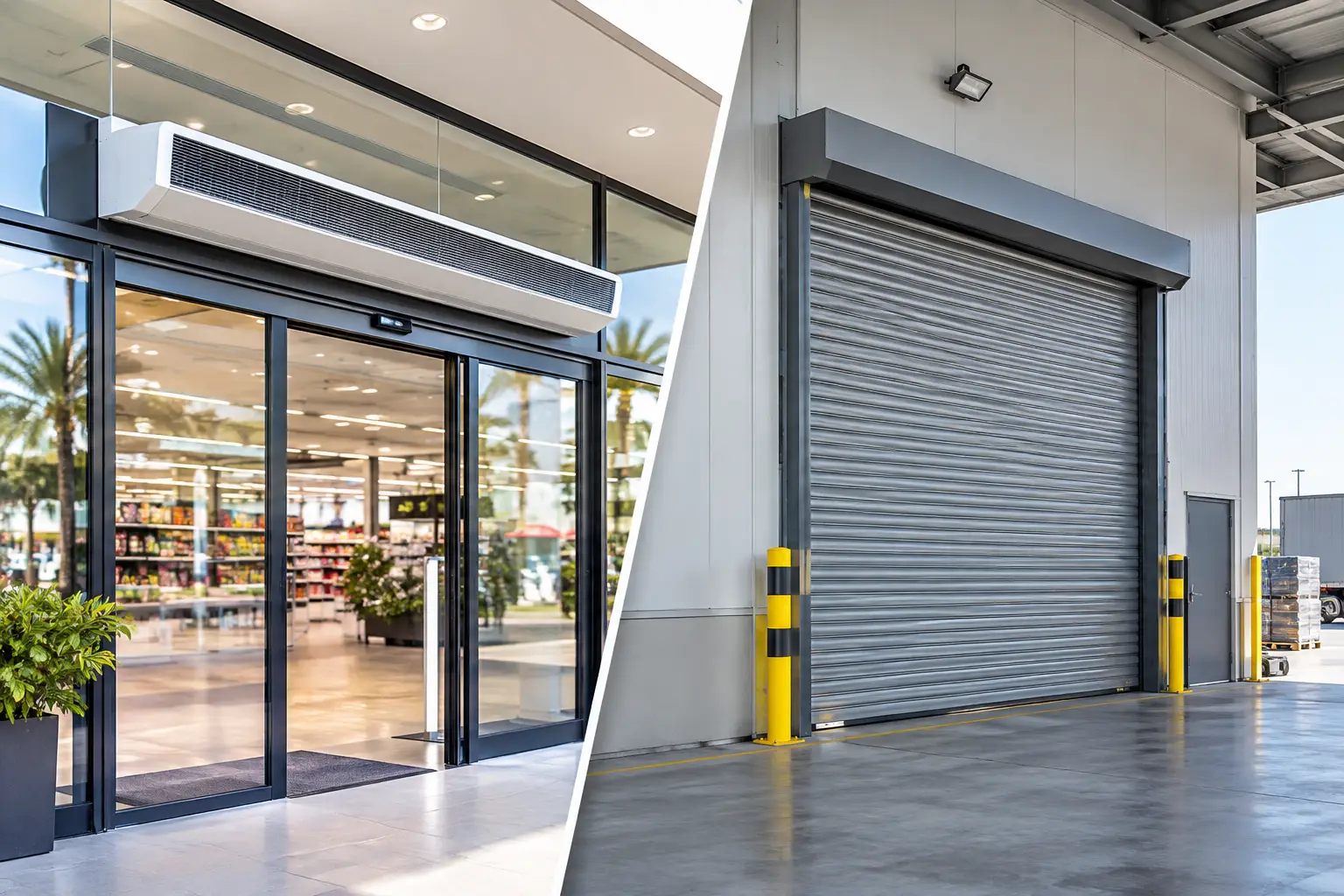
A restaurant kitchen door opens onto a hotel lobby. A warehouse bay faces a loading area with vehicle activity. A supermarket entrance sits beside a food court. In each case, odors can move indoors quickly when the doorway becomes an unprotected path for outside air.
Understanding how air curtains reduce odors starts with a simple distinction: an air curtain does not remove or chemically neutralize an existing odor. It reduces the amount of odor-laden air that crosses an open entrance. By creating a directed, high-velocity stream of air across the doorway, it forms an air barrier that limits uncontrolled air exchange between two zones.
For commercial facilities in Dubai, Riyadh, Doha, Cairo, Lagos, and other hot, humid, or dusty markets, that barrier can support indoor air quality, customer comfort, and HVAC performance at the same time.
How Air Curtains Reduce Odors at Entrances
Odors travel on moving air. When a door opens, pressure differences, foot traffic, wind, and temperature differences encourage air to move from one area to another. If the outside area contains food smells, smoke, diesel fumes, waste odors, dust, humidity, or process-related vapors, those contaminants can enter along with the incoming air.
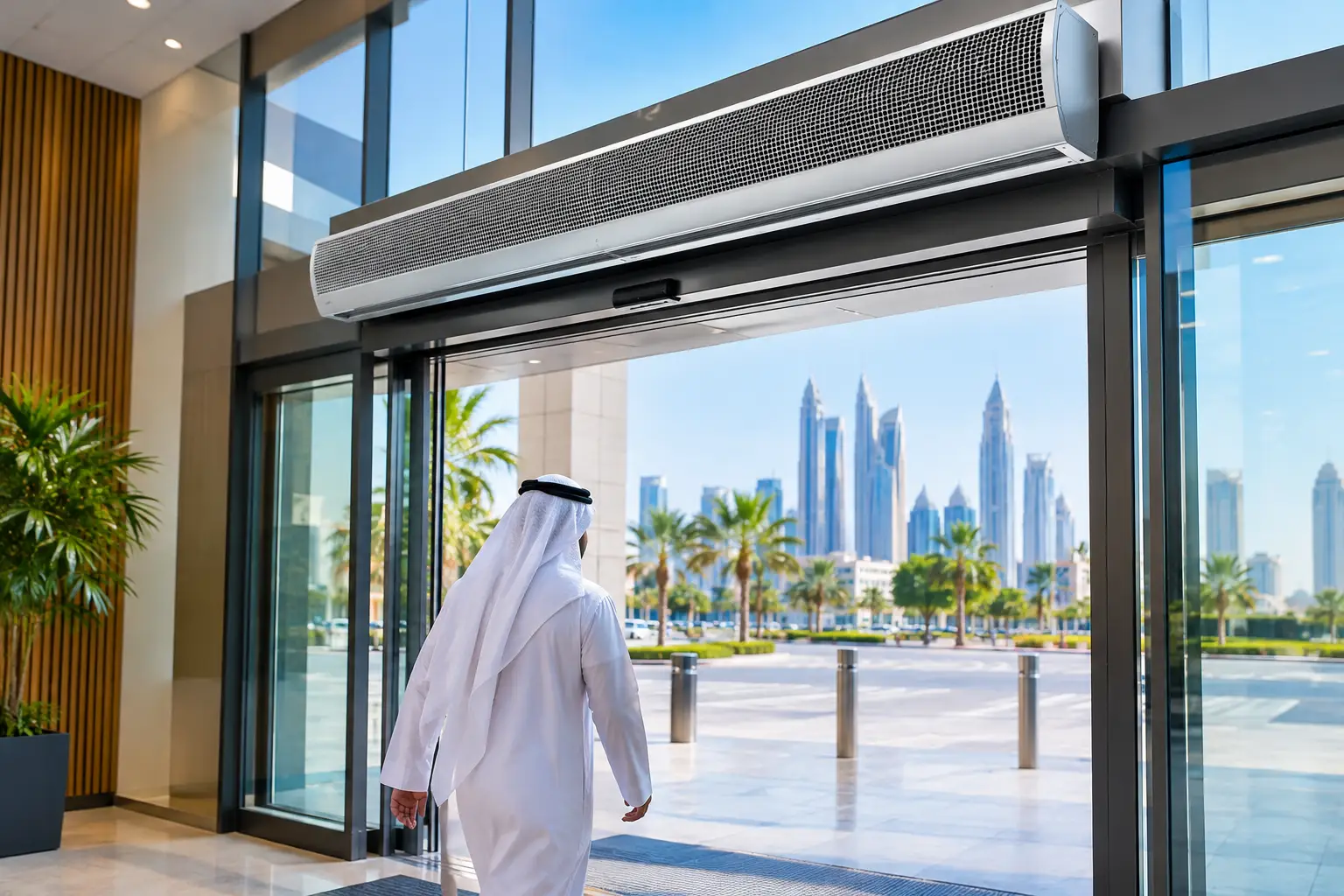
An air curtain projects a controlled airstream from above or beside the opening to oppose that transfer. Correctly selected and installed, the airstream reaches the floor or threshold area with enough velocity to separate the indoor and outdoor air masses. This reduces the volume of untreated outside air entering through the open door.
The practical result is less odor migration, not zero odor under every condition. Performance depends on the doorway size, mounting height, air curtain discharge velocity, crosswinds, building pressure, and the intensity of the odor source. A wide industrial loading door exposed to strong wind requires a very different solution from a standard retail entrance.
The barrier limits airborne odor transfer
Many commercial odor complaints are not caused by a failure of the indoor HVAC system. They begin at an entrance that remains open for frequent deliveries, shoppers, staff movement, or logistics traffic. Every opening event allows air from the adjacent environment to enter.
Air curtains reduce this exchange by creating resistance at the plane of the doorway. The barrier helps prevent outside odors from being drawn into conditioned spaces and helps contain odors within designated areas, such as a food preparation zone, waste holding room, production area, or service corridor.
This is particularly useful where two spaces have different cleanliness, temperature, or odor requirements. For example, a restaurant may use an air curtain at a receiving entrance to reduce exposure to vehicle exhaust and street odors. A food processing site may use one at a personnel entrance to limit the transfer of ambient dust and external smells into a controlled production zone.
Airflow direction and coverage matter
Odor control depends on a continuous air barrier, not simply on placing a unit above a door. The discharge must cover the full opening width, and the airflow needs sufficient throw to reach the lower part of the entrance. Gaps at either side, inadequate throw, or airflow that is deflected by wind can allow odor-laden air to pass through.
For high entrances, wide openings, or exposed loading bays, centrifugal air curtains are often more appropriate because they can provide stronger, more stable airflow. Facilities with demanding traffic conditions should evaluate industrial-grade equipment rather than applying a light commercial unit to a heavy-duty opening.
Why Odor Control Is Harder in Hot and Humid Climates
In GCC, MENA, and African markets, odor transfer is often linked to heat, humidity, and dust. Hot outdoor air can carry road dust, fuel odors, waste smells, and humid air into the building. Once these contaminants enter a cooler indoor environment, they may linger longer and affect perceived air quality.
Humidity also complicates the issue. Moist air can intensify certain odors and contribute to musty conditions where moisture management is already a concern. At entrances to hotels, supermarkets, hospitals, and retail properties, the combined effect of warm air, humidity, dust, and odors can create an immediate negative impression for visitors.
An air curtain supports the building envelope at its most vulnerable point: the frequently open entrance. It reduces infiltration while allowing operational access to continue. That is valuable in facilities where closing doors after every movement is impractical or would slow customer and goods traffic.
Air curtains also reduce cooling loss. When less hot outdoor air enters, the HVAC system has less additional heat and moisture to manage. This is not only an energy consideration. More stable indoor conditions can make odor-control strategies more effective because the facility is not constantly being disrupted by large volumes of unconditioned outside air.
Applications Where Air Curtains Can Make a Noticeable Difference
Restaurants, hotels, and food service operations
Food aromas can be welcome in the right place, but not when they drift into reception areas, guest corridors, retail zones, or neighboring tenancies. Air curtains installed at service entrances, receiving doors, and back-of-house access points can help limit the entry of street odors and the escape of internal cooking-related odors.
They are most effective when paired with correctly designed kitchen ventilation and pressure control. An air curtain is not a substitute for source capture where cooking smoke or grease-laden vapors are generated. Instead, it strengthens the separation at an open doorway.
Supermarkets and shopping centers
Supermarkets manage several odor sources at once: prepared foods, bakery areas, waste handling, delivery activity, and customer entrances exposed to parking or street environments. In a mall or hypermarket, odors can also migrate between common areas and tenant spaces.
A commercial air curtain at busy entrances helps reduce the transfer of outdoor dust, humidity, vehicle-related odors, and food court smells. Recessed ceiling air curtains can be suitable where architects want a less visible installation at a finished public entrance, provided the design allows for correct mounting position and service access.
Warehouses, factories, and logistics centers
Loading docks create one of the most difficult operating conditions. Doors may remain open for extended periods, and forklifts, trucks, packaging materials, or neighboring industrial activity can introduce odors and airborne contaminants. Strong air movement around the building can also disrupt a weak air barrier.
Industrial air curtains can reduce infiltration at personnel doors and selected operational openings. However, very large dock doors require careful assessment. The right approach may involve dividing openings operationally, selecting higher-performance equipment, or coordinating the air curtain strategy with dock layout and building pressurization.
Hospitals and pharmaceutical facilities
In healthcare and pharmaceutical environments, odor complaints can indicate more than discomfort. They can affect occupant confidence and may signal unwanted airflow between areas with different hygiene requirements. Air curtains can support separation at non-critical entrances by reducing airborne exchange while maintaining access.
These facilities require application-specific engineering. Door usage, room pressure relationships, cleanliness protocols, and noise requirements must be considered before selection. An air curtain should complement, not override, the facility’s broader environmental control design.
What Air Curtains Cannot Do
An air curtain is an entrance air-management system, not an odor treatment device. It will not eliminate an odor source inside the building, correct poor waste handling, or replace a properly designed ventilation and filtration strategy.
If the odor originates indoors, the first priority is to identify and control the source. If it originates outside, an air curtain can reduce the incoming load, but severe external conditions may also require adjustments to door operations, building pressure, or the location of sensitive entrances.
It is also important to avoid overpromising performance at open industrial doors. Strong crosswinds, negative building pressure, incorrect installation height, and undersized equipment can weaken the air barrier. The most reliable results come from matching the unit to actual site conditions rather than selecting by door width alone.
Specifying an Air Curtain for Odor Reduction
For odor-focused applications, the specification should begin with the entrance and the surrounding airflow conditions. Measure the clear opening width and height, then assess whether the door is recessed, exposed to wind, or subject to frequent traffic. Identify where the odor originates and whether the objective is to keep it out, contain it within a zone, or both.
A useful review should consider:
- mounting height and available installation position
- entrance width, door type, and daily traffic volume
- crosswinds from outdoor exposure or nearby openings
- indoor and outdoor pressure differences
- ambient heat, humidity, dust, smoke, or fume conditions
- required noise level for public-facing spaces
- integration with existing HVAC and ventilation design
For retail and hospitality entrances, appearance and acoustic performance may influence the selection alongside airflow capacity. For warehouses, factories, and loading areas, throw distance, durability, motor duty, and resistance to harsh operating conditions typically carry more weight.
FreezeeX evaluates these variables before recommending an air curtain configuration. This consultation-based approach is especially relevant in tropical and desert climates, where high ambient temperatures, humidity, dust, and demanding door traffic can quickly expose an underspecified system.
A Better Entrance Strategy Starts With Site Conditions
Odor control at an open door is fundamentally an airflow-control problem. When a correctly sized air curtain creates a stable barrier, it can reduce the entry of unpleasant odors while also limiting heat, dust, humidity, insects, and airborne contaminants. The benefit is strongest when the air curtain is treated as part of the facility’s complete entrance and HVAC strategy, not as a standalone fix for every odor complaint.
For a project in a high-traffic retail, hospitality, industrial, healthcare, or logistics facility, request a FreezeeX consultation and quotation based on the actual entrance dimensions, mounting conditions, climate exposure, and operating requirements. A site-appropriate selection gives the air barrier the airflow strength needed to perform where odors are most likely to enter.